Boost brand trust with ethical marketing strategies

TL;DR:
Ethical marketing builds consumer trust and loyalty, crucial for long-term business success.
Transparency, honesty, fairness, responsibility, and privacy are core principles of ethical marketing.
Prioritizing ethics enhances ROI by fostering genuine customer relationships and brand integrity.
If you’ve ever ghosted a brand after finding out they were sketchy with your data, you’re in very good company. 76% of consumers refuse to buy from companies they don’t trust with their personal information. That’s a massive chunk of potential customers walking out the door before you’ve even said hello. For small business owners, this isn’t just a statistic to nod at — it’s a wake-up call. Ethical marketing isn’t a “nice-to-have” any more than Wi-Fi is optional in 2026. It’s the foundation of every sale, every referral, and every loyal customer you’ll ever have.
Table of Contents
Key Takeaways
Point | Details |
Trust wins loyalty | Ethical marketing is strongly linked with consumer trust, which drives repeat business and positive reviews. |
Transparency is essential | Clear, honest communication and privacy respect are expected by Canadian consumers and help prevent reputational risk. |
Personalisation needs consent | Balancing personalised messaging and privacy protection is critical—always prioritise consent in data usage. |
Ethics boost ROI | Evidence shows brands leading with ethics outperform less reputable competitors in loyalty and revenue. |
Implement stepwise changes | Small businesses can establish ethical marketing practices by following clear, actionable frameworks tailored for Canadian standards. |
Core principles of ethical marketing
So what does “ethical marketing” actually mean? It’s not just slapping “we care about you” on your homepage and calling it a day (we see you, and so do your customers). True ethical marketing rests on five core pillars: honesty, transparency, fairness, responsibility, and respect for consumer privacy. Think of them as the five fingers of a very trustworthy handshake.
Here’s what each one looks like in the real world:
Honesty: No fake scarcity, no inflated “original prices,” no promises you can’t keep.
Transparency: Clear terms, obvious pricing, and no hidden fees lurking like a jump-scare at the checkout page.
Fairness: Reasonable prices and equitable treatment for all customers.
Responsibility: Supporting social causes that align with your values and owning your mistakes publicly.
Privacy: Reasonable prices, social causes, data protection — protecting customer data like it’s your grandmother’s secret recipe.
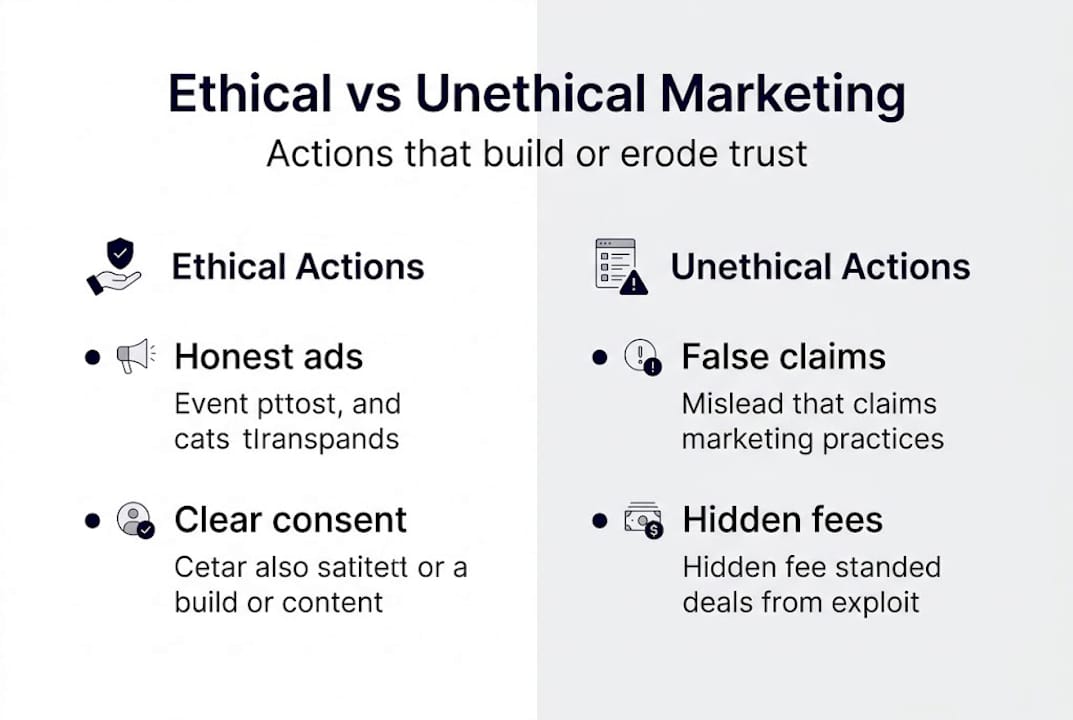
Let’s put ethical versus unethical marketing side by side, because sometimes seeing it laid out plainly is the best teacher:
Ethical marketing action | Unethical marketing action |
Clear, honest product descriptions | Exaggerated claims with fine print |
Transparent pricing with no hidden fees | Surprise charges at checkout |
Consent-based email lists | Buying contact lists without permission |
Straightforward refund policy | Deliberately confusing return terms |
Data collection explained clearly | Collecting data without disclosure |
Notice a theme? Ethical marketing is basically just treating people the way you’d want to be treated. Revolutionary, right?
If you want to understand how these ethical marketing principles connect to your broader strategy, it’s worth seeing the bigger picture.
Pro Tip: Canada’s PIPEDA (Personal Information Protection and Electronic Documents Act) sets the legal floor for how you collect and use customer data. Make sure your privacy policy actually explains what you collect and why — in plain language, not legalese that requires a law degree to decode.
Why ethical marketing drives consumer trust and loyalty
Here’s where things get genuinely exciting. This isn’t just feel-good philosophy. Research shows a strong correlation between ethical practices and consumer trust (r=0.803) and loyalty (r=0.752). For the non-statisticians in the room: those are impressively strong numbers. It means ethics and trust move together almost in lockstep.
Think about what that means for your digital marketing ROI. When customers trust you, they buy more, refer friends, and forgive the occasional hiccup (like when your website goes down during a flash sale — we’ve all been there).
Here’s a quick look at how ethics ratings translate into trust and loyalty scores:
Ethics rating | Trust score | Loyalty score |
High | 8.9/10 | 8.4/10 |
Medium | 6.2/10 | 5.8/10 |
Low | 3.1/10 | 2.7/10 |
The drop-off is dramatic. Low ethics doesn’t just hurt trust a little — it tanks loyalty almost completely.
“76% of consumers refuse to buy from companies they don’t trust with their data.” The implication for Canadian small businesses? Ethical marketing isn’t optional — it’s your revenue strategy.
So how do you actually build trust through ethical actions? Here’s a simple numbered roadmap:
Audit your current marketing materials for any misleading claims or unclear language.
Update your privacy policy to reflect exactly what data you collect and how you use it.
Set up a consent-based email and communications system.
Communicate your core values visibly — on your website, social media, and in every customer interaction.
Create a feedback loop so customers can flag concerns, and actually respond to them.
And if you’re keeping an eye on where things are heading, the 2026 marketing trends point squarely toward ethics and transparency as the defining competitive edges this year.
Balancing personalization and consumer privacy
Here’s the twist that keeps marketers up at night: 71% of consumers expect personalisation, but 76% also refuse to shop with brands they don’t trust with their data. So customers want you to know them, but they don’t want to feel watched. It’s a bit like wanting your barista to remember your order without having followed you home.

And it gets more interesting. 62% of people feel like a “product” in today’s data economy. That’s a majority of your potential customers feeling like their personal information is being bought and sold like a commodity. Not exactly the vibe you want your brand giving off.
The good news? You can personalise without being creepy. Here’s how:
Always get explicit consent before collecting any personal data. Make opting in simple and opting out even simpler.
Collect only what you actually need. If you’re running a local bakery, you don’t need someone’s browsing history.
Be transparent about how personalisation works. A quick “we use your purchase history to suggest products you might like” goes a long way.
Give customers control over their data preferences through a clear, accessible settings page.
Regularly review and delete data you no longer need. Data minimisation is not just ethical — it’s smart.
Your digital branding guide strategy and your digital advertising tips both need to account for privacy-first thinking in 2026.
Pro Tip: Under PIPEDA, Canadian businesses must obtain meaningful consent before collecting, using, or sharing personal information. “Meaningful” means the person genuinely understands what they’re agreeing to — not just clicking “I agree” on a wall of text at midnight.
Implementing ethical marketing in Canadian small businesses
Alright, theory is great, but let’s talk action. Here’s how to actually build ethical marketing into your business, step by step, without needing a team of 50 or a Silicon Valley budget.
Define your values and write them down. If you can’t articulate what you stand for in a sentence or two, your customers won’t be able to either.
Audit every marketing channel. Website copy, social posts, email campaigns — check for anything misleading, vague, or privacy-invasive.
Build a consent framework. Use opt-in forms, cookie banners, and clear unsubscribe options across all digital touchpoints.
Train your team. Everyone from your social media manager to your customer service rep needs to understand why core ethical principles guide your strategy.
Set up a regular review cycle. Ethics in marketing isn’t a one-and-done task — revisit your practices every quarter.
Leverage your marketing plan guide to align ethical frameworks with your overall strategy.
Now, here are the pitfalls you absolutely want to sidestep:
Using dark patterns (confusing design meant to trick users into unwanted actions)
Inflating reviews or manufacturing testimonials
Sending marketing emails to people who never opted in
Burying important information in fine print
Ignoring customer complaints or deleting negative feedback
Pro Tip: When you make a commitment to ethical marketing, say so publicly. Add a short “Our values” section to your website and reference it in your social media bio. Customers notice. And honestly? It feels pretty good to wear your values on your sleeve.
A quick Canadian compliance checklist to keep handy:
PIPEDA compliance for data collection and storage
Canada’s Anti-Spam Legislation (CASL) for email marketing
Competition Act compliance for advertising claims
Accessible website design for inclusivity
Clear refund and return policies posted publicly
Our perspective: Why ethical marketing is a competitive advantage
Here’s something most marketing guides won’t tell you: ethics aren’t a constraint on your creativity. They’re actually a competitive advantage, especially in Canada where consumers are increasingly savvy and vocal about brand behaviour.
We’ve seen businesses explode in growth not because of their ad spend, but because their customers became evangelists. And that only happens when people trust you. Word-of-mouth fuelled by genuine trust is worth more than any paid campaign.
What most guides miss about Canadian consumer values? Canadians are particularly attuned to authenticity and community. A local business that visibly operates with integrity stands out in a way that a flashy multinational simply cannot replicate.
The brands we’ve watched thrive long-term are the ones who treated ethics as a core identity, not a PR strategy. They didn’t “do ethical marketing.” They were ethical, and their marketing reflected that.
For the full story on navigating ethical dilemmas in marketing, our blog is a solid place to dig deeper. Because the conversation about ethics in business is always evolving, and staying informed is how you stay ahead.
Take the next step towards ethical marketing
Ethical marketing can feel like a puzzle when you’re trying to juggle privacy laws, customer expectations, and actually running your business. But you don’t have to figure it all out alone.

At M50 Media, we work directly with small business owners to build marketing strategies that are honest, effective, and built for long-term trust. Whether you want personalised marketing coaching to build your ethical framework from scratch, need a quick sanity check through our get expert advice service, or just want to keep learning at your own pace through our ethical marketing resources, we’ve got your back. Let’s build something you’re genuinely proud of.
Frequently asked questions
Why is data privacy so important in ethical marketing?
Because 76% of consumers refuse to buy from brands they distrust with data, protecting privacy directly impacts your sales and long-term reputation.
How can a small business implement ethical marketing quickly?
Start by being transparent, securing consent for data use, and communicating your core values clearly across every customer-facing channel.
Does ethical marketing reduce ROI?
Not at all. Evidence shows ethical practices actually boost consumer trust and loyalty scores, which translates into stronger ROI over time.
What are common ethical pitfalls in digital marketing?
Misleading claims, unclear privacy policies, and aggressive tracking are common mistakes — all avoidable by sticking to honesty, transparency, fairness and respect for consumer privacy.
Recommended
Comments