Why local SEO matters: attract more customers nearby

TL;DR:
Local SEO is essential for small businesses to attract nearby customers through Google results and maps.
Building a complete Google Business Profile, maintaining NAP consistency, and gathering reviews improve rankings and trust.
Results typically appear within 2-3 months, and consistent effort is key to long-term success.
You’ve built a great business. You show up every day, your product or service is solid, and your current customers love you. So why does it feel like nobody new can find you? Here’s the thing: if you’re not showing up in local search results, you’re basically a hidden gem that nobody knows exists. And unlike actual hidden gems, this one doesn’t get discovered in a feel-good travel blog. Local SEO (Search Engine Optimisation for location-based searches) is the thing standing between you and a flood of nearby customers who are already searching for exactly what you offer.
Table of Contents
Key Takeaways
Point | Details |
Local SEO attracts customers | Optimizing for local search makes your business visible to high-intent customers nearby. |
Reviews build trust | Earning and responding to positive reviews boosts your visibility and reputation. |
AI hasn’t replaced local SEO | Even as search algorithms evolve, local SEO remains vital for small business success. |
DIY local SEO works | With practical steps and patience, business owners can improve local rankings without agencies. |
What is local SEO and how does it work?
Let’s clear something up right away. A lot of small business owners think SEO is this enormous, technical monster reserved for big corporations with six-figure marketing budgets. Not true! Local SEO is actually more like your friendly neighbourhood guide, the one who makes sure people in your area know your business exists when they search “best plumber near me” or “coffee shop open Sunday.”
So what exactly is local SEO? It’s the practice of optimising your online presence to attract customers from specific geographic locations. While traditional SEO focuses on ranking for broad keywords across the entire internet, local SEO zeroes in on maps, location-based results, and what Google calls the “local pack” (that little box with three business listings that pops up when you search for something nearby). Think of it like the difference between advertising on a national TV channel versus putting a sign in your shop window. Both work, but one is way more targeted.
Here are the key building blocks of local SEO that every small business needs to understand:
Google Business Profile (GBP): Your free listing on Google that shows your hours, address, phone number, photos, and reviews. This is the foundation of everything.
NAP consistency: That’s Name, Address, and Phone number. These details need to be identical across every single platform online, from your website to social media to directories. Even a small inconsistency can hurt your rankings.
Online reviews: The more positive reviews you have, the more Google trusts your business and the higher you rank. More on that shortly.
Local citations: These are mentions of your business on other websites like Yelp, Yellow Pages, and local directories.
Localised content: Blog posts, landing pages, or even social media posts that mention your city or neighbourhood.
Here’s a quick breakdown of how local SEO compares to traditional SEO:
Feature | Traditional SEO | Local SEO |
Target audience | National or global | Local or regional |
Primary tools | Keywords, backlinks | GBP, reviews, NAP |
Results shown | Organic web results | Maps, local pack |
Timeline for results | 6 to 12 months | 2 to 3 months |
Cost to start | Moderate to high | Free to low |
And here’s a reassuring fact for anyone fretting about AI taking over the world (we see you): local SEO remains resilient in the AI era because large language models still rely on the same signals like GBP and reviews, and they simply lack the geolocation precision to replace local search results. So your investment here is not going out of style anytime soon. If you’re curious about how AI is shifting the broader marketing landscape, you’ll enjoy reading about AI marketing trends and what they mean for your strategy.
Local SEO isn’t a luxury. For small businesses depending on foot traffic or a specific service area, it’s really the most direct path to new customers.
The business impact of local SEO: prominence, trust, and conversions
Now that you know what local SEO is, let’s look at the real advantages it brings to your business. And we’re not talking vague “brand awareness” stuff. We’re talking people actually walking through your door or calling your number.
Let’s start with reviews, because they are genuinely a game-changer. Reviews boost prominence and trust; businesses with more and higher-rated reviews consistently rank higher in local search and convert significantly better than those without. Think about your own behaviour for a second. When you search for a restaurant or a mechanic, do you pick the one with 4.8 stars and 200 reviews, or the one with no reviews at all? Exactly. Your potential customers think the same way.
Your Google Business Profile is basically your storefront on the internet. A complete and active GBP with photos, updated hours, services listed, and regular posts signals to Google that you’re a real, engaged, legitimate business. An incomplete one? Google treats it like a shop with the blinds permanently closed.

Here’s a side-by-side look at what a business with strong local SEO versus a neglected one actually looks like to a potential customer:
Aspect | Strong local SEO presence | Weak or no local SEO |
Search visibility | Shows in top 3 local pack | Buried on page 2 or invisible |
Reviews | 50+ reviews, 4.5+ stars | Fewer than 10 or none |
GBP profile | Complete with photos and posts | Incomplete or unclaimed |
Trust level | High, feels credible | Low, feels risky |
Conversion rate | Significantly higher | Much lower or none |
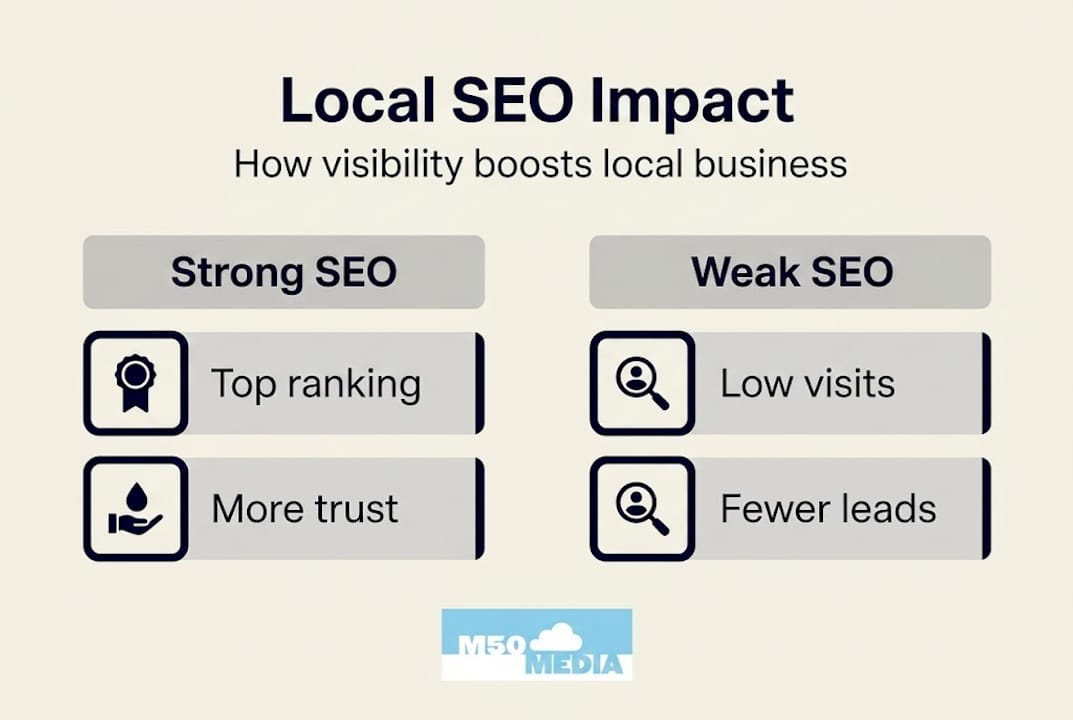
The conversion angle here is particularly exciting. Studies show that people who find a business through local search are often highly motivated buyers. They’re not just browsing. They’re searching because they need something right now. That kind of intent is incredibly valuable.
The impact of online reviews on your revenue is one of the most underestimated forces in small business marketing. And pairing that with an understanding of the broader digital marketing advantages available to you creates a genuinely powerful foundation.
Pro Tip: Responding to reviews, both good and bad, is a ranking signal AND a trust signal. A business that engages with its reviews looks active and accountable. Even a short “Thanks so much, we loved having you!” goes a long way. Set a weekly reminder to check and respond. It takes about five minutes and pays off for months.
The bottom line is simple. A well-maintained local SEO presence is like having your best salesperson working 24/7, never taking a sick day, and never asking for a raise. 🎉
Why local SEO matters in the era of AI and changing search habits
With the benefits crystal clear, some still wonder: does local SEO still matter as search evolves? Absolutely. And here’s why that question is actually worth taking seriously rather than brushing aside.
AI tools like ChatGPT, Google Gemini, and others are genuinely changing how people find information. But here’s the thing about local search: local SEO remains resilient even as large language models become more capable, because those systems still pull from the same signals (GBP, reviews, citations) and lack the real-time geolocation precision that local search requires. An AI chatbot can tell you the best restaurants in Toronto in general. It can’t tell you which pizza place two blocks from you has a fresh batch coming out of the oven right now and is open for another hour.
“Local intent search is still dominated by real-time, location-specific signals that AI tools simply can’t replicate with the same precision as Google’s local algorithms.”
Mobile and voice search have also shifted things dramatically. People are increasingly asking Siri or Google Assistant things like “find me a dentist near me” or “where’s the closest hardware store open right now?” These searches are deeply local, highly specific, and they rely entirely on the same local SEO signals you’re building. If your GBP is optimised and your reviews are solid, you’re in the running for those results.
Consumer search habits are also changing in ways that favour local businesses. People are increasingly prioritising shopping local and supporting community businesses, especially post-pandemic. They’re actively looking for local options first. All you have to do is make sure Google knows you exist and where to find you.
Here’s how to stay ahead of the curve as search keeps evolving:
Claim and fully optimise your Google Business Profile if you haven’t already.
Keep your NAP consistent across every online directory and platform.
Build a steady stream of authentic reviews from real customers.
Post regular updates to your GBP (events, offers, new products or services).
Create location-specific content on your website, even a simple “serving [your city]” page.
Monitor your local rankings monthly and adjust your strategy as needed.
Stay informed on digital marketing trends 2026 so you’re never caught off guard.
Investing in SEO right now, even just the basics of local SEO, is one of the smartest moves a small business can make. The businesses that build this foundation today will be the ones dominating local results in 2027 and beyond.
How to get started with local SEO: steps for small businesses
Inspired to start? Here’s how you can launch your local SEO strategy right away, and yes, most of this is free.
Claim your Google Business Profile. Go to Google Business Profile and search for your business. If it’s already listed (it might be!), claim it. If not, create a new one. Verification usually takes a few days via postcard or phone.
Complete every single section. Don’t leave anything blank. Add your hours, phone number, website, photos, description, and every relevant service or product category. An 80% complete profile is not good enough. Go for 100%.
Ensure NAP consistency. Check your Facebook, Yelp, your website’s contact page, and any directory you’re listed in. Every version of your name, address, and phone number needs to match exactly.
Ask for reviews strategically. After a positive interaction, just ask! “Would you mind leaving us a quick Google review? It really helps us out.” You’d be surprised how many people are happy to do it when asked sincerely.
Respond to every review. Yes, even the awkward ones. Especially the awkward ones.
Add local keywords to your website. Mention your city and neighbourhood naturally in your homepage, about page, and service pages.
Create a simple content routine. Even one blog post per month about local topics or your services can build organic traction over time.
Now, a reality check that we think you’ll actually appreciate. Local SEO does take 2 to 3 months to show meaningful results, and the good news is that people report getting real phone calls and leads through a fully optimised GBP without ever hiring an expensive agency. You don’t have to spend a fortune to see results. You just have to be consistent and patient (we know, not the most exciting advice, but it’s true!).
Pro Tip: To get review momentum, create a simple QR code that links directly to your Google review page. Print it on receipts, business cards, or post it at your counter. Lower friction means more reviews. It’s that simple.
For more on building out a full strategy, check out marketing strategies for small businesses and explore the marketing tools for small business that can make the whole process easier. If you want a technical edge, the SEO Quake tool is a handy resource for analysing where you stand.
A fresh perspective: what most business owners miss about local SEO
Here’s the honest truth that most articles won’t tell you: the biggest barrier to local SEO success isn’t technical skill. It’s the tendency to either massively overcomplicate things or completely ignore them.
Some business owners spend weeks researching tools, platforms, and strategies, and never actually claim their GBP. Others claim it and then forget it exists. Neither approach works. The businesses winning at local SEO right now are not doing anything magical. They’re just being consistent. They update their profile. They ask for reviews. They respond when customers engage.
The other thing worth understanding is that local SEO compounds like interest in a savings account. The reviews you collect today build trust for next year. The keywords you add to your website now help you rank in 2027. It’s not a campaign you run once. It’s a habit you build.
And don’t let the rise of AI tools shake your confidence here. Understanding how AI impacts marketing can actually help you see why the fundamentals of local SEO are more valuable than ever. The businesses that get noticed by AI-powered search are the ones with strong, consistent local signals. Which is exactly what you’re building.
Start simple. Stay consistent. The results will come. 🙌
Need help with local SEO? Start with expert guidance
If this article lit a fire under you (in the best possible way!), but you’re not quite sure where to go next, we’ve got you covered.

At M50 Media, we help small business owners like you cut through the noise and build digital marketing strategies that actually work. Whether you need one-on-one business coaching to map out your local SEO game plan, or you just want a quick sanity check via a Marketing SOS Call, we’re here for it. You can also browse our curated list of tools recommendations to find the right resources to support your growth. Because you shouldn’t have to figure all of this out alone. Let’s get your business found. 📍
Frequently asked questions
How long does it take to see results from local SEO?
You can typically expect to see meaningful improvements within 2 to 3 months, depending on your local competition and how consistently you maintain your profile and reviews.
Is paying for local SEO services necessary?
Not at all. Many business owners get real calls and leads by optimising GBP themselves without ever hiring an agency, as long as they stay consistent and patient.
Do online reviews really affect my local rankings?
Absolutely. Reviews boost prominence and trust, meaning businesses with more and higher-rated reviews rank higher in local search results and convert more visitors into paying customers.
Will AI change the importance of local SEO for small businesses?
Not really. Local SEO remains resilient even with AI-powered search, because algorithms still depend on local signals like your GBP and reviews to surface relevant, location-based results.
Recommended
Comments