Email campaign steps: a practical guide for small businesses

TL;DR:
Effective email marketing requires a structured process from setting clear goals to maintaining list hygiene. Automating key flows, optimizing content for mobile, and segmenting audiences increase engagement and revenue. Proper technical setup and consistent measurement ensure campaigns land in inboxes and improve over time.
Email campaign steps are the structured, sequential actions that small business owners and marketers use to plan, build, send, and analyse email marketing efforts that drive real engagement and sales. Done right, email marketing generates $36–$42 in revenue for every $1 spent. That kind of return does not happen by accident. It happens because someone followed a repeatable process. This guide walks you through every step of that process, from laying the groundwork to reading your results, so you can build campaigns that actually work.
What are the foundational email campaign steps before you hit send?
Before you write a single word of copy, you need a plan. Think of it like building a house. Nobody skips the blueprint and goes straight to hanging drywall (well, nobody who wants the house to stay standing).
Set goals that mean something
Every campaign needs a specific, measurable goal tied to a real business outcome. “Get more opens” is not a goal. “Generate 20 product demo bookings from our October newsletter” is a goal. When your goal is concrete, every decision about content, design, and timing becomes easier.

Know exactly who you are talking to
Segmented campaigns achieve 14% higher open rates and 100% higher click-through rates compared to non-segmented broadcasts. That stat should stop you in your tracks. Sending one generic email to your entire list is leaving money on the table. Segment by purchase history, location, interests, or where subscribers are in the buying cycle.
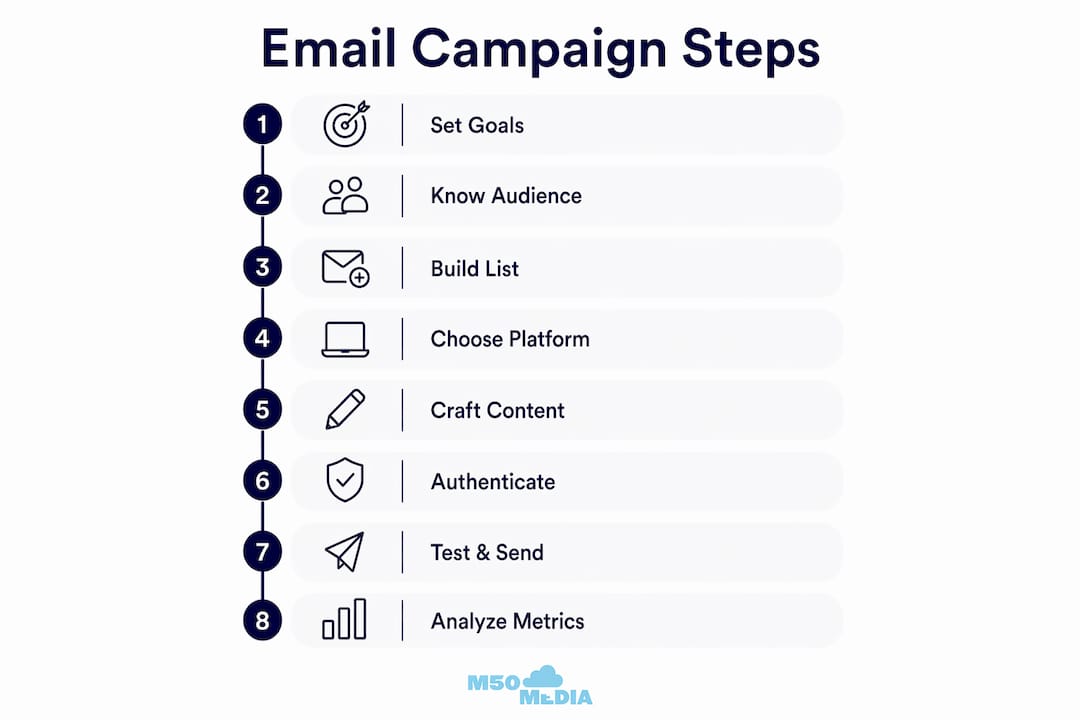
Build a quality list, not just a big one
The first 90 days of building your subscriber list should focus on attracting people who genuinely want your content, not on hitting a vanity number. Permission-based subscribers open emails, click links, and buy things. Scraped or purchased lists do the opposite. They tank your deliverability and get you flagged as spam faster than you can say “unsubscribe.”
Pro Tip: Use a double opt-in process when collecting subscribers. Yes, it reduces raw sign-up numbers slightly. But the subscribers who confirm are far more engaged, and engaged subscribers protect your sender reputation.
Choose your platform and set up authentication
Pick an email marketing platform that fits your budget and technical comfort level. Entry-level platforms work well for lists under a few thousand subscribers. Enterprise platforms add advanced segmentation and automation for growing teams. Whatever you choose, set up SPF, DKIM, and DMARC authentication on your sending domain before your first send. These are the technical records that tell inbox providers like Gmail and Yahoo that your emails are legitimate. Skipping this step is like showing up to a formal dinner in flip-flops. You will not get past the door.
How do you craft email content that people actually want to read?
Great content is not about being clever. It is about being relevant. Your subscribers signed up because they expected value. Deliver it consistently and they will keep opening your emails.
Plan content around your goals and audience segments
Map your content calendar to your business goals and your audience segments. A promotional email to recent buyers looks very different from a nurture email to cold leads. Align the message to where the reader is in their relationship with your brand.
Write subject lines that earn the open
Subject lines and preview text do the heavy lifting before anyone sees your content. Keep subject lines under 50 characters so they display fully on mobile. Preview text should complement the subject line, not repeat it. Use curiosity, specificity, or a clear benefit. “Your free guide is inside” beats “Newsletter Issue 14” every single time.
Aim for 30–50 characters in subject lines for mobile display
Write preview text as a natural continuation of the subject line
Avoid spam trigger words like “free money,” “act now,” or excessive punctuation
Test emoji use carefully. They work for some audiences and fall flat for others
Design for mobile first
More than half of all emails are opened on a mobile device. Single-column layouts, large fonts, and tappable buttons are not optional extras. They are the baseline. Keep your design clean and your call to action (CTA) obvious. One email, one primary CTA. If you give readers five things to click, they will click nothing.
Welcome emails consistently show the highest open rates of any email type. That tells you something important: subscribers are most engaged right after they sign up. Your welcome email is your best first impression. Make it count with a clear value statement and a single, welcoming CTA.
Pro Tip: Personalise beyond just the first name. Reference the specific lead magnet they downloaded, the product category they browsed, or the city they are in. Relevance is the real personaliser.
Which steps protect your deliverability and keep you out of the spam folder?
Technical setup is the unglamorous part of email marketing. It is also the part that determines whether your beautifully crafted email lands in the inbox or disappears into the void.
Authenticate your domain properly
SPF, DKIM, and DMARC are not optional acronyms. They are the three-part authentication system that inbox providers use to verify your identity as a sender. Set them up before your first campaign. Check them again if you switch platforms or sending domains.
Stay compliant with email regulations
Canada’s Anti-Spam Legislation (CASL), the U.S. CAN-SPAM Act, and Europe’s GDPR all require explicit consent, clear sender identification, and a functional unsubscribe mechanism. Gmail, Yahoo, and Microsoft require spam complaint rates below 0.3% and a one-click unsubscribe link. Violate those thresholds and your emails get throttled or blocked outright. For a deeper look at staying in the inbox, the M50media guide on email deliverability covers this in detail.
Clean your list regularly
Remove hard bounces immediately. Suppress unsubscribes. Re-engage or remove subscribers who have not opened an email in six months. A smaller, engaged list outperforms a bloated, inactive one every time. Sender reputation is graded primarily on engagement signals. Inactive subscribers drag your reputation down.
Test before you send
Send a test email to yourself and at least one colleague on a different email client.
Check rendering on both desktop and mobile.
Click every link to confirm they work and point to the right pages.
Preview your subject line in a subject line tester to see how it displays across clients.
Review plain-text version for readability.
Testing email design across multiple devices prevents rendering errors that reduce engagement. A broken layout or a dead link can undo hours of work in seconds.
How does automation make your email campaigns more efficient?
Automation is where email marketing stops feeling like a grind and starts feeling like a system that works while you sleep. (And yes, that is as satisfying as it sounds.)
Lifecycle automation generates roughly 41% of total email revenue despite representing a small fraction of total email volume. That ratio is remarkable. A handful of well-built automated flows can outperform dozens of manual sends.
Key automated flows to build first
Welcome series: Three to five emails sent over the first two weeks after sign-up. Introduce your brand, deliver your lead magnet, and guide subscribers toward a first purchase or booking.
Abandoned cart sequence: Triggered when a shopper leaves without buying. A two to three email sequence with a reminder, a benefit recap, and optionally a small incentive recovers a meaningful portion of lost revenue.
Re-engagement campaign: Sent to subscribers who have gone quiet for three to six months. Give them a reason to stay or let them go gracefully.
Post-purchase follow-up: Thank buyers, request a review, and introduce complementary products. This is relationship building on autopilot.
For practical examples of how these flows look in the real world, the M50media guide on marketing automation workflows is worth bookmarking. You can also find a useful automation planning checklist that maps out the full setup process for small teams.
Reuse what works
Reusing high-performing email templates increases efficiency, maintains brand consistency, and saves hours every week. Build a master template library with your brand colours, fonts, and button styles. When a new campaign comes up, you are filling in content, not rebuilding from scratch.
Documenting your campaign workflows and checklists reduces guesswork and keeps quality consistent across every send. Even a simple shared document with your pre-send checklist makes a real difference, especially when you are managing campaigns across a busy week.
Pro Tip: Build your automation flows before you need them. A welcome series set up before your next big promotion means every new subscriber gets a great experience automatically, with zero extra effort from you.
What metrics tell you if your email campaigns are actually working?
Sending emails without reviewing results is like cooking without tasting. You might get lucky, but you will never get consistently good.
Focus on these core KPIs for every campaign:
Open rate: Measures subject line effectiveness and sender reputation health
Click-through rate (CTR): Shows whether your content and CTA are compelling
Conversion rate: Tracks how many clicks result in the desired action (purchase, booking, download)
Unsubscribe rate: A rising rate signals a mismatch between content and audience expectations
Revenue per email: The clearest measure of campaign ROI
Run A/B tests on one variable at a time. Test subject lines first, since they have the biggest impact on open rates. Then test send times, CTA copy, and content format. Document every test result so you build a knowledge base over time.
Pro Tip: Pick three to five metrics and track them consistently. Chasing every available data point leads to analysis paralysis. A focused dashboard reviewed weekly beats an exhaustive report reviewed never.
Key takeaways
A successful email marketing programme is built on consistent execution of structured steps, not on one-off sends or lucky subject lines.
Point | Details |
Start with clear goals | Every campaign needs a specific, measurable outcome tied to a business objective. |
Segment your audience | Segmented emails drive 100% higher click-through rates than generic broadcasts. |
Protect deliverability | Authenticate your domain, stay compliant with CASL and CAN-SPAM, and clean your list regularly. |
Automate key flows | Welcome, abandoned cart, and re-engagement sequences generate outsized revenue for minimal ongoing effort. |
Measure and iterate | Track open rate, CTR, conversion rate, and revenue per email, then A/B test one variable at a time. |
Why I think most small businesses are doing email marketing backwards
Here is something I have noticed after years of working with small business owners on their digital marketing: most people treat email like a megaphone. They build a list, blast a promotion, wonder why results are mediocre, and then blame the channel.
Email marketing is infrastructure. It is not a one-time campaign. It is a system you build, maintain, and refine over months and years. The businesses that get the best results are the ones who treat their list like a relationship, not a broadcast audience. They send consistently, they segment thoughtfully, and they automate the repetitive stuff so they can focus on the parts that require a human touch.
The biggest mistake I see? Scaling list size before establishing sender reputation. Buying a list or running a giveaway that attracts thousands of unqualified subscribers feels like a win. Then open rates crater, spam complaints spike, and suddenly Gmail is sending your emails straight to junk. It takes months to recover from that. Build slow, build clean, and your deliverability will reward you.
Automation is where the real leverage lives for small teams. A well-built welcome series and abandoned cart sequence can generate revenue around the clock without anyone lifting a finger. That is not magic. That is good infrastructure. If you are not running at least a welcome series, you are leaving money on the table every single day.
Document your workflows. Seriously. A simple checklist for your pre-send process, a saved template library, a notes doc with your A/B test results. These things compound. Six months from now, you will thank yourself.
— Karl
Ready to build email campaigns that actually perform?
If you have been sending emails and not seeing the results you expected, you are not alone. Most small business owners are one or two structural fixes away from a real improvement. M50media exists to help you get there faster.
Karl works directly with small business owners through digital coaching to build email marketing systems that generate consistent revenue, not just occasional opens. From setting up your first automation flow to auditing a list that has gone cold, the coaching is practical, specific, and built around your business. You can also browse Karl’s curated platform and tool recommendations to find the right email marketing software for your budget and goals. Or, if you want to talk through your current situation first, book a free Marketing SOS call and get a clear picture of where to focus.
FAQ
What are the most important email campaign steps for beginners?
The most critical steps are setting a clear goal, building a permission-based list, authenticating your sending domain, and writing a compelling subject line. Get these four right before worrying about advanced tactics.
How often should I send emails to my list?
Consistency matters more than frequency. One well-crafted email per week outperforms three rushed ones. Start with a cadence you can maintain, then adjust based on engagement data.
What is a good open rate for a small business email campaign?
Open rates vary by industry, but a rate above 20% is generally considered healthy for small business senders. Focus on improving your rate over time through better segmentation and subject line testing.
How does segmentation improve email campaign results?
Segmented campaigns achieve 14% higher open rates and 100% higher click-through rates than non-segmented sends. Segmentation works because it delivers relevant content to the right people at the right time.
What is the difference between a broadcast email and an automated email?
A broadcast email is sent manually to a list at a specific time, like a newsletter or promotion. An automated email is triggered by a subscriber action, such as signing up or abandoning a cart, and sends without manual effort each time.
Recommended
Comments