The role of customer feedback in business growth

TL;DR:
Customer feedback is essential for driving business growth, increasing retention, and improving customer experiences. Small businesses that analyze and act on feedback can reduce churn, identify revenue opportunities, and build customer loyalty. Treating feedback as a strategic tool, rather than noise, helps companies grow faster and protect their reputation.
Customer feedback is defined as the direct input customers provide about their experiences with your products, services, and brand. The role of customer feedback goes far beyond collecting star ratings. It is the clearest signal you have about what is working, what is broken, and where your next dollar of growth is hiding. According to a Zendesk 2026 report, 42% of customer experience leaders say feedback management has an extremely high impact on business growth. That number tells you this is not a “nice to have.” It is a financial instrument. Small business owners who treat feedback as a strategic tool, rather than a complaint box, consistently outperform those who do not.
How does customer feedback impact business growth and customer retention?
Customer feedback is the most direct connection between what your customers experience and what your business decides to do next. When you act on it well, the financial results are real and measurable.

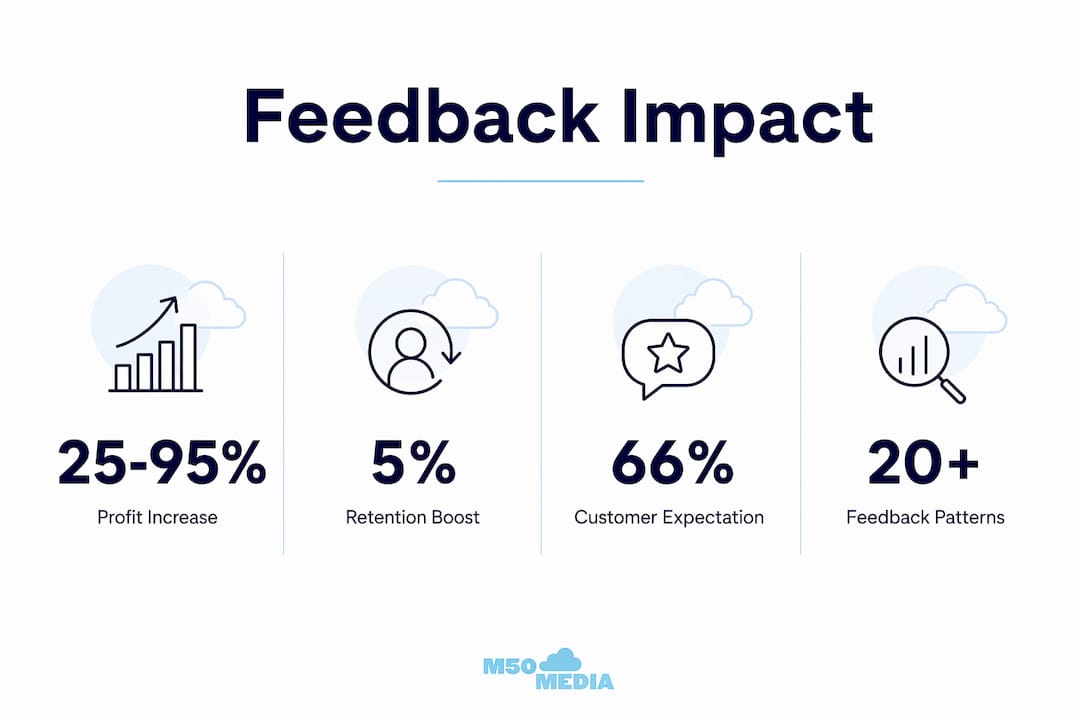
The retention numbers alone make the case. Increasing customer retention by just 5% can raise profits by 25–95%. Repeat customers also spend 67% more by their third year compared to new customers. That means every piece of feedback that helps you keep a customer longer is worth serious money.
The market agrees. 78% of consumers prefer brands that actively collect customer feedback. And 53% of marketers identify feedback as the top tactic for improving customer experience. Those two figures together mean your customers want to be heard, and your competitors already know it.
Here is what feedback actually does for your bottom line:
Identifies friction points in the buying or service experience before they cause churn
Surfaces revenue signals like unmet needs that could become new products or upsell opportunities
Reduces guesswork in product and service decisions by grounding them in real customer data
Supports reputation management by catching dissatisfaction early, before it spreads
Builds loyalty by showing customers their opinions actually change things
The impact of customer feedback on revenue is not theoretical. Businesses that close the loop on feedback, meaning they act on it and tell customers they did, see measurable improvements in retention and referral rates. Think of it like watering a plant. You do not water it once and walk away. You keep at it, and it grows.
What are common challenges in managing customer feedback?
Most small businesses collect feedback. Far fewer actually use it well. The gap between collecting and acting is where most of the value gets lost.
The biggest trap is treating all feedback as equally valid. Acting on feedback from unrepresentative early adopters can mislead product development and backfire commercially. Early adopters are enthusiastic and vocal, but they often do not represent your mainstream customer. Building your roadmap around their edge cases is like designing a restaurant menu based only on what food critics order.
There is also the expectation effect. High expert praise or heavy marketing can inflate customer expectations to a point where even a genuinely good product gets lower review scores. That does not mean your product is failing. It means you need to interpret feedback in context, not just count stars.
Small businesses often fail by treating feedback as noise rather than intelligence, skipping the analysis and prioritisation steps entirely. Volume is not the same as insight. Getting 200 survey responses means nothing if you do not sort them by impact, frequency, and customer segment.
Pro Tip: Set a simple rule before you act on any piece of feedback: ask whether it comes from a customer who represents your core audience. If not, file it separately and look for patterns before making any changes.
A few other pitfalls to watch for:
Vocal minorities dominate feedback channels and can drown out the quieter majority
Self-selected respondents (people who fill out surveys voluntarily) skew toward the most satisfied or most frustrated, not the average
Failing to close the loop destroys trust. When customers give feedback and never hear back, they stop giving it.
Closing the feedback loop by acknowledging customer input increases loyalty and reduces churn significantly. A simple “we heard you, here is what we changed” email does more for retention than most loyalty programmes.
How can small businesses collect and analyse customer feedback?
Collecting feedback well is a system, not a one-time survey. Small businesses have more options than ever, and the best approach combines multiple channels.
Here is a practical order of operations:
Start with surveys. Post-purchase surveys, Net Promoter Score (NPS) questions, and short satisfaction polls give you structured, comparable data over time.
Monitor reviews. Google Reviews, industry-specific platforms, and social media comments are where customers speak freely. That candour is valuable.
Use direct outreach. A quick follow-up call or email to a recent customer yields qualitative depth that no survey can match.
Centralise everything. Feedback sitting in separate inboxes, spreadsheets, and review platforms is feedback you cannot act on. Pull it into one place.
Analyse for patterns, not outliers. Look for themes that appear across multiple customers and channels before drawing conclusions.
AI and natural language processing now enable real-time classification, sentiment analysis, and pattern detection across large volumes of feedback data. That used to require a dedicated analyst. Now, even small teams can get that level of insight with the right tools.
Pro Tip: Do not wait until you have “enough” feedback to start analysing. Even 20 responses can reveal a pattern if you look at them together. Start small, act fast, and build the habit.
66% of customers expect companies to understand their personal needs. That expectation is only met when you actively collect and use feedback to tailor your service. Generic responses to specific problems frustrate customers more than the original issue did.
The qualitative and quantitative sides of feedback work together. Numbers tell you how many customers have a problem. Comments tell you what the problem actually feels like. You need both to make good decisions. For more on using feedback to sharpen your email marketing approach, the M50media blog has practical examples worth checking out.
How to use customer feedback to improve products and relationships
Collecting feedback is step one. Using it is where the real work happens. And honestly, this is where most small businesses leave money on the table.
Customer feedback reveals precise friction points in digital customer journeys, enabling tailored improvements. That means if customers keep mentioning that your checkout process is confusing, that is not just an annoyance. It is a revenue leak you can fix.
Here is how to put feedback to work:
Translate themes into changes. If three or more customers mention the same issue, treat it as a confirmed problem and assign it to someone to fix.
Acknowledge feedback publicly. Responding to reviews, especially negative ones, shows future customers that you take quality seriously. This is a core part of reputation management for any small business.
Use positive feedback in marketing. Testimonials, quotes, and case studies built from real customer words outperform generic ad copy every time.
Feed insights into loyalty programmes. When you know what customers value most, you can reward exactly that.
Track changes over time. After you make a change based on feedback, measure whether satisfaction scores improve. That closes the loop and validates your decisions.
Satisfied customers refer 5–6 people on average. Dissatisfied customers tell 10 or more. That asymmetry is brutal. One unhappy customer who feels ignored can do more damage than five happy ones do good. Acting on feedback is not just about improvement. It is about protecting what you have built.
Feedback also feeds directly into customer retention strategies. When customers see their input reflected in your product or service, they feel ownership. That emotional connection is hard to replicate with discounts alone.
Continuous feedback is a competitive advantage. Markets shift, customer expectations rise, and what worked last year may not work this year. Businesses that keep listening adapt faster than those that rely on gut instinct alone.
Key takeaways
Customer feedback is a financial tool, not an administrative task. The businesses that treat it that way grow faster, retain more customers, and build stronger reputations.
Point | Details |
Feedback drives retention and profit | A 5% retention increase can raise profits by 25–95%, making feedback a direct revenue lever. |
Not all feedback is equal | Prioritise themes from your core customer segment, not just the loudest or most frequent voices. |
Collection needs a system | Combine surveys, reviews, and direct outreach, then centralise data to spot real patterns. |
Close the loop every time | Acknowledging feedback and acting on it reduces churn and builds lasting customer loyalty. |
Use feedback across the business | Apply insights to product changes, marketing copy, reputation management, and loyalty programmes. |
What I have learned from watching small businesses handle feedback
Here is the honest truth: most small business owners I work with are not ignoring feedback because they do not care. They ignore it because it feels like one more thing on an already impossible list. I get it. Running a small business is like being the star, director, and entire crew of your own show simultaneously.
But here is what I have seen over and over again. The businesses that treat feedback as a proactive financial system, not a reactive chore, catch problems before they become expensive. They spot the customer who is about to leave before that customer actually does. They fix the thing that was quietly costing them referrals. That is not magic. That is just paying attention.
The other mistake I see constantly is over-automating without human oversight. AI tools for sentiment analysis are genuinely useful. But a tool that flags “negative” feedback without context can send you chasing the wrong problems. Someone needs to read the actual comments, not just the dashboard. Build the habit of a weekly 20-minute feedback review. It sounds small. The results are not.
The businesses I have coached that build a real feedback culture, where the whole team sees the data and owns the response, outperform those where feedback lives only in one person’s inbox. Accountability and collaboration turn feedback from a report into a results driver.
— Karl
Ready to put your feedback to work?
You now know that customer feedback is one of the most direct paths to growth, retention, and a reputation worth protecting. The question is whether you have a system that actually captures, analyses, and acts on it.

At M50media, Karl works directly with small business owners to build feedback strategies that connect to real business outcomes. Not just surveys for the sake of surveys. Actual systems that tell you what to fix, what to keep, and where your next opportunity is hiding. If you want expert eyes on your current approach, a free Marketing SOS call is the fastest way to get started. Or if you are ready to go deeper, explore Karl’s coaching services and build a feedback programme that actually moves the needle.
FAQ
What is the role of customer feedback in business?
Customer feedback is defined as direct input from customers about their experiences, and its role is to guide product improvements, service decisions, and customer retention strategies. Businesses that act on feedback consistently see stronger growth and lower churn.
How does feedback affect customer retention?
Increasing customer retention by 5% can raise profits by 25–95%, and feedback is the primary tool for identifying what causes customers to stay or leave. Closing the feedback loop by acknowledging input is one of the most effective retention tactics available.
What are the biggest mistakes small businesses make with feedback?
The most common mistake is collecting feedback without analysing or prioritising it. Acting on unrepresentative voices, such as vocal early adopters, can also mislead decisions and hurt commercial results.
How can small businesses collect feedback effectively?
The most effective approach combines post-purchase surveys, online review monitoring, and direct customer outreach, with all data centralised in one place for pattern analysis. AI and natural language processing tools can speed up analysis significantly.
Why does negative feedback matter more than positive feedback?
Dissatisfied customers share their experience with 10 or more people on average, while satisfied customers refer only 5–6. That gap means one unresolved complaint can cost more in lost referrals than several positive reviews can recover.
Recommended
Comments