Why use customer reviews: a small business guide

TL;DR:
Customer reviews are crucial for building trust, increasing sales, and improving search rankings for small businesses. They provide authentic feedback that signals business activity and helps detect early issues, reducing risks and boosting customer retention. Consistently collecting, responding to, and using reviews effectively can drive growth and establish a genuine connection with buyers.
Customer reviews are defined as user-generated feedback that tells potential buyers what real people think about your product or service. And here’s the thing: 97% of consumers read online reviews before making a purchase decision. That number alone should make you sit up straighter. If you’re a small business owner wondering why use customer reviews matters to your bottom line, the short answer is this: reviews are the closest thing to a trusted friend’s recommendation that a stranger on the internet can get. Nearly half of consumers actively avoid businesses with fewer than 20 reviews. That’s not a marketing problem. That’s a survival problem.
Why use customer reviews to build trust with buyers
Trust is the currency of commerce, and reviews are how you earn it before a customer ever walks through your door (virtual or otherwise). Reviews act as authentic word-of-mouth that lower a buyer’s perceived risk in a way that no ad copy ever could. Think about it: you trust your friend’s restaurant recommendation over a billboard, right? Reviews work the same way.
The psychology here is called social proof, and it’s powerful. When a potential customer sees that 47 other people loved your handmade candles or your bookkeeping service, they feel safer saying yes. 22% of consumers trust online reviews most when making a purchase, putting them just behind family and friends as a trusted source. For a small business without a massive advertising budget, that kind of organic credibility is worth its weight in gold.
Not all reviews carry equal weight, though. Buyers are savvier than ever and they notice the details.
Recency matters. A glowing review from three years ago feels stale. Fresh reviews signal that your business is still active and still delivering.
Volume matters. A handful of five-star ratings looks suspicious. Dozens of varied, genuine reviews look real.
Authenticity matters. Overly polished, suspiciously perfect reviews raise red flags. Buyers trust reviews that sound like actual humans wrote them.
Responsiveness matters. Consumers value timely, professional responses more than the absence of complaints. Replying to reviews, good and bad, signals that you actually care.
Pro Tip: Ask customers to mention a specific detail in their review, like the product name or the service they received. This makes reviews sound more genuine and naturally includes keywords that help your SEO.
How reviews directly impact sales and search rankings
Let’s talk numbers, because this is where things get genuinely exciting. A single review increases sales by 10%, and reaching 50 reviews can boost purchase rates by 30%. That is not a rounding error. That is a meaningful, measurable lift that compounds as your review count grows.

The impact of reviews on sales follows a clear pattern. Here’s how the numbers stack up:
Review milestone | Impact on purchase likelihood |
1 review | Up to 10% increase in sales |
50 reviews | Up to 30% increase in purchase rates |
Fewer than 20 reviews | 47% of consumers may avoid your business |
Beyond conversions, reviews do serious heavy lifting for your search visibility. Keywords within reviews boost SEO because search engines treat that text as authentic, user-generated content. When a customer writes “best gluten-free bakery in Halifax,” Google reads that and factors it into your local rankings. You didn’t write it. You didn’t pay for it. It just works.
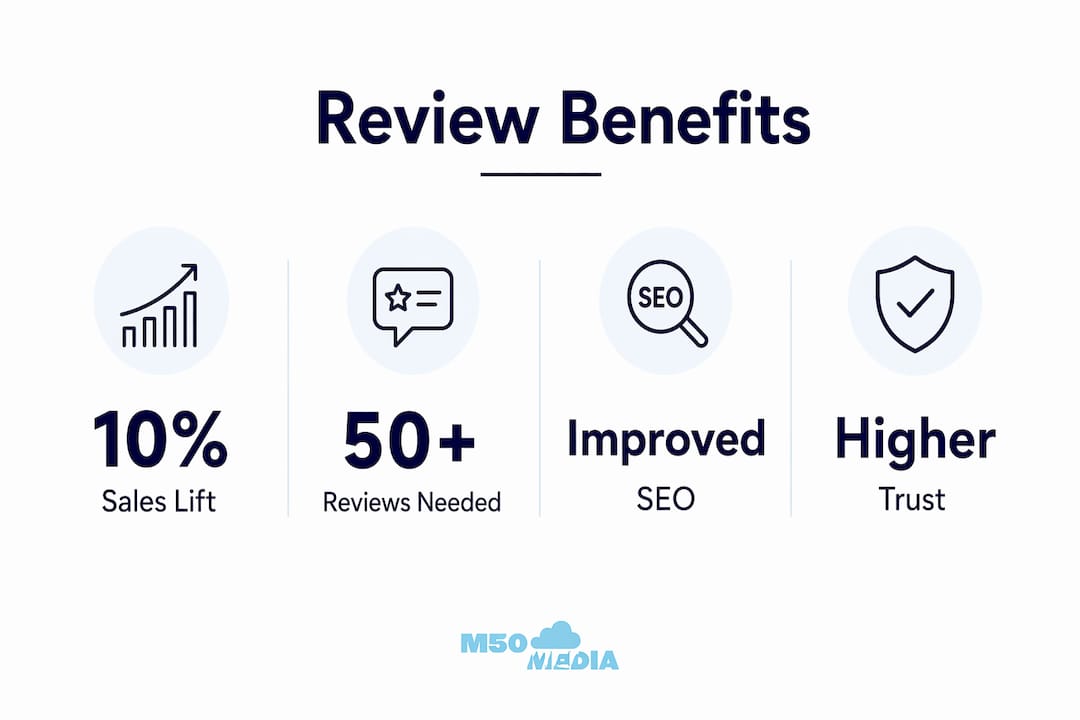
Google Business Profile rankings respond directly to review quantity and quality. Review-generated keywords act as a steady stream of fresh, relevant content that tells search engines your business is active and trusted. For small businesses competing against bigger players with larger ad budgets, this is one of the most cost-effective ways to show up where it counts. You can read more about how this plays out in practice over at reviews and sales strategy.
The impact of reviews on sales extends well beyond the moment of purchase, shaping how prospects find you, compare you, and ultimately choose you over a competitor.
Reviews as a risk management and retention tool
Here’s the angle most small business owners miss entirely: customer reviews are not just a marketing asset. They are a financial risk management tool. Think of them as your early warning system, like a smoke detector for your business before the fire gets out of hand.
Reviews reveal product or service issues early, often before those issues snowball into lost revenue or a reputation crisis. A pattern of complaints about slow shipping or confusing instructions is data. It tells you exactly where to fix things before customers start leaving quietly and never coming back.
Retention is where the real money lives. A 5% increase in customer retention can improve profits by 25%–95%. That range is enormous, and it underscores how much value sits in keeping the customers you already have. Reviews help you spot the warning signs of churn before it happens.
Negative review patterns signal systemic issues, not just one-off bad days.
Unanswered complaints tell at-risk customers that you don’t care, accelerating their exit.
Positive feedback themes reveal what you’re doing right, so you can do more of it.
Neutral or mixed reviews often contain the most useful product improvement ideas.
Mature businesses use customer feedback strategically to detect churn signals and avoid costly product mistakes. Treating reviews as data inputs rather than just star ratings changes how you run your business. It shifts you from reactive to proactive, which is exactly where you want to be.
Pro Tip: Set up a simple spreadsheet to track recurring themes in your reviews each month. Patterns you spot in february might save you a customer exodus by april.
Practical strategies to collect and use reviews effectively
Getting reviews doesn’t have to feel like pulling teeth (though we’ve all been there). The key is making it easy, timely, and natural for your customers to share their experience.
Ask right after the win. Send a post-purchase email within 24–48 hours of delivery or service completion. That’s when the good feelings are freshest and the customer is most likely to respond.
Make it one click. Include a direct link to your Google Business Profile or preferred review platform. Every extra step you add cuts your response rate significantly.
Keep the ask short. A two-sentence email asking for honest feedback converts far better than a lengthy, formal request. People are busy. Respect that.
Respond to every review. Yes, every single one. Thank the happy customers. Address the unhappy ones professionally and without defensiveness. Responding professionally to even one negative review can neutralize its impact. Silence, on the other hand, reads as apathy.
Use reviews in your marketing. Pull standout quotes for your website, social media, and email campaigns. Authentic customer language on a product page builds trust faster than any headline you write yourself.
A word on what to avoid: never buy fake reviews. Platforms detect them, customers spot them, and the reputational damage when you’re caught is far worse than having fewer reviews. Incentivising reviews is fine (a discount on a future purchase, for example), but the review itself must be honest and unbiased. Reviews influence buying decisions at every stage of the customer journey, so the integrity of those reviews matters enormously.
Pro Tip: Add a review request to your email signature or your order confirmation page. These passive touchpoints collect reviews without any extra effort on your part.
For a broader look at how to put this into practice alongside your other marketing efforts, the M50media post on ethical marketing strategies is worth a read.
Key takeaways
Customer reviews are the single most cost-effective trust-building tool available to small businesses, directly increasing sales, improving search rankings, and providing early warning signals for customer retention risks.
Point | Details |
Reviews drive real sales lifts | A single review lifts sales by 10%; 50 reviews can boost purchase rates by 30%. |
Trust precedes price and quality | Buyers assess reviews before considering your product features or pricing. |
SEO benefits are automatic | Customer-written keywords improve Google Business Profile rankings without paid effort. |
Reviews predict retention risk | Recurring negative themes signal churn early, giving you time to fix the problem. |
Response strategy is non-negotiable | Replying to every review, positive or negative, signals accountability and builds loyalty. |
Karl’s take: reviews are your most honest business partner
I’ll be straight with you. When I started working with small business owners on their digital marketing, reviews were almost always treated as an afterthought. Something you checked occasionally, maybe panicked about when a bad one showed up, and otherwise ignored. That approach costs businesses real money.
What I’ve seen shift over the past several years is a recognition that reviews are not a marketing extra. They are a feedback loop that tells you, in plain language, what your customers actually think. No focus group, no expensive survey, no consultant (including me) can give you that kind of unfiltered honesty.
The businesses I’ve watched grow consistently are the ones that treat every review as a conversation. They respond. They adjust. They use the language their customers use to describe their own products, which makes their marketing sound human instead of corporate. That’s not a trick. That’s just listening.
My honest advice: stop waiting for reviews to come to you and build a simple system to ask for them. Start responding to every single one this week. And if a negative review stings, read it twice before you respond. There’s almost always something useful in there, even if the delivery is rough. Reviews are your most honest business partner. Treat them that way.
— Karl
Ready to build a review strategy that actually works?
Getting reviews is one thing. Building a system that collects them consistently, responds to them well, and turns them into real business growth is another challenge entirely. That’s exactly the kind of work M50media helps small business owners tackle.

Karl works directly with business owners to build marketing strategies that include reputation management, review collection systems, and the kind of customer trust-building that moves the needle on sales. If you want a clear plan without the guesswork, book a free Marketing SOS call and let’s figure out where your review strategy stands and what it could become. Or, if you’re ready to go deeper, explore digital coaching built specifically for small business owners who want real results.
FAQ
Why use customer reviews for a small business?
Customer reviews build trust with potential buyers before they ever contact you. They also improve your search rankings and directly increase conversion rates.
How many reviews does a small business need?
Aim for at least 20 reviews to avoid being dismissed by nearly half of potential customers. Reaching 50 reviews can increase purchase likelihood by up to 30%.
Do customer reviews help with Google rankings?
Yes. Keywords that appear naturally in customer reviews improve your Google Business Profile rankings and local SEO without any paid effort on your part.
What should I do about negative reviews?
Respond professionally and promptly to every negative review. A timely, respectful response can neutralize the impact of a complaint and shows other potential customers that you take feedback seriously.
Is it okay to ask customers for reviews?
Asking customers for honest reviews is completely acceptable and encouraged. Avoid incentivising specific ratings or purchasing fake reviews, as both practices damage credibility and violate platform policies.
Recommended
Comments