What is retargeting? Your 2026 guide to winning back visitors

TL;DR:
Retargeting is a digital advertising strategy that uses tracking pixels to serve personalized ads to visitors who left without converting. It offers higher conversion rates and lower costs compared to standard display ads by targeting individuals already interested in your brand. Building a retargeting system with first-party data and dynamic creatives enhances effectiveness, especially as third-party cookies fade.
Retargeting is a digital advertising strategy that serves personalised ads to people who have already visited your website or engaged with your brand but left without converting. Think of it like that friend who gently reminds you about the jacket you left behind at the restaurant. Except in this case, the jacket is a product you almost bought, and the friend is a well-timed ad following you around the internet. Understanding what is retargeting gives you one of the most cost-efficient tools in digital marketing, and this guide breaks down exactly how it works, why it outperforms standard display advertising, and how to use it without annoying your audience into oblivion.
What is retargeting and how does it work technically?
Retargeting works through a five-step process that starts the moment someone lands on your website. Each step builds on the last, turning anonymous browsing behaviour into a targeted ad experience.
Place a tracking pixel. You embed a small JavaScript snippet (often called a 1x1 pixel) in your website’s footer. This fires silently when a visitor loads your page.
Capture behaviour data. The pixel drops a cookie in the visitor’s browser, recording their actions anonymously. No personal details are collected at this stage.
Segment your audiences. Visitors get grouped by behaviour. Someone who viewed a product page lands in a different bucket than someone who abandoned a cart.
Serve personalised ads. Your ad platform uses the cookie data to display relevant ads to those visitors across other websites, social platforms, and apps they use.
Optimise based on performance. You monitor click-through rates, conversions, and frequency data, then adjust bids, creatives, and audience rules accordingly.
The pixel is the engine behind the whole operation. Without it, you are essentially advertising blind. Most major ad platforms provide their own pixel, and you install it once across your site to start building audiences immediately.
One challenge worth knowing: third-party cookie data is being phased out across major browsers. This means relying solely on a single platform’s pixel is increasingly risky. Effective practitioners now integrate CRM data and first-party data directly into their ad platforms to build unified customer profiles that work across devices.

Pro Tip: Connect your CRM to your ad platform so your retargeting audiences reflect real purchase history and lead status, not just anonymous page visits. This produces far more relevant ads and better conversion rates.
What are the key benefits of retargeting for ROI?
Retargeting delivers results that standard display advertising simply cannot match. The numbers tell a clear story.
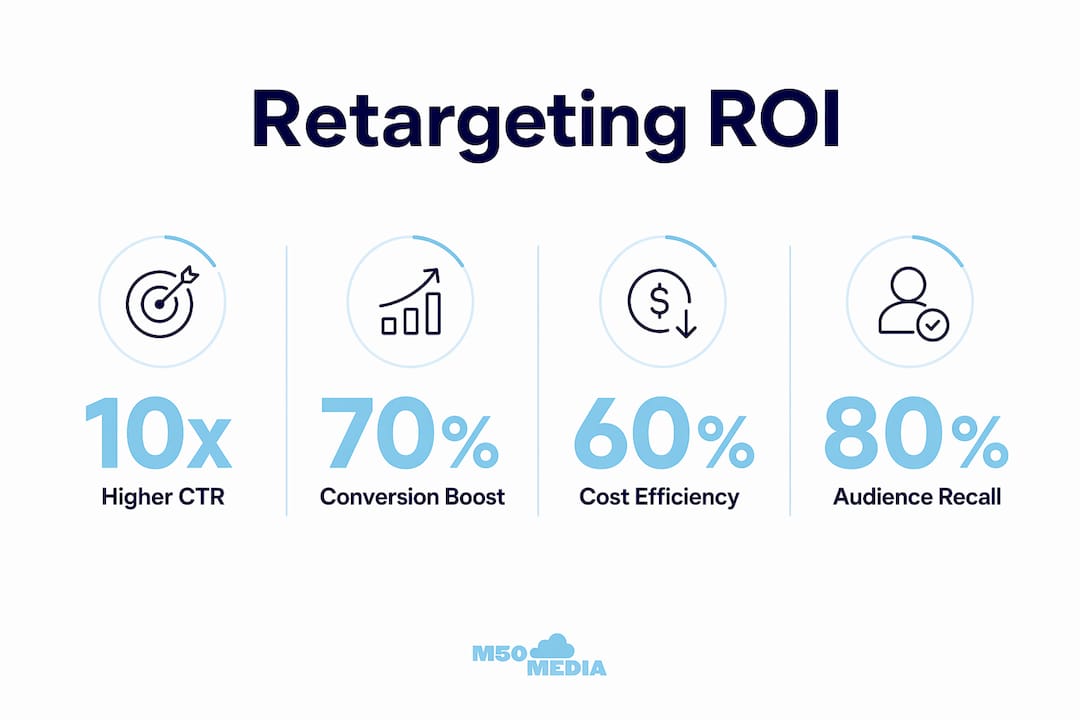
Retargeted users are 70% more likely to convert than first-time visitors. That gap exists because these people already know your brand. They showed interest once. You are not introducing yourself from scratch.
The cost advantages are equally compelling:
Lower cost per acquisition. Retargeting campaigns achieve 40–60% lower CPA compared to standard campaigns. You spend less to win each customer.
Higher click-through rates. Retargeted ads generate click-through rates roughly 10 times higher than standard display ads. Familiar brands get more clicks.
Stronger return on ad spend. Campaigns routinely achieve 4–10x ROAS, with e-commerce businesses often hitting around 8:1. That is a meaningful return for a relatively modest budget.
The reason retargeting outperforms cold advertising comes down to intent. A visitor who browsed your pricing page is far closer to buying than someone who has never heard of you. Retargeting meets them at that moment of near-decision and gives them a nudge.
Marketing experts position retargeting as a performance engine, not just a reminder tool. The distinction matters. Simple reminder ads drive clicks. Dynamic creatives that show the exact product a visitor viewed, at the right price, at the right moment, drive conversions. That is the difference between a retargeting campaign that breaks even and one that funds your next quarter.
Understanding audience segmentation techniques is what separates marketers who get mediocre retargeting results from those who consistently hit strong ROAS.
What is the difference between retargeting and remarketing?
These two terms get mixed up constantly, and honestly, the confusion is understandable. They share the same goal but use different channels and data sources to get there.
Industry standards define the distinction clearly. Retargeting uses paid ads and third-party or first-party data to re-engage anonymous visitors who interacted with your brand. Remarketing typically uses owned channels, most commonly email, to re-engage known contacts already in your database.
Aspect | Retargeting | Remarketing |
Primary channel | Paid ads (display, social, video) | Email and owned channels |
Data type used | First-party and third-party cookie data | Owned customer and contact data |
Audience type | Anonymous past visitors | Known contacts and customers |
Typical use case | Re-engage site visitors who did not convert | Re-engage existing customers or leads |
Goal | Drive first conversion or repeat visit | Upsell, cross-sell, or re-activate |
Both strategies aim to re-engage people who already showed interest in your brand. The key difference is whether you know who they are. Remarketing talks to people in your database. Retargeting talks to people who visited your site but never gave you their contact details.
For most businesses, both belong in your marketing mix. They complement each other rather than compete. A visitor who abandons your cart might see a retargeted ad today and receive a remarketing email tomorrow. That combination is more powerful than either tactic alone.
What are effective retargeting strategies in 2026?
A retargeting campaign without a strategy is just an expensive way to annoy people. Here is what actually works.
Segment audiences by intent
Not all visitors deserve the same ad. Segmenting by intent produces dramatically better results than serving one generic ad to everyone who visited your site. Cart abandoners need urgency and a clear path back to checkout. Casual browsers who read one blog post need awareness-stage content, not a hard sell. Product page viewers sit somewhere in between and respond well to dynamic ads showing exactly what they viewed.
Pairing intent segmentation with your marketing funnel stages gives you a clear framework for which message to serve at which moment.
Use dynamic creatives
Static ads that show the same image to every visitor leave money on the table. Dynamic creatives automatically pull in the specific product, price, and imagery relevant to what each visitor viewed. Dynamic product-focused creatives turn almost-conversions into measurable outcomes far more reliably than generic brand ads.
Cap your ad frequency
Ad fatigue is real. Showing the same ad to the same person 40 times in a week does not increase conversions. It increases resentment. Frequency capping is non-negotiable. Monitor your frequency reports daily during the first week of any new campaign to find the sweet spot before performance plateaus.
Pro Tip: Start with a frequency cap of 3–5 impressions per user per day and adjust based on your click-through rate data. If CTR drops sharply after day three, your audience is fatigued. Rotate your creative or tighten the cap.
Build on existing traffic, not instead of it
Retargeting works best when you already have solid inbound traffic. If your site gets 200 visitors a month, your retargeting audience pool is too small to serve ads effectively. Retargeting is a secondary layer on top of strong lead generation, not a replacement for it. Build your traffic first through SEO, content, and paid acquisition. Then retargeting amplifies what is already working.
Integrating retargeting within a broader digital marketing strategy is what turns it from a standalone tactic into a genuine funnel efficiency tool.
Prioritise first-party data
With third-party cookies fading out, first-party data integration is the future of retargeting. Upload your customer lists directly to ad platforms. Connect your CRM. Use email match audiences. This gives you retargeting capabilities that do not depend on cookies and produces more complete customer profiles across devices.
Key takeaways
Retargeting is the highest-intent advertising channel available to digital marketers because it targets people who already showed interest in your brand.
Point | Details |
Retargeting definition | Paid ads served to past visitors who did not convert, using pixel and first-party data. |
ROI advantage | Retargeted users convert at 70% higher rates with 40–60% lower CPA than cold campaigns. |
Retargeting vs. remarketing | Retargeting uses paid ads for anonymous visitors; remarketing uses email for known contacts. |
Frequency capping | Monitor ad frequency daily and cap impressions to avoid audience fatigue and brand damage. |
First-party data priority | Integrate CRM and customer lists into ad platforms to future-proof retargeting as cookies phase out. |
Karl’s take: retargeting is not a magic eraser
Here is something I have seen trip up a lot of business owners: they set up a retargeting campaign, sit back, and expect it to fix a broken funnel. It does not work that way.
Retargeting amplifies what is already there. If your offer is weak, your landing page is confusing, or your pricing is off, retargeting will just show more people a reason not to buy. I have watched businesses spend significant budget retargeting visitors to a page that had a broken checkout. All that did was remind people of a frustrating experience.
The privacy shift happening right now is also real and worth taking seriously. Third-party cookies are going away, and marketers who have not started building first-party data assets are going to feel that pain. Start collecting emails. Connect your CRM to your ad platforms. Build customer match audiences now, before you need them.
What I find genuinely exciting about retargeting in 2026 is the creative side. Dynamic creatives have gotten remarkably good. When you pair tight audience segmentation with ads that show the exact product someone viewed, at a personalised price point, the conversion lift is not subtle. That is where the real performance gains live, not in simply “following people around the internet.”
Retargeting belongs inside a layered marketing approach. It works alongside SEO, content, email, and paid acquisition. Treat it as one instrument in the band, not the whole concert.
— Karl
Ready to put retargeting to work for your business?
Knowing the theory is one thing. Building a retargeting system that actually drives revenue is another challenge entirely. If you have been running ads without a clear retargeting structure, or if your campaigns are spending without converting, a focused conversation can change that fast.

M50media offers a free Marketing SOS call with Karl, where you can get direct, no-fluff feedback on your current advertising approach and a clear path forward. Whether you are starting from scratch or trying to fix a campaign that is bleeding budget, Karl has seen it before and knows what to do. If you want deeper, ongoing support, digital coaching is also available for businesses ready to build a real marketing system.
FAQ
What is retargeting in simple terms?
Retargeting is a paid advertising method that shows ads to people who visited your website but left without buying or signing up. It uses a tracking pixel to identify those visitors and serve them relevant ads on other sites and platforms.
How does retargeting differ from remarketing?
Retargeting uses paid ads to re-engage anonymous past visitors using pixel and first-party data. Remarketing typically uses email to re-engage known contacts already in your database.
Are retargeted ads more effective than regular display ads?
Retargeted ads generate click-through rates roughly 10 times higher than standard display ads, and retargeted users are 70% more likely to convert than first-time visitors.
What is a tracking pixel and why does it matter?
A tracking pixel is a small JavaScript snippet placed in your website’s footer that drops a cookie in a visitor’s browser. That cookie allows your ad platform to identify and serve ads to that visitor across other websites.
Does retargeting still work without third-party cookies?
Yes, but it requires first-party data. Marketers now upload CRM lists, use email match audiences, and connect customer data directly to ad platforms to maintain retargeting capabilities as third-party cookies are phased out.
Recommended
Comments