SEO trends in 2026: your complete guide

TL;DR:
Effective SEO in 2026 focuses on AI-driven search, technical standards, and content quality signals. Ensuring content demonstrates real experience, utilizes schema, and defines entities improves visibility amid AI answers and zero-click results. Strong technical SEO, structured data, and authoritative content remain vital for ranking success in evolving search landscapes.
SEO in 2026 is defined by AI-driven search, tightened technical standards, and a fundamental shift in how Google rewards content quality. This seo trends in 2026 guide covers every major change you need to act on right now. Google’s search query volume grew 11.3% year-over-year entering 2026, which means traditional search is not dying. It is expanding alongside AI answer engines, and that changes everything about how you build visibility. If you are a digital marketer, SEO professional, or business owner, the strategies that worked in 2024 are already losing ground. Let’s fix that.
What are the most impactful SEO trends shaping 2026?
The biggest shift in 2026 SEO is that ranking first no longer guarantees clicks. AI Overviews and zero-click results now answer many queries directly on the search results page, so your content needs to earn visibility inside those AI-generated summaries, not just below them. Think of it like getting a cameo in the blockbuster instead of starring in the straight-to-streaming sequel. One gets seen; the other does not.
Here are the dominant trends every SEO professional needs to understand right now:
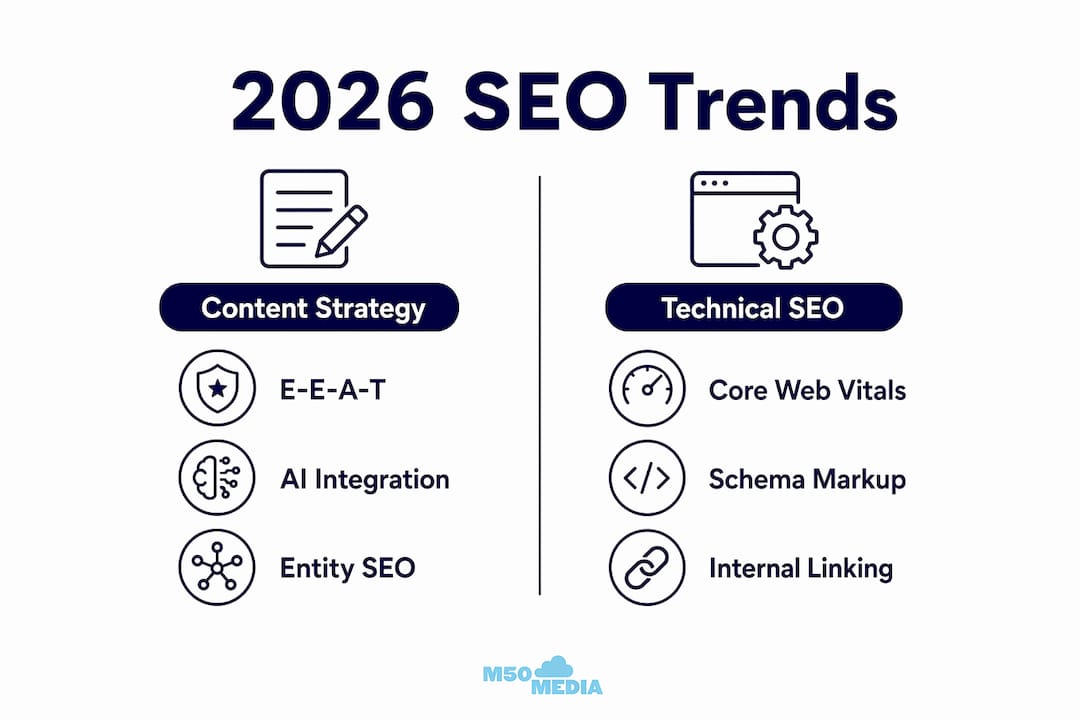
E-E-A-T as a primary ranking signal. AI-generated content now makes up 30–40% of active web content, which pushed Google to make Experience, Expertise, Authoritativeness, and Trustworthiness (E-E-A-T) its primary quality filter. Generic content gets buried. Content backed by real experience gets cited.
Core Web Vitals thresholds tightened. Google tightened its standards in march 2026. Pages with Largest Contentful Paint (LCP) between 2.0 and 2.5 seconds on mobile dropped an average of 4.3 ranking positions. Speed is no longer a bonus. It is a baseline.
Entity-based SEO over keyword density. Pages that define and link named entities are 2.4 times more likely to be cited in AI responses than pages stuffed with keywords. Google thinks in topics and entities now, not just phrases.
Topical authority beats single-keyword targeting. Comprehensive content clusters outperform isolated pages. Building a hub of related content around a topic signals depth to both Google and AI engines.
Zero-click optimisation is non-negotiable. Featured snippets, People Also Ask boxes, and AI Overviews all pull answers directly from well-structured content. If your pages are not formatted to answer questions clearly, you are invisible in these placements.
Pro Tip: Audit your top 10 pages for E-E-A-T signals right now. Add author bios with credentials, cite real sources, and include first-hand examples. These changes can lift your AI Overview eligibility faster than any keyword tweak.
The future of SEO in 2026 rewards sites that act like trusted experts, not content factories.
How can marketers use AI content effectively without losing rankings?
AI content tools are everywhere, and they are genuinely useful. The problem is that most marketers use them to produce volume, not value. Google’s quality systems are now very good at detecting thin, experience-free content, and they penalise it.
Here is how to use AI-generated content in a way that actually holds up in 2026:
Lead with real experience. AI can draft structure and fill in facts, but the insights that earn E-E-A-T come from you. Add a personal example, a client result, or a specific observation that no AI could fabricate. That is the layer Google rewards.
Implement FAQ Schema on every eligible page. Pages with valid FAQ Schema achieved 91% of AI Overview citations in Q1 2026, while 67% of pages that lost citations lacked valid implementation. Structured data is the bridge between your content and AI-powered results.
Update content on a regular schedule. Stale content loses citation eligibility fast. Set a quarterly review cycle for your top pages. Refresh statistics, update examples, and re-check schema validity every time.
Use AI for research and outlines, not final copy. AI tools like ChatGPT or Google Gemini are excellent for generating topic clusters and identifying gaps. The final voice, opinion, and experience layer should always be human.
Target AI-driven content automation carefully. Automation works best for data-heavy pages like product listings or location pages. For thought leadership and service content, human authorship is the differentiator.
Pro Tip: Before publishing any AI-assisted piece, ask yourself: “Does this contain something only I could know?” If the answer is no, add it. One genuine insight outweighs five AI-generated paragraphs.
AI’s role in marketing conversions is growing fast, but the marketers winning in 2026 are the ones pairing AI efficiency with human credibility.

What technical SEO strategies support higher rankings in 2026?
Technical SEO in 2026 is not optional background work. It is a front-line ranking factor, and the gap between well-structured and poorly-structured sites is widening fast.
Hub-and-spoke internal linking
The hub-and-spoke model organises your site around authoritative pillar pages (hubs) that link out to detailed topic-specific subpages (spokes). Implementing this architecture increases indexing speed by 38% compared to unstructured linking. Faster indexing means new content gets evaluated and ranked sooner. For small businesses publishing regularly, this is a significant competitive edge.
Core Web Vitals: the new floor
Google’s march 2026 update set the “Good” LCP threshold at under 2.0 seconds on mobile. Sites sitting in the 2.0 to 2.5 second range saw real ranking drops, not theoretical ones. Use Google Search Console and PageSpeed Insights to identify your slowest pages. Compress images, reduce render-blocking scripts, and consider a content delivery network (CDN) if your audience is geographically spread out.
Schema markup and structured data
Schema type | Primary benefit | 2026 priority |
FAQ Schema | AI Overview citation eligibility | Critical |
Article Schema | Author and E-E-A-T signals | High |
LocalBusiness Schema | Local pack and map visibility | High |
HowTo Schema | Featured snippet placement | Medium |
BreadcrumbList Schema | Site structure clarity for crawlers | Medium |
Valid schema markup, especially FAQ and Q&A structured data, is now critical for gaining citations in AI-powered search results. Treat schema implementation as a standard part of every page publish, not an afterthought.
Entity SEO and semantic linking
Entity SEO means clearly defining the people, places, organisations, and concepts your content covers, then linking those entities to trusted knowledge bases like Wikipedia or Wikidata. Pages that define and link named entities are 2.4 times more likely to appear in AI-generated responses. This is one of the highest-leverage technical changes you can make right now.
Check out M50media’s step-by-step SEO guide for a practical walkthrough of applying these technical tactics.
How should SEO strategies adapt to voice, visual, and zero-click searches?
User behaviour in 2026 looks very different from 2022. People are searching by voice, searching with images, and getting answers without ever clicking a link. Your SEO strategy needs to account for all three shifts.
Voice search optimisation. Voice queries are conversational and question-based. Write content that directly answers “who,” “what,” “where,” “when,” and “how” questions in plain language. Use natural sentence structures, not keyword-stuffed headers. A page that reads like a helpful conversation ranks better for voice than one that reads like a brochure.
Visual search readiness. Google Lens usage continues to climb. Every image on your site needs descriptive alt text, a relevant file name, and surrounding context that tells Google what the image depicts. For e-commerce and local businesses, this is especially high-value.
Zero-click optimisation. Ranking in a featured snippet or People Also Ask box means your brand appears even when nobody clicks. Structure content with clear question-and-answer formatting. Use H2 or H3 headings phrased as questions, then answer them in the first sentence of the paragraph below.
Hyper-personalised local SEO. Local search in 2026 is entity-driven. Your Google Business Profile, local citations, and on-page content all need to reference the same named entities (your business name, location, services) consistently. Inconsistency across sources confuses Google’s entity graph and suppresses local visibility.
Brand authority as a ranking signal. Brand mentions and third-party citations now influence AI search rankings more than many traditional on-page factors. Getting mentioned in industry publications, podcasts, and trusted directories builds the kind of authority that AI engines recognise and reward.
Users of AI-driven answer engines convert at higher rates than traditional organic visitors. That means showing up in AI results is not just a vanity metric. It is a revenue opportunity.
The latest SEO best practices for small businesses cover local and voice optimisation in more detail if you want to go deeper on these tactics.
Key takeaways
SEO success in 2026 requires combining AI-ready content structures, tightened technical performance, and genuine E-E-A-T signals to earn visibility across both traditional and AI-powered search results.
Point | Details |
E-E-A-T is the quality filter | Add real experience, author credentials, and first-hand insights to every key page. |
Core Web Vitals are a ranking floor | Keep mobile LCP under 2.0 seconds or risk losing ranking positions. |
FAQ Schema drives AI citations | Valid FAQ Schema earned 91% of AI Overview citations in Q1 2026. |
Entity SEO beats keyword density | Defining and linking named entities makes pages 2.4x more likely to appear in AI results. |
Brand authority shapes AI visibility | Third-party mentions and citations now outweigh many traditional on-page SEO signals. |
What I’ve actually learned about SEO in 2026 (and what surprised me)
Here is my honest take after working through these changes with clients: most marketers are panicking about AI when they should be doubling down on the fundamentals.
Yes, AI Overviews are real. Yes, zero-click results are eating into traffic numbers for some sites. But good SEO fundamentals like trustworthy content, solid technical structure, and genuine user experience have not stopped mattering. They matter more. The sites I see struggling right now are the ones that chased shortcuts for years and are now exposed because Google’s quality filters got smarter.
The thing that genuinely surprised me is how much entity SEO moves the needle. I started treating named entities as first-class citizens in content, linking to knowledge bases and defining concepts clearly, and the lift in AI Overview appearances was noticeable within weeks. It feels counterintuitive because it is not a “ranking hack.” It is just being clear and credible. Turns out Google likes that.
My advice: run a technical audit every quarter, not once a year. Core Web Vitals thresholds shifted in march 2026 and will likely shift again. Staying on top of those changes is the difference between holding your rankings and watching them quietly erode while you wonder what happened.
Also, stop treating AI content tools as a replacement for expertise. Use them as a research assistant. Your experience and opinions are the differentiator now. Lean into that. It is genuinely the most defensible SEO asset you have in 2026.
— Karl
M50media can help you put these SEO strategies to work
Knowing the trends is one thing. Applying them to your specific business, audience, and content is where most marketers get stuck.
M50media, led by digital marketing coach Karl Lundgren, works with small business owners and marketers to build SEO strategies that hold up as search evolves. Whether you need help with technical audits, content structure, or figuring out where to start with entity SEO, the M50media coaching programme gives you a clear path forward. Karl also offers a free Marketing SOS call where you can get personalised guidance on your biggest SEO challenges right now. No fluff, no generic advice. Just practical next steps tailored to where you actually are. Book your call and walk away with a plan.
FAQ
What is E-E-A-T and why does it matter in 2026?
E-E-A-T stands for Experience, Expertise, Authoritativeness, and Trustworthiness. Google uses it as its primary content quality filter, especially as AI-generated content now makes up 30–40% of active web content.
How do I get my content cited in AI Overviews?
Implement valid FAQ Schema on eligible pages and build entity-based content that links to trusted knowledge bases. Pages with valid FAQ Schema achieved 91% of AI Overview citations in Q1 2026.
What is the Core Web Vitals LCP threshold in 2026?
Google’s “Good” LCP threshold on mobile is now under 2.0 seconds. Sites with LCP between 2.0 and 2.5 seconds experienced an average ranking drop of 4.3 positions after the march 2026 update.
What is entity SEO?
Entity SEO means clearly defining the people, places, organisations, and concepts in your content, then linking them to trusted knowledge bases like Wikipedia. Pages using this approach are 2.4 times more likely to be cited in AI-generated responses.
Is traditional SEO still worth investing in for 2026?
Yes. Google’s search query volume grew 11.3% year-over-year entering 2026, showing traditional search is expanding alongside AI engines. Fundamental practices like technical optimisation, quality content, and user experience remain central to ranking success.
Recommended
Comments