What is lead generation: a guide for small businesses
- karl7209
- Jul 3
- 8 min read

TL;DR:
Effective lead generation involves multi-channel strategies that focus on attracting, qualifying, and nurturing high-quality leads. Small businesses should consistently build their funnels, measure performance, and treat lead generation as an ongoing practice. Combining content marketing, referrals, paid ads, and outbound outreach yields the best results over time.
Lead generation is defined as the process of attracting strangers and converting them into contacts who have given permission to engage further. In marketing, the industry term is “demand generation” at the top, but lead generation specifically refers to capturing identifiable interest and moving it toward a sale. If you’ve ever wondered what is lead generation and why every marketing guru keeps banging on about it, here’s the short answer: without a steady flow of leads, your sales pipeline looks like a Tim Hortons at 3 AM. Empty. A little sad. This guide breaks down the lead generation process, the best strategies for 2026, and how to build a system that actually works for a small business like yours.
What is lead generation and why does it matter for small businesses?
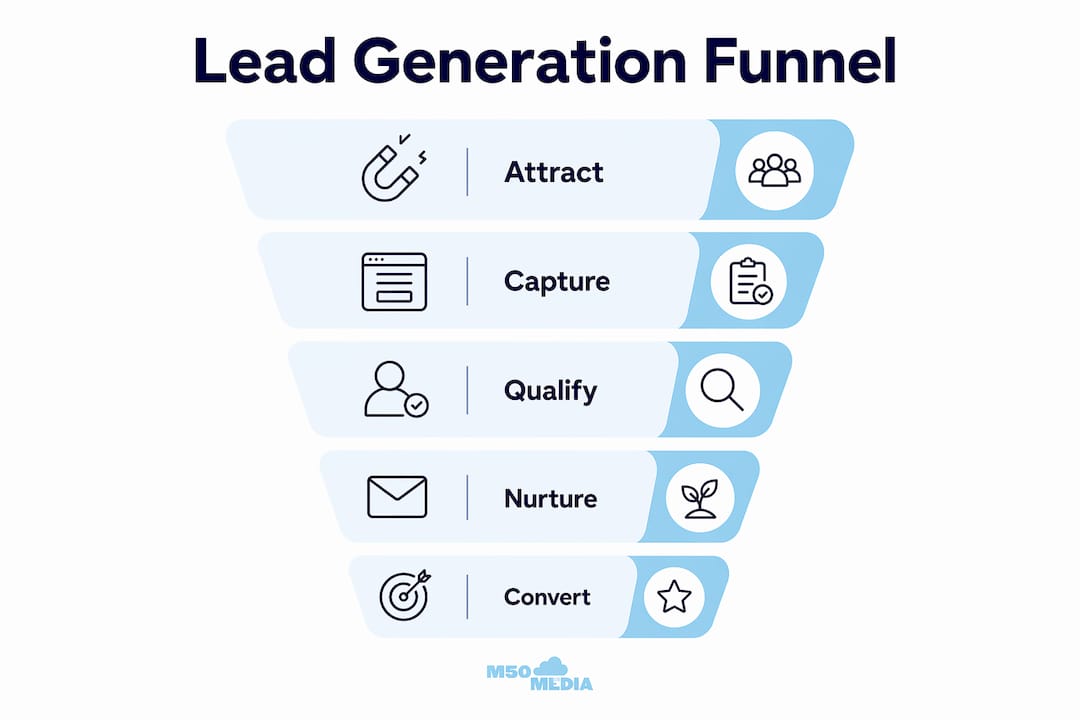
Lead generation is the engine that keeps your business from starving between clients. The process moves through five clear stages: attracting attention, capturing contact information, qualifying interest, nurturing the relationship, and converting the lead into a paying customer. Skip any stage and the whole thing stalls, like a car with no oil. You might still move for a bit, but it won’t end well.
A lead is simply a person who has shown some interest in what you offer. A prospect is a lead you’ve qualified as a realistic buyer. A customer is a prospect who said yes. Most businesses confuse these three and treat every name on a list like a hot buyer ready to pull out their credit card. That’s a mistake.
80% of new leads never convert to sales, which tells you that volume alone is a terrible strategy. The businesses that win focus on lead quality and nurturing effectiveness, not just filling the top of the funnel with warm bodies.
The marketing funnel maps neatly onto the lead journey. TOFU (top of funnel) is awareness. MOFU (middle of funnel) is consideration. BOFU (bottom of funnel) is decision. Your content, ads, and outreach need to match where a buyer actually sits in that journey. Sending a pricing page to someone who just heard of you is like proposing on a first date. Technically possible. Almost always a disaster.
Funnel stage | Lead status | Typical drop-off |
TOFU (awareness) | Visitor or subscriber | Very high |
MOFU (consideration) | Marketing qualified lead | Moderate |
BOFU (decision) | Sales qualified lead | Low |
Conversion | Customer | Minimal |
Pro Tip: Build your marketing funnel examples before you run a single ad. Knowing where your leads land in the funnel tells you exactly what to say to them next.
What are effective lead generation strategies for 2026?
The most effective lead generation strategies in 2026 combine multiple channels rather than betting everything on one. Combining 3–4 complementary strategies produces more consistent lead flow than any single channel approach. Think of it like a hockey team. You need forwards, defence, and a goalie. Running only paid ads is like suiting up with five goalies and hoping for the best.

The core channels worth your attention right now are content marketing, referral programmes, paid social ads, outbound prospecting, and visitor identification tools. Content marketing builds long-term trust and organic traffic. Referrals convert at a higher rate because trust transfers from the referrer. Paid ads on platforms like Meta and Google deliver fast results when your targeting is tight. Outbound prospecting (cold email, LinkedIn outreach) fills gaps quickly. And visitor identification tools now capture leads without requiring a form fill, which matters because buyers increasingly avoid gated content.
Here’s how to start building a multi-channel approach without losing your mind:
Pick two channels that match your current budget and skills.
Set a 90-day test period for each channel with clear metrics.
Add a third channel once the first two show consistent results.
Review performance monthly and cut what isn’t working.
Layer in a fourth channel only after you have a repeatable system.
For a deeper look at how social media fits into this mix, the social media advertising guide at M50media is worth bookmarking.
Pro Tip: Prioritise outbound for quick pipeline results when you need revenue fast. Invest in inbound content for long-term growth. A hybrid of both gives you the best of both worlds.
How to nurture and qualify leads to boost conversion rates
Lead qualification is the art of figuring out who is actually worth your time. The four criteria that matter most are: fit with your ideal customer profile, buying intent, decision-making authority, and timing. A lead who ticks all four boxes is worth ten who tick one.
Lead scoring and segmentation by behaviour and intent help you prioritise the right leads automatically. Assign points for actions like opening emails, visiting your pricing page, or downloading a resource. Leads with high scores get personal outreach. Leads with low scores get nurtured with content until they warm up. This stops you from wasting sales energy on people who are just browsing.
Mapping content to funnel stages is non-negotiable because buyers need different information at each step. A TOFU lead wants education, not a sales pitch. A BOFU lead wants proof, case studies, and a clear next step. Sending the wrong message at the wrong time is the number one reason leads go cold.
Best practices for effective lead nurturing:
Segment your list by behaviour, not just demographics.
Send content that matches the funnel stage, not generic newsletters.
Follow up within 24 hours of a high-intent action (like a pricing page visit).
Use a lead nurturing sequence of at least 5–7 touchpoints before expecting a conversion.
Personalise subject lines and opening sentences, even in automated emails.
Never ask for the sale before you’ve delivered genuine value.
Pro Tip: Building a repeatable lead engine prevents the feast-or-famine cycle that kills small businesses. Set aside time every single week to feed the top of your funnel, even when you’re busy with clients.
What tools and metrics should you track for lead generation success?
A lead generation system is only as good as the data feeding it. The right tools connect capture, qualification, nurturing, and measurement into one loop. Without that connection, isolated tactics fail because you can’t see what’s working or why.
For small businesses, a CRM (customer relationship management tool) is the backbone. Options like HubSpot’s free tier or Zoho CRM let you track every lead, log interactions, and set follow-up reminders. Pair your CRM with a marketing automation tool to handle email sequences, lead scoring, and segmentation without manual effort. Modern visitor identification tools add another layer by capturing anonymous website visitors who never fill out a form.
Key metrics to track every month:
Lead conversion rate: the percentage of leads who become customers.
Cost per lead: total marketing spend divided by number of leads generated.
Lead quality score: average score of leads entering your pipeline.
Sales pipeline velocity: how fast leads move from first contact to closed deal.
Funnel drop-off rate: where leads are leaving the process.
Here’s a simple data feedback loop to keep improving your results:
Review your lead conversion rate and cost per lead weekly.
Identify the funnel stage with the highest drop-off.
Test one change to the content or process at that stage.
Measure the impact over 30 days.
Keep the change if it improves conversion. Cut it if it doesn’t.
Repeat monthly.
Focusing on high-intent leads rather than raw volume produces better return on investment and a healthier sales pipeline. Chasing numbers feels productive. Chasing quality actually pays the bills.
Key takeaways
Lead generation is a connected system of attraction, capture, qualification, nurture, and measurement, and every part must work together to produce consistent sales growth.
Point | Details |
Quality beats volume | 80% of leads never convert, so focus on fit and intent over raw numbers. |
Multi-channel approach | Combining 3–4 channels creates more resilient lead flow than a single source. |
Funnel alignment matters | Match your content and outreach to TOFU, MOFU, or BOFU stage for better results. |
Nurture before selling | Use lead scoring and sequenced follow-up to warm leads before asking for the sale. |
Measure and adjust | Track conversion rate, cost per lead, and pipeline velocity monthly to keep improving. |
Karl’s honest take on lead generation for small businesses
Most small business owners treat lead generation like a one-time project. They run a campaign, get some leads, close a few deals, and then wonder why the pipeline dried up six weeks later. That’s not a lead generation strategy. That’s a lottery ticket.
The businesses I’ve worked with that grow consistently all share one habit: they treat lead generation like a utility bill. It gets paid every week, no matter what. They’re posting content, sending emails, running small ad tests, and following up with prospects even when they’re slammed with client work. Consistency is the actual secret. Not the flashiest funnel or the most expensive ad spend.
I’ve also seen too many small business owners obsess over form fills and lead magnets while ignoring the people already visiting their website. Visitor identification tools have changed the game here. You can now see who’s browsing your site and reach out before they ever raise their hand. That’s a shift worth paying attention to.
My honest advice? Start with one inbound channel and one outbound channel. Run both for 90 days. Measure everything. Then build from there. The lead generation strategies guide at M50media is a solid next step if you want a structured framework to follow.
Stop chasing volume. Build the system. The leads will come.
— Karl
Ready to build a lead generation system that actually works?
Running a small business means wearing seventeen hats at once (we’ve all been there). Lead generation often gets pushed to the back burner until the pipeline runs dry and panic sets in. That cycle is exhausting, and it’s completely avoidable.
M50media offers personalized coaching and practical marketing resources built specifically for small business owners and entrepreneurs. Whether you need help mapping your funnel, choosing the right channels, or setting up your first automated nurture sequence, Karl has worked through these exact challenges with businesses like yours. Book a free Marketing SOS call and get a clear picture of where your lead generation stands and what to fix first. No fluff, no generic advice. Just a real conversation about your business.
FAQ
What is a lead in marketing?
A lead is a person who has shown interest in your product or service and shared their contact information. Not every lead is ready to buy, which is why qualification and nurturing are critical steps.
How does the lead generation process work?
The lead generation process moves through five stages: attracting attention, capturing contact details, qualifying interest, nurturing the relationship, and converting to a sale. Skipping any stage reduces your overall conversion rate.
What is the best lead generation strategy for small businesses?
Combining 3–4 complementary channels produces the most consistent results. A mix of content marketing, referrals, paid ads, and outbound outreach covers both short-term pipeline needs and long-term growth.
Why do most leads not convert to sales?
80% of leads never convert because businesses fail to nurture them properly or target the wrong audience from the start. Lead quality and consistent follow-up matter far more than lead volume.
What metrics should I track for lead generation?
Track lead conversion rate, cost per lead, lead quality score, and sales pipeline velocity. These four metrics tell you whether your system is healthy or where it needs fixing.
Recommended
Comments