Why analyze website traffic: a 2026 guide for small businesses

TL;DR:
Analyzing website traffic helps small businesses understand visitor behavior and improve revenue growth.
Focusing on actionable metrics like conversion rates and segmenting data enhances marketing effectiveness.
Analyzing website traffic is the process of interpreting visitor data to improve online performance and make data-driven marketing decisions. If you have ever wondered why your website gets visitors but not customers, traffic analysis is where the answer lives. The good news? You do not need a data science degree to make it work for you. Companies that actively analyze their traffic are 2.8 times more likely to report year-over-year revenue growth compared to those that do not. That single stat should be enough to make you put down your coffee and pay attention.
Why analyze website traffic for business growth?
Website traffic analysis is the practice of collecting and interpreting data about who visits your site, where they come from, and what they do once they arrive. Think of it like reading the body language of your customers. You cannot improve what you cannot see, and your website is silently telling you a story every single day.

Traffic analysis serves three core functions. First, it is diagnostic: it tells you what is broken or underperforming. Second, it is predictive: it helps you spot trends before they become problems (or missed opportunities). Third, it is prescriptive: it tells you exactly where to invest your time and budget for the best return. Traffic analysis informs budget allocation, content priorities, and technical fixes that drive better conversion outcomes.
The shift from gut-feel marketing to data-driven decision-making is one of the most impactful moves a small business can make. You stop guessing and start knowing. That is a very different (and much more profitable) place to operate from.
Pro Tip: Set clear measurement goals before you open any analytics platform. Decide upfront whether you are measuring leads, sales, sign-ups, or engagement. Without a goal, data is just noise.
Which metrics actually matter when analyzing website traffic?
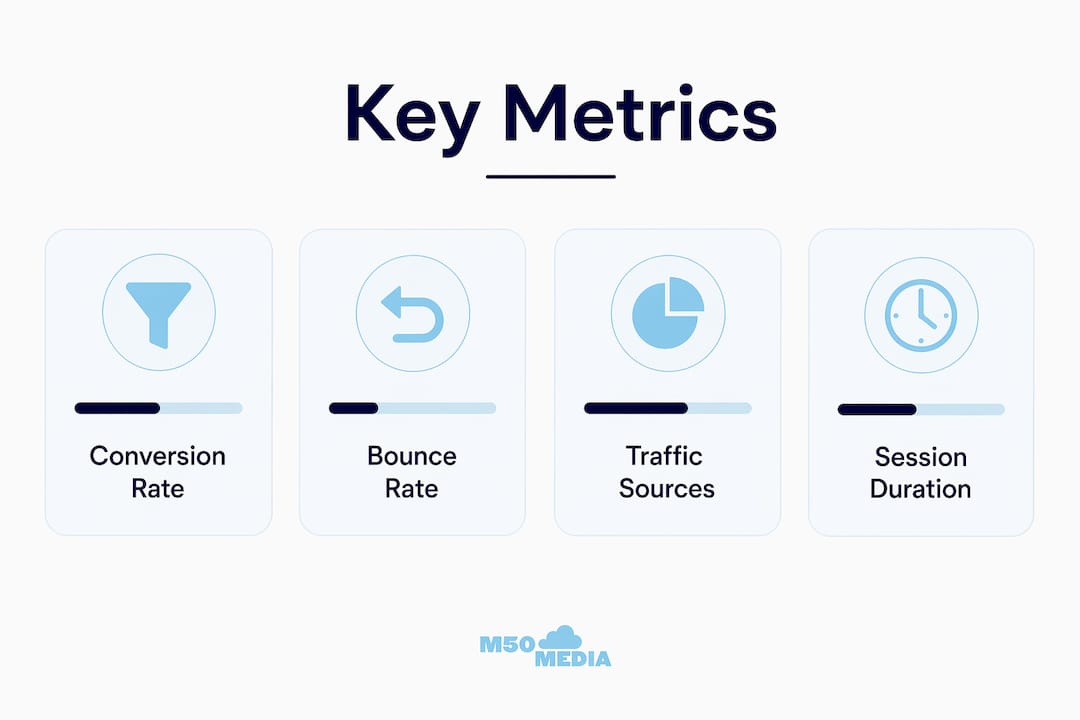
Not all metrics are created equal. Total page views feel satisfying to look at, but they rarely tell you anything useful. Vanity metrics like total page views often obscure real performance. High-actionability metrics like conversion rate by channel and revenue per session are the ones that actually guide decisions.
The most reliable framework for understanding your traffic is the acquisition-behaviour-conversion model. It works like this:
Acquisition asks: where are your visitors coming from? (organic search, paid ads, social media, direct, referral)
Behaviour asks: what do visitors do on your site? (pages visited, time on page, bounce rate, scroll depth)
Conversion asks: did visitors complete a meaningful action? (purchase, form fill, phone call, download)
Volume without intent or conversion signals a mismatch between what visitors expect and what your site delivers. That mismatch costs you money every single day.
Here is a quick look at how different metric types stack up in terms of business impact:
Metric type | Example | Business impact |
Vanity metric | Total page views | Low. Does not indicate quality or intent. |
Behaviour metric | Bounce rate by page | Medium. Reveals content or UX problems. |
Acquisition metric | Traffic by channel | High. Shows where to invest or cut budget. |
Conversion metric | Conversion rate by channel | Very high. Directly tied to revenue outcomes. |
Revenue metric | Revenue per session | Very high. Connects traffic quality to profit. |
Pro Tip: Segment your data by traffic source, device type, and page intent before drawing any conclusions. Site-wide averages mask major drop-offs and engagement problems hiding at specific pages.
How do you interpret traffic data to understand visitor intent?
Reading traffic data well is less about the numbers and more about the story behind them. Visitor intent varies dramatically by channel, and treating all traffic the same is like serving the same meal to someone who ordered a salad and someone who ordered a steak.
Branded organic search visitors typically have higher purchase intent than visitors arriving from broad social ads. Someone who searched your business name already knows you exist and is likely further along in their decision. A visitor from a broad Facebook ad is still in the “just browsing” phase. Knowing this changes how you evaluate your traffic and where you focus your energy.
Bounce rate and session duration both need context to be useful. A high bounce rate on a contact page is a red flag. A high bounce rate on a blog post where someone read the whole article and then left? Totally fine. The metric only becomes meaningful when you attach it to the page type and the goal of that page.
Here are the key signals to watch by channel:
Organic search: Look at which keywords bring visitors and whether those visitors convert. High traffic from informational keywords with zero conversions is normal. High traffic from commercial keywords with zero conversions is a problem.
Paid ads: Monitor cost per conversion, not just click-through rate. Clicks without conversions are expensive decorations.
Social media: Check engagement depth. Did visitors read more than one page? Did they sign up for anything? Social traffic tends to be curious but not always committed.
Direct traffic: This is often your most loyal audience. High direct traffic usually means strong brand recognition.
When page load time increases from 1 to 5 seconds, bounce rates can rise by up to 90%. That is not a UX problem. That is a revenue problem. Slow pages bleed conversions quietly, and most small business owners never connect the two. Pairing your behavioural targeting insights with technical performance data gives you a much clearer picture of what is actually happening.
How to apply traffic insights to improve marketing and conversions
Knowing your data is one thing. Doing something with it is where the real wins happen. Here is a practical sequence for turning traffic insights into results:
Identify your highest-converting channels. Pull conversion rate by channel and rank them. Shift budget toward the top performers before experimenting with new ones. This alone can improve your return on ad spend without spending an extra dollar.
Audit your top landing pages. Find the pages that receive the most traffic and check their conversion rates. If a high-traffic page converts poorly, that is your first priority. A small improvement on a high-traffic page compounds fast.
Fix technical performance issues. Check page load speed, especially on mobile. Given that bounce rates can spike dramatically with slower load times, improving page speed is one of the highest-leverage technical fixes available to small businesses.
Use UTM tagging consistently. UTM parameters are short tags you add to your URLs to track exactly where traffic comes from. Without them, a lot of your paid and social traffic shows up as “direct” in your analytics, making it impossible to measure accurately.
Build a first-party data layer. Perfect attribution is no longer feasible due to privacy tools and ad blockers. The best approach is a measurement layer built on first-party signals, consistent UTM tagging, and conversion tracking. Chasing exact source attribution in 2026 is a losing game.
Prioritise content based on traffic quality, not volume. A blog post that brings 200 highly qualified visitors beats one that brings 2,000 people who bounce immediately. Use customer data insights to understand which content types attract visitors who actually convert.
Modern marketing teams use analytics not just to report results but to predict audience demand and continuously refine their measurement approach. That is the mindset shift that separates businesses that grow from those that plateau.
Key takeaways
Analyzing website traffic is the single most direct way to connect your marketing activity to real business outcomes, and businesses that do it consistently grow nearly three times faster than those that do not.
Point | Details |
Traffic analysis drives growth | Companies that analyze traffic are 2.8x more likely to report year-over-year revenue growth. |
Use the right framework | The acquisition-behaviour-conversion model connects visitor volume to intent and outcomes. |
Ditch vanity metrics | Conversion rate by channel and revenue per session outperform page views as decision-making tools. |
Segment before concluding | Site-wide averages hide critical drop-offs; always segment by source, device, and page type. |
Build for a privacy-first world | First-party data and consistent UTM tagging are the foundation of reliable measurement in 2026. |
What I have learned from years of watching small businesses ignore their own data
Here is something I see constantly: a small business owner spends real money on ads, gets traffic, and then never looks at what that traffic actually does. They check their follower count. They celebrate page views. And then they wonder why sales are flat. It is like checking your car’s paint job instead of the fuel gauge.
The biggest mistake is not ignoring analytics entirely. It is looking at the wrong numbers and feeling productive. I have worked with businesses that were obsessed with their monthly visitor count while their checkout page had a 95% abandonment rate. Blended site-wide conversion rates mask exactly that kind of problem. The moment we segmented by page and device, the issue was obvious and fixable within a week.
My honest advice? Start with one question: “Where are my conversions actually coming from?” Pull that report, rank your channels, and put your energy there first. Everything else is secondary until you know the answer.
The privacy and AI changes reshaping analytics in 2026 are real, but they are not a reason to give up on measurement. They are a reason to build smarter. First-party data, clean tagging, and a clear goal structure will serve you far better than any third-party tracking workaround ever did. Small business owners who embrace this shift now will have a serious advantage over those who wait.
— Karl
M50media can help you make sense of your website data
Knowing you should analyze your traffic and actually knowing how to act on it are two very different things. That gap is exactly where M50media coaching comes in.
Karl Lundgren works directly with small business owners and marketers to build practical, data-driven marketing systems that actually connect to revenue. Whether you want to understand your analytics from scratch or refine a measurement strategy that is already in place, M50media coaching gives you a clear path forward. Not sure where to start? Book a free Marketing SOS call and get a straight answer on what your data is (or is not) telling you. No fluff, no jargon, just real guidance from someone who has done this for a long time.
FAQ
Why analyze website traffic for a small business?
Analyzing website traffic shows you which marketing efforts drive real results and which ones waste your budget. Companies that do it consistently are 2.8x more likely to grow revenue year over year.
What is the best framework for understanding website traffic?
The acquisition-behaviour-conversion framework is the most practical starting point. It connects where visitors come from, what they do on your site, and whether they complete a meaningful action.
What metrics should I focus on when analyzing traffic?
Conversion rate by channel and revenue per session are the highest-value metrics for decision-making. Total page views and follower counts are satisfying but rarely guide useful action.
How does page speed affect website traffic analysis?
Slow pages distort your behaviour metrics and hurt conversions directly. Bounce rates can rise by up to 90% when load time increases from 1 to 5 seconds, making speed a critical factor in any traffic audit.
How do I track traffic accurately in 2026?
Use consistent UTM tagging on all campaigns and build your measurement around first-party data signals. Perfect attribution is no longer achievable due to privacy tools and ad blockers, so focus on directional accuracy over perfect precision.
Recommended
Excelente conteúdo! Gostei da profundidade das informações e da forma acessível como tudo foi explicado. É semper um prazer ler artigos tão bem desenvolvidos. baixar video instagram também pode ser útil para manter vídeos favoritos semper ao alcance.