Why publish white papers: the B2B marketer's guide
- karl7209
- 3 days ago
- 8 min read

TL;DR:
White papers are authoritative, data-driven documents that influence B2B buying decisions and foster trust. They support internal evaluation by providing credible evidence and have a lead lifetime of up to 11 months. Producing a quality white paper requires a strategic approach, longer timelines, and a substantial budget but offers long-term advantages over other content formats.
Publishing white papers is the process of creating authoritative, data-driven documents that educate buyers about complex problems while positioning your organisation as a trusted expert. If you’ve ever wondered why publish white papers when you could just write a blog post or fire off a LinkedIn update, the answer is simple: white papers do something no other content format does quite as well. 71% of B2B buyers rely on white papers to inform purchasing decisions, ranking them second only to case studies among influential content formats. That number alone should make you put down your social media scheduler and pay attention. White papers sit squarely in the middle of the B2B buyer journey, where decisions get made and deals get won or lost.
Why publish white papers? The mid-funnel case
White papers are mid-funnel assets. That distinction matters more than most marketers realise. A blog post builds awareness. A social post sparks a conversation. A white paper does something far more powerful: it gives your internal champion the ammunition they need to convince the other ten people in the room.

Buying committees average 11 people who share and discuss content internally before a purchase decision is made. That is eleven different perspectives, eleven sets of objections, and eleven people who need to feel confident before anyone signs a contract. A white paper travels through that committee like a trusted colleague passing along a recommendation.
The credibility factor is the real secret here. White papers work because they read like research, not like a brochure. When your internal champion shares a white paper with their CFO or their IT lead, it carries weight precisely because it does not sound like marketing. It sounds like evidence.
Here is what a white paper does inside a buying committee:
Gives the champion a credible, shareable document to circulate without looking like they are pushing a vendor
Addresses the technical questions that the analytical members of the committee will ask
Provides the executive summary that the CFO will skim in two minutes flat
Establishes the evaluation criteria before your competitors even get a seat at the table
Pro Tip: Write your white paper so that the champion can forward it without a single word of explanation. If they need to add context, the document is not doing its job.
What are the measurable benefits of white papers?
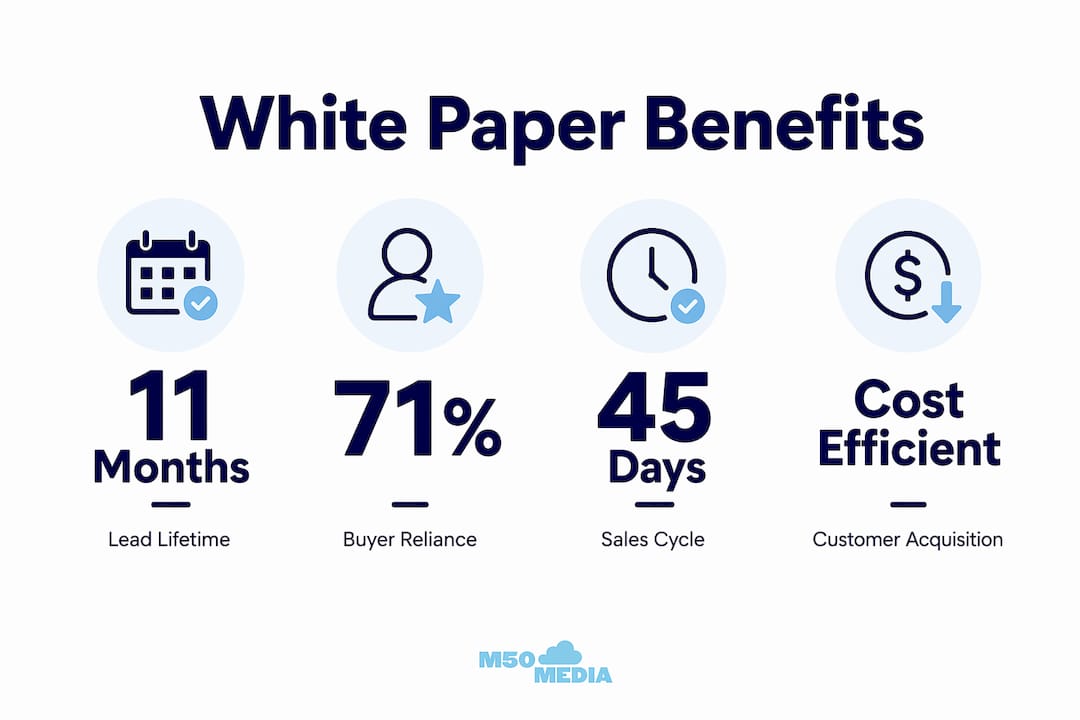
The benefits of white papers go well beyond brand awareness. The numbers tell a story that most content formats simply cannot match.
Effective white papers carry an average lead-generation lifetime of 11 months, far longer than a social media post that disappears from feeds within hours. Think about that for a second. One well-produced document keeps generating leads for nearly a year. Compare that to a paid social campaign that stops the moment you stop paying, and the value of publishing white papers becomes very clear, very fast.
The lead quality argument is equally compelling. Gating a white paper filters out casual browsers and attracts buyers who are actively evaluating solutions. Gating works because white papers offer genuine educational value, not because they are cleverly disguised sales pitches. A reader who fills out a form to download a 2,500-word document on a complex business problem is a very different prospect from someone who clicked a Facebook ad.
Content format | Average lead lifetime | Gating potential | Buying committee reach |
Social media post | Hours to days | Low | Low |
Blog post | Weeks to months | Low | Low |
White paper | Up to 11 months | High | High |
Paid search ad | Active spend only | None | Low |
White papers also build your digital footprint in ways that compound over time. White papers provide AI systems and search algorithms with authoritative content to cite, creating a long-term digital presence that extends well beyond immediate human readership. In 2026, with AI-generated search summaries pulling from credible sources, being that credible source is a genuine competitive advantage.
For sales cycles longer than 45 days, white papers outperform paid search on customer acquisition cost within 90 days. That is a remarkable benchmark. If your average deal takes two months to close, a white paper is likely your most cost-efficient lead generation tool.
How do you build a white paper publication strategy?
A solid white paper publication strategy starts with understanding what the document needs to accomplish and who needs to read it. Spoiler: it is not just one person.
A well-crafted white paper accommodates different readers within a buying committee by delivering tailored content segments within a 20-minute read time. Champions read the full document. CFOs scan the executive summary and case studies. Technical leads go straight for the analytical data sections. Your white paper needs to serve all three without feeling like three different documents stapled together.
Here is a practical framework for producing a white paper that actually works:
Define the problem first. Spend the opening pages educating the reader about the problem, not your solution. Successful white papers avoid product mention until well after explaining the problem and evaluation criteria. Readers who feel sold to early will close the document and never come back.
Set the evaluation criteria. Defining the evaluation framework within a white paper shapes prospects’ criteria for choosing solutions, aligning them with your offering before any product discussion begins. This is strategic positioning at its finest, and it works without a single sales line.
Use original research and real voices. The most effective white papers integrate original customer interviews with real quotes and job titles. That journalistic approach is what separates a credible white paper from a glorified product brochure.
Hit the right length and format. Aim for 5–6 pages or 2,500 or more words. Include an executive summary, an analytical narrative, and a clear call to action. These are not optional extras; they are the structure that makes the document usable for every reader type.
Budget and timeline realistically. Producing a professional white paper typically takes 3 to 5 weeks and costs between $11,000 and $22,000, including writing, design, and interviews. That sounds like a lot until you remember it generates leads for 11 months.
Pro Tip: Pair your white paper with a content marketing strategy that repurposes sections into blog posts, social snippets, and email campaigns. One white paper can fuel months of supporting content.
What are the biggest white paper mistakes to avoid?
The most common mistake is treating a white paper like a top-of-funnel awareness piece. It is not. White papers are mid-funnel assets designed to support buying committee evaluation, not to introduce your brand to cold audiences. Publishing a white paper and then promoting it like a blog post misses the point entirely.
The second biggest mistake is writing a thinly veiled sales brochure and calling it a white paper. Readers see through this immediately, and so does the buying committee. Sales pitch tone early in the paper reduces lead quality and credibility. The moment a reader feels like they are being sold to, the document loses its power as a credible, shareable resource.
A few other pitfalls worth avoiding:
Rushing the production process and publishing generic content that adds nothing new to the conversation
Skipping original research in favour of recycled industry statistics that every competitor is already citing
Forgetting to include a clear call to action, which leaves motivated readers with nowhere to go
Writing for one reader type and alienating the rest of the buying committee
“The white paper that wins deals is the one that makes the champion look smart for sharing it, not the one that makes the vendor look good for writing it.”
The role of blogs in branding is to build awareness and trust over time. White papers pick up where blogs leave off, converting that trust into serious buying conversations. They are two different tools for two different jobs, and confusing them is a costly mistake.
Key takeaways
White papers are the most durable and committee-ready lead generation tool in B2B marketing, outperforming blogs, social content, and paid search across lead quality, shelf life, and buying committee reach.
Point | Details |
Mid-funnel positioning | White papers support buying committee evaluation, not top-of-funnel awareness. |
11-month lead lifetime | A single white paper generates leads far longer than any social or paid format. |
Committee-ready structure | Design for champions, CFOs, and technical leads within one 20-minute read. |
Education before sales | Introduce your product only after establishing the problem and evaluation criteria. |
Budget for quality | Expect 3 to 5 weeks and $11,000 to $22,000 for a professional, credible result. |
Karl’s take: white papers are the long game worth playing
I will be honest with you. When clients first ask me about white papers, their eyes go a little wide when I mention the budget and timeline. Three to five weeks? Eleven thousand dollars? They start doing the mental math and wondering if they should just boost a few posts instead.
Here is what I tell them every time: white papers are not a sprint. They are the content equivalent of planting an oak tree. You do not see the shade for a while, but when it comes, it lasts.
What I have observed over years of working with B2B marketers is that the organisations that invest in quality white papers consistently build stronger pipelines than those chasing short-term content volume. A well-researched white paper with original interviews and a clear evaluation framework does not just generate leads. It shapes how buyers think about the entire category. That is a level of influence that no blog post or paid ad can touch.
The other thing I keep coming back to is the AI angle. In 2026, AI-powered search tools are pulling from authoritative sources to answer buyer questions. If your white paper is that authoritative source, you are getting cited in conversations you are not even in the room for. That is the kind of lead generation that compounds quietly in the background while you sleep.
My honest advice? Stop treating white papers as a “someday” project. If your sales cycle is longer than six weeks and your deals involve more than one decision-maker, a white paper is not optional. It is the most important content investment you can make.
— Karl
M50media can help you get your white paper right
Creating a white paper that actually moves deals forward takes more than good writing. It takes a clear strategy, the right structure, and a deep understanding of your buyer’s world.

At M50media, Karl works directly with business owners and marketers to build content strategies that generate real leads, not just traffic. Whether you need help planning your first white paper or want a full content coaching programme, there is a path forward that fits your goals and your budget. Not sure where to start? Book a free Marketing SOS call with Karl and get a straight answer on whether a white paper is the right move for your business right now. No fluff, no pressure, just practical advice from someone who has seen what works.
FAQ
What is a white paper in marketing?
A white paper is a data-driven, authoritative document that educates buyers about a complex problem and positions the publishing organisation as a trusted expert. It typically runs 2,500 or more words and serves as a mid-funnel asset in B2B marketing.
Why do B2B buyers value white papers so highly?
71% of B2B buyers rely on white papers to inform purchasing decisions because they provide credible, in-depth analysis that supports internal evaluation and stakeholder persuasion within buying committees.
How long does it take to produce a white paper?
A professional white paper takes 3 to 5 weeks to produce and costs between $11,000 and $22,000, covering writing, design, and original interviews. Rushing the process typically results in generic content that fails to generate quality leads.
Should you gate your white paper?
Gating a white paper is effective when the document offers genuine educational value. Readers who submit their contact details to access a substantive white paper are higher-quality leads than those who engage with ungated content.
How is a white paper different from a blog post?
A blog post builds awareness at the top of the funnel. A white paper operates in the middle of the funnel, supporting buying committee evaluation and giving internal champions a credible document to share with sceptical stakeholders.
Recommended
Comments