Why focus on mobile commerce for your business
- karl7209
- Jul 2
- 8 min read

TL;DR:
Mobile commerce accounts for over 60% of global e-commerce sales in 2026 and offers significant revenue potential. Small businesses must focus on mobile-native experiences, fix checkout friction, and integrate omnichannel strategies to maximize conversions. Using features like push notifications, location data, and one-tap payments can substantially boost sales and customer engagement.
Mobile commerce, known in the industry as m-commerce, is the buying and selling of goods and services through smartphones and tablets. It now accounts for around 60% of global e-commerce sales in 2026, generating between $2.4 and $2.82 trillion in revenue worldwide. Smartphones drive 78% of retail traffic, yet mobile web conversion still lags desktop by 18–20 points. That gap represents $280 billion in recoverable revenue sitting on the table. If you run a small or mid-sized business and you’re wondering why focus on mobile commerce matters right now, that number is your answer.
Why focus on mobile commerce: the conversion gap you can’t ignore
The single biggest reason to prioritise m-commerce is the gap between traffic and sales. Smartphones bring the visitors, but your checkout experience decides whether they buy or bounce.

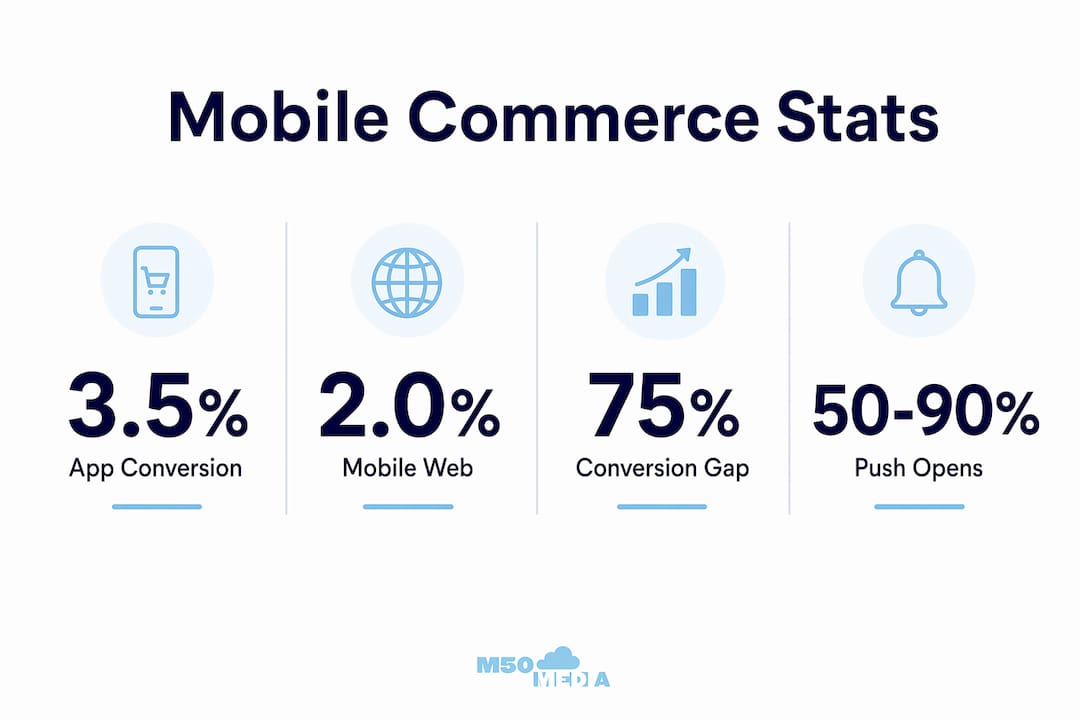
Mobile apps convert at 3.5% compared to 2% for mobile websites. That’s a 75% conversion advantage for apps. Cart abandonment tells an even starker story: app users abandon carts roughly 20% of the time, while mobile browser shoppers abandon at rates between 85% and 97%. That’s not a small difference. That’s the difference between a thriving store and a ghost town.
The revenue implications are real. App users generate 2.8x to 5x higher lifetime value than shoppers who only use mobile web. That retention advantage compounds over time, making every app download worth far more than a single transaction.
So why does mobile web underperform so badly? The friction points are well documented:
Complex, multi-step checkout forms that feel like filing your taxes
Forced account creation before purchase (nobody wants that)
Slow page load times that make shoppers give up and watch Netflix instead
Payment flows not built for mobile, requiring manual card entry
Non-responsive design that makes buttons nearly impossible to tap
These friction sources explain a significant chunk of the conversion gap between mobile web and desktop. The good news is that every one of them is fixable.
Pro Tip: Before investing in a mobile app, audit your mobile website checkout first. Fix the obvious friction points, then build the app on top of a solid foundation.
What mobile features actually drive sales and engagement?
Mobile devices carry capabilities that no desktop can replicate. Using them well is what separates businesses that grow from those that plateau.
Push notifications are the standout example. Push notification open rates run between 50% and 90%, compared to roughly 20% for email. That’s not a marginal improvement. It means a well-timed push about a flash sale or an abandoned cart reaches your customer at a rate email simply cannot match. Americans average 4.5 hours daily on mobile, so the opportunity for product exposure is constant.
Here’s a quick list of mobile-native features that directly support sales:
GPS and location data: Send offers when customers are near your store or a competitor’s location
Camera integration: QR code scanning for instant product info, and augmented reality (AR) for virtual try-ons
Push notifications: Re-engage lapsed customers and recover abandoned carts in real time
Digital wallets and one-tap payments: Apple Pay, Google Pay, and similar tools remove the friction of manual card entry at checkout
Social commerce: Platforms like Instagram and TikTok let customers go from discovery to purchase without ever leaving the app
Social commerce is worth calling out specifically. Mobile devices are where people scroll social feeds, and mobile commerce growth has been turbocharged by the shrinking distance between “I want that” and “I bought that.” When discovery and purchase happen in the same session, conversion rates climb.
Pro Tip: Set up push notification segments by behaviour, not just by product category. A customer who browsed but didn’t buy needs a different message than one who bought last week.
Mobile-native vs. mobile-responsive: why the difference matters
A mobile-responsive website adjusts your desktop layout to fit a smaller screen. A mobile-native experience is built from scratch for how people actually use their phones. These are not the same thing, and treating them as equivalent is one of the most common mistakes small business owners make.
Simply shrinking desktop sites fails to meet mobile user expectations. Thumbs navigate differently than mouse cursors. Attention spans on mobile are shorter. Screens are vertical. A layout designed for a 27-inch monitor will always feel awkward on a 6-inch phone, no matter how well it “responds.”
Building a genuinely mobile-native experience means thinking through these priorities:
Thumb-friendly navigation: Place key actions in the lower half of the screen where thumbs naturally rest
Short-form vertical video: Product demos and testimonials in vertical format outperform horizontal video on mobile feeds
One-tap payment integration: Reduce checkout to as few steps as possible using digital wallets
Minimal form fields: Ask only for what you absolutely need at checkout
Fast load times: Every extra second of load time costs you customers
AI-driven personalisation on mobile, using location data, session behaviour, and purchase history, can boost conversions by 10–15%. That kind of personalisation is only possible when your mobile experience is built to collect and act on that data natively. A responsive website bolted onto a desktop backend rarely has the architecture to pull it off.
Mobile commerce is also a primary data engine for your marketing. Every tap, scroll, and purchase on a well-built mobile experience feeds richer customer profiles. Those profiles power better recommendations, smarter retargeting, and higher average order values over time.
Pro Tip: Web personalisation tools that use real-time behavioural data can significantly lift mobile conversion rates without requiring a full app build. Start there if a native app isn’t in your budget yet.
How does mobile commerce fit into an omnichannel retail strategy?
Mobile doesn’t just live online. It walks into your physical store with your customers. Between 74% and 80% of consumers use their phones inside physical stores to check prices, read reviews, or compare products. That behaviour makes mobile integration a competitive necessity, not a nice-to-have.
An omnichannel retail strategy treats mobile as the connective tissue between your online store, your social channels, and your physical location. When a customer adds something to their cart on their phone during their lunch break and completes the purchase on their laptop that evening, a unified backend makes that feel effortless. Without it, the cart disappears and so does the sale.
Synchronized carts and account data across devices are non-negotiable for this to work. Inconsistency between devices leads to abandonment and erodes trust. Customers who experience a broken cross-device journey rarely give you a second chance.
Here’s how mobile strengthens the omnichannel loop:
Mobile touchpoint | Business benefit |
In-store price checking via app | Keeps customers in your ecosystem instead of a competitor’s |
Push notifications post-visit | Re-engages customers who browsed but didn’t buy |
Loyalty programme via app | Drives repeat visits and builds long-term retention |
Unified cart across devices | Reduces drop-off and closes sales started on mobile |
Location-based offers | Converts foot traffic into purchases in real time |
Mobile web is strongest for discovery and SEO, while mobile apps drive retention and loyalty. Seventy percent of purchases happen through apps despite most product discovery starting on the web. The winning strategy uses both channels intentionally, not interchangeably.
Key takeaways
Mobile commerce is the single largest driver of global e-commerce revenue, and businesses that build mobile-native experiences with unified omnichannel backends will capture the most recoverable revenue in 2026.
Point | Details |
M-commerce dominates e-commerce | Mobile accounts for around 60% of global e-commerce sales, making it the primary sales channel. |
Apps outperform mobile web | Apps convert at 3.5% vs. 2% for mobile web, with cart abandonment as low as 20% compared to up to 97% on browsers. |
Push notifications beat email | Open rates of 50–90% make push notifications your most direct re-engagement tool. |
Mobile-native beats mobile-responsive | Building for mobile from scratch, not just adapting desktop layouts, is what drives real conversion gains. |
Omnichannel integration is essential | Syncing carts, accounts, and data across devices closes the loop between discovery and purchase. |
Karl’s honest take on mobile commerce for small businesses
Here’s something I’ve noticed working with small and mid-sized businesses: most owners know mobile matters, but they treat it like a checkbox. “Yes, our site is mobile-friendly.” Great. So is everyone else’s. That’s table stakes, not a strategy.
The businesses I’ve seen actually grow their mobile revenue are the ones that stop thinking about mobile as a smaller version of their website and start thinking about it as a completely different customer relationship. Your app is not your website on a phone. It’s a direct line to your customer’s pocket, with push notifications, location awareness, and one-tap checkout. That’s a fundamentally different tool.
My advice to any small business owner reading this: fix your mobile web friction first (seriously, go through your own checkout on your phone right now and count how many times you want to quit). Then, once your mobile web converts decently, build toward a native app experience. Don’t skip straight to the app if your mobile web is a disaster. You’ll just be moving the problem to a shinier container.
The other thing I’d push back on is the idea that mobile commerce is just for big retailers. The benefits of mobile shopping apply just as much to a local boutique as to a national chain. A well-timed push notification from a small business feels personal. From a big box store, it feels like spam. That’s your advantage. Use it.
— Karl
How M50media can help you grow with mobile commerce
Mobile commerce growth doesn’t happen by accident. It takes a clear plan, the right tools, and someone who’s actually done it before.

At M50media, Karl works directly with small and mid-sized business owners to build digital marketing strategies that put mobile at the centre. Whether you need help auditing your current mobile experience, mapping out an omnichannel approach, or figuring out where your biggest conversion leaks are, the free Marketing SOS call is the fastest way to get a straight answer. No fluff, no generic advice. Just a real conversation about what’s actually holding your mobile sales back and what to do about it.
FAQ
What is mobile commerce (m-commerce)?
Mobile commerce, or m-commerce, is the buying and selling of goods and services through smartphones and tablets. It accounts for around 60% of global e-commerce sales in 2026.
Why do mobile apps convert better than mobile websites?
Mobile apps convert at 3.5% compared to 2% for mobile web, largely because apps eliminate friction through persistent sessions, one-tap payments, and lower cart abandonment rates of around 20% versus up to 97% on mobile browsers.
How do push notifications help mobile commerce?
Push notifications achieve open rates of 50–90%, far above email’s roughly 20%, making them the most direct tool for recovering abandoned carts and re-engaging customers.
What is the difference between mobile-responsive and mobile-native?
A mobile-responsive site adapts a desktop layout to fit a smaller screen. A mobile-native experience is designed specifically for how people use phones, with thumb-friendly navigation, vertical video, and one-tap checkout built in from the start.
How does mobile commerce support omnichannel retail?
Between 74% and 80% of consumers use their phones inside physical stores to compare prices and read reviews. A unified backend that syncs carts and account data across devices connects the online and in-store experience, reducing drop-off and building customer trust.
Recommended
Comments