How to boost online sales: Practical strategies for small businesses
- karl7209
- Apr 11
- 8 min read

TL;DR:
Most online sales issues stem from understanding customer needs rather than traffic volume.
Optimizing website speed, navigation, and trust signals significantly boosts conversions.
Focus on owned marketing channels like email and SEO for higher long-term ROI.
You’ve got traffic. People are landing on your site, clicking around, and then… vanishing. Like socks in a dryer. It’s one of the most frustrating experiences for a small business owner, and honestly, it’s more common than you’d think. The good news? The gap between “lots of visitors” and “lots of sales” is almost always bridgeable with the right digital marketing moves. This guide walks you through practical, proven strategies to turn those browsing ghosts into paying customers. No fluff, no overnight-success myths. Just real tactics that work.
Table of Contents
Key Takeaways
Point | Details |
Start with research | Understanding your customers and auditing your digital storefront is the first step to more online sales. |
Optimise for conversion | Small changes to site speed, checkout, and trust factors can dramatically raise conversion rates. |
Pick ROI channels | Focus your marketing on email, SEO, and SMS for the highest return on investment. |
Use personalisation and automation | Tailoring your outreach and automating campaigns accelerates sales and builds loyalty. |
Refine continuously | The biggest sales gains come from ongoing testing and minor improvements, not one-off changes. |
Understand your customer and audit your online presence
Here’s a truth that stings a little: most online sales problems aren’t traffic problems. They’re understanding problems. You might be attracting the wrong people, or the right people who can’t figure out what makes you special. That’s where market research and a solid unique selling proposition (USP) come in.
Start by building customer personas. These are semi-fictional profiles of your ideal buyers, based on real data. Think about their age, goals, pain points, and where they hang out online. The more specific, the better. “Sarah, 38, runs a small bakery, shops on her phone during her lunch break, and hates complicated checkouts” is way more useful than “women aged 30-50.”
Once you know who you’re talking to, audit your digital storefront like a detective. Ecommerce optimization covers everything from establishing first-party data to improving site speed, navigation, and unifying your online and offline channels. That’s a lot of ground to cover, so here’s a quick-reference table of tools to help:
Tool | What it audits | Best for |
Google PageSpeed Insights | Site speed | All businesses |
Hotjar | User behaviour and heatmaps | Conversion issues |
Google Search Console | SEO and indexing | Organic traffic |
Semrush | Competitor and keyword gaps | Growing visibility |
Shopify Analytics | Sales funnel and store data | Ecommerce stores |
For a deeper look at marketing advantages online, small businesses that combine market research with local SEO and email outreach consistently outperform those that skip the groundwork. And if you haven’t built a digital marketing plan yet, that’s your very next step.
Here’s what to check during your audit:
Page load time (under 3 seconds is the goal)
Mobile responsiveness on multiple screen sizes
Clear navigation with no dead ends
Visible and compelling calls to action
Checkout process from cart to confirmation
Pro Tip: Run your audit on a mobile device first. Small business online marketing research shows mobile traffic dominates, so if your site is a nightmare on a phone, you’re losing sales before the conversation even starts.
Optimize your website for conversion and user experience
With your foundation in place, it’s time to focus on optimisations that directly influence your customers’ buying decisions at every step.
Page load speed is not just a nice-to-have. It’s a deal-breaker. If your site takes more than three seconds to load, a huge chunk of visitors are already gone (probably rage-clicking their way to a competitor). Fast sites feel trustworthy. Slow sites feel sketchy. It’s that simple.

Navigation matters just as much. Think of your website like a well-organised grocery store. If customers can’t find what they’re looking for in about three clicks, they’re heading for the exit. Keep menus clean, use clear category labels, and make your search bar easy to spot.
Trust signals are your secret weapon. Reviews, money-back guarantees, and secure payment icons (that little padlock!) reassure nervous buyers. Checkout optimisation is a game-changer too. Peepers, an eyewear brand, saw a 30% conversion increase and 20% average order value growth just by streamlining their checkout. One tweak. Massive results.
Personalisation also plays a big role. Showing product recommendations based on browsing history, or saving a customer’s cart for their next visit, makes shopping feel effortless. Holiday ecommerce strategy research confirms that auditing performance, personalising outreach by segment, and aligning inventory with promotions all drive measurable sales lifts.
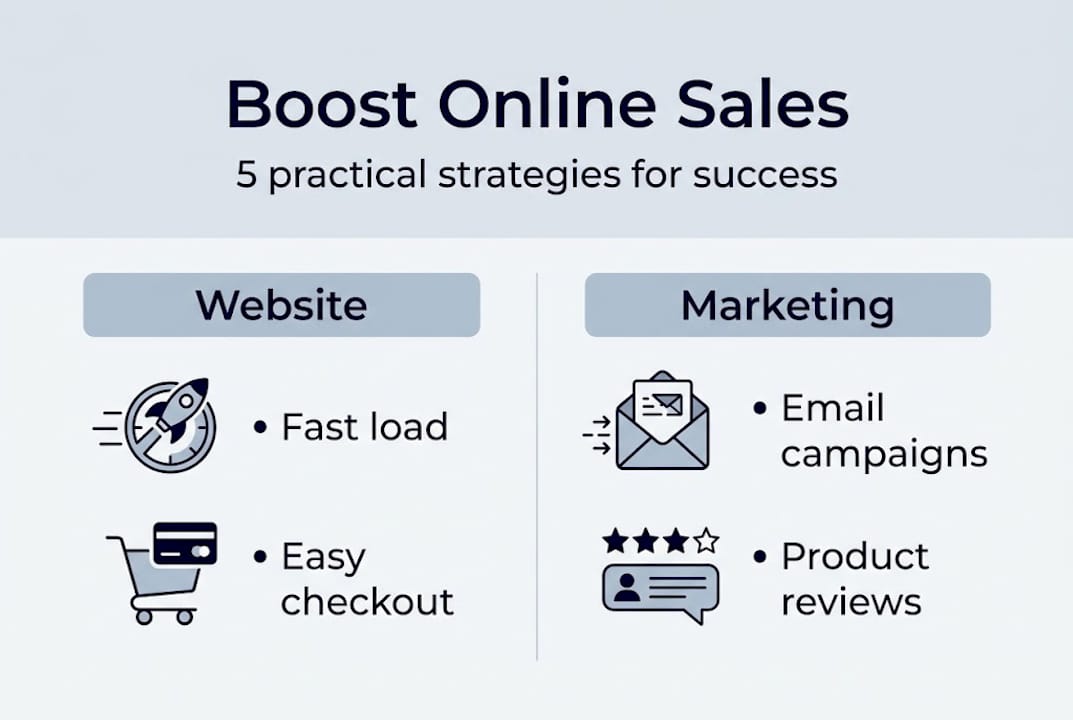
Here’s a snapshot of conversion rate impacts from common site improvements:
Improvement | Estimated conversion lift |
Faster page load (under 2 sec) | Up to 15% |
Simplified checkout (fewer fields) | Up to 35% |
Adding customer reviews | Up to 18% |
Mobile-optimised design | Up to 20% |
Personalised product recs | Up to 10% |
For more on driving organic traffic alongside these improvements, check out SEO strategies for growth and ecommerce marketing essentials.
Pro Tip: Reduce the number of form fields at checkout to the bare minimum. Name, email, shipping address, payment. That’s it. Every extra field is a tiny hurdle that costs you a sale.
Leverage high-impact digital marketing channels
Once your website is primed to convert, accelerating online sales comes down to reaching the right people through the right digital channels.
Not all channels are created equal. Some deliver a return that’ll make your jaw drop. Others will drain your budget faster than a leaky tap. Knowing the difference is everything.
Channel ROI benchmarks for 2026 tell a pretty clear story: email returns $36 to $42 for every dollar spent, SMS delivers $21 to $71, SEO comes in at $7.48, influencer marketing at $5.20 to $5.78, and Google Ads at $2 to $4.50. Owned channels (email, SMS, SEO) outperform paid by 4 to 18 times. That’s not a typo.
Owned channels are your most valuable long-term asset. Building your email list and organic search presence means you’re not renting your audience from a platform that can change its algorithm overnight.
Influencer partnerships are worth a closer look too. Influencer conversion rates average 2.4% to 3.2%, compared to the 1.4% industry average. That’s a meaningful edge, especially for product-based businesses.
Here’s a five-step process to pick and launch your best channel:
Identify where your ideal customer actually spends time online.
Match that platform to the channel ROI benchmarks above.
Start with one owned channel (email is almost always the right first move).
Set a 90-day test period with clear KPIs like click-through rate and conversion rate.
Review results, double down on what works, and layer in a second channel.
For a broader look at effective marketing strategies and how to build out your content marketing strategies, we’ve got you covered on the M50 Blog.
Accelerate growth with personalisation, automation, and creative campaigns
To keep your sales engine running and build loyal customers, it pays to go beyond basics with technology-driven engagement.
Personalisation isn’t just a buzzword. 89% of marketing leaders say it’s key to their success. When you show customers content, offers, and products that actually match their interests, they buy more and come back more often. Average order value goes up. Churn goes down. Everyone wins.
Automation is the sidekick you didn’t know you needed. Set it up once, and it works for you around the clock. Cart abandonment emails alone can recover a significant chunk of lost revenue. Drip email sequences nurture leads who aren’t quite ready to buy yet. Segmented SMS offers hit the right people at the right moment.
Here are some creative campaign ideas to fuel both acquisition and retention:
Run a product quiz that recommends items based on customer answers
Launch a flash sale exclusive to your email subscribers
Create a loyalty rewards programme with points for purchases and referrals
Use retargeting ads to re-engage visitors who browsed but didn’t buy
Partner with a complementary local brand for a co-promotion
Ready to set up your first automated sequence? Here’s how:
Choose your email or SMS platform (Klaviyo and Mailchimp are popular picks).
Map out your customer journey from first visit to repeat purchase.
Write three to five emails for each stage (welcome, nurture, offer, follow-up).
Set triggers based on behaviour, like cart abandonment or a product page visit.
Using reviews strategically within your automated sequences is a smart move. A well-timed review request email after a purchase builds social proof that feeds your next campaign. And as you grow, brand building strategies will help you turn one-time buyers into raving fans.
Monitoring KPIs like conversion rates and organic traffic lets you see what’s actually working, so you’re not just guessing.
Pro Tip: Segment your email list by purchase history or browsing behaviour before sending any campaign. A generic blast to everyone is the marketing equivalent of bringing a fruitcake to a party. Targeted messages convert. Generic ones get ignored.
The often-overlooked truth about boosting online sales
Here’s something the “launch a viral campaign and watch the money roll in” crowd won’t tell you: the biggest online sales wins almost never come from a single blockbuster moment. They come from boring, unglamorous, relentless iteration.
A tweaked subject line. A shorter checkout form. A better product photo. A follow-up email sent two days earlier. These tiny changes, stacked on top of each other, are what actually move the needle over time.
The businesses we see thriving aren’t the ones who went viral once. They’re the ones who tested their checkout flow twelve times, who A/B tested their homepage headline, who noticed a drop-off at step three of their funnel and fixed it. If you ever feel stuck, get expert marketing help to get a fresh set of eyes on what you might be missing.
Track everything. Test one thing at a time. Optimise without mercy. That’s the real playbook.
Take your online sales to the next level with expert help
You’ve now got a solid roadmap for turning your website into a genuine sales machine. But knowing the strategies and executing them confidently are two very different things, and that’s totally okay!
At M50 Media, we specialise in helping small business owners like you cut through the noise and actually implement what works. Whether you’re looking for hands-on business coaching solutions or just want to talk through your biggest marketing challenges, we’re here for it. Book a free marketing SOS call and let’s figure out your fastest path to more online sales together. No pressure, no jargon, just real talk about what will move your business forward.
Frequently asked questions
What are the quickest ways to boost online sales for small businesses?
Focus on site speed and checkout simplification first, then layer in email marketing or retargeting for fast, measurable impact. These changes often deliver results within weeks, not months.
How do I choose the best digital marketing channel for my business?
Start with channels that offer the highest ROI. Email and SEO consistently top the charts, then test influencer or paid ads to see what resonates with your specific audience.
Are websites still important if most sales happen on marketplaces or social media?
Absolutely. A well-optimised website is your home base for building first-party data, capturing leads, and converting visitors on your own terms, without paying a platform a cut of every sale.
Recommended
The emphasis on website navigation and user experience is particularly striking in this discussion. It's interesting how a well-organized site can significantly influence a visitor's decision-making process, much like a well-structured grocery store makes finding items intuitive and quick. I noticed the same thing on a recent exploration of engagement strategies, where concepts like the "girlfriend generator " highlighted the importance of personalizing user experiences to enhance interaction. This parallel reinforces the idea that optimizing for usability can lead directly to improved conversions.