How user generated content boosts trust and engagement

TL;DR:
User generated content is authentic customer-created media influencing 79% of buying decisions.
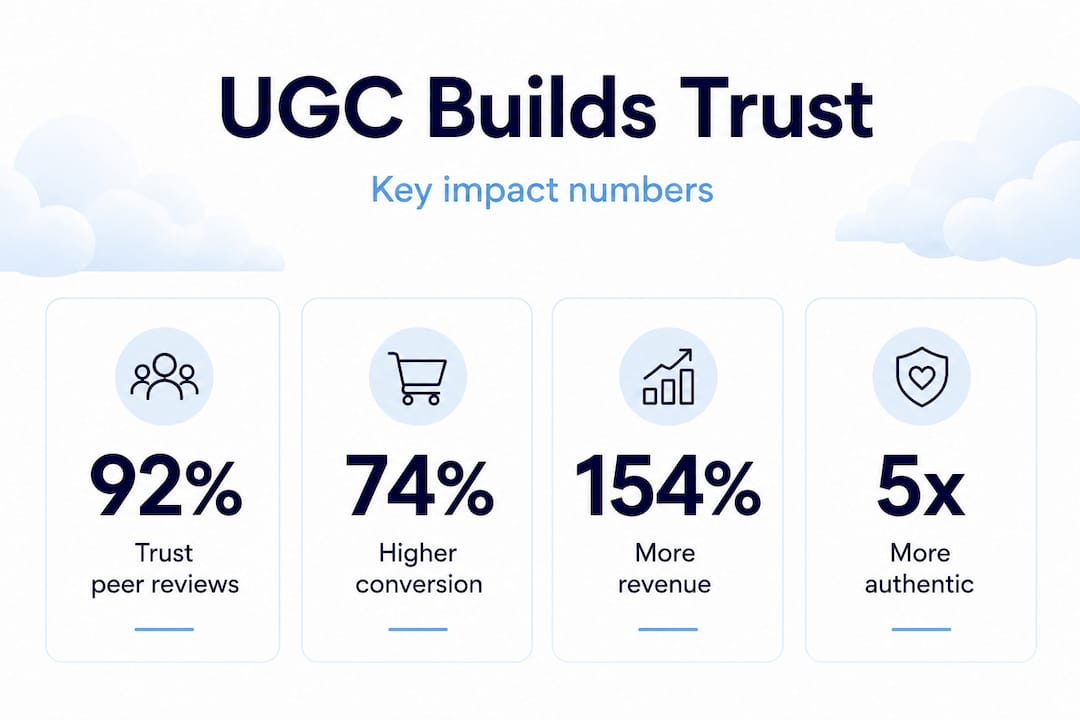
UGC boosts conversions by up to 74% and increases revenue per visitor by 154%.
Building genuine community relationships and respecting permissions are crucial for effective UGC strategies.
Your customers are already creating marketing content for you right now. Seriously. Someone just posted a photo of your product on Instagram, a happy client left a glowing Google review, and somewhere out there a loyal fan filmed an unboxing video that their followers actually trust more than any ad you’ve paid for. Welcome to the world of user generated content (UGC), the marketing goldmine that countless small businesses either completely overlook or barely scratch the surface of. This guide will take you from “wait, what exactly is UGC?” to confidently building a strategy around it.
Table of Contents
Key Takeaways
Point | Details |
UGC defined simply | User generated content is any content created by your customers, such as reviews, photos, and social posts, rather than by your brand. |
Proven impact on sales | UGC can increase conversions by up to 74 percent and is highly trusted during the purchase process. |
Protect your business | Always get permission and moderate UGC to avoid legal issues and build a respectful online community. |
Best uses for small business | Leverage authentic reviews, images, and stories to deepen engagement and trust with your audience. |
What is user generated content?
Now that we’ve set the stage, let’s define exactly what user generated content is and what it looks like in practice.
User generated content is any content such as text, images, videos, reviews, social media posts, or audio created by users or customers rather than the brand itself, often unpaid and reflecting authentic experiences. That’s a mouthful, so here’s the short version: it’s your customers talking about you without you writing the script. And honestly? That’s kind of the magic of it.
Think about the last time you booked a hotel. Did you trust the hotel’s own glossy brochure photos, or did you scroll straight to the TripAdvisor reviews and guest-uploaded pictures? Exactly. We all do it.
Main types of UGC span a surprisingly wide range of formats:
Customer photos and videos on social platforms
Product reviews and star ratings
Testimonials on websites or Google Business Profile
Blog posts written by customers or fans
Q&A forum threads (think Reddit or Quora)
Live streams and unboxing videos
Case studies co-authored with customers
Surveys and responses shared publicly
The beauty here is that UGC is typically unpaid. No budget needed to produce it. Customers create it because they genuinely want to share their experience, which is exactly why it feels so authentic to other potential buyers.
UGC type | Where it lives | Best for |
Product reviews | Google, Amazon, Yelp | Building credibility |
Social media posts | Instagram, TikTok, Facebook | Awareness and reach |
Testimonials | Website landing pages | Conversions |
Unboxing videos | YouTube, TikTok | Product discovery |
Q&A forums | Reddit, brand websites | Educating buyers |
Blog posts | Customer or fan sites | Long-term SEO value |
If you’re building out a broader content marketing strategy for your business, UGC fits in as one of the most powerful and cost-effective layers you can add. It supplements your own content with real voices that your audience genuinely trusts.
Why user generated content works: Impact and trust
With a clear definition in hand, let’s look at the numbers and psychology that make user generated content so powerful.
Here’s a stat that should make your jaw drop (or at least raise an eyebrow): UGC impacts purchasing decisions for a whopping 79% of consumers. That means nearly 8 out of 10 people buying from you were influenced by content your actual customers created. Not your ads. Not your beautifully crafted website copy. Your customers’ words.
But wait, there’s more (yes, we know that sounds like an infomercial, but bear with us). The same research shows that product pages featuring UGC convert 74% higher than those without it. Revenue per visitor jumps by 154%. Web conversions overall climb by 29%. Those aren’t small numbers. That’s the kind of lift most businesses spend thousands in ad spend trying to achieve.
So why does UGC perform so well psychologically? It comes down to social proof. People are wired to look to others when making decisions, especially in unfamiliar situations. It’s the same reason you check Yelp before trying a new restaurant or read Amazon reviews before buying a blender. Real people sharing real experiences are more believable than any polished brand message.
“When real customers speak, potential buyers listen. UGC cuts through the noise because it’s the digital equivalent of a recommendation from a friend.”
Let’s compare UGC to traditional branded content side by side:
Factor | Branded content | User generated content |
Perceived authenticity | Lower | Much higher |
Production cost | High | Minimal |
Consumer trust | Moderate | Very high |
Conversion impact | Standard | Up to 74% higher |
Volume potential | Limited by budget | Scales naturally |
Emotional connection | Controlled | Genuine and relatable |
This isn’t a knock on branded content. You absolutely still need it. But layering in UGC as part of your proven content marketing strategies can dramatically amplify what you’re already doing.
One important thing worth noting: UGC isn’t just about reviews. It’s also about community. When customers see other customers featured by a brand, they feel seen. They feel like they belong to something. And that emotional connection drives loyalty far beyond a single purchase.

If you want to stay ahead of where marketing is heading, keeping an eye on digital marketing trends will show you that UGC continues to grow as a core strategy, not a passing fad.
How businesses leverage user generated content effectively
Understanding the impact of UGC, you may be wondering how your business can successfully encourage and use it in practice.
Great question! And the good news is that encouraging UGC doesn’t require a massive team or a big budget. What it does require is intentionality and a little creativity.
Here’s a practical roadmap to get you started:
Ask for it directly. After a purchase or service interaction, send a follow-up email or text asking customers to share a photo, leave a review, or tag you on social media. A simple, friendly ask goes a long way.
Create a branded hashtag. Give customers a rallying point. A catchy, unique hashtag encourages sharing and makes it easy for you to find and curate UGC across platforms.
Run a contest or giveaway. Invite customers to submit photos or videos for a chance to win a prize. This generates a flood of UGC while creating excitement around your brand.
Feature customers publicly. Repost customer photos (with permission!) on your social accounts or website. When people know they might get featured, they’re more motivated to create and share.
Respond to existing UGC. When customers tag you or leave a review, respond! A simple “thank you, we love seeing this!” signals that you value their contribution and encourages more of it.
Embed reviews on your website. Pull those glowing Google or Yelp reviews directly onto your product pages or homepage. Fresh, real testimonials right where buyers are making decisions? Yes please.
Pro Tip: Don’t just wait for UGC to come to you. Build a simple post-purchase sequence (email or SMS) that actively invites customers to share their experience. Automate it once and let it run. You’ll be amazed at how much content rolls in with minimal ongoing effort.
Now let’s talk about what formats work especially well for small businesses. According to types of UGC that resonate most, reviews and social media posts tend to deliver the biggest bang for your buck, especially when it comes to visibility and conversions.
Some formats to prioritise depending on your goals:
Reviews and ratings: Prioritise Google and industry-specific platforms. These directly influence local search visibility and purchase intent.
Customer photos: Perfect for product-based businesses. Real photos of real people using your product beat stock images every single time.
Video testimonials: These are absolute gold. A short, genuine video content piece from a satisfied customer builds trust faster than almost anything else.
Social media reposts: Share customer posts to your own feed with a genuine caption. It’s community-building in action.
Looking for fresh ideas on how to mix UGC with your broader social presence? Check out these social media post ideas that work brilliantly alongside customer-generated content.
Common mistakes to avoid:
Using UGC without permission (legally risky and just not cool)
Failing to moderate content on your platforms
Cherry-picking only glowing content and ignoring critical feedback
Not crediting the original creator
Letting UGC gather dust instead of actively showcasing it
And for more detailed content marketing tips on making all your content work harder, that resource has a lot of practical firepower for small business owners.
Risks, rights, and moderation: What you need to know
Before launching a UGC campaign, it’s important to consider the risks and how to protect both your business and contributors.
Here’s where things get a tiny bit less glamorous. UGC is brilliant, but it doesn’t come without some real legal and ethical responsibilities. Ignoring these isn’t just a compliance issue. It can damage your reputation and land you in genuinely costly territory.
Reusing UGC without permission is a copyright infringement risk. Even if someone posts a glowing photo of your product publicly on Instagram, that doesn’t mean you legally own it or can freely use it in your ads or on your website. You need to ask. Always.
Beyond copyright, there are other risks to be aware of:
Defamation: Someone may post something about your business that is factually inaccurate and harmful. Having a moderation and dispute process in place protects you.
Privacy violations: Using someone’s image, name, or personal story without consent can violate privacy laws, especially in Canada under PIPEDA and provincial equivalents.
Trademark misuse: Customers might use your trademarked logos or branding in ways that create confusion or misrepresentation.
Negative or harmful content: Not all UGC is sunshine and rainbows. You need moderation policies to handle offensive, misleading, or inappropriate submissions.
DMCA compliance: If your platform hosts third-party content, having a clear Digital Millennium Copyright Act (DMCA) or Canadian equivalent process for takedown requests is essential.
Pro Tip: Create a simple permissions workflow. When you want to repost a customer photo or feature a testimonial, send them a direct message or email asking for explicit permission. Keep a record of that approval. It takes two minutes and saves you enormous headaches later.
Clear terms of service on your website or submission page also help enormously. If you’re running a UGC contest or have a submission form, include clear language about how you might use the content, who retains ownership, and how contributors can withdraw consent.
One more thing worth flagging: moderation isn’t just about legal protection. It’s about brand integrity. Content creation in any form reflects on your brand, including content others create about you. Curating thoughtfully and moderating consistently keeps your brand image aligned with your values.
The overlooked truth about building trust with UGC
Let’s step back and address an often-missed point about UGC that can make or break its effectiveness.
Here’s the uncomfortable reality most marketing content won’t tell you: the majority of businesses treat UGC like a bargain bin version of advertising. They see it as cheap content. “Oh great, a free photo we can post!” They grab it, slap it into a campaign, and move on. And then they wonder why it doesn’t convert.
The brands that truly win with UGC aren’t thinking about it as free ad material. They’re thinking about it as community storytelling. There’s a massive difference.
When you treat a customer’s photo or review as a piece of content to extract value from, you’re missing the entire point. The real magic of UGC happens when you treat every contributor as a brand ambassador. Acknowledge them. Celebrate them. Make them feel like they’re part of something.
Think of it this way: the brands that build fierce loyalty (and we’re talking the kind where customers tattoo logos on their bodies, which is admittedly extreme but you get the idea) aren’t just using UGC. They’re building cultures where sharing is celebrated, contributors are recognised, and community identity runs deep.
The single most important mindset shift? Stop thinking “how can I use this content?” and start thinking “how can I honour the person who created this?” That shift changes everything about how you approach asking for UGC, how you feature it, and how your audience feels when they see it.
You don’t need every piece of UGC. You need the right pieces, featured the right way, with genuine appreciation behind them. That’s what builds the trust that turns one-time buyers into lifelong advocates. And if you want a solid foundation for all of this, effective small business marketing starts with exactly this kind of community-centred thinking.
The brands winning in 2026 aren’t the loudest. They’re the most trusted. And trust is built person by person, story by story.
Need help turning UGC into results? Let us guide you
If everything you’ve just read has your brain buzzing with ideas (and maybe a little overwhelmed), you’re not alone. Building a real UGC strategy takes more than just reposting the occasional Instagram photo. It takes a plan, the right tools, and someone in your corner who knows how to make it all work together.

At M50 Media, we help small business owners and marketers build digital marketing strategies that actually move the needle. Whether you want to launch your first UGC campaign, tighten up your content strategy, or just figure out where to start, our business coaching programme is built for exactly this. Not sure if coaching is for you? Book a Marketing SOS Call and let’s dig into your specific situation together. No fluff, no generic advice. Just real, actionable guidance for your business.
Frequently asked questions
Is user generated content free to use by businesses?
No, businesses must get explicit permission from the creator before using UGC in marketing, since reuse without permission constitutes copyright infringement even if the content is publicly posted.
What are the biggest legal risks with user generated content?
Legal risks include copyright infringement, privacy violations, defamation, and trademark misuse, so always moderate consistently and establish clear terms of service for any UGC you collect or feature.
Does user generated content actually lead to more sales?
Yes, product pages with UGC convert 74% higher and generate 154% more revenue per visitor compared to pages without it, making it one of the highest-impact and lowest-cost strategies available.
What types of user generated content should small businesses focus on?
Focus on customer reviews, social media images, video testimonials, and real customer photos, since images, videos, and reviews consistently drive the strongest trust and conversion results for small businesses.
Recommended
Comments