Inbound marketing: Attract and engage customers online

TL;DR:
Inbound marketing attracts customers through valuable content, SEO, and lead nurturing.
It is a long-term, consistent strategy that builds trust and generates qualified leads.
Success requires patience, data tracking, and focusing on one channel before expanding.
If you think online marketing is just running Facebook ads and crossing your fingers, you’re not alone — but you might be leaving a mountain of opportunity on the table. Most small business owners jump straight to paid ads because it feels like doing something. But there’s a smarter, more sustainable way to grow: inbound marketing. It’s less about chasing customers and more about making them come to you. Sounds like a dream? It’s actually a strategy. Let’s break it all down so you can start putting it to work for your business.
Table of Contents
Key Takeaways
Point | Details |
Inbound attracts not interrupts | Inbound marketing focuses on drawing in your best customers with valuable content rather than pushing messages at them. |
Suits small business budgets | Inbound strategies offer cost-effective ways for small businesses to compete online and build lasting customer trust. |
Combines content and automation | Content creation, SEO, and marketing automation tools work together to attract, nurture, and convert leads. |
Consistency beats quick fixes | Sticking with inbound approaches over time delivers better long-term growth than short-term marketing hacks. |
What is inbound marketing?
Now that we’ve highlighted why not all online marketing is the same, let’s get specific about what inbound marketing actually means for you.
Think of outbound marketing as that one person at a party who interrupts every conversation to hand out business cards. Inbound marketing is the opposite. It’s the person everyone wants to talk to because they share genuinely useful, interesting stuff. People seek them out. That’s the energy we’re going for.
In plain terms, inbound marketing attracts customers by offering them value first — helpful content, useful information, answers to their burning questions — instead of shouting at them with ads they’d rather skip. It pulls people in naturally.
The three core pillars of inbound marketing are:
Content creation: Writing blog posts, filming videos, designing guides, and creating anything that answers your audience’s real questions.
Search engine optimisation (SEO): Making sure the right people can actually find your content when they search online.
Lead nurturing: Building a relationship with potential customers over time, so when they’re ready to buy, you’re the obvious choice.
Here’s a quick look at how inbound and outbound stack up:
Feature | Inbound marketing | Outbound marketing |
Approach | Attracts customers | Interrupts audience |
Cost over time | Lower (builds organically) | Higher (ongoing ad spend) |
Lead quality | Higher (customers seek you out) | Lower (broad targeting) |
Trust building | Strong (value-first) | Weaker (push messaging) |
Examples | Blog posts, SEO, email | Cold calls, paid ads, billboards |
See the difference? Outbound is renting attention. Inbound is earning it. And for a small business with a limited budget, earning it tends to deliver far better long-term returns.
How inbound marketing works: Key channels and strategies
With a clear definition in place, let’s look at how inbound marketing actually plays out for a small business.
The beautiful thing about inbound is that it follows a logical sequence. It’s not random acts of marketing (we’ve all been there). It’s a repeatable process:
Attract: Bring strangers to your website using blog content, SEO, and social media. You’re essentially planting signposts that lead people to your door.
Engage: Once they arrive, give them reasons to stick around and take action — think email sign-ups, free guides, or booking a consultation.
Delight: After they become customers, keep delivering value so they refer others and come back for more. Happy customers are the best marketers you never have to pay.
Here’s a quick breakdown of the main inbound channels and what they do best:
Channel | Primary purpose | Best for |
Blog content | Educate and attract via search | Building authority, driving traffic |
SEO | Help people find you on Google | Long-term organic growth |
Email marketing | Nurture leads over time | Conversions and retention |
Social media | Build awareness and community | Engagement and brand personality |
Lead magnets | Capture contact information | Growing your email list |
Each of these channels works better together than on its own. Your blog drives SEO traffic. SEO gets people to your site. Your lead magnet captures their email. Email nurtures the relationship. It’s a well-oiled machine — once you build it.

One of the biggest game-changers for small business owners is automation. Marketing automation tools can help businesses save time and optimise results, letting you run email sequences, schedule social posts, and segment your audience without manually doing each step. That’s basically hiring a virtual marketing assistant who works 24 hours a day and never complains about Mondays.
Pairing smart automation with solid content marketing strategies is how small businesses punch above their weight. And making sure your site is discoverable through SEO for small business is the foundation underneath all of it.
Pro Tip: Start with one channel and do it really well before spreading yourself thin. Most small businesses find the most traction starting with blogging and basic SEO. Get that humming before you add email automation or paid social.
Inbound vs. outbound: Which is better for small businesses?
Understanding the process is important, but you might be wondering: Is inbound really better than traditional methods like cold calls and paid ads?
Here’s the honest answer: it depends on your timeline, your goals, and your budget. But for most small businesses, inbound wins the long game. Consistently.
Let’s compare them on the stuff that actually matters to you:
Factor | Inbound | Outbound |
Upfront cost | Low to moderate | Can be high |
Time to results | 3 to 6 months | Faster, but short-lived |
Customer trust | High (you gave value first) | Lower (interruption-based) |
Scalability | Grows with your content library | Requires ongoing spend |
Lead quality | Higher intent | Broader, less targeted |
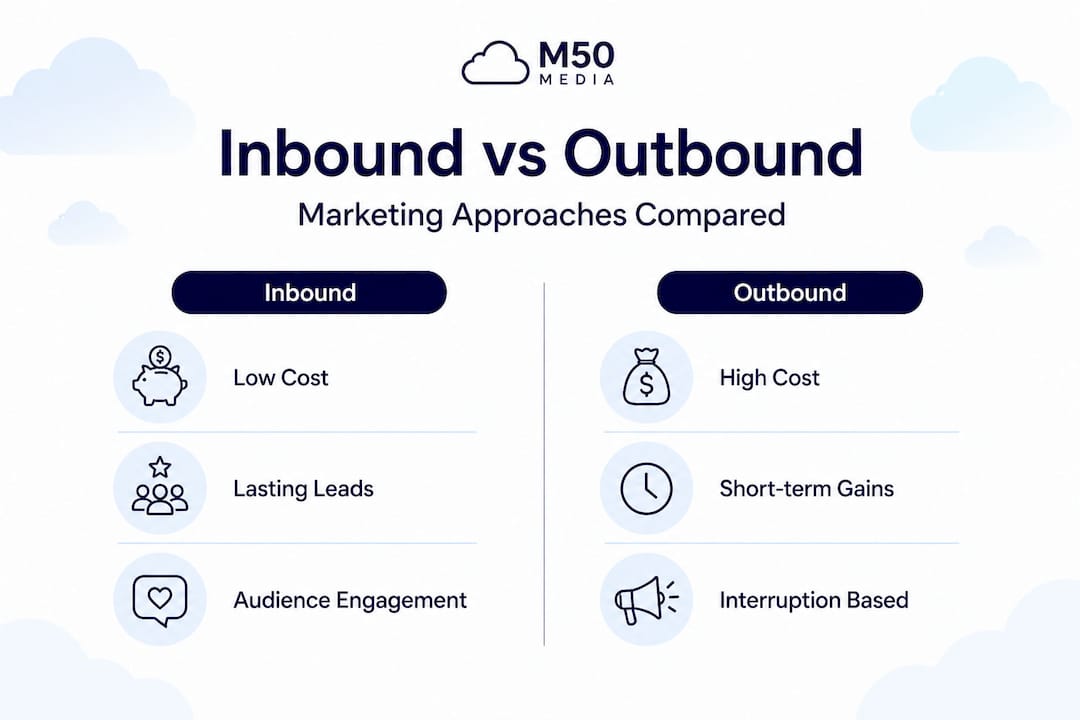
The numbers back this up, too. Inbound marketing generates more qualified leads at a lower cost than outbound. That’s not just theory — it’s the lived experience of businesses that make the shift.
That said, outbound marketing isn’t the villain here. It has its place. If you’re launching a new product and need awareness fast, a well-placed paid ad campaign can give you a quick boost. The mistake most business owners make is treating outbound as a crutch and never building the inbound engine that sustains them long-term.
Think of outbound as a sugar rush and inbound as a balanced meal. One gives you a quick spike, the other keeps you running all day. You might occasionally need a sugar rush, but you can’t live on it.
The pitfall to avoid? Dropping outbound cold turkey before your inbound strategy is generating consistent leads. Transition gradually. Use effective marketing strategies that blend both approaches while you build your content library and SEO presence.
Pro Tip: A good rule of thumb is to start building your inbound presence while keeping a small outbound budget running. Then, as your organic traffic grows, reduce outbound spend and reinvest in content and automation.
For a deeper look at structuring this combination effectively, check out this guide on content marketing for small business. It’ll give you a clearer picture of how to stack your efforts.
Inbound marketing in action: Success stories and practical tips
Still not sure what inbound marketing actually looks like day-to-day? Here are practical, proven ways real small businesses succeed.
Real-world inbound marketing doesn’t require a massive team or a tech stack that looks like the cockpit of a spaceship. Here’s what it can look like in practice:
A local bakery starts writing weekly blog posts about baking tips, seasonal recipes, and behind-the-scenes stories. Within six months, their organic website traffic doubles, and online orders increase because people are finding them through Google searches they never paid for.
A freelance accountant creates a short email course on “five tax mistakes small business owners make.” It builds a list of several hundred ideal clients who already trust her expertise before ever speaking with her.
A fitness studio posts short, educational videos on Instagram answering common questions about workout routines. The content gets shared, grows their following organically, and drives new memberships without a single dollar in paid advertising.
A home renovation company writes detailed project guides that answer the questions homeowners type into Google. Their site starts ranking for local search terms, and leads start coming in without cold calling or flyer drops.
These aren’t Silicon Valley unicorns. These are everyday small businesses that decided to show up consistently with useful content and let it do the heavy lifting.
“Content marketing and SEO are proven to drive organic leads and growth” — and the businesses that commit to the process are the ones who see the compounding results over time.
The common thread in every success story? Consistency. None of these businesses published one blog post and called it a day. They showed up week after week, built trust, and let the content accumulate into a powerful lead-generating asset.
Want to build that kind of library? Start with solid content marketing tips to structure your approach, then expand your creativity with fresh content creation ideas that fit your brand.
Here are a few practical ways to adapt inbound marketing starting today:
Answer one question your customers ask you all the time, in a blog post or video.
Set up a simple email opt-in with a free resource (a checklist, a guide, a mini-course).
Optimise your Google Business Profile so local searches can actually find you.
Post consistently on one social media platform, focusing on education over promotion.
Use a free or low-cost email platform to start nurturing the leads you already have.
None of these require a huge budget. They require intention, a bit of time, and the willingness to keep showing up.
Pro Tip: Repurpose your content! A blog post can become a social media caption, a short video script, an email newsletter, and a podcast talking point. You create it once, and it works in multiple places. Maximum output, minimum extra effort.
The truth most business owners miss about inbound marketing
You’ve now seen the strategies and the examples. But there’s a bigger, often-missed reality about inbound marketing that doesn’t get talked about enough.
Here’s what we see all the time: a business owner gets excited about inbound marketing, spends a weekend setting up a blog and an email list, publishes two posts, and then wonders why the leads aren’t rolling in by Thursday. Sound familiar? (No judgement. We’ve all been there in one form or another.)
The uncomfortable truth is that inbound marketing is not a shortcut. It is, in fact, the opposite of a shortcut. It’s a long game that rewards consistency and punishes impatience. The businesses that treat it like a campaign — a thing you do and then stop — rarely see meaningful results. The businesses that treat it like a channel — something they maintain and build over time — eventually watch it become their number one source of leads.
Another big miss? Ignoring the data. Your analytics are telling you what’s working and what’s not. Which blog posts are getting traffic? Which emails are getting opened? Which pages are people leaving immediately? If you’re not checking, you’re flying blind. And flying blind is a rough strategy for anything other than extreme sports.
The businesses that win with inbound marketing are also the ones who prioritise the right marketing tools for small business to track, automate, and iterate. Tools matter — but only when the commitment to consistency is already there. Tools without strategy are just expensive dashboards.
The final miss? Thinking you need to be everywhere at once. You don’t. Pick the channel where your audience actually spends time, get really good at it, and then expand. Stretching yourself across every platform before you’ve mastered one is the fastest way to burn out and produce mediocre content on all of them. Depth beats breadth, especially in the early stages.
Inbound marketing works. But it works for the businesses that decide it’s worth the long haul. And trust us, it absolutely is.
Unlock inbound marketing for your business
Ready to put inbound marketing strategies into practice? Here’s how to get started quickly with the support you need.
Knowing the theory is one thing. Actually building an inbound engine that generates consistent leads for your specific business is a whole other adventure. The good news? You don’t have to figure it out alone.
At M50 Media, we help small business owners go from “I know I should be doing more marketing” to “My marketing is actually working.” Whether you want a thought partner to help you map out your strategy, or you need someone to point you to the right tools for your situation, we’ve got options. Book a free Marketing SOS Call if you’re feeling stuck and need fast, practical direction. Explore our business coaching support if you want ongoing guidance as you build your inbound presence. Or browse our curated marketing tools recommendations to find the platforms and resources that fit your budget and goals. Your inbound journey starts with one step, and we’ll help you make it a good one.
Frequently asked questions
What makes inbound marketing different from traditional advertising?
Inbound marketing attracts customers by offering useful information and solutions, rather than interrupting them with ads they didn’t ask for. It earns attention instead of buying it.
Is inbound marketing affordable for small businesses?
Inbound marketing can be highly cost-effective since it focuses on building organic traffic rather than paying for every click or impression. The content you create today continues working for you months and years down the line.
What are the first steps to starting inbound marketing?
Start by identifying your ideal customer, creating valuable online content that answers their real questions, and ensuring your website is optimised for search engines so people can actually find you.
How long does it take to see results from inbound marketing?
Results vary based on your industry and consistency, but many small businesses begin noticing increased website traffic and leads within 3 to 6 months of sustained effort. The compounding effect means results keep improving over time.
Recommended
Comments