Unlock programmatic advertising for small business growth

TL;DR:
Programmatic advertising is an accessible, automated approach that allows small businesses to target audiences precisely and compete with larger brands. It offers cost-effective, scalable ad buying with real-time data and optimization, but requires ongoing human oversight to manage risks like fraud and privacy compliance. Starting small, monitoring results, and staying engaged are key to leveraging its growth potential effectively.
You’ve probably heard the phrase “programmatic advertising” and thought it sounded like something reserved for massive corporations with bottomless marketing budgets and entire floors of data scientists. Fair enough! But here’s the thing — that assumption is doing your small business no favours. Programmatic advertising has quietly become one of the most accessible and powerful tools available to small and medium businesses, and if you’re not at least curious about it, you might be leaving serious growth on the table.
Table of Contents
Key Takeaways
Point | Details |
Automated ad buying | Programmatic advertising automates ad placements for smarter targeting and cost savings. |
Key benefits for SMBs | Small businesses can achieve efficient, data-driven marketing once reserved for big brands. |
Challenges to watch | Risks include complexity, minimum spends, and the need for oversight to avoid wasted budget. |
Start small, scale up | Begin with clear goals and limited spend, then optimize as you learn what works. |
Support accelerates success | Expert guidance helps business owners navigate programmatic advertising with less risk and better results. |
What is programmatic advertising?
Let’s start from the beginning, because nobody should feel lost here. Programmatic advertising is simply the automated process of buying and placing online ads in real time. Instead of calling up an ad rep, negotiating rates, and waiting days for your banner to go live, software does the heavy lifting. It analyses data, targets the right audiences, and places your ads across websites, apps, and platforms almost instantly.
Think of it like a super-smart auctioneer working on your behalf 24/7. Every time someone loads a webpage, a lightning-fast auction happens in the background. Programmatic software bids for the ad slot on your behalf, and if you win, your ad appears. The whole thing takes milliseconds. It’s genuinely kind of wild.
Here’s a quick look at the main types of programmatic ads you can run:
Display ads (those banner-style visuals on websites)
Video ads (pre-roll, mid-roll, and everything in between)
Social media programmatic placements
Native ads (content-style ads that blend into a page)
Connected TV and streaming ads
One of the biggest advantages of this system is how it connects digital ads and small business growth in a way that used to require a much bigger team and budget. The system learns as it goes, optimising your spend based on what’s actually working.
“Programmatic advertising enables SMB efficiency and competition against larger brands, but comes with real risks including complexity, minimum spends, fraud, privacy regulations like GDPR and CCPA, and over-reliance on automation without proper oversight.”
So yes, there are trade-offs. But knowing what they are upfront puts you in a much stronger position. More on that shortly.
The benefits of programmatic advertising for small businesses
Here’s where things get exciting. 🎉 Programmatic advertising isn’t just a “nice to have” for businesses with deep pockets. When used thoughtfully, it can genuinely level the playing field between you and the big guys.
Let’s look at the core benefits:
Cost-effective ad buying. Because you’re bidding in real time and only paying when the conditions are right, there’s far less wasted spend than with traditional ad placements. You’re not paying for eyeballs that will never become customers.
Laser-sharp audience targeting. You can target by age, location, interests, browsing behaviour, device type, time of day, and more. Want to reach millennial parents in Toronto who browse home improvement sites on Saturday mornings? Done.
Better data and reporting. Programmatic platforms give you detailed performance data so you can make smarter decisions. No more guessing whether your ad spend was worth it.
Scalability. Start small, test your creative, and scale up what’s working. You don’t need to commit a massive budget to see meaningful results.
Compete with bigger budgets. The targeting precision means you can outmanoeuvre larger competitors by reaching the right people instead of just more people.
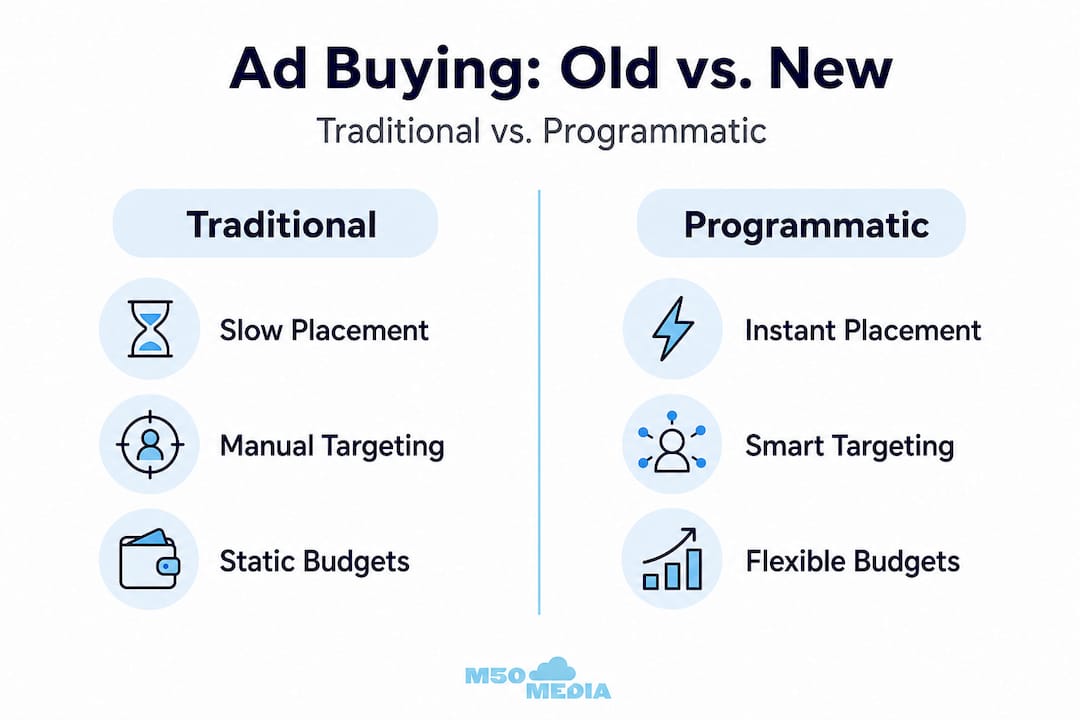
Here’s a quick comparison of how programmatic stacks up against traditional digital ad buying:
Feature | Traditional ad buying | Programmatic advertising |
Speed of placement | Days to weeks | Milliseconds |
Audience targeting | Broad, site-based | Highly specific, behaviour-based |
Budget flexibility | Often fixed, large minimums | Flexible, scalable |
Reporting | Limited | Detailed, real-time |
Optimisation | Manual, slow | Automated and continuous |
Pretty compelling, right? The digital advertising guide for small businesses digs even deeper into how these mechanics work. And if you want to understand the broader picture, exploring online marketing advantages can give you a solid foundation before diving into programmatic specifically.
The research backs this up too. SMB efficiency gains through programmatic are well-documented, with small businesses reporting better ROI when they approach it strategically rather than reactively. If you’re already exploring paid advertising benefits, programmatic is the natural next level.
Pro Tip: Start with a single ad format and one audience segment. Resist the urge to do everything at once. Run a small test, gather data for two to four weeks, then make informed decisions about where to invest more.
Challenges and risks: What to watch for
Okay, let’s keep it real. Programmatic advertising isn’t all sunshine and perfectly targeted banner ads. There are genuine challenges, and going in with eyes wide open is part of what makes the difference between success and a frustrating experience.
Here are the main risks to be aware of:
Steep learning curve. The platforms can be complex for beginners, with a lot of terminology and settings to wrap your head around.
Minimum spend requirements. Some demand side platforms (the software used to manage programmatic buying) require minimum monthly budgets that can be tough for very small operations.
Ad fraud. Bots and invalid clicks are a real issue in the programmatic space. You could end up paying for clicks that aren’t from real humans.
Privacy regulation compliance. Between GDPR in Europe and CCPA in California (plus Canada’s own PIPEDA), data privacy rules affect how you can target audiences. Getting this wrong could be costly.
Over-automation trap. Setting up a campaign and walking away is tempting, but without regular human oversight, you can burn through budget without realising it.
Here’s an honest side-by-side look at the trade-offs:
Efficiency gain | Associated risk |
Automated, real-time bidding | Less human control over placements |
Audience targeting precision | Privacy regulation compliance required |
Scalable ad spend | Minimum budgets can limit very small businesses |
Detailed reporting | Data can be overwhelming without context |
Continuous optimisation | Fraud can inflate performance metrics |
The risks of automation without oversight are real, but they’re manageable. Think of programmatic like your car’s GPS. It’ll get you there faster and more efficiently, but you still need to keep your hands on the wheel and your eyes on the road.

Building a solid multichannel strategy alongside your programmatic efforts helps reduce over-reliance on any single channel. And combining smart targeting with strong branding strategies ensures your ads actually resonate once they reach the right people.
Pro Tip: Set a hard daily and monthly budget cap before you launch anything. Check your campaign dashboard at least three times per week, especially in the first month. It’s like checking your bank account — you want to know before things go sideways, not after.
How to get started with programmatic advertising
So you’re intrigued and maybe a little less intimidated. Fantastic! Here’s a practical step-by-step approach to get you moving without overwhelming yourself.
Define your goals and audience. What do you want the ads to do? Drive website visits? Generate leads? Build brand awareness? Knowing your goal shapes everything else. Map out who your ideal customer is — their demographics, interests, online behaviours, and preferred devices.
Research platforms suited to small budgets. Not all programmatic platforms require enterprise-level spending. Options like Google Display Network, The Trade Desk, StackAdapt, and even some social media platforms use programmatic mechanics and allow smaller minimum spends. Compare them and choose one to start.
Create compelling ad creative. Your targeting can be perfect, but a boring or confusing ad won’t convert anyone. Invest time in creating clear, visually appealing ads with a single, obvious call to action. Test two or three variations.
Set clear KPIs before you launch. KPIs (key performance indicators) are the measurable metrics you’ll use to judge success. Think click-through rate, cost per lead, conversions, or return on ad spend. Having these defined upfront means you can make data-driven decisions instead of gut-feel guesses.
Launch, monitor, and adjust. Don’t just set it and forget it. Check in regularly, review what the data tells you, and make small adjustments. Pause underperforming creative, test new audiences, and shift budget toward what’s working.
Scale gradually. Once you’ve got a combination that’s delivering solid results, increase your spend incrementally. Jumping from $200 to $5,000 a month based on a two-week test is a recipe for panic. Build confidence with your data first.
Building a strong marketing plan for small business before you launch programmatic campaigns is genuinely valuable. It gives your ad strategy context and keeps your spending connected to actual business goals. Also worth noting: AI in marketing is increasingly baked into programmatic platforms, doing things like predicting audience behaviour and optimising bid strategies automatically. This means even solo operators can access sophisticated tools that were previously available only to agencies.
The key insight from programmatic best practices for SMBs is to treat your first campaign as a learning investment, not a revenue-generating machine. Lower expectations, collect data, and build from there.
Pro Tip: Most platforms offer onboarding support, tutorials, or even account reps for new advertisers. Use them! There’s no award for figuring it all out on your own, and getting proper guidance early saves you money and frustration.
A fresh perspective: What most small businesses miss about programmatic advertising
Here’s an honest truth that doesn’t get said enough: the technology is not the hard part.
Most small businesses who struggle with programmatic advertising don’t fail because of the platform or the budget. They fail because they treat automation like a vending machine. Put money in, get results out. That’s not how it works, and it’s not how any of this works, really.
The businesses that genuinely win with programmatic advertising share one characteristic: they stay engaged. They check their dashboards, they tweak their audience segments, they test new creative, and they actually read the data instead of just glancing at it. Automation handles the speed and scale. Humans handle the strategy and common sense.
There’s also a mindset shift that needs to happen around what “small budget” actually means in programmatic. You don’t need $10,000 a month. Some campaigns deliver excellent learning and even meaningful results starting at a few hundred dollars. The goal at first isn’t to crush it — it’s to understand your audience better and find what resonates. That knowledge is worth more than any single campaign result.
Another thing that gets overlooked: creative quality matters enormously. Programmatic can put your ad in front of the perfect person at the perfect moment, but if the ad itself is dull, confusing, or off-brand, the whole machine breaks down. Think of targeting as getting you the meeting, and creative as what you say when you walk in the door.
Keeping up with marketing trends for business success also ensures your programmatic strategy doesn’t live in a vacuum. Audience behaviour shifts, platforms update their algorithms, and privacy laws evolve. Staying informed means you adapt rather than scramble.
The big takeaway? Automation is your co-pilot, not your replacement. Keep your hands on the wheel, stay curious, and treat every campaign as a conversation with your audience rather than a transaction.
Take your next step with expert guidance
Programmatic advertising can feel like a lot to take on solo, especially when you’re already wearing twelve different hats as a small business owner. The good news is, you don’t have to figure it all out by yourself. 🙌
At M50 Media, we specialise in making digital marketing genuinely approachable for small businesses. Whether you want to explore tailored business coaching services, book a focused digital coaching session to map out your programmatic strategy, or just need someone to talk through your options with, we’ve got you covered. Not sure where to start? Book a free marketing SOS call and let’s figure out the smartest next move for your specific business. No jargon, no pressure, just practical guidance that actually moves the needle.
Frequently asked questions
Is programmatic advertising worth it for my small business?
Programmatic advertising can unlock efficiencies and targeting previously available only to large brands, but it requires careful management to avoid wasted spending. For most small businesses, starting small and measuring results carefully is the smartest approach.
How much does programmatic advertising cost for a small budget?
Minimum spends and hidden fees vary by platform, but several options cater to smaller advertisers with flexible budgets. Keeping a close eye on your campaign and optimising regularly is what keeps costs under control.
What’s the biggest risk if I try programmatic advertising alone?
Over-relying on automation without regular human oversight is the most common way small businesses waste budget, whether through poor targeting, irrelevant placements, or ad fraud. Checking in consistently makes all the difference.
Can programmatic advertising help me compete with larger brands?
Absolutely! Programmatic’s efficiency gains for SMBs mean you can reach precisely the right audiences without needing a massive media budget, effectively levelling the playing field against much larger competitors.
Recommended
Comments