SaaS marketing strategies to grow your business in 2026

TL;DR:
SaaS marketing focuses on building lasting customer relationships and reducing churn.
Key metrics like LTV, CAC, churn, and NRR guide growth and retention strategies.
Long-term SaaS success depends on prioritizing retention and personalized customer experience.
SaaS marketing isn’t just regular digital marketing with a fancy new name badge. It’s a whole different animal, and if you’ve been treating it like a standard product launch, that might explain a few things. Unlike selling a one-time product, SaaS marketing is about building relationships that last, reducing churn, and maximising recurring revenue month after month. A healthy LTV:CAC ratio of at least 3:1 is the benchmark that separates thriving SaaS businesses from the ones quietly bleeding subscribers. Stick around, because we’re about to break down the metrics, tactics, and frameworks that actually move the needle.
Table of Contents
Key Takeaways
Point | Details |
Understand SaaS basics | SaaS marketing is defined by recurring revenue, retention, and customer-centric strategies. |
Track core metrics | LTV, CAC, churn, and NRR are crucial for evaluating SaaS success and guiding strategy. |
Use actionable tactics | Effective SaaS marketing covers acquisition, onboarding, engagement, and retention tactics. |
Optimize continuously | Regular measurement and iteration ensure ongoing improvement and sustainable growth. |
Understanding SaaS marketing fundamentals
So, what exactly is SaaS marketing? Think of it this way: traditional software marketing is like selling someone a really nice blender. They buy it once, take it home, and you’re done. SaaS marketing is more like a smoothie subscription service. You’ve got to keep them coming back every single month, which means your job never really stops.
SaaS (Software as a Service) products are delivered via the cloud on a subscription basis. That changes everything about how you market them. You’re not just convincing someone to make a purchase. You’re convincing them to stay.
Here’s what makes SaaS marketing genuinely unique:
You’re selling ongoing value, not a one-time transaction
Customer retention is just as important as customer acquisition
Churn (the rate at which customers cancel) is your enemy number one
Recurring revenue means your marketing ROI compounds over time
Free trials and freemium models are common conversion tools
The core challenges? Retention, churn, and protecting that sweet recurring revenue. Monthly churn for SMB SaaS ranges from 3 to 7%, which sounds small until you do the math and realise you could be replacing your entire customer base every year.
“SaaS marketing without a retention strategy is like filling a bathtub with the drain open. You can keep pouring in leads, but you’ll never actually fill it up.”
For small businesses, the essential objectives are clear: attract the right customers, convert trials into paid subscribers, and keep those subscribers happy enough to stay (and ideally, upgrade). Exploring multichannel marketing strategies can help you reach potential subscribers across multiple touchpoints before they even hit your free trial page. And if you need a solid foundation, brushing up on digital marketing strategies is always a smart move. Not sure where to start? A quick marketing SOS call can help you figure that out fast.
Key SaaS metrics: LTV, CAC, churn, and NRR explained
Okay, let’s talk numbers. Not in a scary spreadsheet way, but in a “these four metrics will literally tell you if your business is healthy” kind of way. Ready? Let’s go.
LTV (Lifetime Value) is how much revenue a single customer generates over their entire relationship with you. CAC (Customer Acquisition Cost) is how much you spend to land that customer. The ratio between these two tells you whether your marketing is actually profitable.
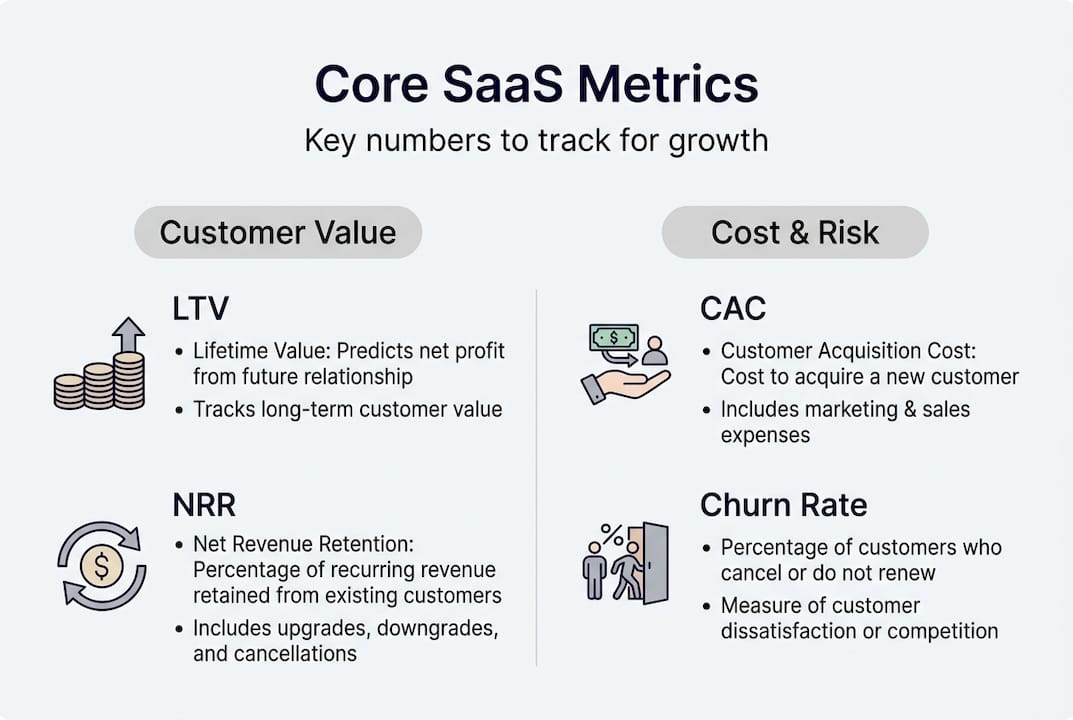
Here’s a quick reference table to keep things straight:
Metric | What it measures | Healthy benchmark |
LTV:CAC ratio | Revenue vs. acquisition cost | Minimum 3:1 |
CAC payback period | Months to recover acquisition cost | 12 to 18 months |
Monthly churn rate | Subscriber cancellation rate | 3 to 7% (SMB) |
NRR (Net Revenue Retention) | Revenue retained and expanded | Over 110% (best-in-class) |
Marketing spend | % of revenue invested in marketing | 20 to 50% of revenue |
These SaaS industry benchmarks aren’t just nice-to-know trivia. They’re the compass that tells you whether to double down or pivot.
NRR deserves a special shoutout here. Net Revenue Retention measures how much revenue you’re keeping (and growing) from your existing customer base. An NRR above 110% means your existing customers are actually spending more over time, which is the SaaS equivalent of finding money in your winter coat pocket. Every month.
Pro Tip: If your LTV:CAC ratio is below 3:1, don’t panic and throw more money at ads. First, look at your churn rate. Fixing retention is almost always cheaper than increasing acquisition spend.
Using a solid marketing analytics guide can help you set up dashboards that track these metrics without needing a data science degree. Seriously, you’ve got enough on your plate.
Effective SaaS marketing tactics: From acquisition to retention
Now we’re getting to the good stuff. You’ve got the foundation, you know your metrics, so let’s talk about what you actually do to grow.
Here’s a practical sequence for building your SaaS marketing engine:
Define your ideal customer profile (ICP) before spending a single dollar on ads
Create educational content that solves the exact problems your ICP faces
Drive traffic to a high-converting free trial or freemium offer
Build an onboarding sequence that gets users to their “aha moment” fast
Use email automation to nurture trial users toward paid conversion
Collect reviews and testimonials to build social proof
Implement upsell and expansion campaigns for existing customers
Here’s a reality check on conversion numbers: visitor-to-lead conversion averages just 2.4%, and trial-to-paid conversion ranges from 2 to 25% depending on your onboarding quality. That’s a massive range, and the difference is almost always the onboarding experience.

Let’s compare the main acquisition channels:
Channel | Best for | Avg. cost | Speed |
Content marketing | Long-term organic growth | Low | Slow |
Email marketing | Nurturing and retention | Very low | Medium |
Paid social/search | Fast acquisition | High | Fast |
Review platforms | Trust and social proof | Low | Medium |
Video content | Education and engagement | Medium | Medium |
Content marketing is the long game that pays off like a solid RRSP (you won’t see the results overnight, but future-you will be thrilled). Check out these content marketing tips to build a strategy that actually attracts the right leads. For a deeper look, this content marketing guide covers how content can drive serious lead volume. And if you haven’t explored video content for growth yet, you’re leaving engagement on the table.
Pro Tip: Your onboarding sequence is your single highest-leverage retention tool. If users don’t experience value within the first 7 days, most of them won’t come back. Map out every touchpoint in that first week.
Measuring and optimising your SaaS marketing efforts
You can’t improve what you don’t measure. (Yes, that’s a bit of a cliché, but it’s also just true, so we’re keeping it.) The good news is that SaaS businesses have more measurable data than almost any other business model. The challenge is knowing which numbers actually matter.
Here’s what to track consistently:
Monthly Recurring Revenue (MRR) growth rate
Customer Acquisition Cost (CAC) by channel
Trial-to-paid conversion rate
Monthly and annual churn rates
Net Revenue Retention (NRR)
Customer satisfaction scores (CSAT or NPS)
Marketing spend in SaaS often ranges from 20 to 50% of revenue, with payback targets of 12 to 18 months. That’s a significant investment, which is exactly why tracking ROI by channel is non-negotiable.
For tools, you don’t need to start with an enterprise-level stack. Google Analytics 4, a CRM like HubSpot, and your SaaS platform’s built-in analytics can get you surprisingly far. The key is setting up your dashboards before you need them, not after you’re already in crisis mode.
A/B testing is your best friend here. Test your trial signup page headlines. Test your onboarding email subject lines. Test your upgrade prompts. Small improvements compound fast when you’re dealing with recurring revenue. A 1% improvement in trial-to-paid conversion can translate into thousands of dollars in additional MRR over a year.
Pro Tip: Set a monthly “metrics review” date in your calendar. Treat it like a non-negotiable meeting. Reviewing your numbers consistently is what separates reactive marketing from strategic marketing.
Avoid the common mistake of measuring vanity metrics like page views or social media followers instead of conversion and retention data. Your content marketing strategy should tie directly to measurable outcomes. For real-world inspiration, content marketing examples show how small businesses connect content to conversions. And a strong social media marketing guide will help you focus your social efforts on channels that actually bring in subscribers.
What most people miss about SaaS marketing
Here’s the uncomfortable truth that most SaaS marketing articles won’t tell you: obsessing over acquisition while ignoring retention is one of the most expensive mistakes you can make. It’s like trying to win a marathon by sprinting the first kilometre and then wondering why you’re face-down on the pavement by kilometre three.
The businesses that win long-term are the ones laser-focused on NRR. When NRR exceeds 110%, it signals that existing customers are not just staying but actively spending more. That’s the kind of growth that doesn’t require you to constantly refill the top of the funnel.
Small SaaS businesses actually have a real advantage here. You can personalise customer touchpoints in ways that enterprise competitors simply can’t. Automation tools let you send targeted, behaviour-based emails that feel genuinely helpful rather than robotic. That personal touch is your secret weapon.
The pitfall? Pouring budget into acquisition channels before your customer experience is solid. Get your onboarding, support, and product communication right first. Then scale acquisition. These marketing tips reinforce exactly that kind of customer-first thinking.
Accelerate your SaaS growth with expert support
You’ve just absorbed a serious amount of SaaS marketing knowledge, and honestly? That’s impressive. But knowing the frameworks and actually implementing them are two very different things (kind of like knowing how to parallel park in theory versus doing it on a busy street in downtown Toronto). 😄
That’s where M50 Media comes in. Whether you need help building your SaaS marketing strategy from scratch, optimising your metrics, or just figuring out where to start, Karl Lundgren and the M50 team have you covered. Explore SaaS business coaching tailored specifically for small businesses ready to scale smart. Or skip the guesswork and book a free marketing SOS call to get personalised guidance on your biggest marketing challenges. Your next level of growth is closer than you think.
Frequently asked questions
How does SaaS marketing differ from traditional software marketing?
SaaS marketing focuses on recurring subscriptions and retention, not one-time purchases, meaning your marketing efforts never really stop after the initial sale. Keeping customers engaged and reducing churn are just as critical as acquiring new ones.
What is a healthy LTV:CAC ratio for SaaS businesses?
A healthy SaaS business targets an LTV:CAC ratio of at least 3:1, with best-in-class companies reaching up to 5:1. Anything below 3:1 usually signals that either acquisition costs are too high or customer lifetime value needs improvement.
What is a typical customer acquisition cost for small business SaaS?
B2B SaaS CAC averages $1,200, with self-serve platforms typically ranging from $100 to $500 and enterprise SaaS climbing from $2,000 to $5,000. Knowing your CAC by channel helps you allocate budget where it actually pays off.
How much should SaaS businesses spend on marketing?
Successful SaaS companies typically dedicate 20 to 50% of revenue to marketing, aiming for a CAC payback period of 12 to 18 months. The exact percentage depends on your growth stage and how aggressively you’re targeting new markets.
Recommended
Comments