Copywriting builds strong brands: 5 proven strategies

TL;DR:
Words are the key to building trust, emotional connection, and brand recognition.
Effective copywriting uses customer language, storytelling, and consistency to stand out.
Prioritizing strategic messaging before visuals creates cohesive, memorable branding.
Your logo is not your brand. Shocking, right? Most small business owners pour their hearts (and budgets) into beautiful visuals, sleek colour palettes, and perfectly chosen fonts. And honestly, that stuff matters. But here’s the thing nobody tells you at the start: words are doing the heavy lifting. Copywriting is the hidden engine behind brands you love, trust, and remember. It’s the reason you feel something when you read a tagline, and why some businesses just seem to “get” you. This guide breaks down exactly how effective copywriting shapes your brand identity, builds customer loyalty, and makes your marketing actually work.
Table of Contents
Key Takeaways
Point | Details |
Copy shapes brand identity | The words you choose form the foundation of how customers perceive and remember your brand. |
Frameworks make words work | Applying proven copywriting principles brings consistency and emotional impact to your messaging. |
Consistency builds trust | A unified brand voice across all channels increases recognition and customer loyalty. |
Expert support pays off | Hiring or consulting with professional copywriters can dramatically improve your branding results. |
Why words matter: The foundation of brand identity
Let’s get one thing straight. A gorgeous logo on a confusing website is like wearing a tuxedo to a job interview and then showing up with no resume. The visuals get you in the door, but the words seal the deal. The role of branding for small business goes far deeper than aesthetics, and copywriting is where that depth lives.
Words shape your customer’s first impression before they even consciously register it. Think about the last time you landed on a website and immediately felt like “yes, this is for me.” That feeling? Mostly copy. The tone, the clarity, the way the brand speaks directly to your situation. It either clicks or it doesn’t.
Here’s what strong copywriting actually does for your brand:
Builds immediate trust by sounding credible and human
Creates emotional connection through relatable language
Communicates your values without a mission statement lecture
Differentiates you from competitors who all sound the same
Guides customers toward action without feeling pushy
Inconsistent or sloppy copy, on the other hand, is a brand killer. You can have the most stunning visual identity on the planet, but if your Instagram caption sounds like a robot wrote it and your website reads like a legal document, people bounce. Fast.
“Great copywriting leverages customer language and emotional architecture.”
That quote is doing a lot of work. “Customer language” means using the exact words your audience uses to describe their own problems. Not industry jargon. Not buzzwords. Their words. When you mirror someone’s language back to them, they feel understood. And feeling understood is the foundation of brand loyalty.
Think about brands like Oatly or Innocent Drinks. Their products are not revolutionary. But their copy? Wildly memorable. Oatly literally prints existential musings on their cartons. Innocent writes like your funniest friend. The words built those brands as much as anything else.
Emotional triggers, clarity, and consistency are the three pillars of copy that builds recognition. Nail those, and your brand starts to feel like a person your customers actually want to hang out with.
Frameworks that drive results: Proven copywriting principles for branding
Understanding why words matter sets the stage for actionable frameworks that make those words truly powerful. Let’s talk about the tools that separate forgettable copy from the kind that makes people screenshot your website and send it to their friends.
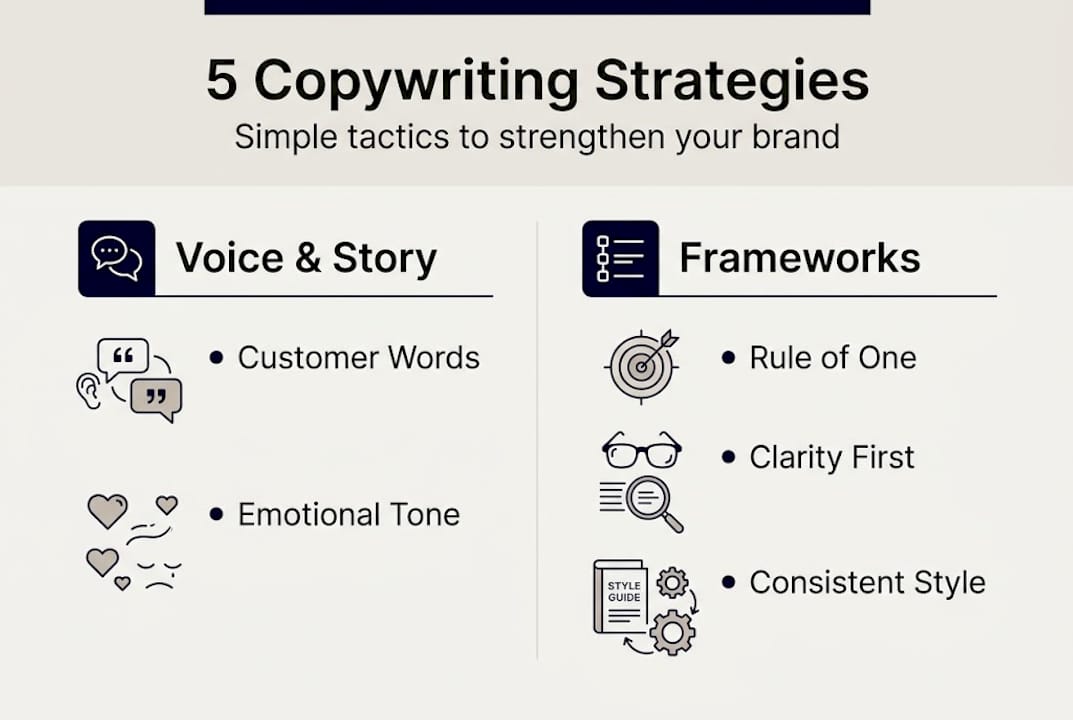
Great copy follows the Rule of One, emotional architecture, and customer voice. These are not just nice-sounding concepts. They are practical frameworks you can apply today.
Principle | What it means | Typical outcome |
Rule of One | One idea per piece of copy | Clearer message, higher conversions |
Emotional architecture | Story, proof, promise flow | Deeper trust and engagement |
Voice-of-customer language | Use your audience’s own words | Stronger relatability and connection |
Here’s how to apply these step by step:
Pick one core emotion or idea for each piece of content. A homepage headline is not the place for five value propositions. Choose one.
Build your copy in a story, proof, promise flow. Tell a relatable story, back it up with evidence, then make a clear promise.
Collect real customer language. Read your reviews, your DMs, your support emails. The phrases people use to describe their problems? Gold.
Test your copy out loud. If it sounds like a press release, rewrite it. If it sounds like you, keep going.
Apply storytelling techniques for engagement to every touchpoint, not just your blog.
Pro Tip: Before writing any new copy, spend 15 minutes reading your customer reviews. Highlight phrases that appear more than once. Those are your brand’s magic words.
These frameworks also tie directly into brand positioning strategies that help you stand out in a crowded market. Copy and positioning are not separate conversations. They are the same conversation.
Storytelling and consistency: How copy builds trust and recall
With frameworks in hand, let’s explore why storytelling and message consistency are key to long-term brand value. Because here’s the uncomfortable truth: customers do not remember features. They remember feelings and stories.

Storytelling in your copy is not about writing a novel on your About page. It’s about framing everything through a human lens. Why did you start this business? What problem were you obsessed with solving? What does life look like for your customer after they work with you? Those answers are your story, and they belong woven into every piece of copy you create.
Consistency is the other half of this equation. Copywriting ROI far exceeds costs when you build trust and recognition over time, and that only happens when your voice stays recognisable across every channel.
Consistent brand voice | Inconsistent brand voice |
Builds trust over time | Creates confusion and doubt |
Customers recognise you instantly | Feels like multiple different brands |
Higher engagement and loyalty | Lower retention and repeat business |
Easier content creation process | Every piece feels like starting over |
Here are the key elements of brand voice consistency to lock in:
A defined tone (warm, witty, authoritative, playful, or some combination)
A vocabulary list of words you use and words you avoid
A consistent point of view (who are you speaking as and to whom)
Templates for common content types so the voice stays on track
Practical tip: create a one-page brand voice guide. It does not need to be fancy. Just document your tone, your favourite phrases, and your no-go words. Share it with anyone who writes for your brand, including yourself six months from now.
For more on storytelling in marketing and how to use it across platforms, there’s a lot more to explore. And if you’re focused on growing your brand online, consistent copy is one of the highest-leverage moves you can make.
Turning words into action: Practical copywriting steps for your brand
After understanding the “why” and “how,” let’s apply these insights directly to your brand and marketing. No more theory. Let’s get practical.
Here’s a step-by-step process for developing your brand voice and elevating your copy:
Define your brand personality. Pick three to five adjectives that describe how your brand should sound. Friendly? Bold? Reassuring? Write them down.
Audit your existing copy. Read your website, social bios, and email newsletters as if you are a stranger. Does it sound like those adjectives? Does it sound consistent?
Rewrite your headline first. Your homepage headline is your most valuable copy real estate. Make it clear, specific, and emotionally resonant.
Build a swipe file. Collect copy you love from other brands. Not to copy, but to understand what works and why.
Measure your copy’s impact. Track metrics like time on page, click-through rates, and conversion rates before and after copy changes.
Knowing when to write yourself versus when to outsource is also a real decision. Outsourcing copywriting can generate significant ROI for businesses that lack the time or expertise to do it well. If writing feels like pulling teeth, or if your copy just is not converting, that’s a signal.
Pro Tip: Copy ROI is almost always underestimated because it compounds. A better homepage headline keeps working for you every single day. Measure its impact over three to six months, not just the first week.
For businesses in the early stages, building a standout identity starts with getting your messaging right before anything else. And pairing strong copy with a solid content marketing strategy for small business is how you turn words into consistent, compounding growth.
A fresh take: Why most small businesses underestimate copy and what to do differently
Here’s a spicy opinion: the standard branding process is backwards. Most small businesses start with a logo, pick their colours, build their website, and then think about what to say. That’s like decorating a house before you’ve decided who’s going to live in it.
Brands that invest in strategic copy consistently outperform those that prioritise visuals first. The words define the feeling. The visuals should express that feeling. Not the other way around.
The bold move? Draft your core messaging before you touch a design tool. Write your tagline, your brand story, and your key value propositions first. Then let those words inform the visual direction. You’ll end up with a brand that feels genuinely cohesive, not just pretty.
Also, get ruthless about editing. Most copy is 30% longer than it needs to be. Cut for emotional clarity and simplicity. If a sentence doesn’t earn its place, it’s gone. Standing out through brand positioning is not about saying more. It’s about saying the right things, clearly and consistently.
Grow your brand faster with expert copywriting support
If this article has you feeling fired up but slightly overwhelmed (totally normal, by the way 😄), that’s exactly where M50 Media comes in. Knowing what great copy looks like and actually writing it for your own brand are two very different things.

Through business coaching services, Karl Lundgren helps small business owners clarify their brand voice, sharpen their messaging, and build copy that actually converts. Not sure where to start? Book a free marketing SOS call and get expert eyes on your brand right away. And if you’re building out your email marketing alongside your copy strategy, MailerLite for email marketing is a fantastic tool to help you put those words to work.
Frequently asked questions
What makes copywriting so important for branding?
Copywriting shapes the voice, values, and emotional connection of a brand, making it memorable well beyond its visuals. Words influence first impressions, trust, and long-term loyalty in ways that design alone simply cannot.
Should small businesses hire a professional copywriter or write their own copy?
If time or expertise is limited, hiring a professional copywriter often yields a much higher return than DIY writing. Pro copy ROI far exceeds the upfront cost when it drives consistent conversions and brand recognition.
How can I make my brand’s copy more consistent?
Develop a simple brand voice guide and ensure all your marketing materials use the same tone, style, and core messaging. Even a one-page document shared with your team can make a massive difference.
What is the ‘Rule of One’ in copywriting?
The ‘Rule of One’ means each piece of copy should focus on one core idea or emotion to maximise clarity and impact. Great copy follows the Rule of One so readers know exactly what to think, feel, and do next.
Recommended
Comments