What is omnichannel marketing? A guide for small businesses

TL;DR:
Omnichannel marketing creates a seamless, integrated customer experience across all touchpoints.
Small businesses benefit from focusing on a few channels and building genuine customer relationships.
Starting small with affordable tools and avoiding over-automation is key to success.
More channels does not automatically mean more customers. That’s a trap a lot of small business owners fall into, and honestly, it’s an easy one. You sign up for every platform, blast out content in every direction, and wonder why your customers still feel like strangers. Here’s the thing: omnichannel marketing is not about being everywhere at once. It’s about making every touchpoint feel like a continuation of the same conversation. This guide breaks down what omnichannel marketing actually is, why it matters for your business (yes, even a small one), and how to get started without losing your mind or your budget. 🙌
Table of Contents
Key Takeaways
Point | Details |
Channels must integrate | Omnichannel marketing only works if customer experiences are connected across all touchpoints. |
Start small, expand wisely | Begin with a few effective channels and scale efforts based on proven customer insights. |
Personalisation is crucial | Balancing technology and human touch creates loyalty and avoids the pitfall of robotic communication. |
Analytics drive improvement | Tracking results lets you refine your omnichannel approach for growing results and loyalty. |
Omnichannel marketing explained
Let’s clear something up right away. Omnichannel marketing is not just a fancy way of saying “we post on Instagram and send emails.” It’s a whole different mindset.
At its core, omnichannel marketing means creating a seamless buying journey for your customers across every channel you use, whether that’s online, in-store, via email, or through social media. The key word is seamless. Your customer should feel like they’re talking to the same brand whether they’re scrolling your Instagram, visiting your website, or walking through your front door.
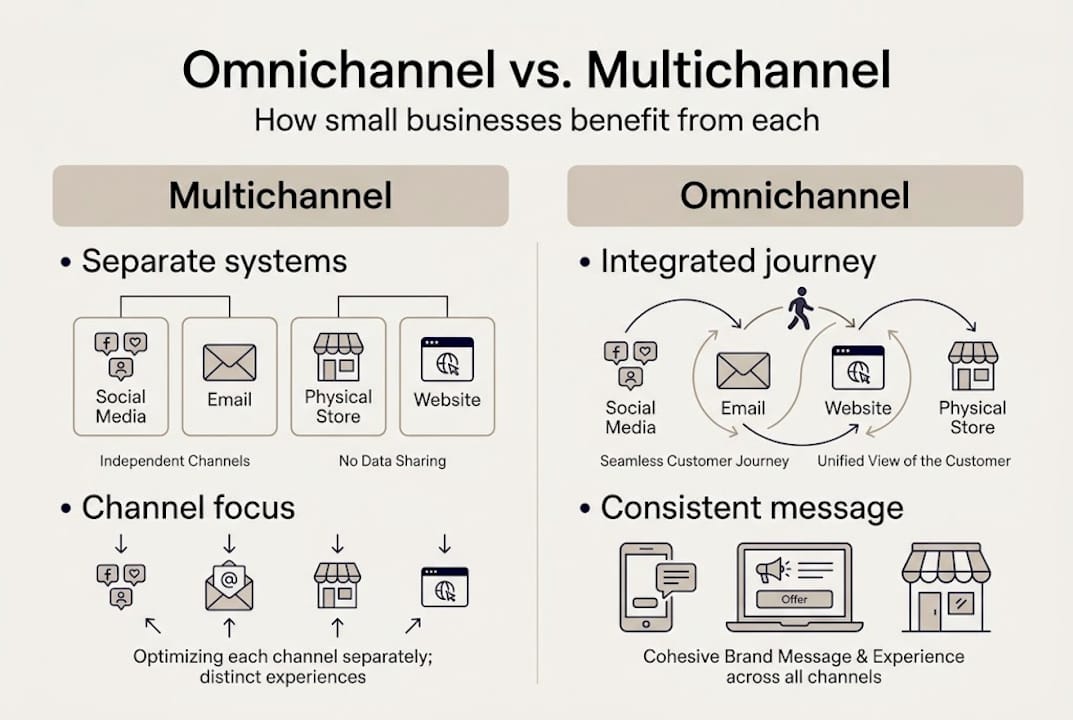
Now, multichannel marketing is a different beast. With multichannel, you’re using several platforms, but they often operate in silos. Think of it like a band where every musician is playing a different song. Loud? Yes. Harmonious? Absolutely not. Omnichannel is when everyone’s playing the same tune, in sync, beautifully.
Here’s a quick comparison to make it crystal clear:
Feature | Multichannel | Omnichannel |
Channel focus | Individual channels | Integrated experience |
Customer view | Fragmented | Unified |
Data sharing | Siloed | Connected |
Personalisation | Limited | High |
Complexity | Lower | Higher |
A practical example: imagine you run a boutique clothing shop. You run Instagram ads promoting a weekend sale, your website shows the same sale with a countdown timer, and customers who walk in are greeted by staff who know about the promotion. That’s omnichannel in action. Everything connects.
The benefits are real:
Improved customer experience (they feel seen and understood)
Better data insights (you learn what’s actually working)
Higher customer loyalty (consistency builds trust)
More repeat purchases (happy customers come back)
“Omnichannel scales for loyalty but requires investment, while multichannel strategies can suit resource-limited small businesses for testing the waters.”
That’s not to say multichannel is bad. As omnichannel vs. multichannel research points out, multichannel can be a smart starting point for businesses with limited resources. But if you want to build lasting loyalty, integration is where the magic happens. Explore more effective marketing strategies to see how they all fit together.
Why omnichannel matters for small businesses
You might be thinking, “That sounds great for Nike or Starbucks, but I’m running a three-person operation out of a converted garage.” Fair point. But here’s the plot twist: omnichannel is arguably more important for small businesses than big ones.

Why? Because you can’t afford to lose customers. Every lost sale stings a little more when your margins are tight.
Here’s what the data tells us about omnichannel adoption:
Business outcome | Impact of omnichannel |
Customer retention | Significantly higher |
Repeat purchase rate | Notably increased |
Customer lifetime value | Grows over time |
Brand consistency | Strongly improved |
The steps to get there don’t have to be massive. Even small, intentional moves can shift the needle:
Connect your email list to your social media ads for consistent messaging.
Ensure your in-store promotions match what’s on your website.
Follow up with customers post-purchase via SMS or email.
Use customer feedback from one channel to improve another.
Track which channels drive the most conversions and double down there.
One thing to watch out for? Over-automation. It’s tempting to set everything on autopilot and let the robots do the work (who wouldn’t want that?). But as experts caution, over-automation without personalisation backfires. Customers can smell a canned response from a kilometre away, and it kills the vibe fast.
The online marketing advantages for small businesses are real, but only when you pair them with a human touch. Automation should support your relationships, not replace them.
Pro Tip: Don’t try to integrate every channel at once. Pick the two or three where your customers already hang out, nail those, and then expand. Check out these essential marketing tools to find what fits your budget and workflow.
First steps: Building your omnichannel foundation
Okay, so you’re sold on the idea. Now what? Let’s talk about actually doing this without spending a fortune or having a full-blown meltdown.
The golden rule here is simple: start small, start smart. As omnichannel planning guidance for small stores recommends, focus on 2-3 channels first to build your data foundation before scaling. Trying to do everything at once is like trying to cook a five-course meal when you’ve just learned to boil water. Not the move.
Here’s a practical roadmap to get you started:
Audit your current channels. Where are your customers actually engaging with you? Start there.
Integrate email and SMS. These two are your bread and butter. They’re affordable, personal, and effective. Tools like Klaviyo for SMS and email make this surprisingly painless.
Sync your online and offline presence. If you run promotions in-store, make sure your website and social media reflect the same offer.
Set up a basic CRM (Customer Relationship Management system). Even a simple one helps you track customer behaviour across channels.
Build your data foundation. Collect emails, track purchases, and note where customers come from. This data is gold when you’re ready to scale.
Low-cost tools that work brilliantly for small businesses include Shopify for e-commerce integration, Square for point-of-sale and online syncing, and Klaviyo for email and SMS automation. None of these will require you to sell a kidney.
Pro Tip: BOPIS (Buy Online, Pick Up In Store) is a surprisingly powerful “phygital” (physical plus digital) strategy that even tiny retailers can implement. It bridges the gap between your online and in-store experience beautifully. Your digital marketing plan guide can help you map out where this fits in your overall strategy.
Also, resist the urge to chase every shiny new platform. TikTok might be trending, but if your customers are on Facebook and in your inbox, that’s where your energy belongs. Build depth before you build breadth.
How to scale your omnichannel marketing strategy
You’ve got the foundation in place. Your email and SMS are talking to each other, your channels are singing in harmony, and customers are starting to notice. Now it’s time to level up.
Scaling your omnichannel strategy is less about adding more stuff and more about refining what you already have. As omnichannel research confirms, omnichannel scales for loyalty but requires ongoing investment, so be intentional about where you put your energy.
Here’s what smart scaling looks like:
Monitor performance across every channel regularly. Don’t just set it and forget it.
Use analytics to identify where customers drop off in their journey and fix those gaps.
Expand to new touchpoints only when your existing ones are performing well.
Personalise more as your data matures. The more you know about your customers, the more relevant your messages can be.
Gather customer feedback actively and use it to improve the experience.
Test new content formats (video, interactive quizzes, personalised recommendations) on your strongest channels first.
Understanding your numbers is non-negotiable at this stage. Dive into marketing analytics to get comfortable with what the data is telling you. It’s not as scary as it sounds, we promise.
Also, don’t underestimate the power of social media as a scaling tool. The benefits of social media marketing for small businesses go well beyond likes and follows. It’s a real-time feedback loop and a channel for deepening relationships.
The biggest mistake businesses make when scaling? Going robotic. More automation does not mean better results. Keep the human element alive, even as you grow.
A practical perspective: The real-world path to omnichannel success
Here’s the honest truth that most marketing articles won’t tell you: the majority of small business owners who struggle with omnichannel aren’t failing because of bad tools or tight budgets. They’re failing because they’re chasing the idea of omnichannel instead of focusing on their actual customers.
The businesses that genuinely win with this approach do something deceptively simple. They obsess over the customer journey. They ask, “What does my customer experience from the moment they discover us to the moment they buy and beyond?” Then they work backwards from there.
Flashy platforms and expensive software are not the answer if you don’t understand your customer’s path. Start with empathy, then layer in technology. The recommended marketing tools are only as powerful as the strategy behind them.
Measure, test, and evolve. Don’t chase trends blindly. What works for a competitor might flop for you, and that’s completely fine. Your omnichannel strategy should be as unique as your business. 💡
Get expert help to build your omnichannel strategy
Building an omnichannel strategy from scratch can feel like assembling IKEA furniture without the instructions. (We’ve all been there. It’s not fun.) But you don’t have to figure it all out alone.
At M50 Media, we work with small business owners just like you to cut through the noise and build marketing strategies that actually connect with customers. Whether you need a full omnichannel roadmap or just a nudge in the right direction, our business coaching services are designed to meet you where you are. Not sure where to start? Book a free marketing SOS call and let’s figure it out together. No jargon, no pressure, just practical guidance tailored to your business. 🚀
Frequently asked questions
What is the main difference between omnichannel and multichannel marketing?
Omnichannel marketing integrates all customer touchpoints into one seamless experience, while multichannel uses separate channels that often operate independently. As omnichannel vs. multichannel research notes, multichannel suits resource-limited businesses for testing, while omnichannel scales for long-term loyalty.
How can a small business get started with omnichannel marketing?
Begin with two or three affordable channels like email and SMS, integrate them for consistent messaging, and expand as your data and capacity grow. Starting with 2-3 channels first helps you build a solid data foundation before scaling up.
Do I need expensive software to implement omnichannel marketing?
Not at all. Low-cost tools like Shopify and Square make omnichannel very accessible for small businesses. As small store planning guides confirm, affordable starts with email and SMS integration are completely achievable without enterprise-level budgets.
What pitfalls should I avoid with omnichannel marketing?
The biggest one is over-automation without personalisation, which experts warn can backfire and damage customer relationships. Balance your tech efficiency with a genuine human touch to keep engagement feeling real and not robotic.
Recommended
Comments