How reviews boost sales: small business marketing explained

TL;DR:
Five reviews can increase small business conversions by 270 percent.
Reviews build credibility, improve online visibility, and reduce buyer hesitation.
Proper collection and strategic display of reviews enhance local search rankings and trust.
Just five customer reviews can lift your conversion rate by 270% compared to zero. That’s not a typo. We’re talking about a handful of sentences from real customers doing more heavy lifting than a fancy ad campaign you spent weeks building. Yet so many small business owners treat reviews like an afterthought, something that happens on its own if you’re lucky. Spoiler: luck is not a marketing strategy. This guide breaks down exactly why reviews matter, how they get your business discovered online, where to show them off, and how to actually collect them without feeling awkward about it. Let’s get into it.
Table of Contents
Key Takeaways
Point | Details |
First reviews matter most | Just one to five reviews can dramatically increase your conversion rates. |
Visibility drives conversion | Displaying reviews in the right spots multiplies their effect in attracting new customers. |
Authenticity builds trust | A blend of positive and not-so-perfect reviews boosts trust and portrays your business as transparent. |
Simple strategy, big gains | Asking for reviews, responding publicly, and sharing them widely leads to measurable business growth. |
Why customer reviews matter for small businesses
Think of reviews as the digital version of your neighbour leaning over the fence and saying, “Oh, you should absolutely try that place.” That kind of word-of-mouth has always been gold for small businesses, and online reviews are just that, scaled up to reach thousands of strangers at once. It’s social proof in action, and it works because people trust other people far more than they trust branded messaging.
Here’s the thing about hesitant buyers: they’re everywhere. A potential customer lands on your website or Google listing, they’re interested, but they’re not quite sure. A few genuine reviews can be the nudge that tips them from “maybe” to “take my money.” In fact, that first review alone increases the likelihood of a purchase by 65%. That’s one review. One person taking two minutes to share their experience can change the trajectory of your sales.
“Reviews are the modern handshake. They tell a new customer everything they need to know before they ever speak to you.”
For small businesses, this matters even more than it does for big brands. You don’t have a million-dollar ad budget or a celebrity spokesperson (unless you do, in which case, respect). What you have is a community, a reputation, and the ability to build genuine relationships. Reviews are the bridge between your real-world reputation and your online presence.
Here’s what reviews actually do for your small business:
Build credibility with first-time visitors who don’t know you yet
Reduce buying hesitation by answering unspoken customer questions
Signal to search engines that your business is active and trustworthy
Give you free, authentic marketing content you can repurpose
Create a feedback loop that helps you improve your products or services
Exploring your online marketing advantages as a small business means recognising that reviews are one of the most cost-effective tools in your kit. And when you pair them with effective marketing strategies, you’ve got a combination that punches well above its weight.
How reviews drive online discovery and conversions
Okay, so reviews build trust. But they also do something equally powerful: they help people find you in the first place. Google’s local search algorithm pays close attention to review quantity, recency, and ratings when deciding which businesses to show in local results. More reviews, especially recent ones, signal to Google that your business is alive, active, and worth recommending.
Let’s talk numbers, because the data here is genuinely exciting. Conversion rates jump by 270% with just five reviews compared to none. For higher-priced items or services, that number climbs to 380%. Think about what that means for your bottom line. You’re not changing your product. You’re not running a sale. You’re simply letting happy customers speak, and it moves the needle dramatically.
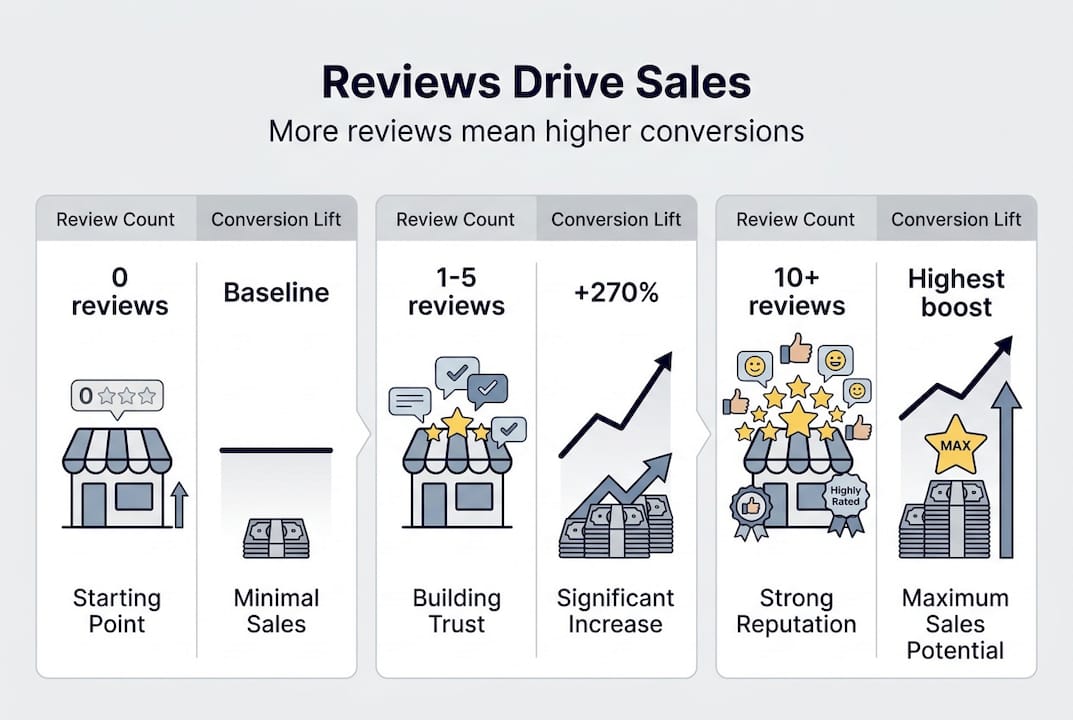
Here’s a quick look at how review volume affects conversion rates:
Number of reviews | Estimated conversion lift | Notes |
0 reviews | Baseline (0%) | Starting point |
1 review | Up to 65% lift | Biggest single jump |
5 reviews | Up to 270% lift | Strong credibility signal |
10 reviews | Continued growth | Diminishing returns begin |
25+ reviews | Sustained trust | Consistency matters more |
There is a point of diminishing returns, roughly after your first 10 reviews, where each additional review adds less dramatic impact. But that doesn’t mean you stop collecting them. Recency matters. A business with 50 reviews from three years ago looks less active than one with 15 reviews from the past six months.
Here’s how to make reviews work for your online discovery:
Claim and optimise your Google Business Profile so reviews are visible in local searches.
Respond to every review, good or not so good, to show engagement and boost your profile’s activity signals.
Use keywords naturally in your responses (mention your service and location) to support local SEO.
Encourage reviews on multiple platforms to widen your discovery footprint.
Keep review collection consistent so your profile always has fresh content.
Pro Tip: Pairing your review strategy with campaigns that boost ROI and content that helps you get more leads creates a compounding effect. Each piece supports the others and your visibility grows faster.
Types of reviews and where to feature them
Not all reviews live in the same neighbourhood, and knowing where to collect and display them can make a real difference. Let’s break down the main types and where they shine brightest.
Google reviews are the heavyweight champions of local business credibility. They show up directly in search results and on Google Maps, which means they’re often the very first thing a potential customer sees before they even visit your website. If you’re only going to focus on one review platform, make it Google.
Facebook reviews (now called Recommendations) are powerful for businesses with an active social media presence. They tap into a customer’s existing social network, so when someone recommends you, their friends see it too. That’s organic reach you didn’t have to pay for.
On-site reviews, meaning testimonials and star ratings displayed directly on your website, are incredibly effective for conversions. A visitor who’s already on your site and sees glowing reviews right there is far more likely to take action. Trust and conversions increase with visible reviews, and placement matters just as much as review count.
Here’s a quick comparison to help you decide where to focus:
Review platform | Best for | Visibility | Conversion impact |
Google Business | Local search discovery | Very high | Very high |
Facebook Recommendations | Social proof and referrals | High | Medium-high |
Website testimonials | On-site trust building | Medium | Very high |
Industry directories | Niche credibility | Medium | Medium |
Where you display reviews matters enormously. Don’t bury them on a page nobody visits. Place them:
On your homepage, near your main call to action
On product or service pages, right next to the “book now” or “buy” button
In your email newsletters to reinforce trust with existing contacts
On landing pages for paid ads or special promotions
Pro Tip: Weaving reviews into your content marketing strategy and using them as brand content ideas gives your testimonials a much longer shelf life than just sitting on a webpage.
Getting and using reviews: Practical strategies
Here’s the part where a lot of small business owners freeze up. Asking for reviews feels awkward, almost like asking someone to compliment you to their face. But here’s the truth: most happy customers are genuinely willing to leave a review. They just need a nudge and a clear, easy path to do it.
Most businesses see the largest gains after collecting their first 5 to 10 reviews. So your goal right now is simple: get those first few. Everything after that is momentum.
Here’s a practical step-by-step approach:
Ask at the right moment. Timing is everything. Request a review right after a positive interaction, when the customer is still feeling great about their experience. Post-purchase follow-up emails work brilliantly for this.
Make it ridiculously easy. Include a direct link to your Google review page or Facebook profile. The fewer clicks required, the more reviews you’ll get. Nobody is going to hunt for your review page.
Personalise the ask. A message that says “Hey Sarah, we loved having you in” feels very different from a generic “Please leave us a review.” Personal touches increase response rates.
Follow up once (and only once). A gentle reminder a few days later is perfectly acceptable. More than that and you risk annoying people, which is the opposite of what we’re going for.
Use reviews across your marketing. Share them on social media, include them in email campaigns, and feature them in ads. A real customer quote in a Facebook ad can outperform polished copy every single time.
Pro Tip: Check out more marketing ideas and social media advertising strategies to see exactly how reviews can supercharge your paid and organic efforts together.
One more thing: always respond to reviews, even the negative ones. A thoughtful, professional response to a critical review shows potential customers that you care and that you take feedback seriously. That kind of responsiveness can actually win you business.
A fresh take: Why small businesses should embrace every review, not just the 5-stars
Here’s an opinion that might surprise you: a perfect 5-star rating can actually hurt you. Sounds wild, right? But think about it. When every single review is glowing and perfect, it starts to feel a little too good to be true, like a Hallmark Christmas movie where nobody has any real problems. Real customers are sceptical, and they should be.
A business with a 4.6-star average and a handful of honest, mixed reviews often builds more trust than one with a suspiciously perfect score. Negative reviews, when handled well, are actually a gift. They show authenticity. They give you a public stage to demonstrate your customer service. And they make your positive reviews look far more credible by comparison.
The businesses that win at marketing through storytelling understand that imperfection is relatable. A thoughtful response to a critical review tells a better story than ten five-star ratings ever could. Stop chasing perfection and start chasing genuine engagement. That’s where the real trust lives.
Get hands-on help growing with reviews
You’ve got the knowledge now. You know why reviews matter, where to put them, and how to collect them. But knowing and doing are two very different things, and sometimes you just need someone in your corner to help you put it all together.

That’s exactly what we do at M50 Media. Whether you need business coaching for marketing to build a full review strategy or you just want to talk through your options, we’ve got you. You can even book a free marketing SOS call to get personalised guidance with zero commitment. Reviews are one of the most powerful and underused tools in small business marketing, and we’d love to help you make the most of them.
Frequently asked questions
How many reviews does my business need to see a boost in sales?
Just five reviews can lift conversion rates by up to 270%, with your very first review delivering the biggest single jump in purchase likelihood.
Do negative reviews hurt my chances of getting new customers?
A few negative reviews actually make your profile look more authentic and give you a valuable opportunity to show off your customer service skills publicly. A range of ratings builds more trust than a suspiciously perfect score.
Where should I display customer reviews for the biggest impact?
Feature reviews on your website homepage, Google Business Profile, and social media channels. Review placement affects both visibility and conversion rates, so put them where buyers are already making decisions.
What’s the best way to ask customers for reviews?
Ask shortly after a positive interaction and include a direct link to make it easy. Early review collection leads to the greatest sales lift, so don’t wait too long after the purchase or service is complete.
Recommended
Comments