What is marketing automation? Tools, tactics, and growth

Think marketing automation is only for big corporations with massive tech budgets and a team of developers on speed dial? Yeah, that’s one of the most stubborn myths in digital marketing, and we’re here to bust it wide open. The truth is, today’s automation tools are more accessible than ever, and small businesses are quietly using them to punch way above their weight class. Whether you’re a solo entrepreneur or running a lean team of five, this guide breaks down what marketing automation actually is, how it works behind the scenes, and how you can start using it to grow without burning out. 🚀
Table of Contents
Key Takeaways
Point | Details |
Automation made simple | Today’s marketing automation tools work for businesses of any size and don’t require big budgets. |
Choose the right tool | Comparing features, price, and support helps you select the best automation platform for your needs. |
Grow efficiently | Automation saves time, improves lead follow-up, and increases sales by streamlining your entire marketing process. |
Strategy first | Successful automation relies on clear goals and effective marketing, not just fancy software. |
Defining marketing automation: What it is and what it isn’t
Let’s start with the basics, because the word “automation” tends to make people picture robots replacing their entire marketing department. Spoiler: that’s not what’s happening here.
Marketing automation is simply the use of software to handle repetitive marketing tasks automatically, so you don’t have to do them manually every single time. Think of it like setting your coffee maker the night before. You do the work once, and the machine handles the rest while you sleep. As HubSpot explains, marketing automation streamlines daily marketing tasks through software for higher efficiency.
But here’s where people get confused. Not every marketing tool is an automation tool. A basic email newsletter platform where you manually hit “send” every Tuesday? That’s just software. Automation kicks in when the system takes action based on a trigger, like a customer signing up, clicking a link, or abandoning a cart.
Common myths worth squashing right now:
“It’s only for big budgets.” Nope. Many platforms start free or under $20/month.
“It’s too complicated for non-tech people.” Most modern tools are drag-and-drop simple.
“It feels spammy to customers.” Done right, automation actually feels more personal, not less.
“You need a big email list to start.” You can automate for an audience of 50 just as easily as 50,000.
“Automation doesn’t replace your marketing. It multiplies it.”
What automation cannot do is think creatively, build genuine relationships from scratch, or fix a bad offer. It amplifies what’s already there. That’s why understanding your digital marketing ROI before you automate is genuinely important. If your current marketing isn’t working, automating it just delivers the wrong message faster. More on that in a bit.
How marketing automation works: Core features and workflow
Now that the definition is clear, it’s important to see how these tools actually function day-to-day. Spoiler: it’s less complicated than assembling IKEA furniture.

Most marketing automation platforms share a core set of features. According to Salesforce, automation tools can manage emails, social media, campaign tracking, and more, all from one dashboard. That’s a lot of heavy lifting off your plate.
Here’s a quick look at the typical features you’ll find:
Feature | What it does |
Email scheduling | Sends emails automatically based on triggers or timing |
Lead scoring | Ranks leads by engagement so you focus on the hottest ones |
Social media scheduling | Posts content across platforms without manual effort |
Analytics and reporting | Tracks campaign performance in real time |
CRM integration | Syncs with your sales pipeline for seamless follow-up |
So how does a typical automation workflow actually run? Here’s the short version:
A visitor lands on your website and fills out a form.
That action triggers an automated welcome email sequence.
Based on how they interact (open, click, ignore), the system scores their interest.
Highly engaged leads get flagged for a personal follow-up or a special offer.
The whole thing runs without you lifting a finger.
Pretty slick, right? And this is just the entry-level version. When you pair automation with AI marketing automation, the system can personalise messaging at a level that would take a human team weeks to replicate manually.
The real magic happens when automation connects to your broader digital strategy for growth, turning scattered marketing activities into a coordinated, always-on engine.
Pro Tip: Don’t try to automate everything at once. Start with a single welcome email sequence for new subscribers. Get that working beautifully, then layer in more complexity. Crawl, walk, run. Your future self will thank you.
For a deeper look at the tools that make this possible, check out this roundup of small business marketing tools that pair well with automation platforms.
Choosing the right automation platform: Options for small businesses
Understanding what’s available helps you choose the tech stack that fits your goals and budget. And honestly, the options in 2026 are better than ever for small businesses.
As Forbes Advisor notes, some platforms cater to small budgets and easy startup, while others require advanced expertise. So knowing where you sit on that spectrum matters before you swipe your card.
Here’s a quick comparison of popular options:
Platform | Best for | Starting price | Ease of use |
MailerLite | Email-first small businesses | Free tier available | Very easy |
Klaviyo | E-commerce brands | Free up to 250 contacts | Moderate |
ActiveCampaign | Growing teams needing CRM | ~$15/month | Moderate |
HubSpot | All-in-one growth | Free tier available | Easy to moderate |
Mailchimp | Beginners and solopreneurs | Free tier available | Very easy |
If you’re just getting started, MailerLite for email marketing is one of the friendliest entry points out there. For e-commerce businesses that want to combine SMS and email, Klaviyo for SMS and email is a powerhouse worth exploring.
When evaluating any platform, here are the must-have features for beginners:
Visual drag-and-drop email builder
Basic automation workflows (welcome series, abandoned cart)
Contact segmentation by behaviour or interest
Simple analytics dashboard
Integration with your existing website or e-commerce platform
When should you graduate to a more advanced platform? When your list grows past 5,000 contacts, when you need multi-channel sequences beyond email, or when your sales team needs deeper CRM integration. Until then, keep it simple. You can always browse a full automation tools comparison to find what fits your stage of growth.
Benefits of marketing automation for small business growth
Once you’ve chosen the right tool, what results can you actually expect? Let’s talk numbers, because this is where things get exciting.
Businesses using marketing automation increase qualified leads by over 451%, according to research compiled by Emailmonday. That’s not a typo. Four hundred and fifty-one percent. That’s the kind of stat that makes you put down your coffee and pay attention.
“Marketing automation isn’t a shortcut. It’s a force multiplier for businesses that already have something good going.”
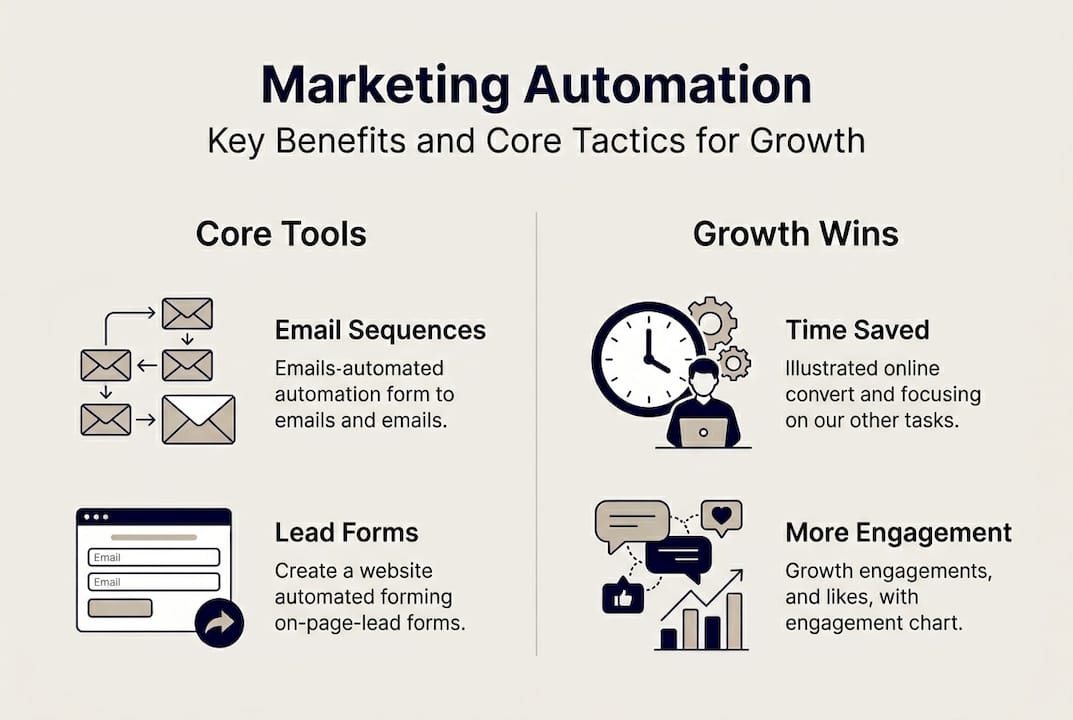
Here’s a quick look at the tangible benefits you can expect:
Time savings. Automated follow-up emails, social posts, and lead nurturing sequences run without your daily involvement.
More sales. Timely, relevant messages convert better than generic blasts. Automation makes personalisation scalable.
Better customer experience. Customers get the right message at the right time, which feels attentive rather than pushy.
Higher productivity. Your team focuses on high-value work instead of repetitive tasks.
Improved data. Automation platforms track behaviour and engagement, giving you real insight into what’s working.
Want to boost engagement with email marketing? Automation is the engine that makes consistent, personalised email campaigns actually sustainable for a small team.
And if you want to go broader, pairing automation with lead generation through social ads creates a full funnel where leads come in and get nurtured automatically. That’s a serious competitive edge.
Pro Tip: Set up a simple “lead rescue” sequence. Any contact who hasn’t engaged in 60 days gets a short re-engagement email series. You’ll be surprised how many warm leads you recover from your existing list. Don’t let good leads go cold when automation can unlock marketing advantages for you around the clock.
Why marketing automation success is about strategy, not software
Here’s the take you won’t hear from most software companies: the platform you choose matters far less than the strategy behind it.
We see this constantly. A small business invests in a shiny new automation tool, sets up a few sequences, and then wonders why results are flat. The software isn’t the problem. The strategy is.
Automation only amplifies what’s already present in your marketing. If your messaging is unclear, your offer is weak, or your follow-up sequence doesn’t match where your customer actually is in their journey, automation just delivers that confusion faster and more consistently. Congrats, you’ve automated mediocrity. 🎉
The businesses that win with automation start with the customer journey first. They map out what a new lead needs to hear, when they need to hear it, and what action they want them to take. Then they build the automation sequence around that map. The software is just the delivery vehicle.
Clear goals, quality content, and a genuine understanding of your audience are the real drivers of automation success. That’s why building a solid integrated marketing strategy before you automate is the move that separates businesses that grow from businesses that just get busier.
Start with your customer journey. Then automate it.
Take the next step with marketing automation support
Ready to stop guessing and start building an automation system that actually works for your business? That’s exactly where we come in. 💪

At M50 Media, we work with small business owners to cut through the noise and build marketing automation strategies that fit their goals, their budget, and their audience. Whether you’re starting from scratch or trying to fix a system that’s not delivering, our business automation coaching gives you a clear, personalised roadmap. Not sure where to start? Book a free marketing SOS call and let’s figure it out together. Or explore our full range of digital coaching services to find the right fit for where you’re at right now.
Frequently asked questions
Is marketing automation expensive for a small business?
Many automation tools offer free or low-cost options for small businesses, and most platforms use pay-as-you-grow pricing so costs scale with your audience size.
What is an example of marketing automation in action?
Email drip sequences are the most common entry point, such as sending a welcome email series automatically to every new subscriber based on a signup trigger.
Can marketing automation replace a marketer?
No. Automation works best as a partner to human creativity and strategy, handling repetitive tasks while your team focuses on the thinking and creative work that software can’t replicate.
How do I measure ROI from marketing automation?
Track key metrics like email open rates, click-through rates, lead volume, and sales closed. ROI can be measured through common marketing KPIs that most automation platforms report on automatically.
Recommended
Comments