Social Media Advertising Guide for Effective Lead Generation

Updated: Feb 19

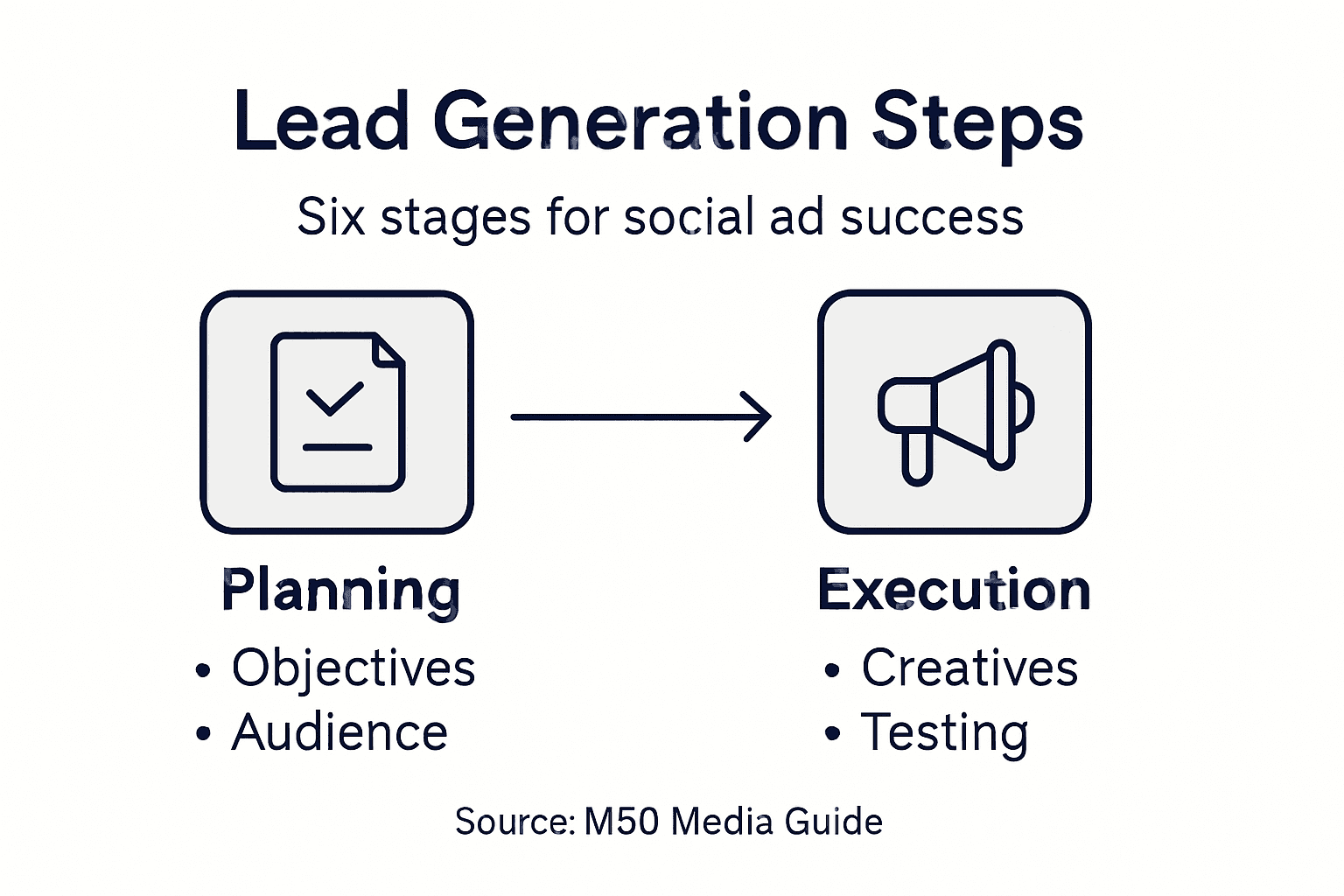
Finding the right approach for social media advertising can often feel like guessing which post will catch a customer’s eye. For Canadian or American ecommerce owners, the stakes are high when your goal is solid lead generation and genuine audience engagement. When you start by defining clear campaign objectives and build every step around your ideal customer, your ads gain purpose and power. This guide shares essential steps that lay the foundation for meaningful strategy, smarter platform choices, and creative that truly connects.
Table of Contents
Quick Summary
Key Insight | Explanation |
1. Define clear campaign objectives | Setting specific objectives aligns your marketing efforts with measurable goals and helps focus your strategy. |
2. Understand your target audience | Creating detailed audience personas enables you to craft more compelling and targeted advertisements. |
3. Choose the right social media platforms | Focus on platforms where your target audience is most active to maximise reach and reduce wasted ad spend. |
4. Structure campaigns methodically | Organising your campaign with clear settings and parameters ensures a focused approach to advertising. |
5. Continuously optimise ad performance | Regularly monitor and adjust your campaigns to enhance their effectiveness and maximise return on investment. |
Step 1: Define your campaign objectives and target audience
Successful social media advertising starts with crystal-clear objectives and a razor-sharp understanding of your target audience. Think of this step as creating a roadmap that guides every single one of your marketing efforts.
To kick things off, you need to determine your specific marketing goals. Are you looking to increase brand awareness, generate high-quality leads, or drive direct sales? Defining clear campaign objectives requires you to align your business goals with precise, measurable targets. Here are some potential objectives to consider:
Boost brand recognition among new customer segments
Generate qualified leads for your product or service
Drive website traffic and increase online engagement
Promote a specific product launch or promotional campaign
Increase social media followers and community interaction
Once you’ve nailed down your objectives, it’s time to dive deep into understanding your target audience. You’ll want to create detailed audience personas that go beyond basic demographics. Consider these crucial characteristics:
Age range and generational cohort
Income level and professional background
Geographic location and cultural context
Personal interests and online behaviour patterns
Pain points and specific challenges your product solves
The more precisely you define your audience, the more effectively you can craft targeted, compelling social media advertisements.
Remember, your campaign’s success hinges on how well you understand and connect with your potential customers. Take time to research and develop a comprehensive audience profile that allows you to create messaging that truly resonates.
Pro tip: Use social media platform analytics and audience insights tools to refine your target audience parameters and uncover hidden demographic opportunities.
Step 2: Select the best social media platforms for your goals
Now that you’ve defined your campaign objectives and target audience, it’s time to choose the social media platforms that will help you reach your marketing goals most effectively. Think of this step as matchmaking between your business strategy and digital communication channels.
Selecting the right platforms means understanding each network’s unique strengths and audience demographics. Selecting strategic social media platforms requires careful consideration of where your target audience actually spends their time online. Here are key factors to evaluate for each platform:
Facebook: Broad demographic reach, excellent for detailed targeting
Instagram: Visual-first platform, ideal for younger audiences and lifestyle brands
LinkedIn: Professional networking, perfect for B2B marketing
Twitter: Real-time engagement and news-driven conversations
TikTok: Short-form video content, predominantly younger user base
Pinterest: Product discovery and visual inspiration
When evaluating platforms, consider these critical selection criteria:
Here’s a quick reference to major social media platforms and their ideal campaign uses:
Platform | Audience Focus | Best For |
Broad, multi-age | Detailed targeting, awareness | |
Youth, trend-driven | Visual branding, engagement | |
Professionals, B2B | Lead generation, networking | |
Real-time, news | Immediate updates, conversations | |
TikTok | Gen Z, short content | Viral campaigns, quick impact |
Creative planners | Product discovery, inspiration |
Audience age and professional background
Content type that performs best on each platform
Your industry’s typical engagement patterns
Advertising cost and potential return on investment
Platform-specific targeting capabilities
Your goal is to maximise reach while minimising wasted advertising spend by choosing platforms strategically.
Remember that you don’t need to be everywhere. Focus on platforms where your specific audience is most active and where your content can shine naturally.
Pro tip: Cross-reference platform demographics with your audience persona to identify the top two or three networks that offer the most precise targeting opportunities.
Step 3: Set up and structure your advertising campaigns
With your objectives and platforms selected, it’s time to architect your social media advertising campaigns with precision and strategic intent. Think of this step as building a digital marketing blueprint that will guide your entire advertising approach.
Campaign structuring is more than just creating ads. Designing comprehensive advertising campaigns requires a methodical approach that aligns with your previously defined goals. Your campaign structure typically involves these key components:
Campaign-level settings and overall objective
Ad set configurations targeting specific audience segments
Individual ad creative and messaging
Budget allocation and bidding strategies
Tracking and conversion mechanisms
When setting up your campaigns, follow these critical organisational steps:
Name your campaign descriptively (e.g., “Q2 Lead Generation - Professional Services”)
Select the primary campaign objective
Define audience targeting parameters
Establish budget and scheduling
Create multiple ad variations for testing
Effective campaign structure transforms your marketing from scattered shots to a precision-guided strategy.
Develop a consistent naming convention for your campaigns, ad sets, and individual ads. This helps you track performance, compare results, and maintain organisational clarity as your advertising efforts grow.
Pro tip: Create a campaign tracking spreadsheet that maps each campaign’s objective, target audience, and key performance indicators to maintain strategic alignment and easy performance review.
Step 4: Craft compelling ad creatives and messaging
With your campaign structure in place, it’s time to create the heart of your social media advertising: the actual ads that will capture your audience’s attention and drive conversions. Your creative assets are the make-or-break element that determines whether people scroll past or stop to engage.
Developing powerful ad creatives requires more than just pretty graphics. Crafting emotionally resonant ad messaging involves understanding your audience’s deepest motivations and speaking directly to their needs. Your ad creative should accomplish these key objectives:
Grab attention within the first 2-3 seconds
Communicate your unique value proposition clearly
Evoke an emotional response or immediate curiosity
Align visually and tonally with your brand identity
Create a compelling reason to take action
When constructing your ad messaging, follow these strategic guidelines:
Start with a provocative headline that addresses a specific pain point
Use high-quality, authentic visuals that represent your target audience
Write concise, benefit-driven copy that speaks directly to viewer interests
Include a clear and specific call-to-action
Ensure visual and textual elements create a cohesive storytelling experience
Great ad creatives don’t just sell a product - they tell a story that makes your audience the hero.
Design your ads with platform-specific best practices in mind. What works on Instagram might fall flat on LinkedIn, so tailor your approach to each network’s unique audience and content consumption patterns.

Pro tip: Create at least three variations of each ad creative to enable A/B testing and discover which emotional triggers and visual styles generate the most engagement.
Step 5: Optimise and test ad performance
Congratulations on launching your social media advertising campaign. Now comes the most critical phase: continuously monitoring, analysing, and refining your ads to maximise their effectiveness and return on investment. Think of this step as ongoing digital fine-tuning.
Performance optimization is a dynamic process. Systematic ad performance evaluation requires methodical tracking and strategic adjustments. Your key performance metrics will help you understand what’s working and what needs improvement:
Click-through rates (CTR)
Conversion rates
Cost per click (CPC)
Cost per acquisition (CPA)
Engagement metrics
To effectively test and optimise your ads, implement these strategic steps:
Set up comprehensive tracking using platform analytics
Establish baseline performance benchmarks
Create multiple ad variations for A/B testing
Monitor performance across different audience segments
Regularly adjust targeting and creative elements
Successful ad optimization is a continuous journey of incremental improvements, not a one-time event.
Focus on data-driven decision making by examining both quantitative metrics and qualitative insights. This means looking beyond surface-level numbers to understand the deeper story behind your ad performance.
This summary highlights critical metrics for effective social ad optimisation:
Metric | What It Measures | Why It Matters |
Click-through Rate | Ad engagement effectiveness | Indicates relevance to audience |
Conversion Rate | Visitors turning to customers | Shows campaign’s ultimate impact |
Cost per Click | Price paid per interaction | Helps optimise ad spend efficiency |
Cost per Acquisition | Spend for each new customer | Measures overall return on ads |
Pro tip: Allocate approximately 20% of your ad budget to experimental variations that challenge your existing assumptions about what resonates with your audience.
Step 6: Analyse results and scale successful strategies
With your social media advertising campaigns running, it’s time to transform raw data into strategic insights that will propel your marketing efforts forward. This stage is where good campaigns become great, and where smart marketers turn performance metrics into actionable growth strategies.
Campaign result analysis goes beyond simply reviewing numbers. Strategic performance evaluation techniques require a comprehensive approach that examines both quantitative and qualitative data. Your analysis should focus on understanding the deeper narrative behind your advertising metrics:
Which audience segments responded most positively
What creative elements generated highest engagement
Identifying unexpected high-performing ad variations
Correlating specific messaging with conversion rates
Discovering potential scaling opportunities
To effectively analyse and scale your successful strategies, follow these systematic steps:
Conduct a holistic performance review across all campaign dimensions
Identify top-performing ad sets and creative variations
Develop hypotheses about why certain ads succeeded
Create expansion strategies for winning approaches
Incrementally increase budget for proven tactics
Scaling is not about blindly increasing spending, but intelligently amplifying what already works.
Look for patterns and insights that can be translated into broader marketing strategies. Sometimes a small tweak in messaging or targeting can dramatically improve overall campaign performance.
Pro tip: Develop a standardised performance tracking spreadsheet that allows you to compare metrics across different campaigns, making trend identification and strategic decision-making more intuitive.
Take Your Social Media Advertising to the Next Level with Expert Guidance
Navigating the challenges of defining clear campaign objectives and selecting the perfect social media platforms can feel overwhelming. If pinpointing your target audience or crafting compelling ad creatives is holding back your lead generation, you are not alone. Successful social media advertising depends on detailed audience analysis, strategic platform choice, and ongoing optimisation to achieve real results.
At M50 Media, we understand these critical steps deeply. From creating precise audience personas to structuring campaigns for maximum impact, our coaching and digital marketing solutions are designed to help you overcome these exact hurdles. Learn how to transform insights into action by visiting the M50 Media homepage.
Ready to stop guessing and start growing your leads through social media? Access expert strategies and personalised coaching tailored for small businesses on M50 Media. Don’t wait until your competitors capture your audience. Explore our proven approach now and turn your digital marketing ambitions into measurable success.
Frequently Asked Questions
How do I define campaign objectives for social media advertising?
To define campaign objectives, start by identifying what you want to achieve, such as increasing brand awareness or generating leads. Write down specific, measurable goals, like aiming for a 25% increase in website traffic within 60 days.
What are the best social media platforms for lead generation?
The best social media platforms for lead generation depend on your target audience. Consider using LinkedIn for B2B leads and Instagram for connecting with younger consumers; focus your efforts on the platforms where your audience is most active.
How can I optimize my social media ads for better performance?
To optimize your social media ads, continuously monitor key performance metrics like click-through rates and conversion rates. Regularly adjust your targeting and creative elements based on performance data to improve results, aiming for a maximum return on investment.
How can I craft compelling ad creatives that generate leads?
Craft compelling ad creatives by focusing on your audience’s pain points and unique value proposition. Use engaging visuals and concise, benefit-driven copy; test multiple variations to see which approach resonates best with your target audience.
What steps should I follow to analyze my advertising results?
To analyze your advertising results, review metrics across all campaigns to identify top-performing ads and segments. Develop insights based on your findings and create strategies to scale successful approaches, increasing budgets for effective campaigns incrementally.
Recommended
Comments