Why Use Email Marketing: Boosting Engagement & Sales

Updated: Feb 19

Sending out emails seems simple until your messages get ignored or land in the junk folder. For small business owners and e-commerce entrepreneurs, cutting through inbox clutter is a daily challenge that directly affects customer engagement and sales. Understanding targeted and personalized email marketing helps you avoid common missteps, connect with real people, and turn regular communication into measurable results.
Table of Contents
Key Takeaways
Point | Details |
Email Marketing is Essential | It provides a direct and personal way to connect with customers, offering a significantly higher return on investment compared to other channels. |
Personalization Increases Engagement | Tailoring content through audience segmentation enhances relevancy and builds meaningful relationships with subscribers. |
Automation Optimizes Campaigns | Implementing automated workflows ensures timely communication while reducing the manual effort required in email marketing. |
Legal Compliance is Crucial | Adhering to regulations builds trust with customers and ensures ethical marketing practices are followed. |
Email Marketing Defined and Common Misconceptions
Email marketing is a powerful digital communication strategy that involves sending targeted messages directly to customers’ inboxes. This digital marketing approach enables businesses to build relationships, promote products, and increase brand awareness with remarkable precision and cost-effectiveness.
Contrary to popular belief, email marketing isn’t just about blasting generic messages to an entire contact list. Modern email marketing leverages sophisticated techniques like:
Audience segmentation to deliver personalised content
Automated workflows that trigger messages based on customer behaviour
Advanced tracking to measure engagement and conversion rates
Dynamic content tailored to individual customer preferences
Many small business owners mistakenly believe email marketing is outdated or ineffective. However, the reality is quite different. Email remains one of the most direct and personal ways to communicate with customers, offering significantly higher return on investment compared to many other marketing channels.
Email marketing isn’t about selling - it’s about building genuine connections with your audience through relevant, valuable communication.
Understanding the nuanced landscape of email marketing requires dispelling common myths. Some persistent misconceptions include believing that emails are intrusive, that people don’t read them anymore, or that social media has completely replaced email communication.
Pro tip: Invest time in building a quality email list with engaged subscribers who genuinely want to hear from you, rather than purchasing generic contact databases.
Personalization and Audience Segmentation Explained
Personalization in email marketing is a sophisticated strategy that goes far beyond simply inserting a recipient’s first name. Research in consumer engagement demonstrates that tailoring content to specific audience segments can dramatically improve marketing effectiveness.
Audience segmentation involves strategically dividing your email list into distinct groups based on various characteristics, enabling more targeted and relevant communication. The most common segmentation approaches include:
Demographic segmentation: Categorizing subscribers by age, gender, income, location
Behavioural segmentation: Tracking purchase history, website interactions, email engagement
Psychographic segmentation: Understanding subscribers’ interests, values, lifestyle preferences
Transactional segmentation: Grouping customers based on their previous buying patterns
Advanced personalization techniques involve crafting dynamic content that adapts to individual user preferences and interactions. This means creating email experiences that feel uniquely crafted for each subscriber, rather than using a one-size-fits-all approach.
Effective personalization transforms generic marketing messages into meaningful, relevant conversations that resonate with each individual recipient.
Successful segmentation requires continuous data collection and analysis. By understanding your audience’s nuanced characteristics and behaviours, you can create email campaigns that feel more like helpful recommendations than intrusive advertisements.
Here’s how popular segmentation methods in email marketing differ:
Segmentation Type | Key Criteria | Typical Impact on Campaigns |
Demographic | Age, location, income | Improves message relevance |
Behavioural | Past actions, purchases | Increases engagement rates |
Psychographic | Interests, lifestyle, values | Enhances content resonance |
Transactional | Buying patterns, frequency | Boosts conversion and retention |
Pro tip: Regularly review and update your audience segments to ensure your personalization strategies remain accurate and effective.
Types of Email Campaigns for Small Businesses
Email campaigns are the strategic heartbeat of digital marketing for small businesses, offering targeted communication channels that can transform casual subscribers into loyal customers. Small business email strategies demonstrate remarkable versatility in connecting with audiences through carefully crafted messaging approaches.
Small businesses can leverage several key types of email campaigns to drive engagement and sales:
Welcome Series: Introducing new subscribers to your brand and creating initial positive impressions
Newsletter Campaigns: Providing regular, valuable content that keeps your audience informed and connected
Promotional Campaigns: Driving sales through time-sensitive offers and discounts
Abandoned Cart Reminders: Recovering potential lost sales by nudging customers about unfinished purchases
Re-engagement Campaigns: Reconnecting with inactive subscribers and preventing list decay
Automated email sequences offer small businesses a powerful way to maintain consistent communication without constant manual intervention. These campaigns can be triggered by specific customer actions, ensuring timely and relevant messaging that feels personalized and intentional.
Effective email campaigns are not about sending more messages, but about sending the right messages to the right people at the right time.
Successful email marketing requires understanding the unique purpose of each campaign type. Some campaigns aim to nurture relationships, while others focus directly on driving immediate sales. The key is matching the campaign type to your specific business objectives and customer journey stage.

Pro tip: Create a comprehensive email marketing calendar that outlines your campaign types, ensuring a balanced and strategic approach to customer communication.
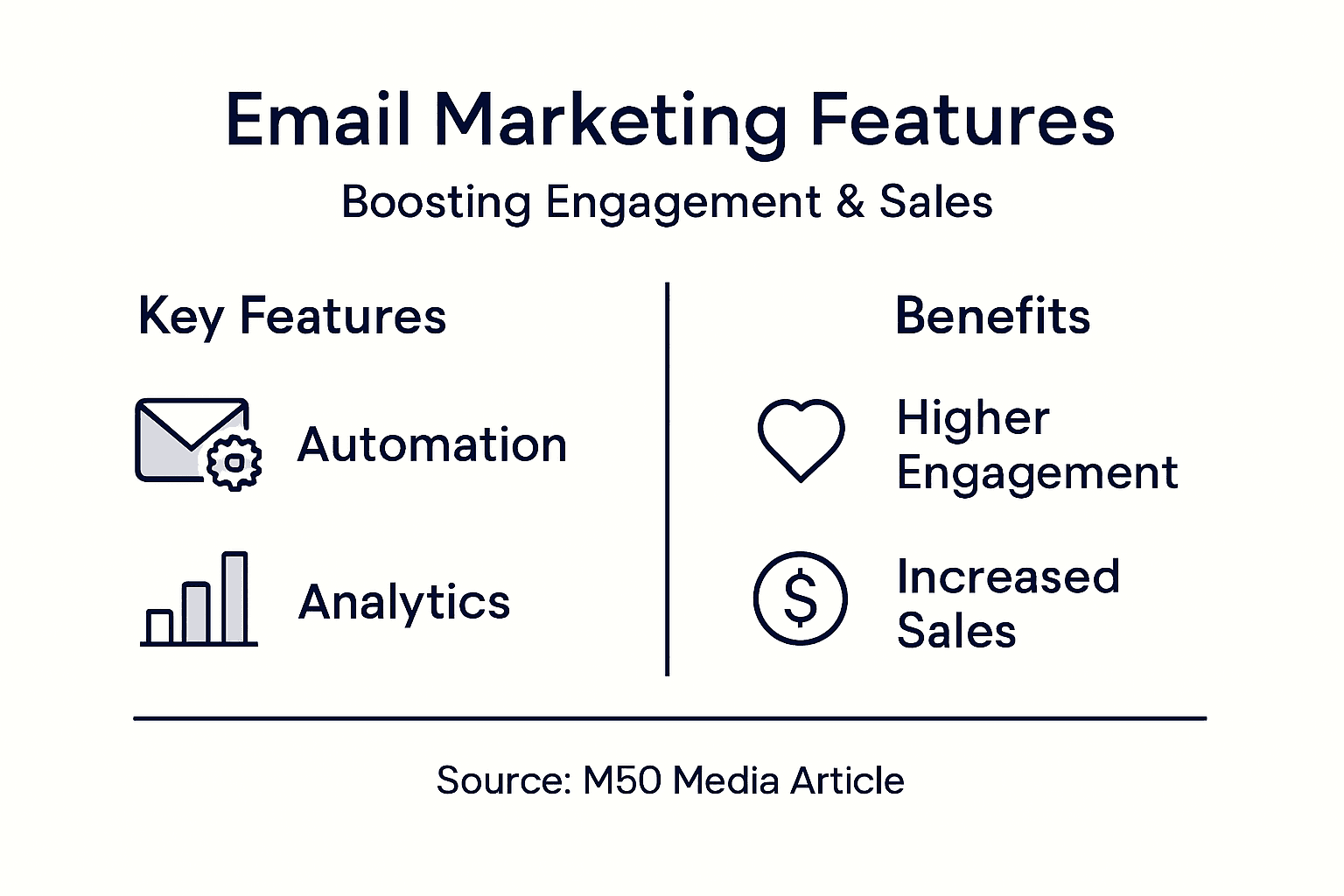
Key Features: Automation, Analytics, and Mobile Reach
Marketing technology has transformed email campaigns from simple communication tools into sophisticated engagement platforms. Marketing automation platforms now enable businesses to create intelligent, responsive communication strategies that adapt to customer behaviours in real-time.
The key technological features that make modern email marketing powerful include:
Automated Workflow Triggers: Sending targeted messages based on specific customer actions
Advanced Segmentation: Categorizing subscribers for highly personalized communication
Performance Tracking: Monitoring critical metrics like open rates and conversions
Mobile Responsiveness: Ensuring emails display perfectly across different devices
Integration Capabilities: Connecting with CRM and other business software systems
Marketing analytics provide crucial insights that help businesses understand and improve their email campaign performance. These tools track everything from basic engagement metrics to complex customer journey analytics, allowing for continuous refinement of marketing strategies.
Effective email marketing is about delivering the right message to the right person at exactly the right moment.
Mobile reach has become particularly critical, with most email interactions now happening on smartphones and tablets. This shift requires marketers to design emails that are not just visually appealing, but also functionally seamless across various mobile platforms and screen sizes.
Pro tip: Test your email campaigns on multiple devices and email clients before sending to ensure consistent performance and user experience.
Legal, Consent, and Compliance Requirements
Email marketing requires navigating a complex landscape of legal regulations designed to protect consumer privacy and prevent unsolicited communications. CAN-SPAM Act regulations establish critical guidelines that businesses must follow to maintain ethical and legal email practices.
Key legal compliance requirements for email marketers include:
Transparent Sender Information: Accurate identification of the sender’s business
Honest Subject Lines: Ensuring email subjects accurately reflect content
Clear Advertisement Labeling: Distinguishing promotional content
Physical Address Disclosure: Including valid business contact details
Straightforward Opt-Out Mechanism: Providing easy unsubscribe options
Consent laws like GDPR have dramatically transformed how businesses collect and manage email marketing permissions. Modern consent requires an explicit, affirmative action from subscribers, moving beyond passive or assumed agreement.
Legal compliance isn’t just about avoiding penalties – it’s about building trust and respect with your audience.
Navigating these regulations requires ongoing vigilance and systematic documentation. Small businesses must implement robust processes to track consent, manage subscriber preferences, and ensure all email communications meet current legal standards.
Pro tip: Develop a comprehensive consent tracking system that records when and how each subscriber agreed to receive emails, creating a reliable audit trail.
Comparing Costs, ROI, and Common Pitfalls
Email marketing represents a uniquely cost-effective digital strategy for small businesses seeking maximum impact with minimal investment. Marketing ROI statistics reveal an extraordinary potential, with businesses averaging $42 in return for every $1 spent on email campaigns.
Key financial considerations and potential challenges include:
Low Initial Investment: Minimal setup and distribution costs
High Conversion Potential: Direct pathway to customer engagement
Performance Tracking: Easy measurement of campaign effectiveness
Scalability: Can grow with business without proportional cost increases
Targeted Messaging: Reduced waste through precise audience targeting
Calculating marketing return on investment requires understanding both immediate and long-term value. Beyond direct sales, email marketing builds brand awareness, nurtures customer relationships, and creates sustainable communication channels.
See how email marketing stacks up against other digital channels for small businesses:
Channel | Average ROI | Targeting Precision | Setup Complexity |
Email Marketing | $42 per $1 spent | High (segmented lists) | Low |
Social Media | $5 per $1 spent | Medium | Medium |
Paid Search | $8 per $1 spent | High (keyword targeting) | High |
Successful email marketing isn’t about spending more, but about spending smarter and measuring impact comprehensively.
Common pitfalls can dramatically reduce campaign effectiveness. These include poor list management, generic messaging, inconsistent sending frequencies, and neglecting mobile optimization. Small businesses must remain vigilant and adaptive to maintain their email marketing performance.
Pro tip: Implement a quarterly review of your email marketing metrics to continuously refine your strategy and maximize return on investment.
Elevate Your Small Business Growth with Expert Email Marketing Guidance
If you have read “Why Use Email Marketing: Boosting Engagement & Sales” you understand the critical need for personalized messaging, audience segmentation, and strategic automation to transform generic emails into meaningful customer conversations. Struggling with how to implement these concepts effectively or unsure how to turn engagement into real sales is a common challenge many small businesses face. Without expert insight, the powerful potential outlined in the article can be difficult to unlock.

Take confident action today by exploring tailored digital marketing coaching and resources at M50 Media. Karl Lundgren’s expert guidance will help you build a high-quality email list, create targeted campaigns, and leverage automation and analytics for maximum return. Don’t let your email strategy fall flat—visit M50 Media now to discover actionable solutions that connect education with execution. Start turning your email marketing efforts into measurable growth and sustained customer engagement immediately.
Frequently Asked Questions
What are the main benefits of using email marketing?
Email marketing allows businesses to communicate directly with their audience, build relationships, promote products, and increase brand awareness, all while being cost-effective and providing high ROI.
How does audience segmentation improve email marketing effectiveness?
Audience segmentation allows for targeted communication by dividing your email list into distinct groups based on demographics, behaviour, interests, or transactional history, which leads to more relevant and personalized messaging for recipients.
What types of email campaigns are effective for small businesses?
Small businesses can utilize various email campaigns, including welcome series, newsletters, promotional offers, abandoned cart reminders, and re-engagement campaigns, to foster customer relationships and boost sales.
How important is mobile optimization in email marketing?
Mobile optimization is crucial as most email interactions occur on smartphones and tablets. Emails must be visually appealing and functional across various devices to ensure a seamless user experience.
Recommended
Comments