What Is Ecommerce Marketing and Why It Matters
- Karl Lundgren

- Feb 17
- 7 min read
Updated: Feb 19

Expanding your online store beyond local borders can feel daunting for many small business owners. Ecommerce marketing offers a powerful way to reach customers across Canada, the United States, and Europe, turning simple digital interactions into meaningful business opportunities. By focusing on channels like social media marketing and content quality, you can create tailored strategies that build trust and drive sales. Discover how using digital tools and refined tactics can help your business stand out in global marketplaces.
Table of Contents
Key Takeaways
Point | Details |
Ecommerce Marketing Strategy | Small businesses should leverage digital channels to create meaningful customer experiences that drive sales and loyalty. |
Digital Marketing Channels | Focus on two to three primary channels that fit your audience for effective engagement and growth. |
Budget and Measurement | Allocate 7% to 20% of revenue for marketing, and track KPIs to optimize resource allocation and marketing effectiveness. |
Avoid Common Pitfalls | Prioritise user experience and clear audience targeting to prevent mistakes that can hinder ecommerce success. |
Defining Ecommerce Marketing for Small Businesses
Ecommerce marketing represents a strategic approach for small businesses to sell products and services through digital channels, transforming traditional commerce into a dynamic online experience. By leveraging digital technologies, entrepreneurs can expand their market reach far beyond geographical limitations. Electronic marketing strategies enable businesses to create exchanges that simultaneously satisfy customer needs and organizational objectives.
For small business owners, ecommerce marketing involves several critical components:
Digital storefront design that attracts and converts online visitors
Strategic product positioning across multiple digital platforms
Customer engagement through targeted digital communication channels
Data-driven marketing tactics to optimize sales performance
The core purpose of ecommerce marketing goes beyond mere transactions. It’s about creating meaningful digital experiences that build trust, demonstrate value, and encourage repeat business. Small businesses can achieve this by understanding their target audience’s online behaviour, developing compelling digital content, and utilizing sophisticated yet affordable marketing technologies.
Digital marketing channels play a pivotal role in ecommerce success. These include social media platforms, email marketing, search engine optimization, and targeted advertising. Each channel offers unique opportunities to connect with potential customers, showcase products, and drive sales.
Pro tip: Start by selecting two to three digital marketing channels that align best with your target audience’s preferences and invest time in mastering those platforms before expanding.
Popular Ecommerce Marketing Strategies Explained
Ecommerce marketing strategies are sophisticated approaches designed to attract, engage, and convert online customers in an increasingly competitive digital marketplace. Key marketing strategies encompass a comprehensive range of digital techniques that help small businesses expand their online presence and drive sales effectively.
Small businesses can leverage several powerful digital marketing strategies:
Pay-per-click (PPC) advertising to drive targeted traffic
Content marketing to build brand authority and trust
Email marketing for nurturing customer relationships
Social media marketing to engage potential customers
Search engine optimization (SEO) to improve online visibility
These strategies work synergistically to create a robust digital marketing ecosystem. By understanding and implementing targeted approaches, entrepreneurs can create personalized customer experiences that differentiate their brand in crowded online markets. Successful ecommerce marketing requires a nuanced understanding of digital consumer behaviour, technological trends, and data-driven insights.
Digital targeting has revolutionized how businesses connect with potential customers. Modern ecommerce marketing allows for unprecedented precision in audience segmentation, enabling businesses to deliver highly personalized marketing messages that resonate with specific customer demographics, interests, and purchasing behaviours.

Pro tip: Develop a holistic marketing strategy by integrating at least three complementary digital channels and continuously analyse performance metrics to refine your approach.
Essential Tools and Channels for Growth
Successful ecommerce marketing depends on leveraging the right digital tools and channels that enable small businesses to reach, engage, and convert online customers. Ecommerce marketing tools provide critical infrastructure for managing operations, automating marketing processes, and delivering personalized customer experiences across multiple digital platforms.
Small businesses should consider investing in these essential marketing channels:
Social media marketing for building brand awareness
Content marketing to establish thought leadership
Search engine optimization (SEO) to improve online visibility
Email marketing for direct customer communication
Pay-per-click (PPC) advertising to drive targeted traffic
Video advertising to create engaging brand narratives
Each marketing channel offers unique advantages for reaching potential customers. The key is developing an integrated approach that allows seamless communication and consistent brand messaging across different platforms. Modern ecommerce businesses must think strategically about how these channels complement each other, creating a cohesive digital marketing ecosystem.
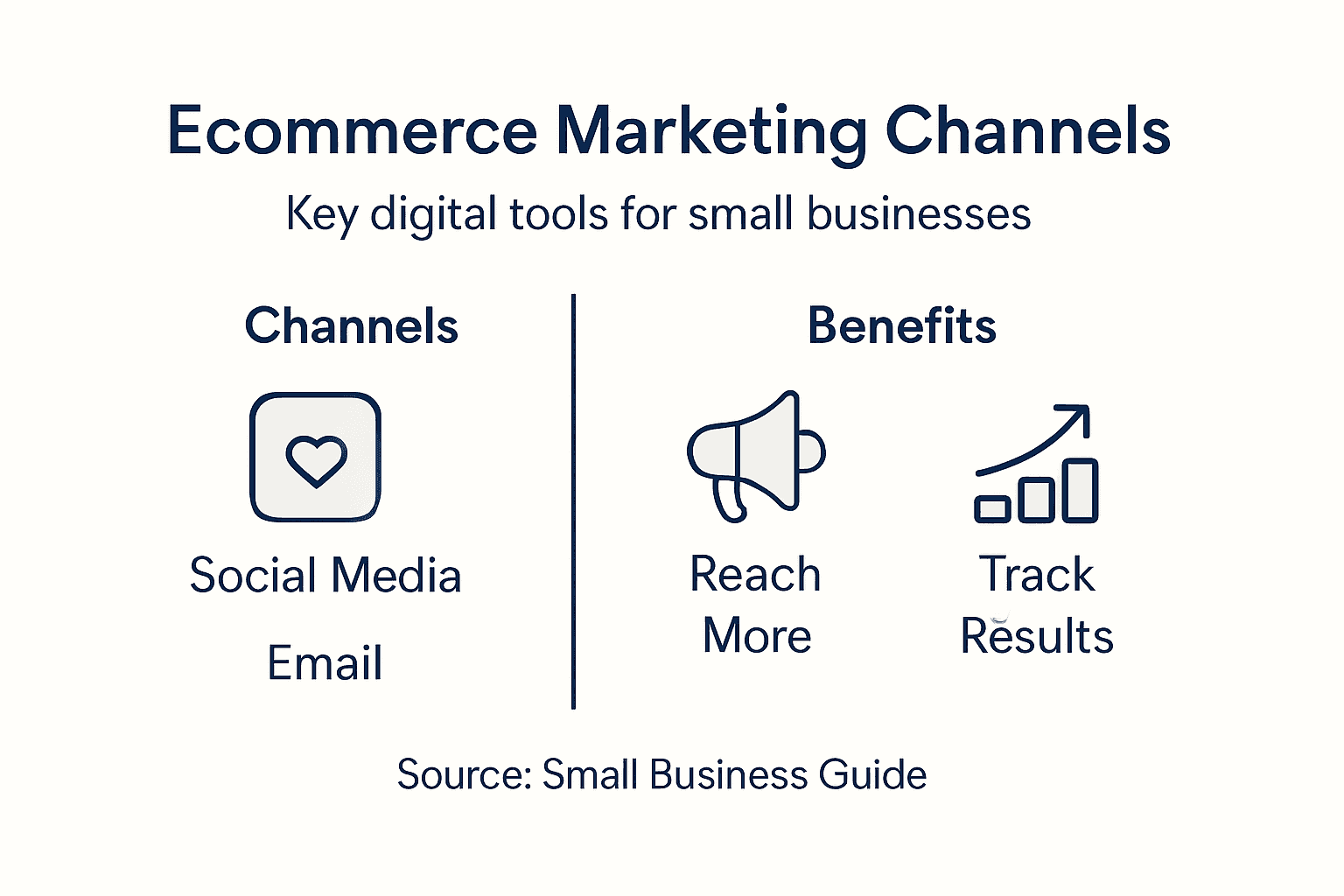
Here’s a comparison of popular digital marketing channels and their primary business benefits:
Channel | Main Purpose | Key Business Benefit |
Social media marketing | Brand awareness & engagement | Builds loyal online community |
Content marketing | Thought leadership | Establishes business credibility |
SEO | Improves online visibility | Attracts organic website traffic |
Email marketing | Direct communication | Fosters repeat customer purchases |
PPC advertising | Targeted traffic boost | Immediate sales opportunities |
Video advertising | Engaging brand stories | Increases user time on site |
Digital analytics play a crucial role in understanding channel performance. By tracking metrics like conversion rates, engagement levels, and customer acquisition costs, entrepreneurs can continuously refine their marketing strategies and allocate resources more effectively.
Pro tip: Select marketing tools that offer robust integration capabilities and provide comprehensive analytics to help you make data-driven decisions about your digital marketing investments.
Budgeting, Costs, and Measuring Success
Effective ecommerce marketing requires strategic financial planning and robust performance tracking. Marketing budget allocation typically ranges from 7% to 12% of total revenue, with growth-focused businesses investing up to 20% to accelerate their digital expansion.
Key budget considerations for small businesses include:
Digital advertising expenses
Content creation costs
Marketing tool subscriptions
Social media campaign investments
Search engine optimization efforts
Email marketing platform fees
Comprehensive marketing success depends on tracking critical performance metrics. Small businesses must monitor key performance indicators (KPIs) that provide actionable insights into marketing effectiveness and return on investment. These metrics help entrepreneurs make data-driven decisions and optimize their marketing strategies continuously.
Performance measurement involves understanding complex interactions between marketing investments and business outcomes. By systematically analysing conversion rates, customer acquisition costs, and lifetime customer value, entrepreneurs can refine their marketing approaches and allocate resources more intelligently.
Below is an overview of essential marketing KPIs for small businesses:
Metric | What It Measures | Why It Matters |
Conversion rate | Visitor-to-customer ratio | Indicates sales effectiveness |
Customer acquisition cost | Spend per new customer | Helps manage marketing budget |
Lifetime customer value | Revenue per customer | Supports growth forecasting |
Engagement rate | Interaction per campaign | Reveals content resonance |
Pro tip: Allocate at least 10% of your marketing budget for experimental channels and continuously track performance to identify emerging opportunities and optimize spending.
Common Mistakes and How to Avoid Them
Ecommerce marketing success requires strategic awareness and proactive error prevention. Common ecommerce mistakes can significantly undermine a small business’s digital performance and customer engagement, making it crucial to identify and address potential pitfalls early.
Key mistakes small businesses often encounter include:
Poor website user experience
Ineffective audience targeting
Complicated checkout processes
Neglecting mobile optimization
Inconsistent brand messaging
Weak customer support strategy
Understanding these challenges is only half the battle. Successful entrepreneurs develop robust strategies that anticipate and mitigate potential marketing obstacles. This involves continuous learning, data analysis, and a willingness to adapt marketing approaches based on customer feedback and emerging digital trends.
Marketing personalization represents a critical area where many businesses fall short. By developing detailed buyer personas and leveraging customer data intelligently, entrepreneurs can create more targeted, engaging marketing experiences that resonate with their specific audience segments.
Pro tip: Conduct monthly audits of your digital marketing strategies, systematically reviewing user experience, conversion rates, and customer feedback to identify and address potential performance gaps.
Elevate Your Ecommerce Marketing with Expert Guidance and Proven Solutions
If you are navigating the complex world of ecommerce marketing and seeking effective ways to overcome challenges such as poor audience targeting, inconsistent brand messaging, or low conversion rates, exploring tailored solutions can make a significant difference. The article highlights crucial concepts like digital storefront design, strategic product positioning, and data-driven marketing tactics that resonate deeply with small business goals to build trust and increase sales.

Unlock your business potential today by visiting All Products | Karl Lundgren M50 to discover tools and resources designed for your unique marketing needs. With the expert coaching and digital marketing product recommendations at M50 Media, you can confidently implement strategies that are backed by professional insight. Start transforming your ecommerce approach now before your competitors seize the opportunity.
Frequently Asked Questions
What is ecommerce marketing?
Ecommerce marketing refers to the strategic approach that small businesses use to sell products and services online. It involves leveraging digital channels to enhance customer engagement and drive sales through effective marketing strategies.
Why is ecommerce marketing important for small businesses?
Ecommerce marketing is crucial for small businesses as it allows them to expand their market reach beyond geographical limitations, attract new customers, and create engaging online experiences that can lead to repeat business and brand loyalty.
What are some effective ecommerce marketing strategies?
Effective ecommerce marketing strategies include pay-per-click (PPC) advertising, content marketing, email marketing, social media marketing, and search engine optimization (SEO). These strategies work together to increase online visibility and optimize sales performance.
How can small businesses measure the success of their ecommerce marketing efforts?
Small businesses can measure the success of their ecommerce marketing efforts by tracking key performance indicators (KPIs) such as conversion rates, customer acquisition costs, and lifetime customer value. By analyzing these metrics, businesses can refine their strategies and allocate their marketing budget more effectively.
Recommended
Comments