What Is SEO and Why It Matters for eCommerce


Finding customers online can feel impossible when your store seems invisible compared to larger brands. For eCommerce owners, understanding even the basics of search engine optimisation is the difference between steady organic sales and constant reliance on ads. This guide clears up what SEO really means, why it matters for your Canadian or international business, and how learning the fundamentals helps more buyers discover your products.
Table of Contents
Key Takeaways
Point | Details |
Continuous SEO Effort | SEO is not a one-time task; it requires ongoing optimisation to keep up with changing algorithms and market conditions. |
Keyword Strategy | Focusing on natural keyword usage rather than stuffing keywords improves readability and search rankings. |
Three Types of SEO | On-page, off-page, and technical SEO are crucial pillars that must work together for effective search visibility. |
Investment in SEO | SEO involves both time and financial investment, covering content creation, technical improvements, and backlink building to achieve competitive rankings. |
SEO Explained: Core Concepts and Misconceptions
SEO stands for search engine optimisation and it’s not as complicated as it sounds. Think of it as teaching Google and other search engines what your online store is actually about so they can show it to people actively searching for what you sell.
At its core, SEO involves keyword research, on-page optimisation, and content quality to help your website rank higher on search engines. The goal? Getting real people to find you organically—without paying for ads.

What SEO Actually Does
SEO increases organic traffic to your site, which means visitors who arrive through search results rather than paid advertisements. When someone searches for “handmade ceramic mugs” or “sustainable leather wallets,” you want your eCommerce store showing up near the top.
Here’s what proper SEO accomplishes for your business:
Attracts customers actively searching for your products
Builds brand credibility through higher search rankings
Increases conversion rates by reaching qualified buyers
Reduces your dependence on paid advertising budgets
Creates long-term traffic that compounds over months and years
Your website’s visibility in search results directly determines how many potential customers even know you exist.
Common SEO Misconceptions
Before diving deeper, let’s clear up some myths that trip up eCommerce owners.
Myth 1: SEO is a one-time project. Wrong. Search engines constantly update their ranking factors, competitors optimise their sites, and your own product catalogue changes. SEO requires ongoing effort.
Myth 2: More keywords mean better rankings. This actually hurts you. Stuffing your product descriptions with keywords reads awkwardly and search engines penalise it. Focus on natural, relevant keywords instead.
Myth 3: Links don’t matter anymore. They absolutely do. Quality backlinks from reputable websites signal to search engines that your content is trustworthy and valuable.
Myth 4: SEO takes overnight. Most eCommerce sites see meaningful results in 3-6 months. Some competitive niches take longer. Patience wins here.
How SEO Works for eCommerce
Your eCommerce site needs to align with what customers are actually searching for. When your product pages, category pages, and content address customer needs through strategic keyword use, people click on your results instead of your competitors’.
The mechanics involve three main areas:
On-page factors: Keywords in titles, headings, product descriptions, and image alt text
Technical foundation: Site speed, mobile responsiveness, proper URL structure, and clean code
Off-page authority: Backlinks from other websites, social signals, and brand mentions
All three work together. A perfectly optimised product page with no backlinks won’t rank as well as a good page with strong link authority.
Pro tip: Start by identifying 5-10 keywords your ideal customers actually search for, then optimise your homepage and top product pages around those terms first—quick wins build momentum.
Types of SEO: On-Page, Off-Page, Technical
SEO breaks down into three interconnected categories, and understanding each one matters for your eCommerce success. Think of them as three pillars holding up your search visibility—remove one and the whole structure weakens.
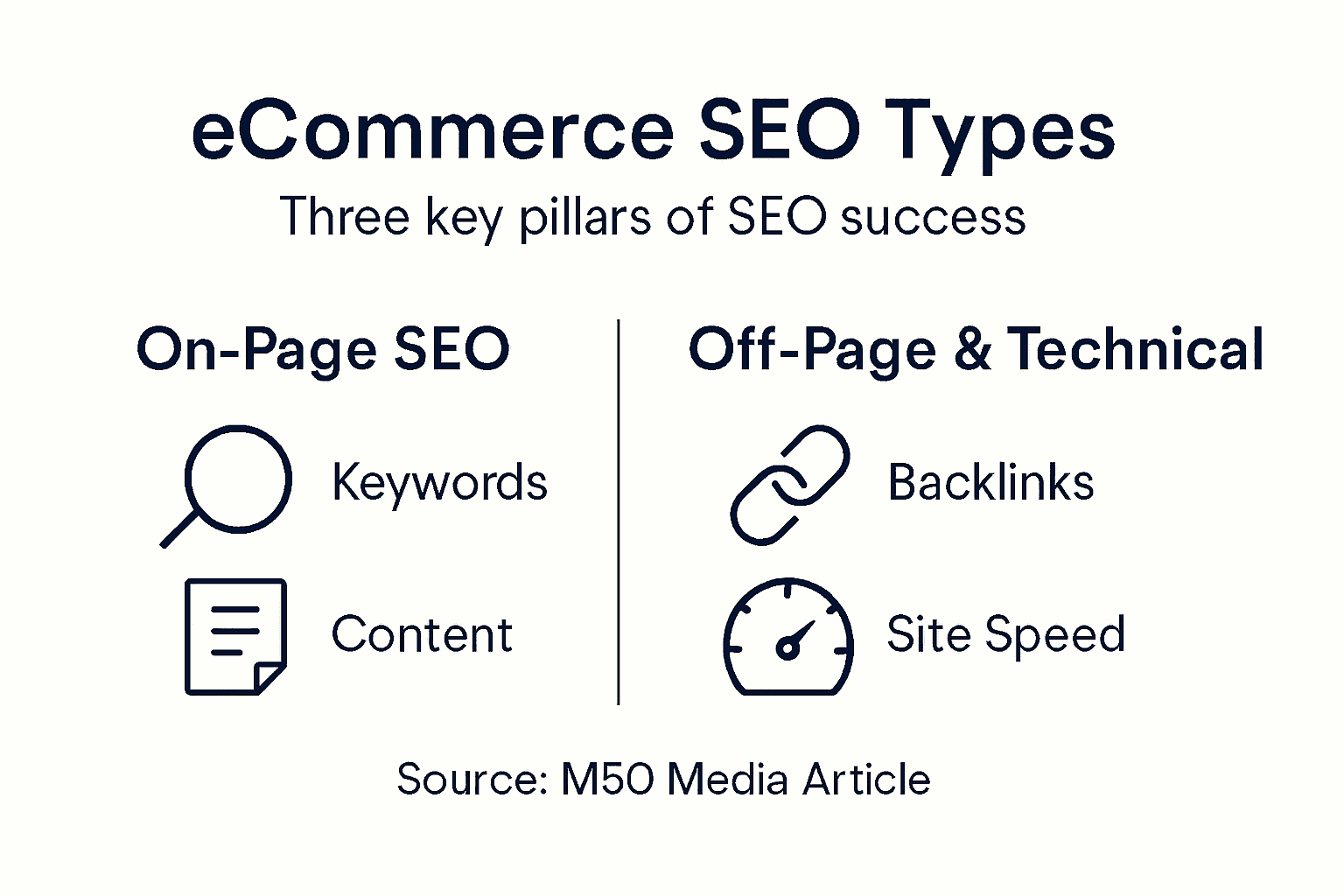
To clarify the distinct roles within SEO, here’s a summary of each main type:
SEO Type | Main Focus | Key Tools & Tactics | Business Value |
On-Page SEO | Content and site elements | Optimised titles, keywords | Immediate relevance to users |
Off-Page SEO | Website authority | Backlink outreach, influencers | Long-term credibility boost |
Technical SEO | Site structure/backend | Speed, mobile, schema markup | Efficient indexing and ranking |
On-Page SEO
On-page SEO focuses on optimising the content and elements within your website that visitors and search engines actually see. This is where most eCommerce owners can make quick wins.
You control everything here:
Product titles and descriptions with relevant keywords
Meta titles and meta descriptions (the preview text in search results)
Heading structure and internal linking between pages
Image alt text describing your products
Page speed and mobile responsiveness
User experience signals like time on page and click-through rates
On-page SEO is the foundation—you can’t rank without getting these basics right.
When someone searches for “organic cotton t-shirts,” your product description needs to naturally include that phrase. But here’s the catch: it has to read naturally for humans first, not just for search engines.
Off-Page SEO
Off-page SEO happens outside your website and builds your site’s authority and reputation. The most powerful signal is backlinks from reputable websites pointing to your store.
Think of backlinks as votes of confidence. When a respected blog mentions your product, that link tells Google your site is trustworthy.
Off-page activities include:
Earning backlinks through quality content and outreach
Social media mentions and engagement
Brand citations on industry directories
Influencer collaborations and product reviews
Local business listings for geo-targeted traffic
Off-page SEO takes longer to build but creates lasting competitive advantage. You can’t buy your way in—you earn it through quality products and strategic relationships.
Technical SEO
Technical SEO ensures search engines can actually crawl, index, and understand your website properly. This lives in the backend—things visitors don’t see but Google absolutely cares about.
Critical technical elements:
Site architecture and URL structure (clean, logical hierarchy)
Page speed and Core Web Vitals (how fast pages load)
Mobile optimisation (responsive design on all devices)
XML sitemaps and robots.txt files
Structured data markup for rich snippets
SSL security and HTTPS protocol
Technical SEO includes site speed, mobile-friendliness, and crawlability, all working together to help search engines index your products efficiently. A slow eCommerce site loses rankings and customers—people abandon sites that take more than three seconds to load.
How They Work Together
All three types are essential and complementary. Imagine on-page SEO as writing a great product description, off-page SEO as getting other stores to recommend you, and technical SEO as making sure your store website doesn’t crash when traffic spikes.
Neglect any one and your rankings suffer. But master all three and you build a sustainable competitive advantage that compounds over time.
Pro tip: Audit your top ten product pages for on-page basics first (titles, descriptions, internal links), then identify three competitor backlink sources you could target—quick wins in both areas accelerate overall results.
How SEO Works in 2026 for eCommerce
SEO in 2026 is more practical and measurable than ever before. Search engines now prioritise user experience, content quality, and business legitimacy over keyword stuffing tricks. For eCommerce owners, this means focusing on what actually converts customers rather than gaming algorithms.
The Modern eCommerce SEO Approach
Today’s SEO works by aligning your store with how real people search. When someone types “waterproof hiking boots size 10,” they’re not just browsing—they’re ready to buy. Your job is making sure your product pages appear for those high-intent searches.
eCommerce SEO focuses on keyword research, structured product data, site performance, and trustworthy backlinks to increase the chances customers find your products and make purchases. This isn’t about ranking for vanity keywords anymore. It’s about ranking for searches that generate revenue.
The Four Pillars Working Together
Modern SEO success relies on four key pillars: technical SEO, on-page SEO, off-page SEO, and continuous monitoring. Each pillar supports the others.
Here’s how they interact:
Technical foundation ensures search engines can crawl and index your product pages without friction
On-page optimisation makes your content relevant to customer search intent
Off-page authority signals to Google that other websites trust your store
Data analysis reveals what’s working so you can double down on winning strategies
Without continuous monitoring and adjustment, even perfectly optimised content eventually falls behind competitors.
Think of technical SEO as the plumbing and electrical systems in a store. If customers can’t navigate or the lights don’t work, nothing else matters. On-page SEO is your storefront display—it catches attention. Off-page SEO is your reputation—what people say about you when you’re not listening.
What Changed in 2026
Search engines now prioritise expertise, authoritativeness, and trustworthiness (sometimes called E-E-A-T). For eCommerce, this means:
Customer reviews and ratings carry more weight than before
Product schema markup helps Google understand what you’re selling
Page experience metrics directly impact rankings
Content must demonstrate genuine product knowledge, not just descriptions
Mobile optimisation isn’t optional—it’s mandatory for visibility
Google’s algorithms now recognise when content is genuinely helpful versus when it’s written purely for search engines. Your product descriptions should answer real customer questions: sizing, materials, durability, shipping costs.
Practical Implementation for Your Store
Stop thinking about SEO as separate from business strategy. Ecommerce marketing strategy encompasses SEO as one critical channel among email, social, and paid advertising. They work together.
Your priority list should be:
Fix technical issues slowing down your site
Optimise your top-performing product pages first
Build backlinks by reaching out to relevant industry sites
Analyse what keywords drive actual purchases
Repeat and refine based on data
This isn’t a one-time project. eCommerce SEO is an ongoing cycle of testing, measuring, and improving. The stores that win in 2026 treat SEO like they treat customer service—as a continuous investment that pays dividends.
Pro tip: Start by identifying your ten highest-revenue product categories, then optimise those pages first using your best keywords and customer reviews—quick wins in high-value categories compound faster than spreading effort across your entire catalogue.
Risks, Costs, and Common SEO Mistakes
SEO isn’t free, and cutting corners can cost you far more than investing properly. The risks range from wasted time to actual security threats. Understanding these dangers helps you avoid expensive mistakes.
Real Costs of SEO
SEO requires investment—either your time or your money, usually both. Many eCommerce owners underestimate what it truly costs to rank competitively.
Your SEO budget typically includes:
Content creation: Product descriptions, blog posts, and category pages (time or freelancer fees)
Technical optimisation: Site speed improvements, mobile responsiveness, schema markup (developer time)
Tools and software: SEO platforms, analytics tools, keyword research software (monthly subscriptions)
Backlink building: Outreach campaigns, guest posting, relationship management (time or agency fees)
Monitoring and analysis: Tracking rankings, traffic, conversions, and competitor moves
Treating SEO as free marketing is the fastest way to waste months achieving nothing.
Small business owners often spend 5–15 hours monthly on DIY SEO or pay agencies £500–£5,000 monthly. The return justifies the investment when done correctly, but there’s a real upfront cost.
For eCommerce owners considering SEO investments, compare main cost categories and potential ROI:
SEO Investment Area | Typical Cost Range | Measurable Outcomes |
Content Creation | $200–$2,000/month | Improved product rankings |
Technical Optimisation | $300–$3,000/project | Faster load time, higher conversions |
Backlink Building | $500–$5,000/month | Elevated domain trust, traffic growth |
Monitoring & Analysis | $20–$150/month | Better targeting, ongoing gains |
Common Mistakes That Tank Rankings
Common SEO mistakes include keyword stuffing, poor site structure, slow page speed, mobile neglect, and low-quality backlinks that trigger search engine penalties. These errors waste resources and diminish performance.
Keyword stuffing sounds smart in theory—use your target keyword everywhere. In reality, it reads awkwardly and Google penalises it. Your product description should flow naturally for humans, not robots.
Slow page speed kills rankings and conversions. If your eCommerce site takes more than three seconds to load, you’re losing customers and Google rankings simultaneously.
Neglecting mobile optimisation in 2026 is unforgivable. Most eCommerce traffic comes from mobile devices. If your site isn’t mobile-friendly, you’ve already lost.
Poor site architecture confuses both search engines and customers. If your product categories are buried three levels deep with illogical URL structures, Google struggles to crawl you.
Low-quality backlinks actually hurt you. Buying links from spammy directories or accepting links from irrelevant sites signals to Google that your site isn’t trustworthy.
Security and Cybersecurity Risks
SEO poisoning is a cybersecurity threat where attackers manipulate search results to promote malicious sites through malware distribution or social engineering. Your eCommerce store’s security directly impacts your SEO viability.
Protect yourself through:
Regular software updates and security patches
Strong passwords and two-factor authentication
Web application firewalls blocking suspicious traffic
Regular malware scans on your website
Collaboration between your SEO team and security experts
A hacked website ranks nowhere. Attackers inject malicious code, redirect traffic, or destroy your content. Recovery takes months and costs thousands.
How to Avoid These Mistakes
When building your digital marketing plan, include SEO strategy alongside other channels for comprehensive coverage. Don’t treat SEO in isolation.
Your mistake-prevention checklist:
Write naturally for humans first, keywords second
Test page speed monthly and optimise ruthlessly
Check mobile experience on real devices, not just browsers
Build logical site structure before adding content
Focus on earning backlinks from relevant, authoritative sites
Monitor your site for security issues weekly
Review Google Search Console for errors and warnings
Most mistakes stem from rushing or trying to game the system. Patience and fundamentals win every time.
Pro tip: Audit your current site for the three biggest mistakes (slow speed, mobile issues, or keyword stuffing), fix those first, then move to advanced optimisation—fixing obvious problems compounds faster than pursuing perfect strategy.
Emerging Trends and Future of SEO Marketing
SEO isn’t static. The tactics that worked last year shift constantly as search engines evolve and technology advances. Staying ahead means understanding what’s coming and adapting before your competitors do.
Artificial Intelligence Transforming SEO
Artificial intelligence is reshaping how SEO works at every level. AI now handles content creation, data analysis, keyword research, and user personalisation at scale.
AI’s impact on your eCommerce SEO includes:
Automating repetitive optimisation tasks (meta tags, internal linking suggestions)
Analysing customer behaviour to personalise product recommendations
Generating content variations for A/B testing at speed
Predicting which keywords will convert before you launch campaigns
Identifying technical issues faster than manual audits
The catch? AI-generated content without human review reads hollow. Search engines reward genuine expertise. Use AI as an assistant, not a replacement for real knowledge.
Voice Search and Conversational Queries
Voice search optimisation has become crucial as smart assistants grow in popularity, changing how people search and how you should optimise.
When someone uses voice search, they speak naturally. “What’s the best waterproof hiking boot for wet terrain?” instead of “waterproof hiking boots.” Your product descriptions need to match these conversational patterns.
Optimising for voice search means:
Writing in natural language, not keyword syntax
Targeting long-tail, question-based keywords
Creating FAQ sections answering customer questions directly
Ensuring your site speed handles rapid voice queries
Claiming and optimising your Google Business Profile for local voice searches
Voice search will soon account for 50% of all searches—ignoring it now costs you future traffic.
Short-Form Video and User-Generated Content
Marketing trends now emphasise short-form video content, user-generated content strategies, and authentic branding as search engines increasingly favor diverse content formats.
Ecommerce brands winning in 2026 use video heavily. Product unboxing videos, customer testimonials, and behind-the-scenes content rank for relevant keywords and drive conversions.
User-generated content (customers reviewing, unboxing, and recommending your products) builds trust better than polished marketing. Google favours authentic voices. Encourage customers to create video content about your products and link to it from your site.
Future-Ready Technologies
Beyond voice and video, emerging technologies are reshaping SEO strategy:
Augmented reality: Virtual try-on features for clothes, shoes, or glasses boost engagement and reduce returns
Blockchain: Building transparency and trust in your supply chain story
Internet of Things (IoT): Smart product data that personalises shopping experiences
Chatbots: AI-powered customer service that improves user experience signals
What This Means for Your Store
You don’t need to adopt every new technology immediately. Focus on fundamentals that compound: fast site speed, mobile optimisation, quality content, genuine customer reviews.
The stores thriving in 2026 prioritise customer-centric strategies and data-driven creativity. Test new formats (video, voice, interactive content) on small audiences first, measure results, then scale what works.
Evolution beats revolution. Small, consistent improvements compound faster than chasing every trend.
Pro tip: Start by optimising three product pages for voice search (conversational keywords, FAQ sections) and filming one genuine customer testimonial video—test these emerging formats before investing heavily in new trends.
Elevate Your eCommerce Success with Strategic SEO Support
Struggling to turn your SEO knowledge into real growth? This article highlights common SEO challenges like ongoing optimisation, effective keyword use, and building trustworthy backlinks—all critical for attracting your ideal customers and boosting sales. You do not have to navigate these complexities alone. M50 Media offers tailored coaching and expert digital marketing solutions designed to help your eCommerce store master on-page, off-page, and technical SEO fundamentals with confidence.

Take control of your store’s search visibility today. Visit M50 Media to explore how digital marketing education and consulting can transform your SEO strategy from overwhelming to actionable. Learn more about effective eCommerce marketing strategies at M50 Media Blog and discover practical insights to avoid costly SEO mistakes at M50 Media. Get started now and build the sustainable online presence your business deserves.
Frequently Asked Questions
What is SEO and why is it important for eCommerce?
SEO, or search engine optimisation, is the process of optimising your website to improve its visibility in search engine results. For eCommerce, effective SEO drives organic traffic, attracts customers searching for products, and enhances brand credibility, ultimately leading to higher conversion rates.
How does on-page SEO impact my eCommerce site?
On-page SEO focuses on optimising elements within your website, like product titles, descriptions, and headings, to align with customer search intent. It directly influences your site’s relevance to users, helping your products rank higher and gain visibility in search results.
What are common mistakes to avoid with SEO?
Common SEO mistakes include keyword stuffing, slow page speed, neglecting mobile optimisation, and poor site structure. These can lead to penalties from search engines, lower rankings, and lost traffic, making it crucial to follow best practices in your SEO strategy.
How long does it take to see results from SEO?
Most eCommerce sites can expect to see meaningful results from SEO within 3-6 months. However, competitive niches may take longer. Continuous optimisation and adjustment are necessary to maintain and improve your rankings over time.
Recommended
Comments