Affiliate marketing explained: Earn more through online partnerships

TL;DR:
Affiliate marketing is an accessible, low-risk strategy that allows small businesses to generate online revenue through performance-based partnerships. Success depends on building long-term relationships, actively managing risks like fraud, and integrating it into a comprehensive marketing plan. With patience and proper management, affiliate marketing offers ongoing growth and diversified income streams for small enterprises.
Affiliate marketing has a reputation problem. Too many small business owners hear the phrase and picture massive corporations with seven-figure budgets, tech wizards coding tracking systems, and influencers with millions of followers. Sound familiar? Here’s the reality check: affiliate marketing is one of the most accessible, low-risk ways for Canadian small businesses to generate extra revenue online, and you don’t need a massive budget or a computer science degree to get started. This guide is going to break it all down, step by step, so you can decide if affiliate marketing belongs in your growth toolkit.
Table of Contents
Key Takeaways
Point | Details |
Low-risk, scalable revenue | Affiliate marketing lets you pay commissions only on results, making it ideal for small businesses. |
Understand both pros and cons | Success requires recognizing both the opportunities and limitations of affiliate partnerships. |
Protect against fraud | Active measures such as payout holds and post-conversion tracking reduce your risk of losses. |
Integrate with broader marketing | Combine affiliate strategies with digital, email, and content marketing for best results. |
What is affiliate marketing and how does it work?
Let’s begin by clarifying what affiliate marketing really means and how it works in practice.
Affiliate marketing is a performance-based partnership. A merchant (that’s you, the business owner) teams up with an affiliate (a blogger, content creator, or website owner) who promotes your products or services. When a customer clicks the affiliate’s unique link and makes a purchase, the affiliate earns a commission. Simple as that.
There are three main players in every affiliate arrangement:
Merchant: The business offering a product or service (hello, that’s you!)
Affiliate: The promoter who drives traffic and sales through content or ads
Customer: The person who clicks, browses, and hopefully buys
The magic behind the scenes is a unique tracking link or code. Every affiliate gets their own link. When a customer uses it, the system records the sale and attributes the commission correctly. No tracking link, no commission. It’s surprisingly tidy.
What makes this model so appealing for small businesses is the financial structure. You only pay when results happen. No results, no payout. Compare that to traditional advertising where you spend money upfront and hope for the best. Measuring your digital marketing ROI becomes much easier when you’re only paying for actual conversions.
Pro Tip: Don’t try to build a dozen affiliate relationships at once. Start with a single program, test it, learn from it, and then expand. Scaling slowly means you actually understand what’s working.
Advantages and disadvantages of affiliate marketing
Now that you know how affiliate marketing works, it’s important to look at both the upsides and the challenges.
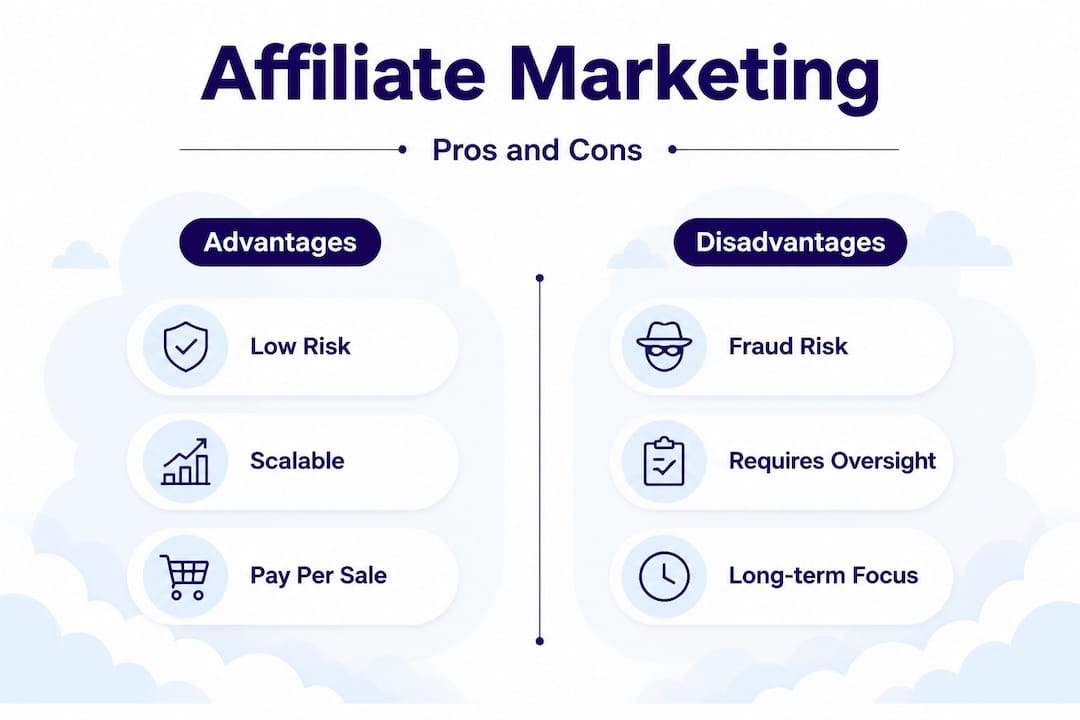
Affiliate marketing isn’t a magic money machine (wouldn’t that be nice). Like any business strategy, it comes with genuine benefits and real drawbacks. Let’s get honest about both.

The pros and cons of affiliate marketing are worth understanding before you commit your time and energy.
Here’s a quick comparison to give you the full picture:
Factor | Pros | Cons |
Startup cost | Very low, often minimal | Platform fees can add up |
Scalability | Grows with your affiliate network | Hard to control partner quality |
Income type | Potential for passive, ongoing income | Payouts can fluctuate or be delayed |
Inventory | No need to manage extra stock | Dependent on partner performance |
Competition | Open to many niches | Saturated markets can limit results |
Risk | Pay on results only | Vulnerable to algorithm changes |
The major advantages for small businesses include:
Low startup costs, since you’re not paying for ads upfront
Scalability, because you can add more affiliates as your business grows
Potential for passive income once systems are set up
No inventory headaches, since affiliates promote what you already sell
Access to new audiences you might never have reached on your own
There are also some genuine challenges to keep in mind:
High competition in popular niches means standing out takes effort
You become dependent on your affiliates’ performance and reputation
Payouts can fluctuate based on seasonality or partner activity
External factors like social media algorithm changes can tank an affiliate’s reach overnight
Fraud and low-quality traffic can drain your budget without delivering real customers
“Affiliate marketing offers a compelling mix of low-cost entry and scalable revenue potential, but businesses must actively manage the risks of partner dependency and external market shifts to see sustainable results.”
Understanding these online marketing advantages alongside the risks helps you go in with realistic expectations. Affiliate marketing isn’t a guaranteed income stream, and it rarely produces overnight results. But for businesses willing to invest time in building the right partnerships, the long-term payoff can be genuinely impressive.
It’s also worth noting that affiliate marketing works best when it’s part of a broader strategy. Think of it less like a standalone business model and more like one powerful channel in a well-rounded marketing mix. When combined with marketing funnels, your affiliate traffic has a much better chance of converting into loyal customers.
Building an effective affiliate program for your business
If you’re ready to try affiliate marketing, here’s exactly how to get started, with pitfalls to watch for.
Launching an affiliate program isn’t complicated, but it does require some planning. Flying blind here is like showing up to a potluck without knowing what dish you’re bringing. Here’s a clear sequence to follow:
Set your goals. Decide what success looks like. More sales? Email sign-ups? App downloads? Being specific here guides every other decision.
Choose your affiliate software. Tools like ShareASale, Impact, or Refersion help you manage links, track conversions, and automate payouts. Pick one that fits your budget and technical comfort level.
Recruit affiliates. Look for content creators, bloggers, or niche sites whose audiences match your ideal customer. Quality beats quantity every single time.
Create marketing materials. Give your affiliates banners, email templates, product images, and key messaging. The easier you make their job, the better your results.
Set clear policies. Define commission rates, cookie windows, and acceptable promotional methods in writing. Ambiguity causes headaches later.
Monitor and optimise continuously. Review your data regularly and adjust based on what’s actually working.
Here’s a snapshot of what typical commission structures look like across different business types:
Business type | Typical commission rate | Cookie window |
E-commerce (products) | 5% to 15% | 30 days |
Software/SaaS | 20% to 40% | 60 to 90 days |
Digital products | 30% to 50% | 30 to 60 days |
Service-based businesses | 10% to 25% | 30 days |
One area many business owners overlook is fraud. This is not a minor issue. Research shows that 10 to 30% of affiliate spend can be lost to fraudulent tactics like cookie stuffing (where fake cookies are placed on a user’s browser without their knowledge), bot traffic, and fake leads. According to the same source, approximately 17% of all affiliate traffic can be fraudulent. That’s a significant chunk of your marketing budget potentially going nowhere.
Building ethical, transparent systems from the start is exactly why ethical marketing strategies matter so much in this space. Your reputation is on the line alongside your budget.
Having a solid digital marketing plan in place before you launch your affiliate program will also help you integrate it smoothly with the rest of your marketing activities.
Smart client acquisition strategies remind us that the foundation of any successful program is attracting the right people, not just the most people.
Pro Tip: Protect your budget from day one. Ban affiliates from bidding on your branded keywords in paid search, require a payout hold period (so you can verify sales are genuine before paying out), and set up post-conversion tracking to catch fake leads before they cost you money.
Maximising your results: Best practices and next steps
Now that your program is up and running, let’s look at ways to maximise its value and avoid common mistakes.
Getting a program live is a win. Keeping it healthy and growing? That’s where the real effort begins. The businesses that see the best long-term results from affiliate marketing aren’t the ones who set it up and walk away. They’re the ones who treat it like a living, breathing part of their business.
Here are the strategies that actually move the needle:
Monitor performance regularly. Track clicks, conversions, and revenue per affiliate. If someone isn’t converting, figure out why before you cut them loose.
Test commission rates. Sometimes a small increase in commission dramatically boosts affiliate motivation. Experiment and see what threshold turns casual promoters into enthusiastic ones.
Refresh your marketing assets. New banners, seasonal promotions, and updated product descriptions keep your affiliates engaged and their content current.
Integrate with email and content campaigns. When your affiliate programme runs alongside strong email marketing, you’re reinforcing your message across multiple touchpoints.
Use social media partnerships. Affiliates who are active on Instagram, YouTube, or TikTok can extend your reach into audiences that organic social alone wouldn’t touch.
Build real relationships with top performers. Send personalised check-ins, offer performance bonuses, and make your best affiliates feel like genuine partners, not just contractors.
The pros and cons of affiliate marketing make it clear that sustainability comes from actively managing the relationship side, not just the technical side. Affiliates who feel valued stick around longer and promote more enthusiastically.
Staying current with marketing strategies for 2026 is another way to stay ahead, as the affiliate landscape shifts with every new platform and algorithm update.
The broader lesson here connects to what the most effective marketing strategies have in common: consistency, testing, and genuine value creation.
Pro Tip: Use AI in marketing tools to automate fraud detection, generate performance reports, and even identify which types of affiliates tend to convert best for your specific business. Working smarter here gives you more time to focus on the relationships that matter.
Why most small businesses underestimate affiliate marketing’s long-term potential
With these practical best practices in mind, it’s worth stepping back to consider what makes affiliate marketing work, especially for smaller brands.
Here’s an uncomfortable truth: most small businesses abandon their affiliate programs within the first three to six months. They launch with excitement, see slow initial traction, and conclude that affiliate marketing “just doesn’t work.” Then they move on to the next shiny strategy. Sound like anyone you know?
The thing is, affiliate marketing isn’t a sprint. It’s more like growing a garden than ordering takeout. You plant the seeds (recruit affiliates, set up tracking, create assets), water them consistently (provide support, refresh materials, pay promptly), and then wait for things to take root. The businesses that stick with it long enough to see that growth are often the ones that quietly build some of the most resilient revenue streams around.
Long-term affiliate relationships are genuinely undervalued. A loyal affiliate who’s been promoting your brand for two years isn’t just generating commissions. They’re creating evergreen content, building brand awareness, and sending you warm, pre-qualified leads on an ongoing basis. That compounding value is hard to replicate with any paid advertising campaign.
The fraud conversation also deserves more attention than most guides give it. Research on affiliate fraudsters reveals that cookie stuffing, bot traffic, and fake leads are far more common than most business owners realise. Ignoring fraud protection isn’t just financially risky. It also means you might end up rewarding bad actors while your legitimate affiliates get lost in the noise. Building a clean, fraud-resistant program from the start sets you apart from the majority of small businesses running sloppy affiliate operations.
The deeper mindset shift here is thinking about affiliate marketing as a channel for building a diversified revenue base, not just a quick commission generator. When affiliate income is one stream among several (alongside email, content, and social), your business becomes more resilient to the inevitable ups and downs of any single channel. That’s genuinely valuable, especially for a small business navigating an unpredictable market.
Start with one good affiliate. Protect your program with solid policies. Stay consistent when growth feels slow. The payoff, over time, tends to justify every bit of that patience.
Take your next step with expert support
Ready to put these strategies into action? Get hands-on support to accelerate your affiliate marketing journey.
Affiliate marketing has real, proven potential for small businesses, but knowing the theory and successfully building a program are two different things entirely. If you’re feeling fired up but not quite sure where to start (or you’ve tried before and hit a wall), expert guidance can make an enormous difference. At M50 Media, we help small business owners like you launch, refine, and grow affiliate programmes that actually deliver results.

Whether you want a one-on-one strategy session or ongoing coaching solutions to keep your marketing on track, we’ve got options built for real businesses with real budgets. Book a free marketing SOS call and let’s map out your next move together. No jargon, no fluff, just a clear plan you can actually use.
Frequently asked questions
How much can my business realistically earn through affiliate marketing?
Earnings vary widely based on your niche, traffic volume, and program management, but the scalable nature of affiliate marketing means income potential grows as your network and audience expand. There’s no fixed ceiling, but there’s also no guaranteed floor.
Is affiliate marketing legal for Canadian businesses?
Absolutely, affiliate marketing is completely legal in Canada. Just make sure your affiliates follow Advertising Standards Canada guidelines for disclosure, and keep your own tax reporting up to date for commissions earned or paid.
How do I protect my business from fraud in affiliate programs?
Use dedicated tracking software, monitor new affiliate signups closely, and enforce policies like payout holds to reduce exposure. Research shows that 17% of affiliate traffic can be fraudulent, so this is one area you really don’t want to skip.
How quickly will I see results from my affiliate program?
Most small businesses need at least three to six months before seeing meaningful, consistent sales from a new affiliate program. Early months are about building relationships and testing what works, not counting commissions.
Can affiliate marketing work if I have a niche or local business?
It absolutely can. Niche and local businesses often outperform broader brands in affiliate marketing because they can partner with highly targeted creators whose audiences closely match their ideal customer. Specificity is your superpower here.
Recommended
Comments