Digital advertising guide for small businesses in 2026


Small businesses waste thousands on digital ads that miss their target audience. You’re not alone if you’ve launched campaigns that drained your budget without delivering leads or sales. Digital advertising in 2026 offers powerful tools to reach customers precisely when they’re ready to buy, but success requires strategy, not just spending. This guide walks you through everything from foundational setup to measuring results, helping you build campaigns that actually work.
Table of Contents
Key takeaways
Point | Details |
Digital advertising drives measurable small business growth | Targeted campaigns reach customers at decision moments, increasing conversions and ROI when properly executed. |
Prerequisites like Google Business Profile optimisation are essential | Local search optimisation and analytics setup form the foundation for successful campaign performance. |
Strategic campaign setup improves targeting efficiency | Defining goals, creating audience personas, and choosing channels based on behaviour maximises ad effectiveness. |
Common mistakes waste budgets and reduce performance | Ignoring mobile optimisation, relying on single channels, and skipping audience research drain resources without results. |
Continuous measurement and adjustment sustain success | Tracking KPIs like conversion rate and ROAS enables data-driven optimisation for long-term growth. |
Introduction to digital advertising for small businesses
Digital advertising encompasses paid promotional efforts across online channels like search engines, social media platforms, display networks, and video sites. For small businesses, it levels the playing field against larger competitors by enabling precise audience targeting based on demographics, interests, and behaviours. Unlike traditional advertising, digital campaigns deliver measurable results in real time, allowing you to adjust strategies based on actual performance data.
The importance of digital advertising for small business growth cannot be overstated. Online marketing advantages for small business include reaching customers actively searching for your products or services, building brand awareness in specific geographic areas, and generating qualified leads at lower costs than traditional media. In 2026, consumers expect to discover and research businesses online before making purchase decisions, making digital presence non-negotiable.
Current trends shaping digital advertising in 2026 include:
AI-powered automation for bid management and audience targeting
Privacy-focused advertising following cookie deprecation
Short-form video content dominating social platforms
Voice search optimisation for local business discovery
Omnichannel campaigns coordinating touchpoints across platforms
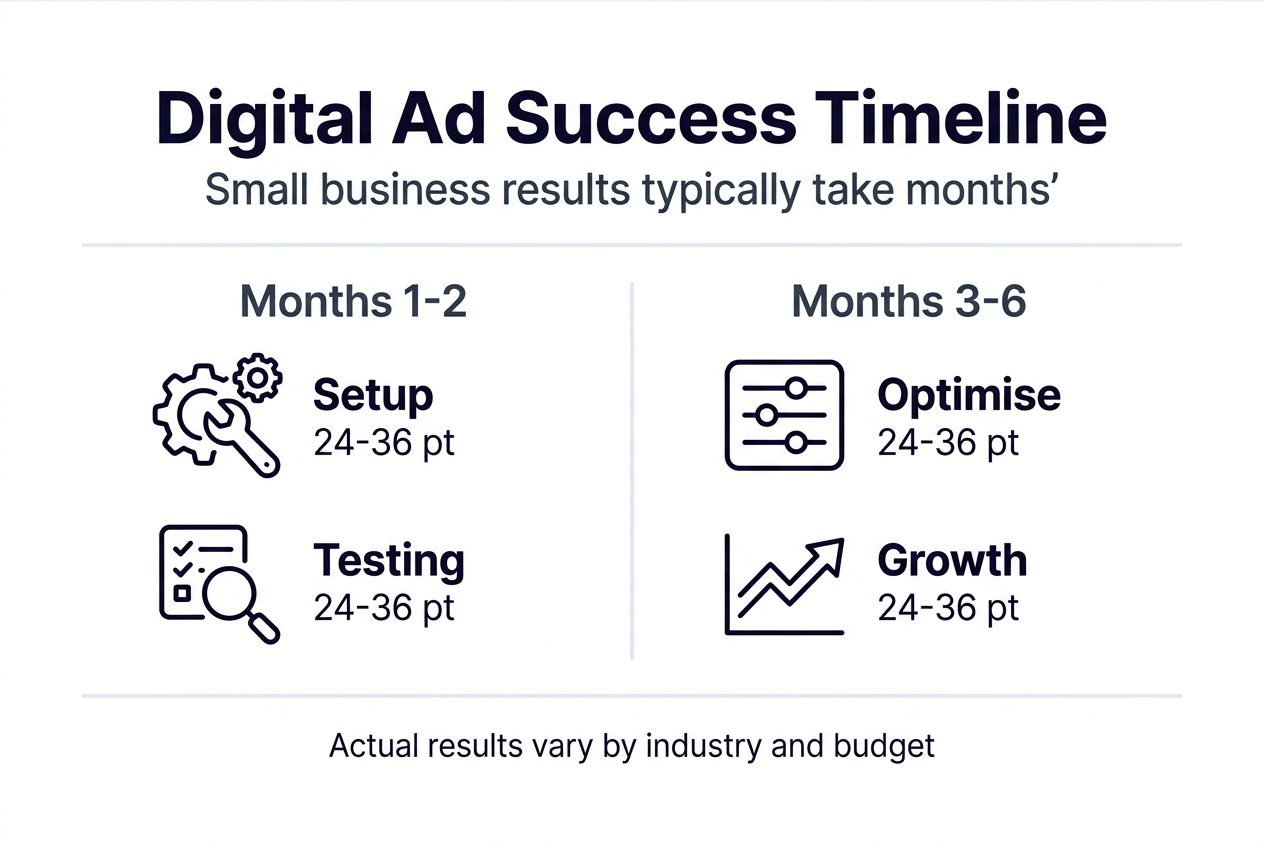
Many small business owners believe that digital advertising success happens overnight, but in reality, it typically takes 3 to 6 months to see solid results. This timeline allows algorithms to optimise, audiences to respond, and data to accumulate for meaningful insights. Patience combined with continuous refinement separates successful campaigns from abandoned experiments.
Integrating content marketing with paid advertising amplifies results. Why build business blog explores how organic content supports paid campaigns by providing valuable resources that build trust and authority. When prospects click your ads and land on helpful, informative content, conversion rates improve dramatically compared to generic landing pages.
Prerequisites and tools needed before starting
Before launching your first campaign, establishing foundational tools ensures you can track performance and optimise effectively. Google Business Profile optimisation stands as the most critical starting point for local businesses. Optimising Google Business Profile gives a local search advantage, improving visibility in map results and local pack listings where high-intent customers discover businesses ready to serve them.
Setting up marketing analytics and tracking tools provides the data infrastructure for campaign success. Google Analytics 4 tracks website behaviour, showing how ad traffic converts compared to organic visitors. Google Tag Manager simplifies tracking code deployment without developer assistance. Conversion tracking pixels from advertising platforms measure specific actions like form submissions, phone calls, and purchases, connecting ad spend directly to revenue.

Conducting audience research and basic segmentation prevents wasted impressions on unqualified prospects. Analyse your existing customer base to identify common characteristics like age ranges, income levels, geographic locations, and interests. Survey customers about how they discovered your business and what problems your products solve. This research informs targeting parameters that focus budgets on audiences most likely to convert.
Essential accounts you’ll need include Google Ads for search and display campaigns, Meta Business Suite for Facebook and Instagram advertising, and LinkedIn Campaign Manager if targeting professionals. Each platform requires business verification and payment method setup before launching campaigns.
Tool | Purpose | Cost | Key benefit |
Google Business Profile | Local search visibility | Free | Appears in map results for local searches |
Google Analytics 4 | Website traffic analysis | Free | Tracks user behaviour and conversions |
Google Ads | Search and display advertising | Pay per click | Captures high-intent search traffic |
Meta Business Suite | Social media advertising | Pay per impression | Targets detailed demographic and interest segments |
Google Tag Manager | Tracking code management | Free | Simplifies conversion tracking setup |
Pro Tip: Create a dedicated business email address for all advertising accounts rather than using personal credentials. This prevents access issues when team members change and maintains professional boundaries between business and personal digital assets.
Invest in SEO boost small business efforts alongside paid advertising for long-term sustainability. While ads deliver immediate visibility, organic search rankings reduce customer acquisition costs over time. Understanding digital marketing ROI helps you balance paid and organic investments for optimal growth.
Step-by-step digital advertising campaign setup
Successful campaigns start with crystal-clear goals aligned to business objectives. Vague aims like “get more customers” fail because they lack measurable targets. Instead, define specific outcomes such as generating 50 qualified leads monthly, achieving $5 cost per lead, or driving 100 store visits weekly. These concrete goals enable precise campaign configuration and objective performance evaluation.
Creating detailed audience personas for targeting transforms generic campaigns into personalised messages that resonate. Develop 2 to 3 personas representing your ideal customers, including demographic details, pain points, preferred platforms, and buying triggers. For example, “Budget-Conscious Homeowner” might be aged 35 to 50, researching contractors on weekends via mobile, prioritising reviews and transparent pricing.
Choosing digital channels based on audience behaviour ensures your ads appear where prospects spend time:
Identify which platforms your personas use most frequently
Match campaign goals to channel strengths (search for intent, social for awareness)
Start with 1 to 2 channels to master before expanding
Allocate budget proportionally based on expected performance
Plan for cross-channel attribution as campaigns mature
Leveraging AI tools for optimisation and automation improves ROI by making data-driven decisions continuously. Google’s Smart Bidding automatically adjusts bids based on conversion likelihood, while Meta’s Advantage+ campaigns optimise creative delivery across placements. These tools handle routine optimisation tasks, freeing you to focus on strategy and creative development.
Launching mobile-optimised ad creatives is non-negotiable in 2026. Design ads specifically for smartphone screens with large, tappable buttons, concise copy that communicates value instantly, and vertical or square formats that fill mobile feeds. Test landing pages on various devices to ensure fast loading and seamless conversion paths from ad click to action completion.
Pro Tip: Create separate campaigns for mobile and desktop rather than combining them. This separation enables device-specific bid adjustments and creative optimisation, often revealing that mobile users convert differently and require distinct messaging approaches.
Explore comprehensive social media advertising guide strategies for lead generation across platforms. Integrate your paid campaigns with broader digital marketing plan guide small businesses frameworks that coordinate all marketing activities for maximum impact.
Common mistakes and how to avoid them
Skipping audience research leads to poor targeting that burns through budgets showing ads to uninterested users. Without understanding who your customers are and what motivates their decisions, you’re essentially hoping random people stumble upon your offer and convert. Invest time upfront analysing customer data, conducting surveys, and testing audience segments to identify responsive groups worth targeting.
Over-reliance on single-channel advertising creates vulnerability when platform algorithms change or costs increase. Businesses exclusively dependent on Facebook ads or Google search face existential threats when policy updates or competitive pressure spike costs overnight. Diversifying across complementary channels builds resilience and often reveals unexpected high-performing audiences on platforms you hadn’t prioritised.
Ignoring mobile optimisation results in 20% lower click-through rates and 15% higher bounce rates compared to mobile-friendly campaigns. With mobile devices generating over 60% of search traffic, failing to optimise means alienating the majority of potential customers. Every element from ad creative to landing page must function flawlessly on smartphones.
Not monitoring and adjusting campaigns regularly wastes opportunities to improve performance. Set a recurring schedule to review metrics weekly initially, then biweekly as campaigns stabilise. Look for declining performance trends, test new ad variations, pause underperforming keywords or audiences, and shift budget toward top performers. Static campaigns deteriorate as market conditions evolve.
Poor budget distribution without performance review compounds inefficiency:
Spreading thin budgets across too many campaigns prevents any from reaching meaningful scale
Funding underperforming campaigns equally with successful ones misallocates resources
Failing to increase budgets for profitable campaigns leaves growth potential unrealised
Not setting daily caps risks overspending during traffic spikes or algorithm errors
“The biggest mistake small businesses make is treating digital advertising as a one-time setup rather than an ongoing optimisation process. Your best results come from continuous testing, learning, and refinement based on real performance data.”
Understanding benefits of social media marketing helps you avoid common social advertising pitfalls while maximising platform-specific advantages for audience engagement and conversion.
Budget considerations and timeline expectations
Typical small business digital ad budgets range from $500 to $3,000 monthly depending on industry competitiveness, geographic market size, and business goals. Service businesses in competitive markets like legal or home services often require higher budgets to achieve meaningful visibility, while niche retailers in smaller markets can see results with modest spending. Start conservatively, prove ROI, then scale investment proportionally.
Return on ad spend (ROAS) benchmarks vary significantly by industry and business model. E-commerce businesses commonly target 4:1 ROAS or higher, meaning $4 revenue for every $1 spent on ads. Lead generation businesses evaluate cost per lead against customer lifetime value rather than immediate return. Professional services might accept higher acquisition costs given substantial transaction values and long client relationships.
It typically takes 3 to 6 months for small businesses to see measurable improvements from digital advertising campaigns. This timeline accounts for algorithm learning periods, audience testing phases, and accumulating sufficient data for statistical significance. Initial weeks focus on gathering insights rather than expecting profitability, with optimisation driving improvement throughout the period.
Continuous optimisation shortens results timeline by accelerating the learning process. Weekly performance reviews, A/B testing multiple ad variations simultaneously, and rapidly pausing underperformers concentrate budget on proven winners faster. Businesses that actively optimise often see positive ROI by month 3, while passive campaigns may take 6 months or never achieve profitability.
Budget allocation tips for multiple channels:
Assign 60% to your primary channel based on audience research
Allocate 30% to a complementary secondary channel
Reserve 10% for testing new platforms or experimental campaigns
Shift allocations quarterly based on performance data
Maintain minimum spend thresholds for algorithms to optimise effectively
Monthly Budget | Recommended Distribution | Expected Outcomes |
$500-$1,000 | Single channel focus | 10-25 qualified leads |
$1,000-$2,000 | 2 channels with testing | 25-60 qualified leads |
$2,000-$3,000 | Multi-channel strategy | 60-100+ qualified leads |
Review comprehensive digital marketing budget tips that help you allocate resources effectively across paid and organic channels for balanced growth. Realistic digital ad timeline expectations prevent premature campaign abandonment before optimisation delivers results.
Alternative digital advertising approaches and tradeoffs
Omnichannel marketing coordinates messaging across multiple platforms to create cohesive customer journeys, while single-channel campaigns concentrate resources on one platform. Omnichannel approaches increase brand recall through repeated exposure and reach prospects at different stages of awareness. However, they require larger budgets, more complex tracking, and sophisticated campaign management that challenges resource-constrained small businesses.
Single-channel campaigns offer simplicity and faster optimisation by focusing learning and budget on one platform. You develop platform-specific expertise quickly and achieve meaningful scale sooner than spreading budgets thin. The tradeoff is increased vulnerability to platform changes and missing prospects who prefer other channels. Most small businesses start single-channel, then expand as campaigns prove profitable.
Approach | Pros | Cons | Best For |
Omnichannel | Higher brand recall, multiple touchpoints | Complex management, higher budget needs | Established businesses scaling growth |
Single-channel | Simplified optimisation, faster learning | Platform dependency, limited reach | New advertisers testing viability |
Content + Paid | Sustainable long-term costs, authority building | Slower initial results, requires creation skills | Businesses building thought leadership |
Influencer partnerships | Authentic endorsements, engaged audiences | Finding reliable partners, variable results | Consumer brands targeting younger demographics |
Integrating content marketing with paid ads combines immediate visibility with long-term organic growth. Paid campaigns drive traffic to helpful blog posts, guides, or tools that demonstrate expertise and build trust. Visitors who engage with quality content convert at higher rates than those landing on purely promotional pages. This approach requires content creation investment but reduces customer acquisition costs over time as organic rankings improve.
Leveraging user-generated content and influencer partnerships adds authentic social proof to campaigns. Customer reviews, testimonials, and user photos build credibility more effectively than brand-created content. Micro-influencer partnerships in your niche connect you with engaged audiences at fraction of celebrity endorsement costs. These approaches work exceptionally well for consumer brands but offer limited value for B2B professional services.
Choosing approaches aligned with business goals and resources prevents overextension. Match your strategy to current capabilities, knowing you can evolve as campaigns succeed. A solo entrepreneur might start with focused Google Ads while building content assets, then expand to social advertising as resources grow.
Explore how content marketing benefits amplify paid advertising performance by providing valuable resources that nurture prospects through decision processes. Review comprehensive social media advertising guide strategies that coordinate organic and paid social efforts for maximum impact.
Measuring success: key metrics and next steps
Important KPIs reveal campaign health and guide optimisation decisions. Conversion rate measures the percentage of ad clicks resulting in desired actions, whether purchases, lead form submissions, or phone calls. Click-through rate (CTR) indicates ad relevance, with higher rates suggesting your messaging resonates with targeted audiences. Cost per lead quantifies acquisition efficiency, enabling comparison across channels and campaigns. Return on ad spend (ROAS) connects advertising investment directly to revenue generation.
Tools for tracking and reporting campaign results include native platform dashboards like Google Ads and Meta Ads Manager, which provide real-time performance data. Google Analytics reveals post-click behaviour, showing how ad traffic navigates your website and where conversion friction occurs. Call tracking services attribute phone inquiries to specific campaigns, crucial for service businesses where phone leads drive revenue. CRM integration connects advertising data to closed deals, calculating true customer acquisition cost.
Analysing data for actionable insights requires looking beyond surface metrics to understand performance drivers:
Segment performance by device, location, and time to identify patterns
Compare landing page conversion rates to isolate creative versus page issues
Track customer journey touchpoints to understand multi-channel attribution
Calculate lifetime value by acquisition source to prioritise long-term profitable channels
Monitor quality scores and relevance metrics that impact costs
Strategies for scaling campaigns based on performance start with identifying your top-performing audiences, keywords, and ad variations. Gradually increase budgets for these winners while maintaining cost per acquisition targets. Expand into similar audiences and related keywords that share characteristics with proven performers. Test new ad formats and placements within successful campaigns before launching entirely new initiatives.
Continuous optimisation serves as the key to sustained success. Schedule regular performance reviews, maintain a testing calendar for new variations, document learnings from both successes and failures, and stay current with platform updates that introduce new targeting or bidding options. Marketing is never truly finished, it evolves with your business and market conditions.
Master digital marketing KPIs that matter most for small business growth, ensuring you focus measurement efforts on metrics that drive real business outcomes rather than vanity numbers.
Discover expert digital coaching and marketing support
Implementing effective digital advertising requires expertise that many small business owners develop over months or years of trial and error. M50 Media offers digital marketing coaching specifically designed for small businesses navigating the complexities of online advertising. Our coaching programmes provide personalised guidance on campaign strategy, platform selection, and optimisation techniques that accelerate your path to profitable advertising.
Feeling overwhelmed by the technical details or unsure where to start? Book a free marketing SOS call to discuss your specific challenges and goals. This complimentary consultation identifies immediate opportunities and creates a roadmap tailored to your business situation. Whether you need hands-on support or strategic direction, our digital coaching services adapt to your needs and budget, helping you achieve advertising success faster than going it alone.
Frequently asked questions
What is the best digital channel for small business advertising?
The best channel depends entirely on where your target audience spends time and your specific business goals. Google Ads excels for capturing high-intent local searches when people actively seek your services, while social media platforms like Facebook and Instagram work brilliantly for building awareness and engaging younger demographics through visual storytelling. Most successful small businesses ultimately adopt an omnichannel approach, starting with one platform to prove profitability before expanding to complementary channels that reach prospects at different awareness stages.
How much should a small business budget for digital advertising?
Small business advertising budgets typically range from $500 to $3,000 monthly, though optimal spending varies dramatically based on industry competition, local market size, and growth objectives. Start with an amount you can sustain for at least six months without financial strain, as consistent presence matters more than sporadic large investments. Focus on strategic allocation and continuous optimisation rather than raw spending, as efficient campaigns at $1,000 monthly often outperform wasteful campaigns at $5,000. Scale investment proportionally as you prove positive return on ad spend.
How do AI tools improve digital advertising campaigns?
AI tools automate time-consuming optimisation tasks like bid adjustments, audience targeting refinements, and budget allocation across campaigns, making these decisions based on performance patterns human marketers would miss. They analyse thousands of signals simultaneously to predict which prospects are most likely to convert, then automatically adjust bids to prioritise valuable traffic while reducing waste on unlikely conversions. However, AI handles tactical execution rather than replacing strategic thinking, creative development, or understanding your unique business context that only human marketers provide.
What metrics should I track to know if my digital ads are working?
Track conversion rate to measure how effectively your ads and landing pages turn clicks into customers, click-through rate to gauge ad relevance and messaging resonance, cost per lead to evaluate acquisition efficiency, and return on ad spend to connect advertising investment directly to revenue generation. Secondary metrics like impression share, quality score, and bounce rate provide diagnostic insights when primary metrics underperform. Regular monitoring enables timely adjustments that compound into significant performance improvements over weeks and months of continuous optimisation.
Recommended
Comments