Step by step branding: Your guide to a standout business

TL;DR:
Effective branding builds trust, loyalty, and competitive advantage for small businesses.
The branding process involves research, defining positioning, creating visuals, and consistent digital rollout.
Ongoing measurement and refinement are essential for long-term brand success.
You’ve got a great product, a solid service, and a genuine passion for what you do. So why does it feel like you’re shouting into a void while your competitors seem to get all the attention? Here’s the thing: without a clear, consistent brand, even the best businesses fade into the background like a forgotten extra in a Grey’s Anatomy episode. Branding isn’t a luxury reserved for big corporations with massive budgets. It’s your secret weapon. This guide walks you through a practical, step-by-step branding process so you can go from invisible to unforgettable.
Table of Contents
Key Takeaways
Point | Details |
Branding fuels growth | A strong, consistent brand is critical to standing out and building trust for your small business. |
Step-by-step clarity | Following a proven branding process makes it easier and more effective to build your identity. |
Balance short and long term | Combine quick wins with long-term branding to avoid sacrificing lasting equity for rapid results. |
Test and refine | Gather feedback and measure results to continuously improve your brand’s impact. |
Why branding matters: Setting the foundation
Let’s start by understanding why branding is worth the investment before diving into hands-on steps.
Branding is not just a logo slapped on a business card. It’s the whole experience someone has when they interact with your business, from the colours on your website to the tone of your emails to how you respond to a negative review. It’s the gut feeling people get when they think of you. And that feeling? It’s worth building intentionally.
Here’s what strong branding actually delivers:
Trust. People buy from businesses they recognise and believe in.
Loyalty. A consistent brand keeps customers coming back.
Perceived value. A polished brand lets you charge what you’re worth.
Competitive edge. Branding is how you stand out in a crowded market.
Clarity. It aligns your team and your messaging around a common vision.
A common misconception is that branding is only for companies with deep pockets. That couldn’t be further from the truth. In fact, long-term branding builds trust that no one-off ad campaign can replicate. And if you’re still not sold, consider this: 93% agree long-term branding is essential for growth, and 91% say it’s key to sustained success. That’s not a coincidence.
“Branding is the promise you make. Consistency is the promise you keep.” Think of your brand as your business’s personality. It either attracts your people or it doesn’t.
Misconceptions about branding run deep. Many small business owners think a rebrand means starting from scratch, or that good branding requires a six-figure budget. Neither is true. Understanding the digital branding basics is the real starting point, and it’s more accessible than you think.
Get ready: Tools and essentials for successful branding
Now that you see the value of branding, it’s time to gather your tools and essentials before stepping into action.
Think of this phase like packing for a road trip. You wouldn’t leave without a map, snacks, and a playlist. Branding works the same way. Here’s what you need in your toolkit:
Branding element | What it includes | Tools to use |
Visual assets | Logo, colours, fonts, imagery | Canva, Adobe Express |
Brand story | Origin, mission, values | Google Docs, Notion |
Positioning statement | Who you serve and how | Worksheets, customer interviews |
Digital platforms | Website, social media profiles | WordPress, Squarespace |
Messaging guide | Tone of voice, taglines, key phrases | Brand style guide template |
Before you race ahead, do a quick audit of what you already have. Sometimes you’re closer than you think!
Do you have a logo? Is it consistent across all platforms?
Is your brand story written down somewhere, or just living in your head?
Do your social profiles match your website in look and feel?
Have you defined your target audience clearly?
One of the biggest pitfalls here is rushing. It’s tempting to jump straight to designing a logo or posting on Instagram before you’ve nailed down your positioning. Standout branding steps always start with clarity, not colour palettes.

Also worth noting: balancing short-term tactics with long-term branding builds equity without sacrificing quick wins. You don’t have to choose between getting new customers now and building a lasting brand. You can do both, if you’re strategic about it.
Pro Tip: Before you open Canva or hire a designer, write a one-paragraph description of your ideal customer. What do they worry about? What do they want? That clarity will shape every branding decision you make, and it costs exactly nothing.
If you’re building out your broader strategy, pairing your branding work with a solid entrepreneur marketing plan will make the whole process click into place faster.
The step by step branding process: From discovery to launch
With tools in hand, you’re ready to move through the key steps of building a strong, recognisable brand.
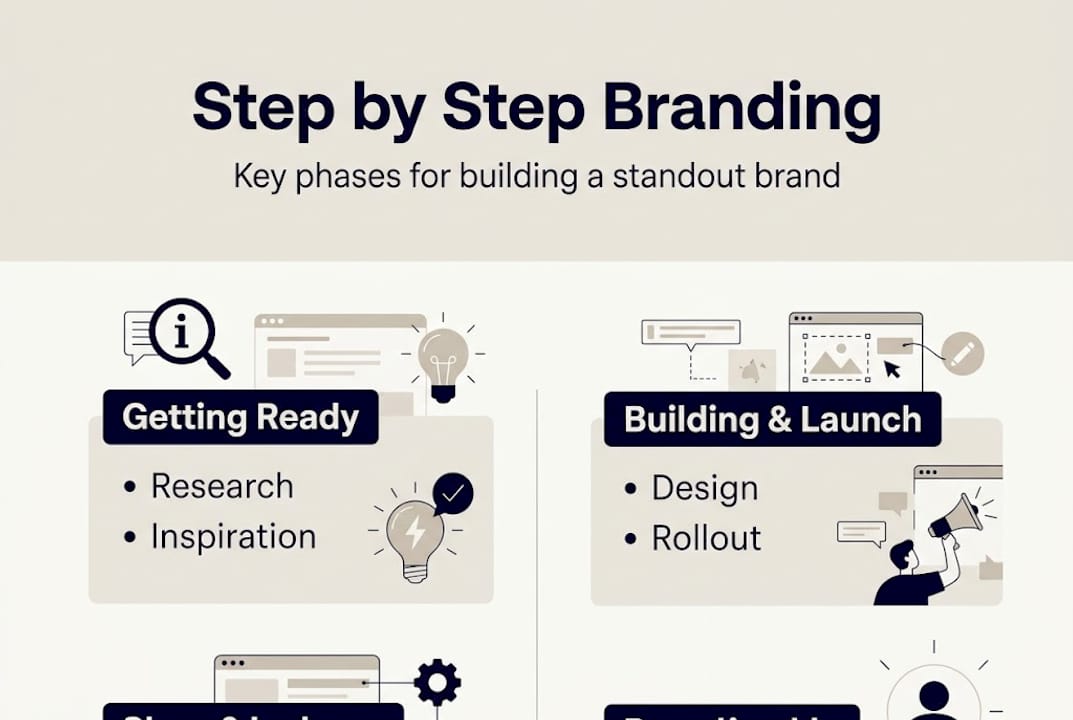
Do your market research. Understand your competitors, your target audience, and the gap you fill. Survey customers, check out competitor reviews, and identify what’s missing in your space.
Define your brand positioning. What do you do, for whom, and why does it matter? A great framework to use: “We help [audience] achieve [result] through [unique approach].” Test this statement with real customers before committing to it. You’ll be surprised by what they say.
Build your visual identity. Choose colours, fonts, and a logo that reflect your brand personality. Consistency here is non-negotiable.
Craft your messaging. Write your tagline, your elevator pitch, and your brand story. These should all feel like they come from the same voice.
Roll out digitally. Update your website, social profiles, email signatures, and any marketing materials to reflect your new brand consistently.
Not sure whether to DIY or bring in an expert? Here’s a quick comparison:
Factor | DIY branding | Working with an expert |
Cost | Lower upfront | Higher upfront, better ROI |
Time | More time-intensive | Faster with guidance |
Quality | Variable | More polished and strategic |
Best for | Early-stage, tight budget | Ready to scale or rebrand |
Pro Tip: Once you’ve written your positioning statement, read it out loud to three people who don’t work in your industry. If they look confused, simplify it. Your brand message should be instantly clear to anyone.
Once you’ve nailed your positioning, explore strong positioning strategies to deepen your competitive advantage. And when you’re ready to go live, check out the full guide to building your brand online for a smooth digital rollout.
Troubleshooting and common branding mistakes to avoid
Even with a solid plan, every brand journey hits obstacles. Here’s how to avoid the most common mistakes.
Let’s be real: branding mistakes happen to everyone. Even huge companies (yes, including ones that have entire brand teams) get it wrong sometimes. The key is knowing what to watch for and how to course-correct fast.
Here are the most common traps and how to dodge them:
Inconsistency across platforms. Your Instagram looks one way, your website looks another, and your business card looks like it’s from 2009. Fix it by creating a simple brand style guide and sticking to it religiously.
Unclear or generic messaging. If your tagline could work for literally any business in your city, it’s not working for yours. Get specific about who you serve and what makes you different.
Neglecting audience feedback. Your brand isn’t just what you say it is. It’s what your customers experience. Regularly ask for feedback and listen to it, even when it stings a little.
Chasing every trend. Rebranding every six months because a new aesthetic is trending is exhausting and confusing for your audience. Evolve thoughtfully, not reactively.
“Your brand is a long game. The businesses that win aren’t the ones that look the coolest right now. They’re the ones that show up consistently, year after year.”
A strong brand foundation is a safeguard against inconsistent messaging and wasted marketing spend. Think of it as your business’s immune system. When things get chaotic (and they will), your brand foundation keeps everything on track.
Stay flexible. Your brand should grow with your business. Revisit your messaging and visuals annually, and check in with your audience often. Need help with the bigger marketing picture? Effective small business marketing ties it all together beautifully.
Measure your results and refine your brand
After launch, it’s vital to measure your progress and keep evolving. Great brands never stand still.
You’ve done the work. Now how do you know if it’s actually working? Branding results don’t always show up in a neat spreadsheet, but there are absolutely ways to track your progress.
Monitor brand awareness. Are more people finding you organically? Are you getting more direct searches for your business name?
Track engagement. Are your social posts getting more comments, shares, and saves? Engagement is a sign your message is resonating.
Collect feedback. Ask new customers how they heard about you and what made them choose you. Their answers reveal whether your brand is landing the way you intended.
Watch your revenue trends. Strong branding builds trust, and trust converts. Look for patterns in repeat purchases, referral rates, and average transaction value.
Review and adjust. Set a quarterly date to review your brand performance and make small tweaks as needed.
Pro Tip: Block off two hours every quarter for a “brand check-in.” Review your visuals, reread your messaging, and check in with a few loyal customers. Small, regular adjustments are far easier than a full rebrand down the road.
And remember: 91% say sustained branding is key to ongoing business success. Branding is not a “set it and forget it” situation. It’s more like a houseplant. It needs regular attention to thrive. If you want to tie your brand metrics into a broader strategy, a solid digital marketing plan is your next best move.
Our perspective: Why branding isn’t just a logo, and what really works
Let’s step back to share the hard truths and what really works from hands-on branding experience.
Here’s something most branding advice won’t tell you: obsessing over your logo is the branding equivalent of judging a book by its cover. It matters, sure, but it’s not even close to the most important thing. The businesses we’ve seen truly break through? They lead with clarity of purpose and radical consistency, not a trendy colour palette.
Most small business branding advice focuses on aesthetics because aesthetics are easy to sell. A shiny new logo feels like progress. But if your messaging is muddled and your audience doesn’t actually understand what you do, no amount of gorgeous design will save you.
What actually works is listening to your audience obsessively, then speaking back to them in a language that makes them feel seen. It’s showing up the same way, every single time, across every touchpoint. Long-term brand logic beats chasing trends or patchwork marketing, every time.
The real mindset shift? Your brand is a promise. And your job, every day, is to keep it. That’s it. That’s the whole strategy. Curious how this connects to your digital branding perspective? It all starts with being honest about who you are and who you serve.
Next steps: Get support for your branding journey
If you’re ready to elevate your brand, here’s how to get hands-on help and support.
Branding is a journey, not a one-afternoon project. And the good news? You don’t have to figure it all out on your own. Whether you’re just getting started or you’ve hit a wall mid-process, having the right support makes an enormous difference.
At M50 Media, we work with small business owners just like you to cut through the confusion and build brands that actually connect. From brand coaching support to hands-on digital branding coaching, we’ve got options for every stage of the journey. Not sure where to start? Book a free marketing SOS call and let’s figure it out together. Your standout brand is closer than you think. 🚀
Frequently asked questions
What are the most important first steps in branding for small businesses?
Start by identifying your target audience, clarifying your value proposition, and choosing consistent visual styles and messaging. Branding is about perception, consistency, and clarity, so getting those foundations right first makes everything else easier.
How long does step by step branding take?
It can range from a few weeks to several months, depending on your preparation, how many revisions you go through, and whether you’re working solo or with a team of experts.
How do I test if my brand is working?
Monitor customer feedback, brand recognition, and any changes in engagement or sales to track impact. Measuring awareness and acting on feedback consistently is what helps you refine and strengthen your brand over time.
Do I need a professional designer for branding?
Not always. Clear positioning and consistency matter most, though bringing in a designer can definitely elevate your visual presence once your strategy is solid.
Can branding really help grow my business online?
Absolutely. 93% agree branding is essential for business growth, and a well-executed brand builds the trust that turns casual browsers into loyal, paying customers.
Recommended
Comments