Why use organic social media for your small business

TL;DR:
Organic social media helps small businesses build trust and credibility through genuine engagement without paid advertising. Combining organic content with paid ads creates a powerful strategy that boosts long-term trust and immediate visibility. Consistent posting, authentic storytelling, and platform-specific content are key to growing reach and converting leads effectively.
Organic social media is the practice of building relationships with your audience through unpaid content and genuine interactions on social platforms. No ad budget required. Just you, your brand, and the people who actually want to hear from you. If you’ve been wondering why use organic social media when paid ads promise faster results, the short answer is this: paid ads rent attention, but organic social media earns it. And for small business owners who want lasting credibility, that difference matters more than most people realise.
Why use organic social media to build real trust?
Organic social media builds trust more effectively than a single paid advertisement by creating multiple engagement touchpoints over time. Think of it like getting to know a neighbour. One wave from the driveway doesn’t make you friends. But consistent hellos, a borrowed cup of sugar, and a few good conversations? That’s a relationship.

The same logic applies to your brand online. When your audience sees you consistently showing up with helpful content, honest answers, and a recognisable voice, they start to trust you. That trust is the foundation of every sale you’ll ever make.
Here’s what consistent organic activity actually does for your credibility:
Builds social proof. Comments, shares, and saves signal to new visitors that real people value your content.
Shows your brand is alive. Authentic social media activity tells potential customers your business is active and worth their attention.
Reinforces your voice. Repeated signals from helpful posts and genuine replies gradually build the kind of audience trust that paid ads simply can’t replicate.
Converts leads from other channels. When someone finds you through a Google search or a referral, they check your socials next. A strong organic presence closes that loop.
Pro Tip: Think of your organic social profiles as your brand’s “digital proof of life.” If your last post was from 2023, potential customers will notice. Aim for consistency over perfection.
Learning how to build trust online is one of the most practical skills a small business owner can develop, and organic social is one of the best places to practise it.
How do social media algorithms affect organic reach?
Algorithms are the gatekeepers of who sees your content, and they have opinions. Strong ones. The good news is that platforms reward content that earns genuine engagement, which is exactly what a solid organic strategy produces.
Organic reach is declining as platforms prioritise paid content, but that doesn’t mean organic is dead. It means you have to be smarter about it. Here are four tactics that actually move the needle:
Post when your audience is active. Early engagement is a key algorithm signal. A post that gets five comments in the first hour outperforms one that gets fifty comments over three days.
Tailor content to each platform. Posting the same content everywhere reduces reach. A punchy Instagram Reel and a thoughtful LinkedIn post serve different audiences and different algorithms.
Use interactive formats. Polls, questions, and “this or that” posts invite responses. Responses tell the algorithm your content is worth showing to more people.
Prioritise original content. Platforms favour original, quality content built for their specific format and audience. Repurposed content from other channels consistently underperforms.
The importance of organic reach isn’t just about vanity metrics. It’s about showing up during the moments when your potential customers are discovering and deciding. Organic reach builds brand authority by keeping your business visible at exactly those moments, without paying for every impression.
Pro Tip: Check your platform analytics weekly. The posts that get the most saves and shares are your algorithm’s favourites. Make more of those.
Organic vs paid social media: why you need both
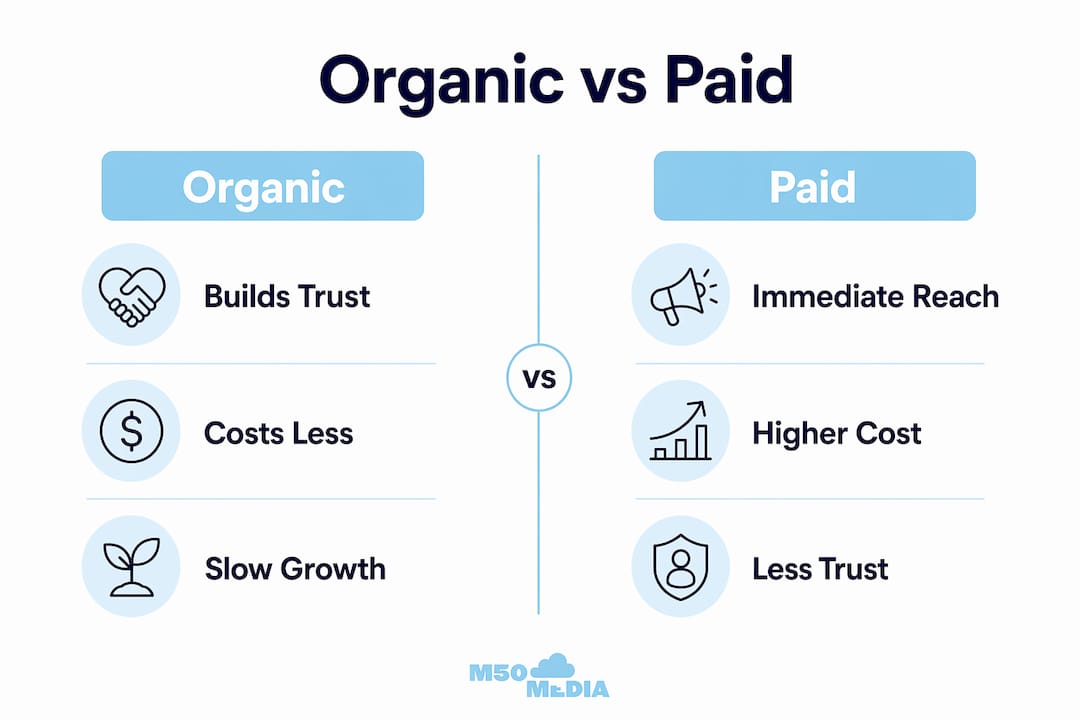
Here’s a take that might surprise you: organic social media and paid advertising are not rivals. They’re more like a buddy comedy duo. Organic builds the credibility. Paid amplifies it. Without the organic foundation, paid ads land on a cold, unfamiliar audience. Without paid amplification, organic growth can feel painfully slow.
Combining organic content with paid advertising creates a hybrid approach that balances long-term trust with immediate visibility. Businesses that use paid promotion to amplify an already engaged, trusting audience base see better conversion rates than those running cold ad campaigns to strangers.
Think of it this way:
Approach | Strength | Weakness |
Organic only | Builds trust, costs less cash | Slow reach growth |
Paid only | Fast visibility | Low credibility, high cost |
Hybrid (both) | Trust plus reach | Requires planning and budget |
The risk of relying solely on paid ads is real. Without an organic presence, your brand looks like a pop-up shop rather than an established business. Customers are savvy. They check your profile before they click your ad. Organic content acts as a legitimacy layer that converts those ad-driven leads far more effectively.
Pro Tip: Before you boost a post, make sure your profile looks active and credible. A paid ad pointing to a sparse profile is money left on the table.
Practical organic social media strategy for small businesses
The biggest myth about organic social media is that it’s free. It’s not. Effective organic social media requires time, planning, and consistent effort. It’s an investment in brand equity, not a shortcut. The good news? Small businesses have a genuine advantage here. You’re not a faceless corporation. You have a story, a personality, and a community. Use all three.
Here’s what actually works for small business owners:
Share customer stories. Real results from real people build more credibility than any polished ad copy. Ask happy customers for a quick testimonial and post it.
Show behind the scenes. People love seeing how things are made, how your day runs, or even the occasional blooper. It’s relatable and it humanises your brand.
Teach something useful. Content that solves audience problems and shares your expertise drives meaningful engagement. A quick tip post often outperforms a promotional one.
Engage with your community. Reply to every comment. Ask questions. Tag local businesses. Organic social media is a two-way street, not a broadcast channel.
Use a content calendar. Consistency beats brilliance. Posting three times a week on a schedule beats posting ten times in one week and then going silent for a month.
For tracking your results, focus on metrics like reach, saves, shares, and profile visits rather than just likes. These signals tell you whether your content is actually resonating. Check out these social media tips for small businesses for a deeper look at what to measure and when.
Organic marketing attracts audiences through content merit, building natural connections that paid traffic simply cannot manufacture. That’s the real advantage of organic social for small businesses. You’re not buying attention. You’re earning it, and earned attention converts better over time.
Authentic storytelling is one of the most underused tools in a small business owner’s kit. The power of storytelling for brand engagement is well documented, and it costs nothing but a bit of your time and honesty.
Pro Tip: Batch your content creation. Set aside two hours on a Sunday to create posts for the week. You’ll post more consistently and stress less about it on busy days.
Key takeaways
Organic social media builds the trust and credibility that paid advertising alone cannot create, making it the essential foundation for any small business marketing strategy.
Point | Details |
Trust over transactions | Consistent organic content builds audience trust through repeated, genuine engagement over time. |
Algorithms reward quality | Tailoring content to each platform and posting when your audience is active improves organic reach. |
Hybrid approach wins | Combining organic credibility with paid amplification produces better conversions than either alone. |
It’s an investment, not free | Organic social requires time and planning; treat it as brand equity, not a zero-cost shortcut. |
Consistency beats perfection | A regular posting schedule with authentic content outperforms sporadic bursts of polished posts. |
Organic social in 2026: what I’ve actually seen work
I’ve worked with a lot of small business owners who come to me convinced that paid ads are the answer to everything. And look, I get it. Paid ads feel like a vending machine. You put money in, leads come out. Organic social feels more like planting a garden. Slower, messier, and you’re never quite sure when things will bloom.
But here’s what I’ve seen over and over again: the businesses that skip organic social and go straight to paid ads hit a wall. Their ads perform okay at first, then costs creep up and conversions drop. Why? Because there’s no trust underneath. When a potential customer clicks that ad and lands on a profile with three posts from 18 months ago, they bounce. Every time.
The businesses that invest in growing organic reach before or alongside paid campaigns see a completely different result. Their paid ads convert better because the organic presence does the trust work first. It’s not magic. It’s just how people make decisions.
My honest advice? Stop thinking about organic social as a chore and start thinking of it as a conversation. Post like a human, not a brand brochure. Share what you know, celebrate your customers, and show up regularly. The algorithm will notice. More importantly, your audience will notice.
— Karl
Ready to build your organic social presence?
Building a strong organic social media strategy takes clarity, consistency, and a plan that actually fits your business. That’s exactly what M50media’s digital coaching services are built for.
Karl works directly with small business owners to cut through the noise and build organic social strategies that create real engagement and real results. Whether you’re starting from scratch or trying to figure out why your current efforts aren’t landing, a free Marketing SOS call is the fastest way to get clear on your next steps. No pressure, no fluff. Just practical guidance from someone who’s been in the trenches with businesses just like yours.
FAQ
What is organic social media?
Organic social media is any content or engagement on social platforms that is not paid for. It includes regular posts, stories, replies, and community interactions that build brand presence over time.
Why does organic reach matter for small businesses?
Organic reach builds brand authority and trust during the moments when potential customers are discovering and evaluating your business. It creates a credible foundation that makes paid advertising more effective.
How is organic social media different from paid social media?
Paid social media uses an ad budget to place content in front of targeted audiences for immediate visibility. Organic social media earns reach through content quality and engagement, building long-term trust without direct ad spend.
How often should a small business post organically?
Consistency matters more than frequency. Posting three to five times per week on your primary platform with tailored, quality content produces better results than daily posting with low-effort content.
Can organic social media replace paid advertising?
Organic social media and paid advertising work best together. Organic builds the credibility and trust that makes paid campaigns convert more effectively. Relying solely on paid ads without an organic presence reduces conversion rates and increases costs over time.
Recommended
I like the emphasis on platform-specific content and authentic storytelling—those are what make organic posts feel credible instead of promotional. I've been using https://postbridge.online/postbridge-for-creators
I like the point about pairing authentic organic storytelling with paid ads—trust and visibility really can grow together. I’ve been using https://postbridge.online/postbridge-multiple-platforms
The point about combining authentic storytelling with paid ads really stood out—organic content builds trust while ads extend your reach. I’ve been using https://hitem3d.site/hitem3d-blender
The balance between authentic storytelling and paid ads is especially practical for small businesses—organic content builds trust while paid campaigns expand visibility. I’ve been using https://transcribeai.pro/transcribe-tool
The point about pairing authentic storytelling with paid ads really stood out—organic content builds trust while ads expand reach. I’ve been using https://easemate.pro