Role of hashtags in marketing: your 2026 guide

TL;DR:
Hashtags help categorize content and increase reach by signaling relevance to platform algorithms.
Using the right number of targeted hashtags on each platform boosts engagement and visibility.
Small businesses should focus on niche hashtags under 500,000 posts and rotate curated sets regularly.
Hashtags are defined as clickable labels that categorise social media content and connect posts to relevant audiences searching for that topic. The role of hashtags in marketing goes well beyond slapping a pound sign on a trending word. Used correctly, they act as signals to platform algorithms, telling Instagram, TikTok, LinkedIn, and X exactly where your content belongs. The result? Your posts reach people who actually care about what you sell. Sprout Social confirms that branded hashtags centralise conversations, create searchable archives, and boost recognition when used consistently. That is not a small thing for a small business trying to get noticed.
How do hashtags enhance marketing reach and engagement across social platforms?
Hashtags work by tagging your content into topic feeds that users actively browse. When someone searches #smallbusiness on Instagram, your post can appear there, even if they have never heard of you. That is free discoverability, and it is the core mechanic behind why hashtag strategy for brands matters so much.

Platform benchmarks make this concrete. Research shows that Instagram performs best with 4–8 hashtags, delivering a 12–15% reach lift. TikTok responds well to 3–5 tags with a 10–30% reach lift. LinkedIn rewards 3–5 hashtags with a 5–10% lift, and X (formerly Twitter) sees diminishing returns beyond 1–2 tags. These are not suggestions. They are the numbers that separate posts that get seen from posts that disappear.
Not every platform plays by the same rules, though. Facebook hashtags have minimal measurable impact on reach or engagement. The algorithm there favours comments, shares, and reactions instead. Spending energy on Facebook hashtags is a bit like bringing a snow shovel to a beach volleyball game. Technically possible, but not exactly the right tool.
Platform | Optimal hashtag count | Engagement/reach lift |
4–8 | 12–15% reach lift | |
TikTok | 3–5 | 10–30% reach lift |
3–5 | 5–10% reach lift | |
X | 1–2 | 21% more engagement vs. zero |
Minimal impact | Focus on groups and social signals |
Pro Tip: Place hashtags at the end of your Instagram caption or in the first comment to keep the caption clean and readable. Readers see your message first, and the algorithm still picks up the tags.
What is the difference between niche, broad, and mega hashtags?
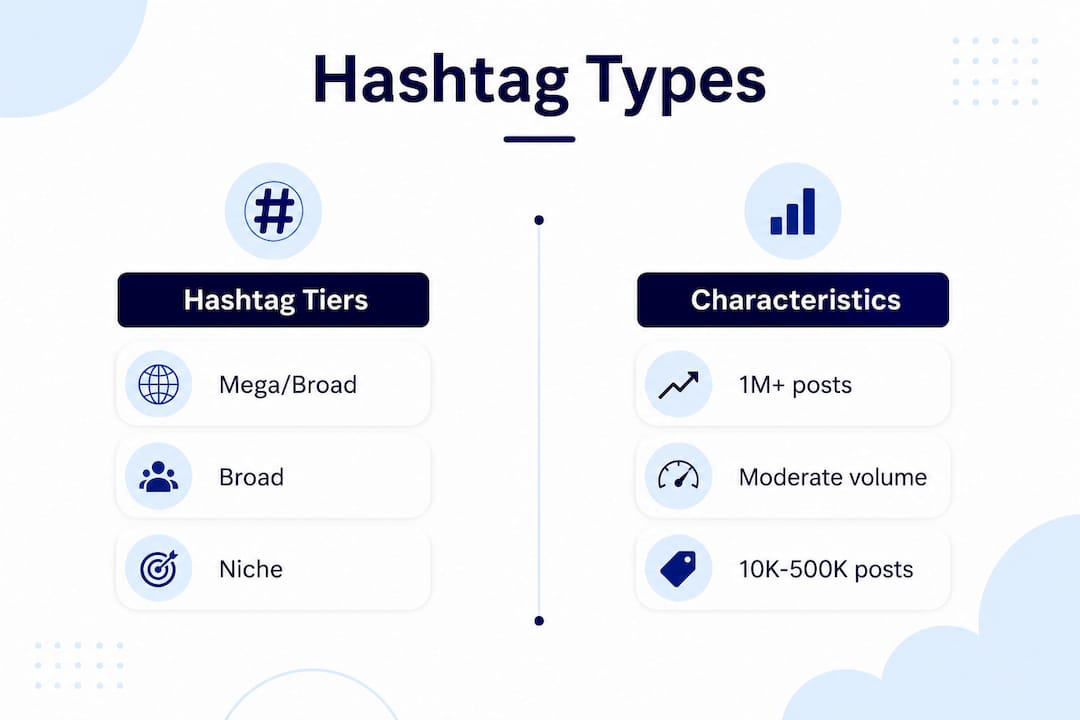
Not all hashtags are created equal, and this is where most small business marketers go wrong. Hashtags fall into three tiers: broad or mega tags (think #coffee with hundreds of millions of posts), mid-tier tags (like #tokyocafe with a few hundred thousand), and niche tags (like #omotesandocafe with under 50,000 posts). Each tier serves a different purpose.
Mega hashtags feel tempting because the audience looks enormous. The problem is that your post gets buried in seconds. Niche hashtags under 500,000 posts outperform mega-hashtags by roughly 3 times in reach-to-engagement ratio. That gap exists because niche audiences are more focused and more likely to engage. A post about handmade soy candles will perform far better under #soycandles than under #candles.
Niche hashtags with 10,000–500,000 posts typically offer the highest return for small businesses because they balance engagement with manageable competition. You are not fighting a million accounts for the top spot. You are showing up in a smaller, more relevant feed where your ideal customer is already browsing.
The winning approach is to mix broad, mid-tier, and niche hashtags in each post. One or two broad tags give you exposure. A couple of mid-tier tags add context. Two or three niche tags put you in front of the people most likely to buy. Think of it like fishing with a net that has different sized holes. You catch the big fish and the small ones worth keeping.
Hashtag tier | Post volume | Best for | Risk |
Mega/broad | 1M+ posts | Brand awareness | Content buried instantly |
Mid-tier | 100K–1M posts | Topical relevance | Moderate competition |
Niche | Under 500K posts | Targeted engagement | Smaller reach ceiling |
Pro Tip: Before committing to a hashtag, search it on the platform first. Check whether the top posts are from accounts similar to yours. If the feed is dominated by massive brands, move down to a more specific tag.
What are the best practices for building and rotating hashtag sets?
Building a hashtag library is one of the most underrated moves in social media marketing. The idea is simple: create a pool of 15–25 relevant hashtags across different tiers and rotate which ones you use per post. Rotating hashtag sets prevents algorithmic penalties and signals authenticity to platforms. Using the exact same 20 tags on every single post looks like spam, because to the algorithm, it is.
Your library should include four types of tags:
Branded hashtags: Your business name or a campaign-specific tag (e.g., #YourBrandName). These centralise your content and make it searchable.
Niche hashtags: Highly specific to your product, service, or community. These drive the most qualified traffic.
Trending hashtags: Time-sensitive tags tied to current events, seasons, or viral moments. Use these sparingly and only when genuinely relevant.
Geographic hashtags: Location-based tags like #VancouverEats or #TorontoFitness. These are gold for local businesses trying to reach nearby customers.
Measurement matters just as much as selection. Track profile visits, impressions, and follower growth tied to specific hashtag sets. Most platform analytics tools show you which posts drove the most reach. Over time, you will see patterns. Some tags consistently outperform others, and that data tells you exactly where to focus. For more on social media campaign performance, the M50media blog has real examples worth studying.
Pro Tip: Create three or four distinct hashtag sets for your most common content themes. Label them in a notes app or spreadsheet. Rotate through them weekly so no two consecutive posts share the same set.
How does hashtag usage vary across major platforms in 2026?
Each platform has its own hashtag culture, and treating them all the same is a fast way to underperform everywhere. Here is how the major platforms stack up right now.
Instagram recommends 3–5 focused hashtags over the old strategy of maxing out at 30. Focused hashtag use boosts engagement by 12.6% on average, while excessive tagging signals spam behaviour to the algorithm. Instagram’s discovery features, including Reels and Explore, rely heavily on hashtag signals to categorise content.
TikTok uses hashtags for both discovery and trend participation. The For You Page algorithm is powerful on its own, but 3–5 relevant tags help the system categorise your video faster. Trending sound and hashtag combinations are particularly effective for reaching new audiences.
LinkedIn is where hashtags genuinely punch above their weight for B2B marketers. LinkedIn posts with 3–5 relevant hashtags receive approximately 30% more reach, and B2B brands see 12.6% more engagement with 3–4 industry-specific tags. Place hashtags at the end of your post, not scattered throughout the text. It reads more professionally and performs better. If you are curious about the broader picture of B2B marketing tactics, LinkedIn hashtags are a great starting point.
X rewards restraint. Posts with 1–2 hashtags see 21% more engagement than posts with zero. Add a third tag and engagement drops by 17%. The lesson here is to pick one highly relevant tag and one conversational or trending tag, then stop.
Facebook and YouTube sit at the bottom of the hashtag priority list. Facebook’s algorithm favours comments, shares, and reactions. YouTube hashtags appear above video titles and can help with search, but they are far less impactful than strong titles and descriptions. Redirect your hashtag energy to Instagram, TikTok, and LinkedIn instead. For a broader look at digital marketing trends shaping platform strategy this year, the M50media blog covers the full picture.
Key takeaways
Hashtag success in 2026 depends on using the right number of relevant, tiered tags per platform, rotating sets to avoid spam flags, and measuring results to refine your approach over time.
Point | Details |
Platform-specific counts matter | Use 4–8 tags on Instagram, 3–5 on TikTok and LinkedIn, and just 1–2 on X. |
Niche tags outperform mega tags | Hashtags under 500,000 posts deliver 3x better reach-to-engagement for small businesses. |
Rotate your hashtag sets | Build a library of 15–25 tags and rotate them to avoid algorithmic spam flags. |
Mix all three tiers | Combine broad, mid-tier, and niche hashtags to balance reach with targeted relevance. |
Measure and adjust | Track impressions and profile visits per post to identify which hashtag sets perform best. |
The hashtag truth nobody talks about
Here is something I have noticed after years of working with small businesses on their social media: the “hashtags are dead” crowd is not entirely wrong, but they are blaming the wrong thing. What is dead is the old spray-and-pray approach of stuffing 30 random tags onto every post and hoping for the best. That strategy deserved to die.
What I have seen work, consistently, is treating hashtags like a targeting tool rather than a volume game. A local bakery in Hamilton using #HamiltonBakery and #SourdoughBread will outperform a national chain using #Food and #Delicious every single time. The myth that hashtags no longer work persists because people tried the old way, got burned, and gave up. The new way rewards relevance.
I also want to flag something that does not get enough attention: branded hashtags. Creating a unique tag for your business and using it consistently is one of the cheapest community-building tools available. It turns your content into a searchable archive and gives your customers a way to tag themselves into your world. That is organic word-of-mouth at scale.
My honest advice? Spend 30 minutes this week auditing your last 10 posts. Look at which ones got the most reach. Check what hashtags you used. The pattern will tell you more than any generic guide. Test, measure, and adjust. That is the whole game. For more on essential social media tips built for small businesses, the M50media blog is a solid next stop.
— Karl
Ready to put your hashtag strategy to work?
Getting hashtags right is one piece of a larger social media puzzle, and it is a lot easier when you have someone in your corner who has already figured out what works. At M50media, Karl Lundgren works directly with small business owners and marketers to build data-driven social media strategies that actually move the needle.

Whether you want to sharpen your hashtag approach or rethink your entire digital marketing coaching plan, M50media has the tools and expertise to help. Pair that with insights on influencer marketing strategies to amplify your reach even further. Book a free Marketing SOS call with Karl today and walk away with a clear, personalised plan for growing your audience on the platforms that matter most to your business.
FAQ
What is the role of hashtags in marketing?
Hashtags categorise social media content and connect posts to audiences searching for that topic. They signal relevance to platform algorithms, increasing the chances that your content reaches people outside your existing followers.
How many hashtags should I use per post?
The optimal count varies by platform. Use 4–8 on Instagram, 3–5 on TikTok and LinkedIn, and just 1–2 on X for the best engagement results.
Do hashtags still work in 2026?
Yes, but quality and relevance matter far more than quantity. Niche hashtags under 500,000 posts deliver roughly 3 times better reach-to-engagement than mega-hashtags, making them the stronger choice for small businesses.
What is a branded hashtag and why should I use one?
A branded hashtag is a unique tag tied to your business name or a specific campaign. It centralises your content into a searchable archive and encourages customers to tag themselves into your brand community.
Should I use the same hashtags on every post?
No. Using identical hashtag sets repeatedly can trigger spam flags from platform algorithms. Rotate a library of 15–25 relevant hashtags across posts to maintain reach and signal authenticity.
Recommended
The reminder to adjust hashtag volume by platform is especially useful for 2026 strategies—targeted relevance beats stuffing every post. I’ve been using https://art-list.pro/art-styles/ink-wash
The platform-specific hashtag counts are especially useful—targeting relevance instead of stuffing should matter even more in 2026. I’ve been testing this with a hashtag research tool and recommend checking out https://vidmuse.pro/suno-link-to-video
The point about using a targeted number of hashtags for each platform is especially useful—copy-pasting the same set everywhere can hurt relevance. I’ve been using https://rapidads.site/privacy-policy
The reminder to tailor hashtag volume by platform is especially useful—targeted beats stuffing every time. I’ve been using https://easemate.pro
The reminder to tailor hashtag counts by platform is especially useful—relevance matters more than volume when signaling to algorithms. I’ve been using https://transcribeai.pro/transcribe-music-software