Audience targeting process: a practical guide for 2026

TL;DR:
Effective audience targeting involves using customer data and segmentation to reach the most likely buyers. Small businesses should validate their segments with real data and adapt campaigns regularly to improve results. Relying on behavioral data and community insights helps identify reachable, relevant customer groups for better marketing impact.
The audience targeting process is a systematic approach to defining, segmenting, and reaching the customers most likely to buy from you. Get it right, and your ad spend works harder. Get it wrong, and you’re basically handing out flyers at a concert for a band nobody came to see. The Pareto Principle tells us the top 20% of your customers typically drive 60–80% of revenue. That single fact should reshape how you think about who you’re actually marketing to. This guide walks you through every stage of the process, from gathering raw data to refining segments over time, so you can run campaigns that actually convert.
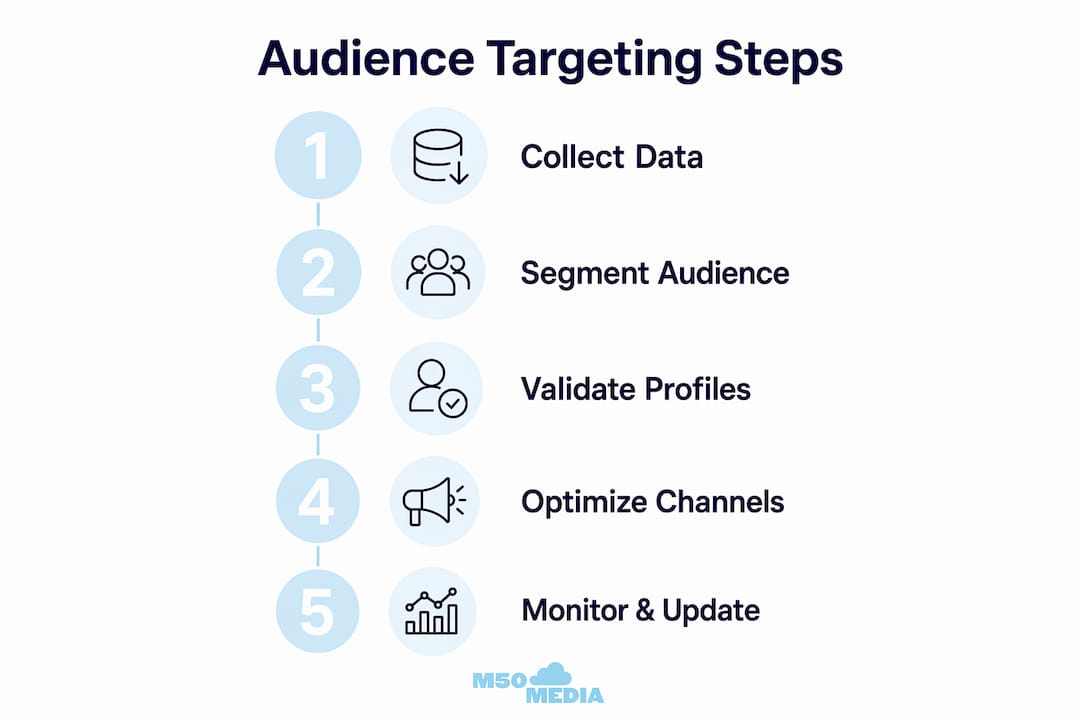
What data and tools do you need before starting the audience targeting process?
Before you build a single audience segment, you need real data. Guessing who your customers are is like trying to bake a cake without knowing the recipe. You might end up with something edible, but probably not what you were hoping for.

The best starting point is your own first-party data. That means sales records, CRM notes, email lists, and website behaviour. This data reflects people who have already shown interest in your business, making it far more reliable than anything you could assume. The role of customer data in small business marketing is foundational, not optional.
From there, layer in platform analytics. Google Analytics 4 (GA4) and Meta Audience Insights are the two workhorses here. GA4 shows you who visits your site, what they do, and where they drop off. Meta Audience Insights reveals the interests, demographics, and behaviours of people engaging with your content on Facebook and Instagram. Together, they paint a much clearer picture than either tool does alone.
Competitive research rounds out your prep work. Look at who engages with similar businesses in your space. Read their reviews, check their comment sections, and notice what language their customers use. You’re not copying them. You’re identifying gaps and patterns in the market that your targeting can fill.
Data source | What it tells you |
CRM and sales records | Who has bought, how often, and how much they spend |
Google Analytics 4 | Site behaviour, traffic sources, and conversion paths |
Meta Audience Insights | Social interests, demographics, and engagement patterns |
Customer reviews and surveys | Language, pain points, and motivations in the customer’s own words |
Competitor audience research | Market gaps and underserved segments |
How do you segment and profile your audience for real results?
Segmentation is the engine of effective audience targeting. It breaks a broad market into smaller groups that share meaningful traits, so you can speak directly to each group rather than shouting into the void.
There are four main segmentation types every marketer should know:
Demographic segmentation covers age, gender, income, education, and occupation. It’s the most common starting point, but it’s also the least predictive on its own.
Behavioural segmentation focuses on what people actually do: purchase history, website activity, content consumption, and loyalty patterns. This is where the real gold is.
Psychographic segmentation digs into values, interests, attitudes, and lifestyle. It explains why people buy, not just who they are.
Geographic segmentation targets by location, from country down to neighbourhood. For local businesses, this one is non-negotiable.
The mistake most small business owners make is building fictional personas. You know the type: “Meet Sarah, a 34-year-old yoga instructor who loves oat milk lattes.” Sarah is not real. Effective buyer personas must be grounded in actual sales data and customer interviews, focusing on specific barriers to purchase rather than invented lifestyle details.
A useful segment has four qualities: it’s observable, meaningful, accessible, and stable. Observable means you can actually track it with your analytics tools. Meaningful means it’s large enough and distinct enough to matter. Stable means it won’t disappear next quarter. And accessible? That’s the big one.
Audience segments must be reachable through paid, organic, or influencer channels. A segment you can’t reach through any available channel is just a fun thought experiment. It wastes your time and budget.
One often-overlooked approach is community-based segmentation. Community membership reflects cultural and behavioural similarity, and it often outperforms traditional demographics in predicting customer behaviour. Think Facebook groups, subreddits, or niche online forums where your ideal customers already hang out.
Pro Tip: Prioritise segments based on accessibility first, not conceptual appeal. The most perfectly defined segment in the world is worthless if you have no channel to reach them.
How do you validate your audience profiles with real data?
Defining a segment is step one. Confirming it actually exists and responds to your messaging is step two. Skipping validation is how businesses burn through ad budgets on audiences that looked great on paper.
Here’s a practical validation sequence you can run without a big budget:
Use GA4 to verify your assumptions. GA4 lets you create audience segments by behaviour to check whether your assumed demographics actually convert. If you think your buyers are women aged 35–44, GA4 will either confirm that or show you something surprising.
Run small-scale A/B tests. Low-cost A/B tests on messaging and landing pages within your target segments confirm what language and offers actually land. Spend a small amount, learn a lot.
Test your positioning statement with real people. Share your core message with 5–10 people who fit your target segment. Ask them if it resonates. Their reactions will tell you more than any algorithm can.
Check your audience size for paid campaigns. Paid media audiences work best in the range of 100,000 to 2 million people. Too small and your ads get fatigued fast. Too large and you lose the specificity that makes targeting worth doing.
Pro Tip: Don’t just ask people if they like your message. Ask them what they think it means. The gap between what you intended and what they heard is where most campaigns fall apart.
Validation is also where you start moving away from static personas toward what marketers increasingly call conversion segments. Conversion segments dynamically track behaviour linked to purchasing, rather than locking you into a fixed demographic profile. This shift makes your targeting more responsive and far more effective over time.
How do you adapt your targeting across channels and keep it sharp over time?
Getting your segments right is not a one-and-done task. Audiences shift, platforms change their algorithms, and what worked last quarter might underperform this one. The marketers who win long-term treat audience targeting as a living process, not a finished document.
Here’s how to keep your targeting sharp across channels and over time:
Adjust your messaging by platform. The same audience behaves differently on LinkedIn versus Instagram versus Google Search. A B2B buyer browsing LinkedIn is in a different headspace than when they’re scrolling Instagram at 10 PM. Match your tone and offer to the platform context, not just the person.
Track which segments convert and which don’t. Exclude non-performing segments from paid campaigns rather than letting them drain your budget. This is one of the fastest ways to improve return on ad spend without increasing your total spend.
Split-test audience definitions regularly. Don’t assume your best-performing segment from six months ago is still your best performer today. Run controlled tests with slightly different segment definitions to find improvements.
Conduct quarterly data audits. Review your CRM data, analytics reports, and campaign performance every quarter. Customer behaviour changes, and your segments should reflect that. The digital marketing strategy guide from M50media covers lifecycle-based segmentation in detail if you want to go deeper here.
Explore behavioural targeting as your primary lens. The shift away from demographics toward behaviour-driven identification is the defining trend in 2026 audience work.
AI-driven clustering is also worth paying attention to. AI-enhanced segmentation in 2026 lets marketers create segments based on lifecycle stages like new or loyal customers, improving return on ad spend in ways that manual segmentation simply can’t match. You don’t need to be a data scientist to use these tools. Most major ad platforms now offer them natively.
Key takeaways
The audience targeting process works best when it combines first-party data, observable segmentation criteria, and regular validation cycles rather than relying on assumptions or static personas.
Point | Details |
Start with first-party data | Use CRM records, sales data, and GA4 before any paid research or platform tools. |
Prioritise accessible segments | Only build segments you can actually reach through paid, organic, or influencer channels. |
Validate before scaling | Test messaging with 5–10 real people and run A/B tests before committing full budget. |
Size your paid audiences correctly | Aim for 100,000 to 2 million people for paid media to balance reach and relevance. |
Audit quarterly | Review and update your segments every quarter to reflect real shifts in customer behaviour. |
What I’ve learned from years of watching small businesses target the wrong people
Here’s the uncomfortable truth I keep running into with small business clients: most of them have a pretty good product and a completely wrong audience. Not slightly off. Wrong. They’re marketing a premium service to bargain hunters, or a time-saving tool to people who actually enjoy doing the task manually. No amount of clever copy fixes a targeting mismatch.
The fix I always come back to is behavioural data over demographic assumptions. Demographics tell you who someone is on paper. Behaviour tells you what they actually care about right now. A 55-year-old accountant and a 28-year-old freelancer might both be searching for the same invoicing software at midnight. Demographics would never put them in the same segment. Behaviour absolutely does.
I’ve also seen community-based segmentation completely change the game for small businesses with niche products. When you find the online community where your ideal customers already gather, you stop interrupting people and start showing up where they’re already paying attention. That’s a fundamentally different relationship with your audience.
My practical advice: don’t wait until you have perfect data. Start with what you have, validate fast, and update often. The businesses that win at targeting aren’t the ones with the biggest data sets. They’re the ones who stay curious and keep testing. You can also use retargeting strategies to re-engage people who showed interest but didn’t convert. That’s one of the highest-ROI moves available to small businesses right now.
Stay agile. Your audience will tell you who they are if you’re paying attention.
— Karl
M50media can help you target smarter, not harder
Knowing the theory is one thing. Putting it into practice for your specific business, with your specific budget and goals, is where most marketers get stuck.
M50media offers digital marketing coaching designed specifically for small business owners and marketers who want to build real audience targeting systems, not just follow generic advice. Karl works directly with you to identify your highest-value segments, set up the right tools, and build a targeting process that actually fits your business. If you’re not sure where to start, a free Marketing SOS call is the fastest way to get clarity on what’s holding your campaigns back. No pressure, no pitch. Just straight answers from someone who’s done this for a long time.
FAQ
What is the audience targeting process in digital marketing?
The audience targeting process is a systematic method of defining, segmenting, and reaching the customers most likely to convert. It combines first-party data, segmentation techniques, and ongoing validation to improve campaign relevance and return on investment.
What are the four main audience segmentation techniques?
The four main types are demographic, behavioural, psychographic, and geographic segmentation. Behavioural segmentation, which focuses on actual purchase and engagement patterns, consistently delivers the strongest targeting results.
How large should a paid media audience be?
Paid media audiences work best between 100,000 and 2 million people. Smaller audiences exhaust quickly, while larger ones lose the specificity that makes targeting effective.
How often should you update your audience segments?
Quarterly audits are the standard practice for keeping segments accurate. Customer behaviour shifts over time, and segments built on outdated data will underperform even with strong creative and offers.
What is the difference between a persona and a conversion segment?
A persona is a static profile, often based on assumptions. A conversion segment dynamically tracks real behaviours linked to purchasing, making it far more responsive and reliable for active campaign targeting.
Recommended
The reminder to validate segments with real data is especially useful for small businesses, where assumptions can get expensive quickly. Behavioral and community insights make the targeting process much more actionable. I've been using https://vibecodingai.online/vibe-coding-tutorial