Why use Facebook ads: a 2026 guide for small businesses
TL;DR:
Facebook ads provide small businesses with affordable access to billions of users through precise targeting and measurable results.
Performance depends heavily on high-quality creative and a patient testing approach over 60 to 90 days.
Facebook ads are paid promotions on Meta’s platforms that give small businesses direct access to billions of users with precise audience targeting and measurable results. If you’ve been wondering why use Facebook ads when there are so many channels competing for your attention (and your budget), the answer comes down to three things: scale, targeting, and cost efficiency. No other paid channel combines all three at a price point that works for a business spending $10 a day. M50media has seen this firsthand working with entrepreneurs across Canada, and the numbers back it up.
Why use Facebook ads for your small business budget
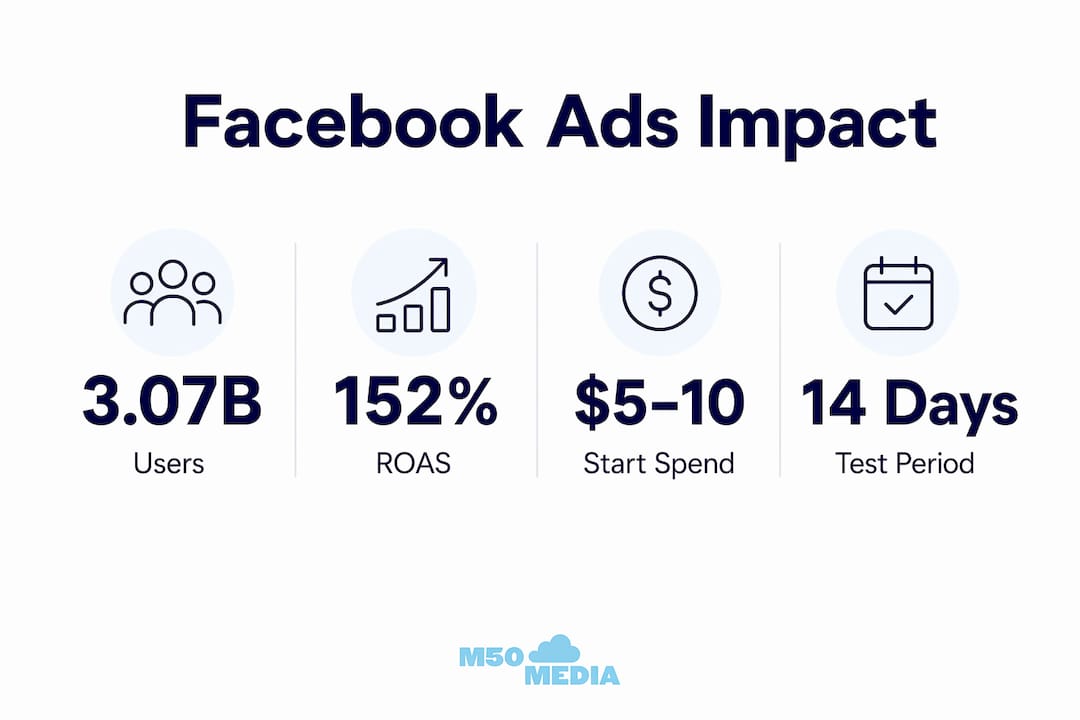
Facebook ads are genuinely affordable in a way that most paid channels are not. The minimum daily spend starts at just $5–$10, which means you can test an offer without betting the farm on it. That’s the kind of entry point that lets you learn before you commit.
The cost per thousand impressions (CPM) on Facebook is also 3–5 times cheaper than the Google Display Network. That gap matters enormously when you’re working with a lean budget, because you get far more eyeballs for every dollar you spend.
Here’s what makes the cost story even better:
Low floor, high ceiling. You can start at $5/day and scale to thousands once you know what works.
Pay for results. Facebook’s auction model means you only pay when your ad is shown or clicked, depending on your objective.
Measurable ROAS. Businesses with a clear offer and a solid landing page see an average return on ad spend of approximately 152%, meaning roughly $2.52 earned for every $1 invested.
No long-term contracts. You can pause, adjust, or stop campaigns any time, unlike print or broadcast advertising.
That 152% ROAS figure is not a best-case scenario. It’s the average for businesses that pair a clear offer with a matching landing page. The takeaway? The offer and the destination page matter just as much as the ad itself.
Pro Tip: Start with a $10/day test budget for 14 days before scaling. You’ll gather enough data to make a real decision without risking a significant amount of money.
How does Facebook’s audience reach benefit small businesses?
Facebook reaches 3.07 billion monthly active users. That number is almost impossible to wrap your head around, so think of it this way: nearly 40% of the entire planet’s population logs into Facebook at least once a month. For a small business, that means your ideal customer is almost certainly on the platform.
The real advantage is not just the size of the audience. It’s the depth of the targeting. Facebook lets you layer multiple signals to reach exactly the right people. Understanding audience segmentation is the foundation of making those layers work for you.
Here’s how the targeting layers stack up:
Demographics. Age, gender, location, language, education level, and relationship status.
Interests. Pages liked, topics followed, and content engaged with over time.
Behaviours. Purchase behaviour, device usage, travel patterns, and more.
Custom Audiences. Upload your own customer email list or phone numbers to target existing contacts directly.
Lookalike Audiences. Facebook finds new users who share characteristics with your best existing customers.
Retargeting. Re-engage people who visited your website, watched your video, or interacted with your page.
That last one, retargeting, is where a lot of small businesses leave money on the table. Someone who visited your product page and left without buying is a warm lead. Showing them a follow-up ad with a special offer or a customer testimonial is far more efficient than chasing cold traffic.
Pro Tip: Build a Lookalike Audience from your top 10% of customers by purchase value. Facebook’s algorithm will find people who behave similarly, and your conversion rate on cold traffic will improve noticeably.
For businesses targeting a specific geographic area, like a local restaurant, gym, or service provider, Facebook’s radius targeting lets you focus ads within a set number of kilometres of your location. You’re not paying to reach people in another province who will never walk through your door.
Does creative quality really drive Facebook ad results?
Creative quality is the single biggest driver of Facebook ad performance. More important than your targeting. More important than your bid strategy. Visual stopping power is what determines whether someone pauses their scroll or keeps going. Think of your ad as a stranger at a party. If it’s boring, nobody talks to it.
Here’s a practical process for building creative that actually performs:
Lead with the hook. The first 1–3 seconds of a video or the top third of an image must grab attention. A question, a bold claim, or an unexpected visual all work well.
Match the offer to the landing page. If your ad promises 20% off, the landing page must show that offer immediately. Disconnect here kills conversions.
Test multiple angles. Run at least three creative variations per campaign: one emotional, one logical, one social proof. Let the data tell you which resonates.
Iterate, don’t overhaul. When a creative stops performing, change one element at a time (headline, image, or call to action) so you know what caused the shift.
Give it time. Facebook’s algorithm optimises toward your objective by learning from conversion data. That learning takes time.
The platform’s adaptability for creative testing is one of its genuine advantages over traditional advertising. You can produce a short video on your phone, test it against a polished graphic, and know within a week which one your audience prefers. No expensive production cycle required.
Patience is non-negotiable here. Small businesses that expect immediate massive results typically quit too early. A 60–90 day testing phase is the realistic window for campaigns to gather enough data for the algorithm to optimise properly. Treat the first two months as tuition, not failure.
What can small businesses actually use Facebook ads for?
Facebook advertising advantages show up differently depending on your business model. The platform is not a one-trick pony. Here are the most common and effective use cases for small businesses:
Local service businesses. A plumber, dentist, or yoga studio can use radius targeting to reach people within 5–15 kilometres. Pair that with a strong offer (free consultation, first class free) and you have a direct pipeline to local customers.
E-commerce stores. Dynamic product ads automatically show users the exact products they viewed on your website. Retargeting abandoned carts with a small discount is one of the highest-ROI tactics available to online retailers.
Lead generation. Facebook Lead Ads let users submit their contact information without leaving the platform. The friction is minimal, which means more leads at a lower cost per lead compared to sending traffic to an external form.
Brand awareness for longer sales cycles. Consultants, financial advisors, and B2B service providers benefit from top-of-funnel awareness campaigns that keep them visible while prospects are still in the consideration phase. Facebook excels at this because users are in a browsing mindset, not a buying mindset, which makes them receptive to discovery.
Event promotion. Local events, webinars, and product launches can be promoted to a hyper-targeted list of people who match your ideal attendee profile.
Facebook ads also work best when they’re not doing all the heavy lifting alone. The platform serves best as a complementary channel, generating awareness and building demand that other channels (email, SEO, direct sales) then convert. Think of it as the top of your funnel, not the whole funnel. For a broader look at how paid social fits into your overall plan, the M50media social media advertising guide covers the full picture.
You can also explore how digital ads grow small businesses beyond Facebook, which helps you see where Facebook fits relative to other paid channels.
Key takeaways
Facebook ads deliver the best results for small businesses when low-cost entry, precise audience targeting, strong creative, and patient campaign optimisation work together.
Point | Details |
Low entry cost | Start testing Facebook ads for as little as $5–$10 per day with no long-term commitment. |
Massive, targetable reach | Facebook’s 3.07 billion users can be filtered by demographics, interests, behaviours, and CRM data. |
Creative drives performance | Visual stopping power matters more than targeting precision; test at least three creative angles per campaign. |
Allow 60–90 days | The algorithm needs time to learn; expect meaningful ROI after a proper testing phase, not week one. |
Use it as a funnel top | Facebook ads build awareness and demand best when paired with email, SEO, or direct sales to close. |
Karl’s honest take on Facebook ads in 2026
Here’s something I’ve noticed after years of working with small business owners on their Facebook ad strategies: most people either quit too early or spend too much time obsessing over targeting and not enough time on their creative. It’s like spending three hours picking the perfect outfit for a first date and then showing up with nothing interesting to say.
The targeting on Facebook is genuinely impressive. But the algorithm has gotten good enough that broad targeting with excellent creative will outperform narrow targeting with mediocre creative almost every time. I’ve watched clients with a 5-kilometre radius and a funny, relatable video outperform competitors running elaborate interest-stack campaigns. The creative is the strategy.
What I also tell every small business owner I work with: Facebook ads are not a magic tap you turn on for instant sales. They’re more like a garden. You plant, you water, you wait, you adjust. The businesses that win are the ones that treat the first 60–90 days as a learning investment and keep iterating. The ones that lose are the ones who spend $200, see no immediate return, and declare Facebook ads “dead.” (They’re not dead. Your offer might just need work.)
My strongest advice? Use Facebook as your awareness engine and pair it with a strong email list or follow-up sequence. The combination is where the real results live. Check out the M50media post on social media marketing benefits if you want to see how Facebook fits into a broader strategy that actually compounds over time.
— Karl
Ready to get your Facebook ads working harder?
If you’ve read this far, you already know Facebook advertising has real potential for your business. The gap between knowing that and actually building campaigns that convert is where most small business owners get stuck.
M50media offers business coaching and digital marketing support tailored specifically to entrepreneurs who want results without the guesswork of figuring it all out alone. Karl works directly with small business owners to build ad strategies that fit their goals, budget, and audience. If you want a no-pressure starting point, book a free Marketing SOS call and get clarity on exactly where your Facebook ads should go next.
FAQ
Why use Facebook ads instead of other paid channels?
Facebook combines the largest social audience (3.07 billion monthly active users) with CPMs that are 3–5 times cheaper than the Google Display Network. That combination of reach and cost efficiency is difficult to match elsewhere.
How much does it cost to start Facebook advertising?
You can begin testing Facebook ads with a minimum daily spend of $5–$10. There are no long-term contracts, so you can pause or stop at any time.
How long before Facebook ads show results?
A realistic testing phase is 60–90 days. Facebook’s algorithm needs conversion data to optimise properly, and expecting significant results in the first week sets most small businesses up for disappointment.
What makes a Facebook ad perform well?
Creative quality, specifically the visual hook that stops someone from scrolling, is the biggest performance driver. A clear offer paired with a matching landing page is equally critical for converting that attention into sales.
Are Facebook ads good for local businesses?
Facebook’s radius targeting lets local businesses focus ads within a specific number of kilometres of their location. This makes it highly efficient for service businesses, restaurants, gyms, and any business that depends on foot traffic or local clientele.
Recommended
The reminder to judge Facebook ads over 60–90 days—not a few clicks—is spot on, especially when testing creative for small-business audiences. I’ve been using https://vibecodingai.online/vibe-coding-tutorial