Why use storytelling: the marketer's guide to real impact

TL;DR:
Storytelling engages the brain by combining emotion and logic, significantly improving memory retention and trust. It triggers oxytocin release and synchronizes audience and storyteller brains, driving deeper connection. Marketers who incorporate authentic narratives see higher engagement, loyalty, and action from their audiences.
Storytelling is defined as the structured delivery of a narrative that connects emotion and logic to engage, persuade, and retain an audience. If you have ever wondered why use storytelling instead of just stating the facts, neuroscience has a pretty clear answer: facts alone do not move people. Stories do. Research from the University of Mississippi shows that storytelling rivals survival processing in memory retention, which is the gold standard of mnemonic tools. That is not a small claim. For content creators and marketers, understanding the importance of storytelling is the difference between content that gets scrolled past and content that actually lands.
Why use storytelling to improve memory and learning?
Stories are not just entertaining. They are one of the most effective memory tools humans have ever used, and the research backs this up in a big way.

A University of Mississippi study found that storytelling matched or outperformed survival processing in memory retention experiments. Survival processing is the brain’s highest-priority memory mode, the one that kicks in when your life might depend on remembering something. Storytelling sitting at that same level is genuinely wild. It means your audience is more likely to remember a well-told story than a slide deck full of bullet points (sorry, PowerPoint fans).
Stories work because they give the brain a mental framework. Instead of processing isolated facts, the brain organises information into cause-and-effect sequences. Think of it like a filing cabinet versus a novel. The filing cabinet holds information. The novel makes you feel it, follow it, and remember it weeks later.
From an evolutionary standpoint, storytelling is how humans passed down survival knowledge long before writing existed. Campfire stories about dangerous animals, seasonal floods, and which berries would ruin your afternoon were literally life-saving. The brain evolved to pay attention to narrative structure. You are not fighting human nature when you use storytelling. You are working with it.
Memory method | Retention strength | Why it works |
Storytelling | Very high (rivals survival processing) | Engages emotion, context, and sequence simultaneously |
Survival processing | Highest baseline | Brain prioritises life-relevant information |
Pleasantness processing | Moderate | Relies on positive association only |
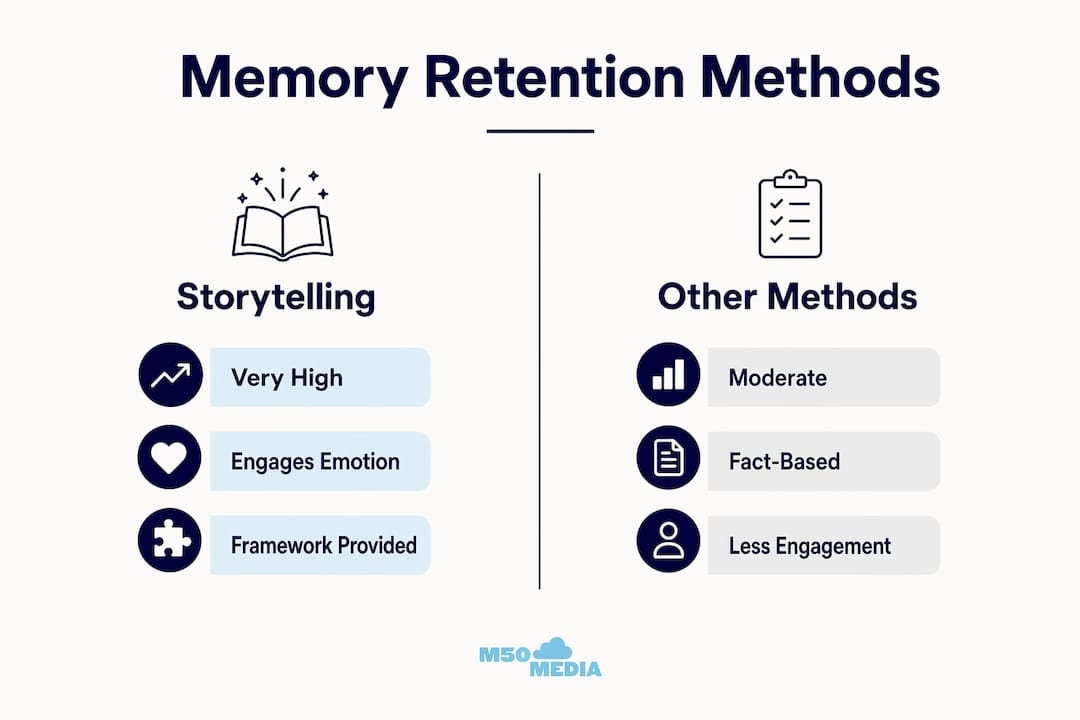
The takeaway here is clear. If you want your audience to actually remember your message, wrapping it in a story is not a creative luxury. It is a communication strategy with real cognitive science behind it.
How does storytelling engage the brain emotionally?
Here is where things get genuinely fascinating. Storytelling does not just help people remember things. It physically changes what happens inside their brains while they listen.
Emotional stories trigger oxytocin release, the neurochemical associated with empathy, trust, and social bonding. Oxytocin is the same chemical your brain produces when you hug a friend or watch a dog reunite with its owner in a viral video. When a story activates oxytocin, your audience is not just paying attention. They are physiologically primed to trust you. That is a significant advantage for any marketer or content creator trying to build a loyal audience.
Storytelling also engages both the limbic system (the emotional brain) and the frontal cortex (the logical brain) at the same time. Most communication hits one or the other. A spreadsheet hits the frontal cortex. A jump scare hits the limbic system. A great story hits both simultaneously, which is why it feels so much more persuasive than either data or pure emotion alone.
Dr. Paul Zak’s research confirms that real conflict and rising tension are what trigger the strongest neurochemical responses in audiences. A story without tension is just a sequence of events. Think of it like a Grey’s Anatomy episode where nobody’s life is in danger. Nobody’s watching that. The gap between what a character wants and what stands in their way is what keeps brains locked in.
There is also a phenomenon called neural coupling, where audience brains synchronise with the storyteller’s during narrative engagement. The storyteller and listener literally start thinking in sync. For marketers, this means a well-crafted story does not just communicate a message. It creates a shared mental experience between your brand and your audience.
Pro Tip: Build emotional tension by identifying the gap between your audience’s current reality and their desired outcome. Name that gap clearly in your story’s opening, then let the narrative arc move toward resolving it. That structure is what keeps people reading, watching, and clicking.
How does storytelling in marketing drive real results?
The benefits of storytelling in marketing are not theoretical. They show up in measurable outcomes, and one corporate case study makes this very concrete.
A company facing a major employee relocation used story-driven narratives instead of standard corporate messaging to communicate the change. Employee ambassador videos showed real people talking about their lives, their families, and their decisions around the move. The result? 75% of employees took voluntary action on the message. Standard corporate communication rarely gets anywhere close to that kind of engagement. The difference was authenticity and narrative structure, not budget.
For content creators and marketers, the power of storytelling in marketing comes down to a few consistent principles: consistency in your narrative voice, activation of your audience’s emotions early, and amplification through channels where your audience already spends time. A story told once in one place rarely sticks. A story told consistently across email, social, and video becomes a brand identity.
Here is what storytelling does for your marketing that plain messaging simply cannot:
Emotional connection: Stories make audiences feel something, and people act on feelings far more than on facts alone.
Clarity: A narrative structure simplifies complex ideas by putting them in a relatable human context.
Memorability: As the University of Mississippi research confirms, story-encoded information sticks longer than list-based information.
Brand trust: Authentic stories, especially those featuring real people and real conflict, build brand trust faster than polished corporate copy.
Audience action: When audiences feel connected to a narrative, they are more likely to share it, respond to it, and act on it.
The key word in that last point is authentic. Audiences in 2026 have a finely tuned radar for corporate scripts dressed up as stories. A genuine narrative with real stakes and real people will always outperform a manufactured emotional appeal. You can also explore visual storytelling tips to layer your narrative across formats and reach audiences who prefer images and video over text.
What is storythinking and how do you apply it?
Most marketers understand storytelling as something you do after the strategy is set. Storythinking flips that entirely.
Storythinking is a cognitive mode where you use narrative structure to plan, adapt, and solve problems. Instead of starting with data and building a message around it, you start with the human story and let the data support it. Research shows that leaders who think in story adapt more creatively and resiliently in unpredictable situations than those who rely on static data strategies alone. That is a meaningful edge in a marketing environment that changes faster than most editorial calendars can keep up with.
There is also an important distinction that gets glossed over constantly: storytelling is not the same as sharing an anecdote. True storytelling requires a clear conflict, a gap between desires and reality, and a rising tension arc. An anecdote is “here is something that happened.” A story is “here is something that happened, here is what stood in the way, and here is what changed because of it.” That structure is what engages the brain. Without it, you are just talking.
Here is how to apply storythinking to your content creation process:
Identify the human conflict. What does your audience want, and what is stopping them from getting it? Name that gap before you write a single word of content.
Build the tension arc. Show the struggle. Do not skip straight to the solution. The middle of the story is where emotional engagement happens.
Introduce the turning point. This is where your product, service, idea, or insight enters. It should feel like relief, not a sales pitch.
Resolve with a clear outcome. Show what life looks like after the conflict is resolved. Make it specific and believable.
Iterate based on response. Storythinking is not a one-time creative act. It is an ongoing process. Watch how your audience responds and refine the narrative accordingly.
Pro Tip: Avoid shallow emotional appeals like stock-photo happiness or vague inspiration. Audiences recognise manufactured emotion immediately. Ground your story in a specific, real scenario with concrete details. Specificity is what makes a story feel true.
Key takeaways
Storytelling is the most effective communication method available to marketers because it simultaneously engages emotion, builds trust through oxytocin release, and encodes information at the same depth as survival-level memory processing.
Point | Details |
Memory retention | Storytelling rivals survival processing, the brain’s highest-priority memory mode. |
Emotional engagement | Stories trigger oxytocin release, priming audiences to trust and connect with your brand. |
Marketing results | Story-driven campaigns have driven audience action rates as high as 75% in corporate settings. |
Storythinking | Using narrative structure to plan and adapt makes content creators more resilient and creative. |
Authentic narrative | Real conflict and genuine tension outperform polished corporate scripts every time. |
Storytelling is not optional anymore
I have worked with a lot of small business owners and content creators who treat storytelling like a nice-to-have. Something they will get to once the “real” marketing is sorted. I get it. When you are juggling a content calendar, ad spend, and email sequences, sitting down to craft a narrative arc feels like a luxury.
But here is what I have seen consistently: the brands that grow fastest are not the ones with the biggest budgets. They are the ones with the clearest story. A founder who can articulate the conflict their business was born out of, the tension they faced, and the outcome they created for their customers will always outperform a competitor with better production values and no narrative.
The neuroscience is not ambiguous on this. When you tell a real story with real stakes, you are not just communicating. You are synchronising your audience’s brain with your message. That is not a metaphor. That is literally what happens neurologically. The brands that understand this in 2026 are treating storytelling as infrastructure, not decoration.
My honest advice? Stop waiting until your story feels “ready.” Start with the conflict. The rest will follow.
— Karl
Ready to build a story that actually works?
Knowing the theory is one thing. Putting it into practice for your specific brand, audience, and goals is where most marketers get stuck. That is exactly what M50media coaching is built for.
Karl works directly with content creators and small business owners to develop marketing strategies grounded in authentic storytelling. Whether you are starting from scratch or trying to sharpen a message that is not landing, the free Marketing SOS call is the fastest way to get a clear, personalised direction. No fluff, no generic advice. Just a real conversation about what your brand needs to connect with the people you are trying to reach.
FAQ
Why use storytelling instead of just stating the facts?
Facts inform, but stories persuade. Storytelling engages both the emotional and logical brain simultaneously, triggering oxytocin release that builds trust and making information far more memorable than data alone.
How does storytelling improve memory retention?
Research from the University of Mississippi found that storytelling matches or outperforms survival processing in memory retention, which is the brain’s highest-priority memory mode. Story-encoded information sticks significantly longer than list-based or fact-only formats.
What makes a story effective in marketing?
Effective marketing stories require a clear conflict, a rising tension arc, and a relatable character. Without genuine tension between a desire and an obstacle, a story is just an anecdote and will not trigger the neurochemical engagement that drives audience action.
What is storythinking and why does it matter for content creators?
Storythinking is a cognitive approach where you use narrative structure to plan strategy and solve problems, not just to communicate outcomes. Content creators who think in story adapt more creatively to changing conditions than those who rely on static data strategies alone.
How quickly can storytelling build brand trust?
Authentic stories featuring real people and real conflict build brand trust faster than polished corporate copy. A single well-crafted narrative campaign has been shown to drive voluntary audience action rates as high as 75%, far outperforming standard messaging formats.
Recommended
Comments