Role of networking online for small business growth

TL;DR:
Online networking helps small businesses build trust and find opportunities through digital platforms. It offers broader reach, passive lead generation, and strong relationship-building over time. Consistency and personalized engagement are key to long-term success in online networking.
Online networking is the intentional use of digital platforms to build and nurture professional relationships that generate real business opportunities. If you have ever landed a client through a LinkedIn comment or a referral from someone you met in a Slack community, you already know the role of networking online firsthand. 85% of jobs and business opportunities are filled through personal and professional connections rather than cold applications. That number should make you put down your cold email template and pay attention. For small business owners and entrepreneurs, building connections online is not optional. It is the infrastructure your growth runs on.
What are the key benefits of networking online for small businesses?
Online networking gives you reach that no local chamber of commerce breakfast ever could. You can connect with a potential partner in Vancouver, a mentor in Toronto, and a future client in Halifax, all before your second coffee. That geographic freedom is one of the biggest benefits of networking digitally, and it compounds fast.
Here is what online networking actually does for your business:
Access to hidden opportunities. Up to 80% of high-level positions are never publicly advertised. They circulate through established digital networks. The same applies to business contracts, partnerships, and referrals.
Broader reach through weak ties. People find opportunities more often through acquaintances than close friends, because acquaintances move in different circles and carry different information. Online platforms make it easy to maintain hundreds of these “weak tie” relationships at once.
Asynchronous relationship building. You do not need to be “on” all the time. A thoughtful comment left on a post at 10 PM can spark a conversation that turns into a client by Friday.
Inbound opportunity through a digital footprint. A well-maintained profile and consistent contributions attract people to you. That is passive lead generation without a single ad dollar spent.
Credibility through consistency. Showing up regularly with useful ideas builds trust over time. Trust is what converts a connection into a paying customer.
61% of professionals report that online networking generates more opportunities than in-person events alone. That stat tells you where the action is. Pair that with the importance of networking in marketing and you have a growth engine that works around the clock.
How has online networking evolved and what modern approaches work best?

The old playbook was simple: connect with as many people as possible and hope something sticks. That approach is about as effective as handing out business cards at a concert and expecting callbacks. In 2026, networking prioritises trust built through consistent contribution and sound judgement rather than volume or generic outreach.
The shift is from broadcasting to signalling. Your posts, comments, and replies now form a public record of how you think. Algorithms on platforms like LinkedIn surface content based on engagement quality, not just frequency. That means one genuinely useful post outperforms ten hollow ones every single time.
Private, curated communities have also become a major venue for high-trust networking. Slack groups, Discord servers, and invite-only forums create the kind of focused, lower-noise environment where real relationships form. These spaces reward contribution over self-promotion.
Pro Tip: Embed a digital business card in your email signature. A team of 50 people sending 30 emails daily creates 1,500 daily touchpoints for potential new connections, all without any extra effort.
AI and platform algorithms now influence who discovers you and how legible your expertise appears to others. Trust cannot be automated or simulated. It emerges from consistent, coherent judgement across multiple digital touchpoints. The practical implication is clear: your online behaviour needs to be coherent whether you are writing a post, replying to a comment, or sending a DM.
Pairing your networking activity with a simple CRM or even a spreadsheet to track conversations and follow-ups makes a significant difference. Structured networking groups create digital trails like chat logs and meeting records that facilitate accountability and smoother follow-ups, making them more effective than ad-hoc interactions.
What practical strategies help entrepreneurs network online effectively?
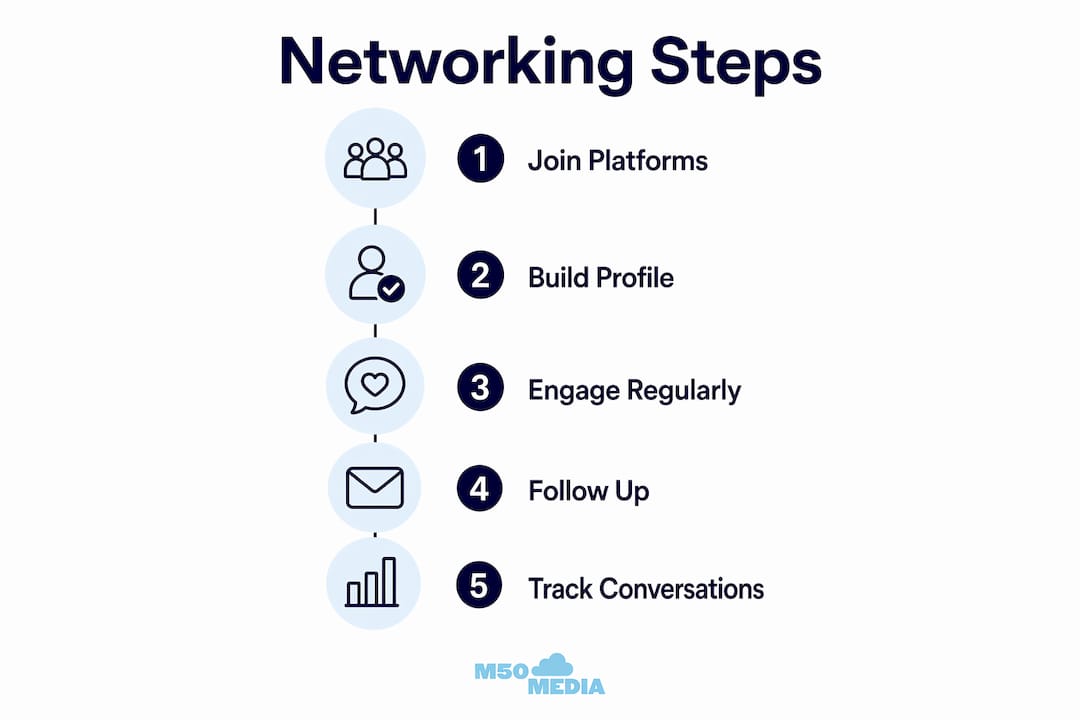
Good online networking is less about hustle and more about habit. The entrepreneurs who build the strongest networks are not the loudest ones. They are the most consistent ones. Here is a practical framework you can start using this week.
Optimise your profile for clarity. Your LinkedIn headline, bio, and featured section should answer one question: “What do you do and who do you help?” Vague profiles get ignored. Specific ones get messages.
Personalise every outreach message. Reference something specific about the person’s work, a post they wrote, a project they mentioned, or a shared connection. Generic or transactional outreach messages drastically reduce acceptance rates and damage long-term relationship potential.
Follow up within 48 hours. Following up within 48 hours on new connections is the key to converting one-time interactions into lasting relationships. Keep it short, warm, and specific.
Engage consistently with a simple rhythm. Post once a week, comment three times daily, and engage with five new people monthly to build a credible and visible professional presence. Small habits compound into strong reputations.
Join niche communities and contribute first. Find two or three online groups where your ideal clients or collaborators hang out. Spend the first month giving answers, not pitches.
Track your connections. Use a simple system to note who you spoke with, what you discussed, and when to check back in. Periodic check-ins keep relationships warm without feeling forced.
Pro Tip: When you meet someone new online, send a voice note instead of a text reply. It is personal, fast, and almost nobody else is doing it. You will be remembered.
Combining these habits with a broader digital marketing strategy multiplies their impact. Networking and marketing are not separate activities. They feed each other.
What mistakes should you avoid in online networking?
The biggest mistake in online networking is treating it like a vending machine. You put in a connection request and expect a contract to fall out. That is not how relationships work, online or anywhere else.
Watch out for these common pitfalls:
Pitching too soon. Leading with your offer in a first message is the digital equivalent of proposing on a first date. Build rapport before you ask for anything.
Copy-paste outreach. People can smell a template from a mile away. A message that could have been sent to anyone signals that you do not actually care about the person you are contacting.
Networking only when you need something. The entrepreneurs who struggle most with networking are the ones who only show up when business is slow. Networking as a long-term asset compounds through trust and clarity. It does not work on demand.
Ignoring weak ties. Your closest contacts are not always your most valuable ones. The acquaintance you chatted with in a Facebook group six months ago might be the one who refers your next big client.
Chasing follower counts over real connections. A thousand passive followers deliver less value than fifty people who genuinely know what you do and trust your work.
Inconsistent follow-through. Saying you will send something and then not sending it is a trust-killer. Every dropped ball costs you credibility.
Building trust online requires the same thing it always has: showing up reliably, adding value without expectation, and being the same person in every interaction. The digital part just means more people are watching.
Key takeaways
Online networking is the single most cost-effective growth tool available to small business owners, provided it is built on consistency, personalisation, and genuine value rather than volume or self-promotion.
Point | Details |
Hidden opportunities dominate | Up to 80% of high-level opportunities never get publicly posted; digital networks are where they circulate. |
Consistency beats volume | Posting weekly and engaging daily builds more credibility than sporadic bursts of high-volume outreach. |
Follow up fast | Reaching out within 48 hours of a new connection dramatically increases the chance of a lasting relationship. |
Personalise every message | Specific, tailored outreach consistently outperforms generic templates in both response rate and relationship quality. |
Weak ties carry real weight | Acquaintances in different networks often deliver bigger opportunities than your closest contacts. |
Karl’s take on online networking
Networking used to feel like a chore to me. The idea of “working a room” online, firing off connection requests and hoping someone bites, felt hollow and exhausting. What changed my perspective was realising that online networking is infrastructure, not a tactic. You build it once, you maintain it consistently, and it pays you back in ways you cannot always predict or plan for.
One thing I have noticed working with small business owners is that introverts often thrive in online networking environments. Asynchronous communication is an introvert’s strategic advantage because it allows for thoughtful, considered responses without the social drain of live events. If you have ever felt awkward at a networking mixer, the online version might actually suit you better.
The mistake most entrepreneurs make is waiting until they need something before they start networking. By then, it is too late to build the trust that makes people want to help you. Start now, even if your business is going well. Especially if it is going well. The connections you make when you have nothing to sell are the ones that last.
I also want to be honest: online networking works best when it complements offline relationships, not replaces them. A coffee meeting with someone you have been engaging with online for three months is worth ten times a cold call. Use digital tools to warm people up, then find ways to deepen those connections in person when you can. That combination is where the real magic happens.
— Karl
How M50media can help you build your network
Building a network that actually drives business growth takes more than a polished LinkedIn profile. It takes a clear strategy, consistent habits, and someone in your corner who has done it before.
At M50media, Karl Lundgren works directly with small business owners to build personalised digital marketing and networking strategies that fit their business, their personality, and their goals. Whether you are starting from scratch or trying to get more out of the connections you already have, the M50media coaching programme gives you a clear path forward. Not sure where to start? Book a free Marketing SOS call with Karl and walk away with a concrete next step you can use the same day.
FAQ
What is the role of networking online for small businesses?
Online networking is the intentional use of digital platforms to build professional relationships that generate referrals, partnerships, and business opportunities. For small businesses, it replaces expensive advertising with trust-based connections that compound over time.
How often should I engage online to build a strong network?
Post once a week, comment three times daily, and connect with five new people monthly. That rhythm builds a visible, credible presence without consuming your entire workday.
Why do personalised messages outperform generic ones?
Generic outreach signals low effort and low interest, which most people ignore or decline. A specific message referencing the recipient’s actual work shows respect and dramatically increases the chance of a positive response.
What are weak ties and why do they matter in online networking?
Weak ties are acquaintances outside your close circle who move in different networks and carry different information. Research shows they deliver more opportunities than close contacts because they connect you to worlds you would not otherwise reach.
How does online networking differ from traditional networking?
Online networking removes geographic limits, allows asynchronous communication, and creates a permanent digital record of your expertise and character. Traditional networking is bounded by location and time; online networking compounds continuously.
Recommended
The point about passive lead generation really resonated—consistent, personalized engagement can keep opportunities moving even when you’re not actively selling. I’ve been using https://easemate.pro
The point about passive lead generation really resonates—consistent, personalized engagement can keep opportunities coming even between active campaigns. I’ve been using https://transcribeai.pro/video-to-text
The point about passive lead generation really stood out—consistent, personalized engagement can keep opportunities coming even between active outreach. I’ve been using https://faceless-ai.pro
The point about passive lead generation really stood out—consistent, personalized engagement can keep opportunities growing even when you’re focused on daily operations. I’ve been using https://vibecodingai.online/vibe-coding-tutorial