Online reputation management guide for small businesses

TL;DR:
Online reputation management involves continuously monitoring and shaping how your business appears across digital platforms.
Regular audits, authoritative content, and prompt review responses are essential for building and maintaining a strong online reputation.
Online reputation management (ORM) is the proactive process of monitoring, shaping, and maintaining how your small business appears across search engines, social media, AI platforms, and review sites. Think of it as your digital first impression, except it runs 24/7 and never takes a coffee break. This online reputation management guide covers the four core pillars every small business owner needs: auditing your current presence, building positive digital assets, responding to feedback well, and managing how AI search engines portray you. Expect realistic timelines. Meaningful results from consistent ORM efforts typically appear within 3 to 6 months, and full crisis recovery can take years.
What does a proper online reputation audit look like?
A reputation audit is your starting point. You cannot fix what you cannot see, so the first step is getting a clear, honest picture of your digital presence across every platform that matters.
Here is a simple audit process to follow:
Open an incognito browser window and search your business name on Google, Bing, and DuckDuckGo. Note what appears on page one.
Search your name plus words like “reviews,” “complaints,” and “scam” to surface hidden sentiment.
Open ChatGPT, Gemini, and Perplexity and ask each one to describe your business. Screenshot every result.
Check your profiles on LinkedIn, Google Business Profile, Facebook, and any industry directories.
Document everything in a spreadsheet, classifying each result as positive, neutral, or negative.
That spreadsheet becomes your reputation baseline. Without it, you are just guessing.
Key profiles to prioritise during your audit:
Google Business Profile: Often the first thing a potential customer sees.
LinkedIn: Critical for B2B credibility and personal brand authority.
Social media handles: Check that you own your brand name on every major platform, even ones you do not actively use.
Review platforms: Google Reviews, Yelp, and any industry-specific sites relevant to your sector.
Pro Tip: Schedule your audit quarterly. AI engines like ChatGPT and Gemini update their summaries regularly, so what they said about you in january may be completely different by april.
The AI engine piece deserves special attention. AI engines significantly affect reputation and require quarterly monitoring to track which external sources they cite about your business. That means the articles, directories, and review sites feeding those AI summaries matter just as much as your own website.
How do you build a strong positive online reputation?
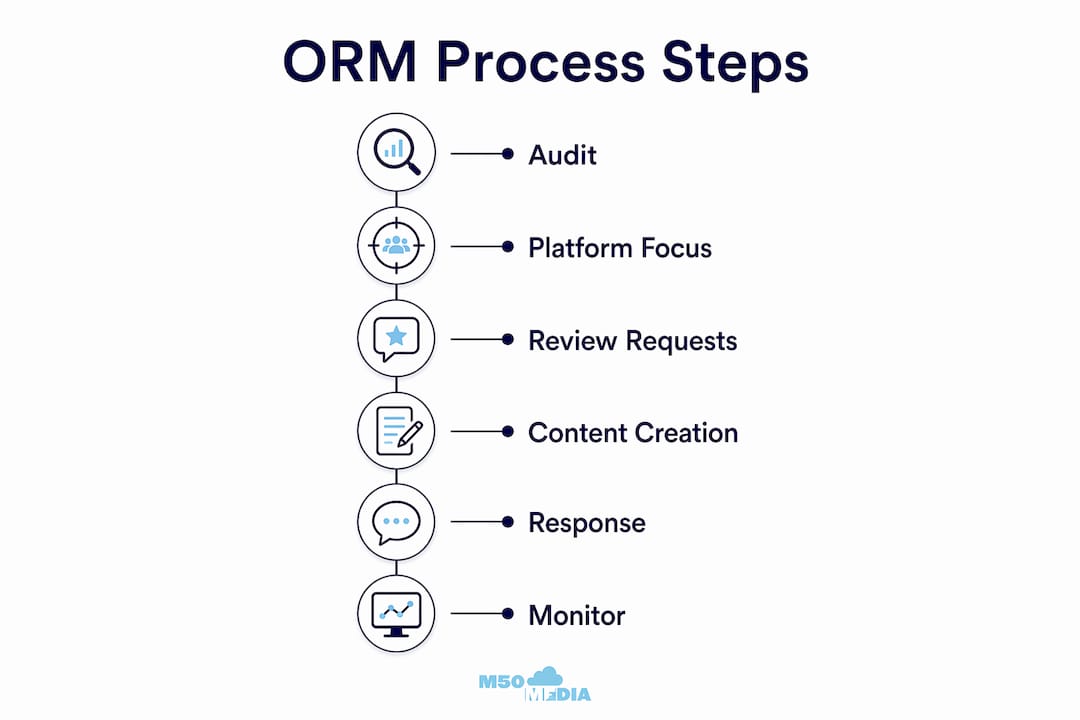
Building a positive online brand reputation is not about being everywhere. It is about being authoritative in the right places. Spreading yourself across 15 platforms with mediocre content is a fast track to burnout and zero results.

A central canonical website with schema markup and connected social accounts is the single most impactful ORM asset you can build. It serves as the primary entity reference for AI engines and anchors all your other profiles. Think of it as your digital headquarters. Everything else links back to it.
Here is where to focus your energy:
Your own website: Publish consistent blog posts, case studies, and thought leadership content. This is your most controllable asset.
LinkedIn: Optimise your profile fully and publish articles regularly. LinkedIn content ranks well in Google and feeds AI engine summaries.
Google Business Profile: Keep it updated with fresh photos, posts, and accurate business information.
Tier 1 content platforms: Guest posts on reputable industry publications build authority and create positive citations that AI engines trust.
Prioritising a limited number of high-authority platforms consistently outperforms scattered activity across many lower-impact channels. Quality beats quantity every single time.
Reviews are a big part of this picture. Businesses that systematise review requests after positive interactions build richer, more genuine review profiles. Send a personalised, direct review link immediately after a project completion or a positive customer interaction. Do not wait a week. The moment passes and so does the motivation to leave a review.
Pro Tip: Pick two or three platforms and commit to them fully before adding more. A well-maintained LinkedIn profile and an active Google Business Profile will do more for your reputation than ten half-hearted accounts.
Sustained content creation also pushes negative results down the search rankings over time. Positive content saturation is the most effective long-term method to suppress negative search results. Legal threats rarely achieve removal, and they are expensive. Fresh, authoritative content is your best weapon.
How should you respond to reviews and negative feedback?
Here is the thing about negative reviews: they are not the end of the world. How you respond to them can actually make you look better than if the review never existed. Potential customers read your responses just as carefully as they read the original complaint.
Responding to negative reviews within 24 hours with empathy and a professional tone improves how your reputation is perceived. That 24-hour window matters. A week-old unanswered complaint signals that you do not care.
Follow this response process for every negative review:
Acknowledge the issue. Do not get defensive. Start with something like, “Thank you for sharing your experience.”
Apologise if appropriate. You do not have to admit fault to express genuine empathy.
Offer to resolve it offline. Provide a direct email or phone number so the conversation moves out of the public eye.
Keep it short. Long defensive paragraphs make things worse, not better.
Follow up. If the issue gets resolved, a brief public update shows other readers that you follow through.
Professional responses to negative feedback act as reputation signals to both potential customers and AI algorithms. They demonstrate accountability, which builds trust faster than a wall of five-star reviews ever could.
Never delete a negative review unless it clearly violates platform policies (spam, hate speech, or fabricated content). Deleting legitimate criticism looks worse than the original complaint. If a review is fake, use the platform’s official flagging process and document your case carefully.
Pro Tip: Respond to positive reviews too. A simple “Thank you, we loved working with you!” takes 10 seconds and shows you are engaged and human.
How do AI search engines affect your reputation in 2026?
AI search engines are not the future anymore. They are the present. ChatGPT, Claude, Perplexity, Gemini, and Google AI Overviews are actively shaping how potential customers perceive your business before they ever visit your website.
AI engines like ChatGPT, Claude, and Gemini require quarterly auditing to track what they say about your brand and which sources they cite. This is a newer layer of reputation management that most small business owners are still ignoring. Do not be one of them.
Here is what to focus on for AI reputation management:
Entity consistency: Make sure your business name, address, phone number, and description are identical across every platform. AI engines cross-reference these signals to build their summaries.
Authoritative citations: Get your business mentioned in reputable publications, directories, and industry blogs. These become the sources AI engines pull from.
Owned content quality: Regularly update your website and LinkedIn with accurate, detailed information about what you do and who you serve.
Quarterly AI audits: Screenshot what each major AI engine says about you every three months and track changes over time.
AI Platform | What to check | How often |
ChatGPT | Business description and cited sources | Quarterly |
Gemini | Summary accuracy and linked profiles | Quarterly |
Perplexity | Review sentiment and source citations | Quarterly |
Google AI Overviews | Featured snippets and knowledge panel | Monthly |
AI-powered monitoring tools can automate real-time sentiment tracking and alert you to reputation risks across channels. That kind of early warning system is worth its weight in gold when a negative story starts gaining traction.
Tracking broad sentiment patterns and recurring complaints reveals insights for improving your products and services. It is not just about managing perception. It is about learning what your customers actually think.
What are the most common ORM mistakes small businesses make?
The biggest mistake in online reputation management is treating it like a fire extinguisher. You do not pull it out only when something is burning. By then, the damage is already done.
ORM must be treated as a continuous, multi-year operational discipline that integrates social listening, SEO, and content creation. Brands that succeed in ORM monitor, respond, and build content consistently. They do not wait for a crisis.
Common pitfalls to avoid:
Waiting for a crisis to start. Reactive ORM is slower, more expensive, and far less effective than proactive work.
Expecting overnight results. Significant ORM shifts are visible within 3 to 6 months of consistent effort. Full crisis recovery takes longer.
Relying on legal removal. Suppressing negative results depends on SEO-driven content creation, not legal threats. Courts rarely order removal of legitimate reviews.
Spreading too thin. Maintaining 10 mediocre profiles is worse than maintaining three excellent ones.
Ignoring AI engines. Skipping quarterly AI audits means you have no idea what potential customers are reading about you in AI-generated summaries.
Understanding digital reputation strategies as a long-term commitment rather than a one-time project is the mindset shift that separates businesses with strong reputations from those constantly playing catch-up.
Pro Tip: Block one hour every quarter for your reputation audit. Put it in your calendar like a client meeting. Consistency is the whole game.
Working with a web presence partner who understands digital reputation signals can also help you build the technical foundation (schema markup, site structure, and local SEO) that supports your ORM efforts long-term.
Key takeaways
Effective online reputation management requires consistent auditing, authoritative content creation, prompt review responses, and quarterly AI engine monitoring to build lasting trust.
Point | Details |
Audit first, act second | Search your business across Google, Bing, and AI engines quarterly and document every result. |
Own your canonical website | A schema-marked website connected to your social profiles is your most powerful ORM asset. |
Respond within 24 hours | Prompt, empathetic responses to negative reviews build trust with future customers and AI algorithms. |
Content beats legal threats | Positive content saturation suppresses negative results far more effectively than pursuing legal removal. |
Treat ORM as ongoing work | Meaningful reputation improvements take 3 to 6 months and require consistent, long-term effort. |
What I have learned about reputation management the hard way
I have worked with a lot of small business owners over the years, and the pattern is almost always the same. They come to me after something has gone sideways. A bad review went viral. A competitor is outranking them. An AI engine is describing their business inaccurately. And the first thing they say is, “I had no idea this was happening.”
That is the real problem. Not the bad review. Not the inaccurate AI summary. The problem is that nobody was watching.
The most resilient brands I have seen are the ones that treat their online reputation like a utility bill. You pay it every month whether you feel like it or not, because the lights go out if you do not. They publish content consistently. They respond to every review. They check what ChatGPT says about them. It is not glamorous work, but it compounds over time in a way that nothing else does.
The AI engine piece is genuinely new territory, and I will be honest: it changes faster than most of us can keep up with. What I tell my clients is to focus on what they can control. Accurate, consistent information across all platforms. Quality content on their own website. Genuine reviews from real customers. Those inputs feed every algorithm, whether it is Google’s or an AI engine’s.
The businesses that win at this are not the ones with the biggest budgets. They are the ones who show up consistently, respond with empathy, and never stop building. That is the whole playbook, really. Explore the M50media blog for more on why this work matters more than ever in the AI era.
— Karl
How M50media can support your reputation goals
Managing your online reputation while running a business is a lot. It is like being asked to cook dinner, answer emails, and do a cartwheel simultaneously. That is where M50media comes in.

M50media offers digital coaching and marketing strategy built specifically for small business owners who want real results without the corporate price tag. Karl works directly with you to audit your digital presence, build a content plan, and set up the systems that keep your reputation growing on autopilot. Not sure where to start? Book a free Marketing SOS call and get a clear picture of where you stand and what to do next. No pressure, no jargon, just straight talk from someone who has been in the digital marketing trenches for years. Visit m50media.com to explore coaching options and tools that fit your budget and your goals.
FAQ
What is online reputation management?
Online reputation management (ORM) is the practice of monitoring, shaping, and maintaining how your business appears across search engines, review sites, social media, and AI platforms. It combines SEO, content creation, review management, and social listening into one ongoing discipline.
How long does it take to improve your online reputation?
Consistent ORM efforts typically take 3 to 6 months before meaningful movement appears in search results. Crisis recovery situations can require a multi-year commitment.
Can you legally remove negative reviews?
Legal removal of negative reviews is rarely successful and generally slow. Positive content saturation is the most effective method for pushing negative results off page one of search results.
How do AI engines affect my business reputation?
AI engines like ChatGPT, Gemini, and Perplexity generate summaries about your business based on external sources they find online. Inaccurate or negative sources directly shape those summaries, which is why quarterly AI audits are a necessary part of any modern online presence management strategy.
How often should you audit your online reputation?
A full audit covering search engines, review platforms, and AI engines should happen at least quarterly. Google AI Overviews and knowledge panels change more frequently and benefit from monthly spot checks.
Recommended
The reminder to treat reputation management as an ongoing process—not a one-time cleanup—is especially useful, particularly with prompt review responses. I’ve been using https://imagineartai.pro
The reminder to pair regular reputation audits with prompt review responses is especially practical for small businesses. I’ve been using https://pikaai.pro
The reminder to combine regular reputation audits with prompt review responses is especially practical for small businesses. I’ve been using https://png-to-stl.site
The emphasis on regular audits and prompt review responses is especially practical for small businesses with limited time. I’ve been using https://photocraft.world
The focus on regular audits and prompt review responses is especially practical for small businesses with limited time. I’ve been using https://aiadcreatives.online/ai-ad-creatives-examples