Digital Marketing Plan Guide for Small Businesses Success


Trying to grow your ecommerce business without a plan can feel like throwing spaghetti at the wall to see what sticks. For small teams, every marketing decision and dollar counts when you want real growth. By mastering defining your business goals and target audience, you set a strong foundation for smart marketing choices and avoid wasting time on strategies that do not fit your customers.
Table of Contents
Quick Summary
Key Insight | Explanation |
1. Define SMART Goals | Clearly outline specific, measurable, achievable, relevant, and time-bound business objectives for effective marketing. |
2. Identify Target Audience | Create detailed customer profiles to tailor marketing efforts and enhance engagement through targeted strategies. |
3. Choose Effective Channels | Select marketing channels based on where your audience spends time, avoiding unnecessary expenditures on irrelevant platforms. |
4. Analyze and Optimize Campaigns | Continuously track campaign performance, focusing on outcomes to refine strategies and improve ROI over time. |
5. Develop Valuable Content | Craft content that addresses customer needs and combines educational and promotional offers to drive conversions. |
Step 1: Define business goals and target audience
Before you spend a penny on advertising or create a single social media post, you need clarity on two things: where you’re going and who you’re taking with you. Without these anchors, your marketing efforts become scattered shots in the dark instead of deliberate, measured actions.
Start by defining your business goals. These are the specific outcomes you want your marketing to achieve. Your goals should connect directly to your bottom line. Are you launching a new product line? Trying to increase repeat customers? Looking to expand into a new geographic region? Write these down clearly. A goal like “increase sales” is too vague. Instead, aim for something measurable: “increase online sales by 25% within six months” or “acquire 50 new wholesale accounts by Q3.”
Make your goals SMART:
Specific: exactly what do you want to accomplish?
Measurable: how will you know when you’ve succeeded?
Achievable: is this realistic for your team and budget?
Relevant: does it matter to your business right now?
Time-bound: when will you hit this target?
Once your goals are locked in, turn your attention to your audience. A target audience is a specific group of people likely interested in your product, identified using characteristics like age, income, location, and interests. The key insight here is understanding that your target audience is narrower and more specific than your overall market.
Start by answering these questions about your ideal customer: Who has the problem your product solves? What’s their approximate age range and income level? Where do they live or shop? What are their main interests and pain points? Do they buy online or prefer brick-and-mortar? What time of year do they typically make purchases in your category?
Create a simple customer profile (or two or three if you serve different groups). Give each profile a name and write down their characteristics. This sounds basic, but it transforms how you approach everything from ad copy to product positioning. When you know your audience deeply, your marketing becomes targeted instead of generic.
A strong goal paired with a crystal-clear target audience makes every marketing decision that follows exponentially easier and more effective.
Your marketing plan should clearly define goals and target audiences to help allocate your budget efficiently and achieve specific organisational objectives. This foundation lets you avoid wasting money on channels or messages that don’t resonate with the people most likely to buy from you.
Pro tip: Document your goals and audience profiles in a shared document your team can access. Review them quarterly and adjust based on what your sales and customer data actually show you, not what you assumed at the start.
Step 2: Build effective channel strategies
Now that you know your goals and audience, it’s time to choose where to reach them. Your channel strategy is essentially your roadmap for which platforms, tools, and methods you’ll use to connect with customers. Pick the wrong channels and you’re shouting into the void. Pick the right ones and your message lands exactly where it matters.

Marketing channels are methods a business uses to reach customers, such as social media, email, or print. The key is not picking every channel available, but rather selecting the ones where your specific audience actually spends time. If you’re selling vintage vinyl records to collectors aged 35 to 55, spending heavily on TikTok might waste your budget. But email, podcasts, and niche online communities could be goldmines.
Start by mapping where your target audience lives online and offline. Consider these channels for evaluation:
Social media platforms (Facebook, Instagram, LinkedIn, TikTok)
Email marketing campaigns
Search engine optimisation (SEO) and paid search ads
Content marketing through blogs or video
Print advertising or local media
Direct outreach and partnerships
Influencer collaborations
For each channel, ask yourself three things: Does my audience use this? Can I afford to do this well? Do I have the skills or resources to execute here? Skip any channel where you answer “no” to two or more questions.
Social media advertising delivers lead generation when done strategically, making it a strong contender for most small ecommerce businesses. If you’re unsure where to begin, start with one or two channels where your competitors already operate successfully. That’s market validation doing your research for you.
Develop a channel calendar showing which platforms you’ll use, what type of content you’ll post, and how often. Be honest about capacity. One well-executed channel beats three neglected ones every single time. A small team posting consistently on Facebook and email will outperform scattered efforts across six platforms.
Your channel strategy succeeds when it concentrates effort where your audience naturally gathers, not where every business happens to be.
Remember that consistency matters more than perfection. Plan to test, measure, and adjust your channels quarterly based on actual results from engagement rates, conversion data, and customer feedback.
Pro tip: Start with just two channels that align with your audience and budget, then expand only after proving you can sustain them with quality content and consistent posting.
Step 3: Develop compelling content and offers
Content is the heartbeat of your digital marketing plan. Without it, your channels sit empty and your audience has nothing to engage with. This step is about creating content and offers that actually make people want to stick around, not just scroll past.
A content strategy outlines a clear plan for creating and publishing content aligned with your business goals. Before you write a single post or design a single graphic, get clear on what you’re trying to accomplish. Are you building trust through educational content? Driving immediate sales through promotions? Building community through storytelling? Your answer shapes everything that follows.
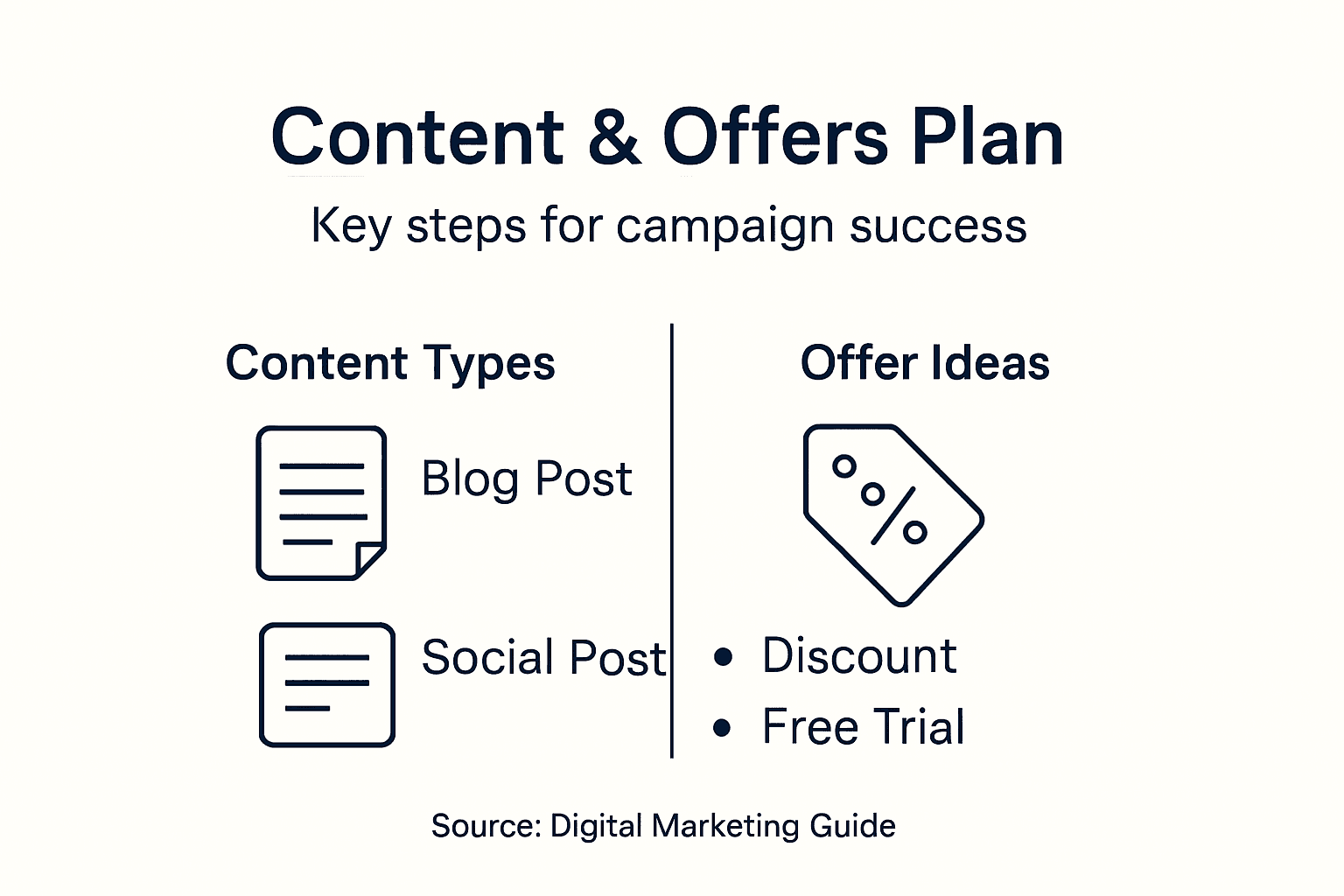
Start by understanding what your audience actually needs. Your customers aren’t looking for content about your business. They’re looking for answers to their problems. Someone browsing for running shoes doesn’t want to read about your company’s history. They want to know if those shoes handle wet pavement, how they fit compared to other brands, and whether they’re worth the price.
Create content that addresses these needs across different stages of the customer journey:
Awareness stage: educational content, blog posts, how-to guides
Consideration stage: product comparisons, customer reviews, case studies
Decision stage: special offers, product demos, testimonials
Beyond content, develop compelling offers that give people a reason to buy now rather than later. Offers can include discounts, free trials, bundle deals, or exclusive access. The key is making them feel valuable without destroying your margins. A 15 percent discount on a high-margin product beats a 40 percent discount that leaves you struggling.
When communicating benefits rather than features, you connect emotionally with buyers. Someone doesn’t care that your moisturiser contains hyaluronic acid. They care that their skin will feel hydrated and look younger. Lead with the benefit, then back it up with features if needed.
Your content and offers work together. Share educational content to build authority, then present offers at the right moment to convert that trust into sales. Mix promotional and non-promotional content in a roughly 80-20 ratio. Too many sales pitches and people tune you out. Too little promotion and you’re just giving away value without capturing any.
Compelling content answers real questions your customers ask; compelling offers give them a genuine reason to act now.
Pro tip: Document 10 common questions your customers ask, then create one piece of content answering each question, followed by a soft offer for your product or service.
Step 4: Implement and track digital campaigns
Launching your campaigns is exciting, but it’s only half the battle. The real power comes from tracking what actually happens and using that data to improve. Without measurement, you’re flying blind and wasting money on tactics that don’t work.
Start by setting up tracking from day one. Before your campaign goes live, install analytics tools on your website, set up conversion tracking in your ad platforms, and create unique codes or URLs for each campaign. This lets you see exactly which channels, ads, and messages drive results. If you don’t track it, you can’t measure it.
Decide which metrics actually matter to your business. Effective implementation requires applying optimisation techniques like testing and analysis to improve campaigns. Common metrics include:
Click-through rate (how many people clicked your ad)
Conversion rate (how many people took the desired action)
Cost per acquisition (how much you spent to gain each customer)
Return on ad spend (how many pounds you earned for every pound spent)
Email open rate and click rate
Website traffic and engagement time
The difference between outputs and outcomes matters tremendously. An output is an activity (you posted 10 times this month). An outcome is a result (those 10 posts generated 47 new customers). Track outcomes, not just outputs. Your boss doesn’t care how many posts you made. They care how many sales you generated.
Here’s a summary of examples contrasting outputs and outcomes in digital campaigns:
Activity Type | Output Example | Outcome Example |
Social Media | Scheduled 10 posts this month | Generated 47 new customers |
Sent 3 promotional emails | Achieved 12% sales growth | |
Blog | Published 5 articles | Improved website traffic by 25% |
Ad Campaign | Ran Facebook ad for 2 weeks | Gained 20 paid signups |
Implement A/B testing to compare campaign variations and discover what resonates with your audience. Test one element at a time: headline, image, call-to-action, or timing. Change everything at once and you won’t know what actually worked.
Review your data weekly and adjust accordingly. If an email subject line has a 35 percent open rate while another has 18 percent, use more of what works. If a particular social media channel drives zero sales but costs money to maintain, consider pausing it. This isn’t about perfection. It’s about continuous improvement based on real results.
You can’t improve what you don’t measure. Tracking is your roadmap to knowing exactly what’s working and what’s wasting your budget.
Schedule monthly reviews where you analyse performance, celebrate wins, and identify what needs adjustment. Share these insights with your team so everyone understands which efforts matter most.
Pro tip: Create a simple one-page dashboard showing your top 5 metrics updated weekly; this keeps your team focused on what actually drives business results.
Step 5: Analyse and optimise for better results
You’ve launched your campaigns and collected data. Now comes the part that separates thriving businesses from those stuck spinning their wheels. Analysis is where you uncover what’s actually working and double down on it.
Marketing analytics involves collecting and analysing data to understand the success of your marketing initiatives. This isn’t about drowning in spreadsheets or obsessing over vanity metrics. It’s about identifying patterns that tell you what to do next. Which content types generate the most engagement? Which audience segments convert at the highest rates? Which channels deliver the lowest cost per customer?
Start by categorising your data into three buckets. First, look at performance winners – campaigns, channels, or messages that exceeded your targets. Second, identify underperformers – the areas dragging down your overall results. Third, spot opportunities – gaps where you could test something new based on what’s working.
Use these analysis approaches to guide your optimisation:
The following table illustrates key approaches to marketing data analysis and their core business value:
Analysis Approach | Primary Question Addressed | Main Business Value |
Descriptive | What happened and why? | Understand past performance |
Predictive | What may happen next? | Anticipate future trends |
Prescriptive | What actions to take? | Inform smarter decision-making |
Descriptive analysis: what happened and why (your past performance)
Predictive analysis: what might happen next (trends and forecasts)
Prescriptive analysis: what you should do about it (specific actions)
To optimise performance, understand which levers to pull. Real-time data use enables businesses to adjust campaigns throughout their duration instead of waiting until completion. If your email open rate starts dropping halfway through a campaign, test a new subject line immediately. If a particular audience segment responds brilliantly to your ads, increase budget there while decreasing spend on weaker segments.
Testing becomes your best friend. Set up experiments comparing variations of your messaging, targeting, creative, or timing. Run each test long enough to gather meaningful data, then apply the winner to future campaigns. Small wins compound. A 2 percent improvement in conversion rate might seem insignificant, but applied across 1000 customers, that’s 20 additional sales monthly.
The best performing campaigns aren’t the ones that succeed on the first try. They’re the ones that evolve based on continuous testing and honest analysis.
Document what you learn. Create a simple spreadsheet or shared file noting which tactics worked, which didn’t, and why. This becomes your team’s institutional knowledge and saves you from repeating mistakes or forgetting winning strategies.
Pro tip: Pick one metric as your north star (usually revenue or customer acquisition cost) and obsess over improving it; everything else becomes secondary to that primary focus.
Unlock Your Small Business Potential With Expert Digital Marketing Solutions
Building a successful digital marketing plan involves defining clear goals, understanding your target audience, selecting the right channels, creating compelling content, and measuring your results. If you find yourself overwhelmed by these steps or unsure how to turn your strategy into measurable results, you are not alone. Many small business owners struggle with crafting focused campaigns that avoid wasted efforts and budget. M50 Media offers tailored coaching and a curated selection of digital marketing products designed specifically to solve these challenges. From strategic planning to content creation and campaign optimisation, our solutions help you build consistency and drive real growth.
Don’t let uncertainty hold you back. Explore our range of practical resources and tools at All Products | Karl Lundgren M50 and start transforming your marketing today. Visit M50 Media to access expert guidance that makes complex marketing concepts simple and actionable. Ready to take control and see results that matter? Act now and turn your digital marketing plan into a powerful engine for growth.
Frequently Asked Questions
What are the first steps in creating a digital marketing plan for my small business?
To begin crafting a digital marketing plan, first, define your business goals and identify your target audience. Take time to outline specific, measurable goals that align with your bottom line, such as increasing online sales by 25% within six months.
How do I know which marketing channels to use for my business?
Choose marketing channels based on where your target audience spends their time. Evaluate options like social media, email marketing, and content marketing to ensure you focus on two or three channels that resonate with your specific audience’s preferences and behaviours.
What types of content should I create for my marketing campaigns?
Focus on creating content that addresses your audience’s needs at various stages of their customer journey. Develop educational blogs and how-to guides for the awareness stage, product comparisons for the consideration stage, and special offers for the decision stage.
How can I track the effectiveness of my digital marketing campaigns?
Set up tracking tools to monitor key metrics such as click-through rate, conversion rate, and cost per acquisition from the start of each campaign. Use this data to evaluate performance weekly and make necessary adjustments to improve outcomes immediately.
What should I focus on when analysing my marketing data?
When analysing your marketing data, concentrate on identifying performance winners, underperformers, and opportunities for new tests. Regularly review these results to adjust your campaigns, aiming for continuous improvement to enhance your overall strategy.
How often should I update my digital marketing plan?
Review and update your digital marketing plan at least quarterly to ensure it reflects current business goals and market trends. This regular assessment will help you adjust your strategies based on actual performance data rather than assumptions.
Recommended
Comments