What is B2B Marketing and Why It Matters Now


Securing lasting business partnerships can be more complex than attracting individual shoppers. For small business owners and ecommerce entrepreneurs, understanding B2B marketing means shifting focus to organizational decision makers, longer sales cycles, and relationship building. Mastering these core concepts from targeted communication to nuanced buying behaviour is the key to unlocking revenue potential and establishing your business as a trusted partner in this competitive arena.
Table of Contents
Key Takeaways
Point | Details |
Understanding B2B Marketing | B2B marketing focuses on solving organizational challenges, requiring a deep understanding of decision-making processes and longer sales cycles. |
Effective Strategies | Modern B2B marketing should leverage content, account-based, social media, email, and digital advertising to engage decision makers. |
Implementation Best Practices | Successful B2B marketing requires developing buyer personas, value-driven content, and multi-channel engagement approaches. |
Avoiding Common Pitfalls | To enhance success, businesses must address communication gaps, personalise messaging, and embrace modern digital strategies. |
Defining B2B Marketing and Core Concepts
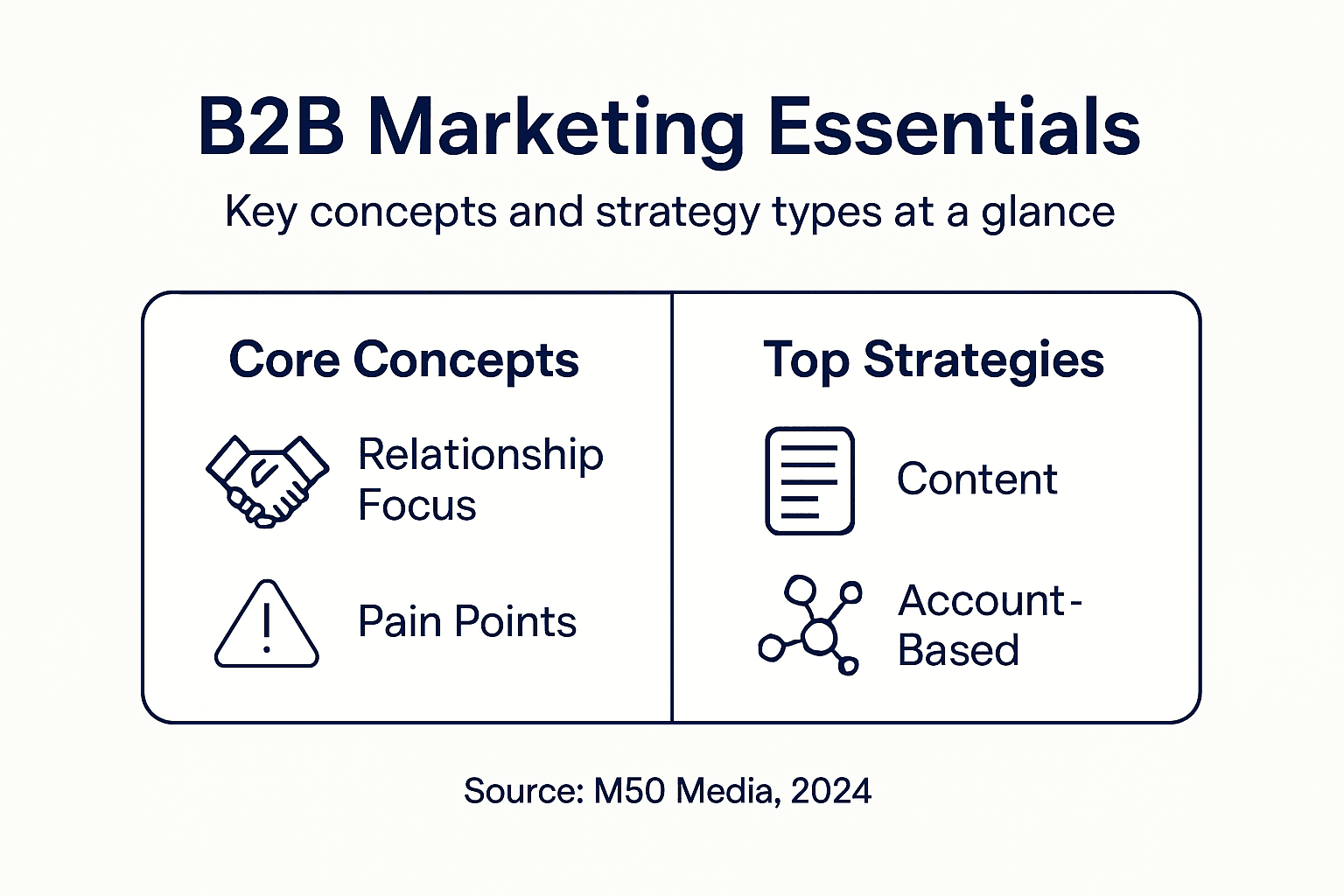
B2B marketing represents a sophisticated approach where businesses strategically promote products and services directly to other organizations. Unlike consumer-focused marketing, B2B marketing requires a nuanced understanding of organizational decision-making processes and complex purchasing dynamics. Business-to-business marketing strategies involve targeting key stakeholders who make strategic procurement decisions for their companies.
At its core, B2B marketing differs fundamentally from business-to-consumer (B2C) approaches through several critical characteristics:
Focuses on solving organizational challenges
Targets professional decision makers, not individual consumers
Emphasizes long-term relationship building
Requires deeper technical understanding of product/service benefits
Involves longer sales cycles with multiple approval stages
The strategic landscape of B2B marketing demands a comprehensive approach that goes beyond traditional advertising. Companies must develop sophisticated communication strategies that demonstrate clear value propositions, return on investment (ROI), and alignment with organizational objectives.
Here’s a comparison of B2B and B2C marketing to clarify their distinct business focuses:
Aspect | B2B Marketing | B2C Marketing |
Primary Audience | Organisational decision makers | Individual consumers |
Sales Cycle | Longer, involves multiple stages | Shorter, direct decision making |
Key Concern | ROI and business value | Price and personal satisfaction |
Relationship Focus | Long-term strategic partnerships | Single or repeat transactions |
Key Elements of Effective B2B Marketing:
Detailed market research
Understanding organizational buying behaviour
Developing targeted communication strategies
Building trust through expertise demonstration
B2B marketing is not about selling a product, but solving a business challenge.
Pro tip: Invest time in understanding your target organization’s specific pain points and craft messaging that directly addresses their strategic needs.
Types of B2B Marketing Strategies Today
In the dynamic world of business marketing, organizations leverage diverse B2B marketing strategies to connect with potential corporate clients. Digital marketing has become a cornerstone of contemporary B2B approaches, enabling businesses to reach decision makers through sophisticated, targeted communication channels.
Modern B2B marketing encompasses several key strategic approaches:
Content Marketing: Creating valuable, educational resources that demonstrate expertise
Account-Based Marketing (ABM): Highly personalized targeting of specific high-value organizations
Social Media Marketing: Engaging professional networks and industry communities
Email Marketing: Nurturing leads through strategic, segmented communication
Digital Advertising: Precision-targeted online campaigns focusing on business decision makers
Each strategy requires careful customization to address the unique needs of organizational buyers. Unlike consumer marketing, B2B approaches demand deeper technical understanding, longer relationship-building processes, and messaging that directly connects to potential financial returns.
Strategic Considerations for B2B Marketing:
Understand the specific pain points of target organizations
Develop multi-channel communication approaches
Create measurable, ROI-focused content
Build trust through consistent, expert-level messaging
Successful B2B marketing transforms product offerings into strategic solutions for organizational challenges.
Pro tip: Develop comprehensive buyer personas that map the complex decision-making landscape within target organizations.
How B2B Marketing Works in Practice
Understanding the practical implementation of B2B marketing requires a nuanced approach to customer-centric business strategies. Relationship building stands at the core of successful B2B interactions, where businesses focus on creating meaningful connections that transcend simple transactional exchanges.
The practical workflow of B2B marketing involves several critical stages:
Lead Generation: Identifying and qualifying potential corporate clients
Needs Assessment: Deep analysis of organizational challenges and opportunities
Targeted Outreach: Customized communication addressing specific business requirements
Relationship Nurturing: Developing long-term strategic partnerships
Performance Tracking: Measuring engagement and ROI through sophisticated metrics
Successful B2B marketing demands a sophisticated blend of technological tools and human insight. Businesses must leverage data analytics, customer relationship management (CRM) systems, and targeted communication strategies to effectively navigate complex organizational decision-making processes.
Key Practical Implementation Steps:
Develop comprehensive buyer personas
Create value-driven content strategies
Implement multi-channel engagement approaches
Continuously refine targeting methodologies
Effective B2B marketing transforms potential leads into strategic business partners.
Pro tip: Invest in advanced analytics tools that provide deep insights into organisational buying behaviours and decision-making patterns.

Best Practices for Small Businesses
Small businesses can effectively implement B2B marketing by leveraging strategic customer-centric approaches. Digital resources play a critical role in helping smaller organizations compete effectively against larger competitors with more extensive marketing budgets.
Key best practices for small business B2B marketing include:
Targeted Networking: Focus on building genuine professional relationships
Cost-Effective Digital Tools: Utilize affordable marketing technologies
Personalized Communication: Create tailored messaging for specific business clients
Niche Positioning: Develop clear, unique value propositions
Strategic Resource Allocation: Prioritize high-impact marketing channels
Successful small business B2B marketing requires a disciplined approach that maximizes limited resources. Companies must develop sophisticated strategies that demonstrate expertise, build trust, and showcase their unique capabilities without requiring massive financial investments.
Strategic Implementation Guidelines:
Identify your most promising market segments
Develop compelling, value-driven content
Leverage free and low-cost digital marketing platforms
Track and analyse marketing performance meticulously
Small businesses can transform limited resources into powerful marketing opportunities.
Pro tip: Create a detailed ideal customer profile that helps you laser-focus your marketing efforts and communication strategies.
Common Pitfalls and How to Avoid Them
B2B marketing success requires understanding and navigating critical sales and marketing misalignments. Strategic awareness helps businesses proactively address potential challenges that can derail marketing effectiveness.
Common B2B marketing pitfalls include:
Fragmented Communication: Disconnected marketing and sales teams
Generic Messaging: Lack of personalized, targeted content
Outdated Sales Tactics: Relying on traditional approaches
Insufficient Data Usage: Neglecting analytics and buyer insights
Slow Technology Adoption: Failing to leverage digital marketing tools
Overcoming these challenges requires a comprehensive approach that integrates modern digital strategies with sophisticated understanding of buyer behaviours. Businesses must develop agile, data-driven marketing processes that adapt quickly to changing market dynamics and customer expectations.
Below is a summary of common B2B marketing pitfalls and suggested solutions:
Pitfall | Impact on Business | Solution Approach |
Fragmented communication | Confused messaging, lost opportunities | Enable cross-team collaboration |
Generic marketing messages | Low engagement from key stakeholders | Personalize all client outreach |
Outdated sales techniques | Reduced competitiveness | Adopt modern digital strategies |
Under-utilization of data | Missed growth insights | Invest in analytical tech tools |
Slow adoption of technology | Inefficient campaigns | Prioritize digital transformation |
Strategic Mitigation Techniques:
Implement cross-functional team collaboration
Develop buyer-centric content strategies
Invest in continuous skills training
Utilize advanced analytics for performance tracking
Successful B2B marketing transcends traditional boundaries by embracing innovation and buyer-focused approaches.
Pro tip: Conduct regular interdepartmental workshops to ensure seamless alignment between marketing and sales objectives.
Unlock the Full Potential of Your B2B Marketing Strategy Today
The article highlights key challenges such as crafting personalized messaging, building long-term relationships, and navigating complex organisational decision-making. Many businesses struggle to translate these concepts into actionable marketing plans that genuinely solve their client’s business challenges. If you want to overcome fragmented communication and outdated sales tactics while delivering measurable ROI you need expert guidance tailored to your unique market.

Empower your small business with proven coaching and innovative digital marketing products from M50 Media. Discover strategic customer-centric approaches that turn leads into trusted partners by visiting our main website. Learn more about how to develop buyer personas, build trust through expertise, and create targeted content that resonates deeply with your ideal clients at M50 Media. There is no better time than now to elevate your B2B marketing and experience growth through focused, data-driven strategies. Take the next step by exploring our resources and services designed specifically for businesses ready to thrive in today’s competitive digital marketplace.
Frequently Asked Questions
What is B2B marketing?
B2B marketing, or business-to-business marketing, is a strategy where businesses promote products and services directly to other organizations, focusing on solving organizational challenges rather than individual consumer needs.
How does B2B marketing differ from B2C marketing?
B2B marketing differs from B2C marketing in that it targets organizational decision makers, involves longer sales cycles with multiple approval stages, and emphasizes long-term relationship building rather than singular transactions.
What are some common B2B marketing strategies?
Common B2B marketing strategies include content marketing, account-based marketing (ABM), social media marketing, email marketing, and digital advertising, all tailored to address the unique needs of organizational buyers.
Why is understanding buyer behaviour important in B2B marketing?
Understanding buyer behaviour is crucial in B2B marketing because it allows businesses to create targeted communication strategies that effectively address the specific pain points and challenges faced by target organizations.
Recommended
Comments