Grow your online audience: proven strategies for small businesses

TL;DR:
Consistent, value-driven content and building a strong owned asset like an email list are essential for sustainable online audience growth. Focusing on one primary platform and mastering it before expanding maximizes engagement and avoids burnout. Slow, steady relationship-building outperforms quick hacks, creating trust that turns followers into loyal customers.
You’ve posted consistently (ish), tweaked your bio, maybe even danced awkwardly in a Reel — and yet your audience still looks like a family reunion with three cousins and your mum. Sound familiar? You’re not alone. Tons of small business owners pour real money and energy into digital marketing and still can’t seem to crack the code on steady, sustainable audience growth. Here’s the good news: content marketing ROI averages 300% across industries, meaning smarter strategy beats bigger budgets every single time. This guide walks you through exactly what to do, step by step, with no fluff and no algorithm-hacking nonsense.
Table of Contents
Key Takeaways
Point | Details |
Consistency drives growth | Posting regularly and focusing on one channel first achieves much faster audience gains. |
Content marketing pays off | High-ROI content like case studies and blogs attract and nurture audiences effectively. |
Email is your asset | Building and segmenting an email list secures your connection to your audience beyond algorithms. |
Measure and adapt | Tracking growth and experimenting lets you continuously improve results and avoid wasted effort. |
Sustainable beats viral | Long-term, engaged communities outlast the fleeting impact of viral content. |
Prepare your foundation: audience, goals, and assets
Before you start posting anything anywhere, you need a solid foundation. Think of it like building a house. Nobody skips the blueprint and goes straight to the roof (well, not successfully, anyway).
First things first: who exactly are you trying to reach? Not “everyone” and not “women aged 25 to 55.” Get specific. Are you targeting first-time entrepreneurs in Vancouver who are overwhelmed by Instagram? Or local restaurant owners in Calgary who are tired of relying on word of mouth? The more precisely you can picture your ideal audience member, the more effective every single piece of content you create will be.
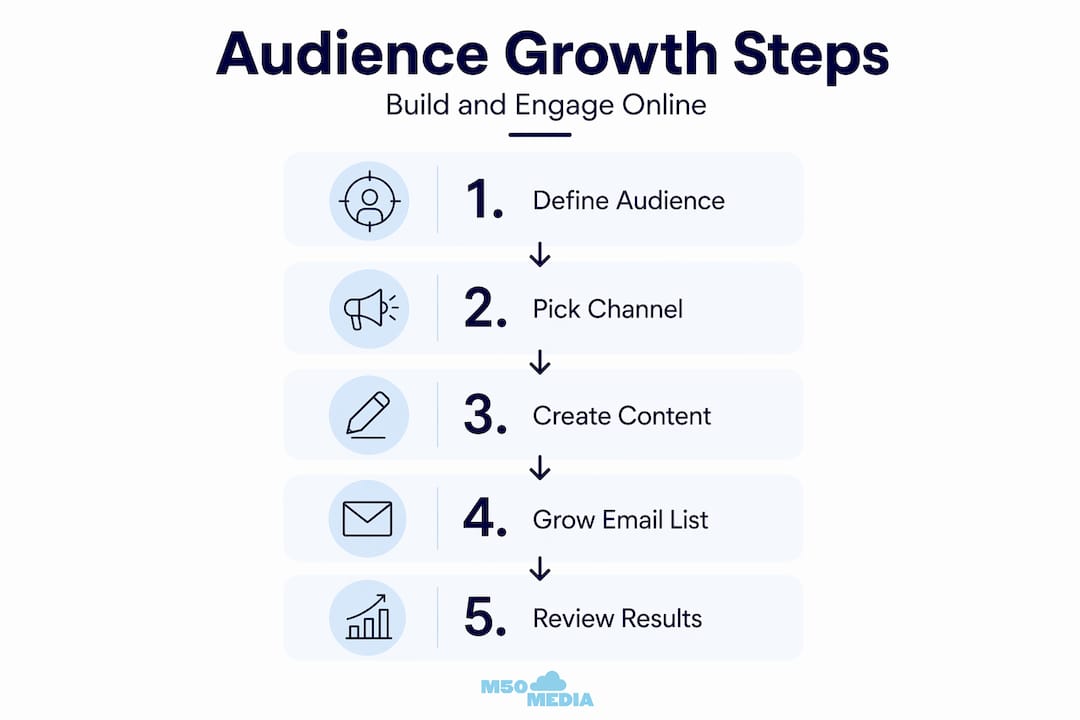
Next, set goals that actually mean something. Vague goals like “grow my audience” are about as useful as a chocolate teapot. Instead, aim for measurable targets: 200 new email subscribers in 90 days, 15% more website traffic this quarter, or 50 direct messages from potential clients per month. Real goals give you real direction.
Here are the core digital assets every small business needs before executing any growth tactics:
A branded website (your home base, not a rental on someone else’s platform)
Email marketing software (even the free tier works to start)
One primary social media channel (just one!)
A simple content calendar (a Google Sheet works fine)
A basic CRM or contact management tool
Speaking of free tools, small businesses can use free tools like HubSpot for email and CRM right out of the gate. No need to spend hundreds of dollars monthly when you’re just building momentum.
Digital asset | Free option | What it does |
Website | Hosts your content and brand | |
Email software | Mailchimp / HubSpot | Captures and nurtures leads |
Social scheduling | Buffer / Later | Keeps you consistent |
Content calendar | Google Sheets | Plans your publishing rhythm |
CRM | HubSpot Free | Tracks contacts and conversations |
Pro Tip: Don’t try to be everywhere at once. Spreading yourself across six platforms is a recipe for burnout and mediocre results. Pick one channel, get really good at it, then expand. Seriously, one channel first.
Choose your primary channel and commit to consistency
Alright, foundation built. Now let’s talk about where you’re going to show up consistently. Because here’s the truth: showing up imperfectly every day beats showing up perfectly once a month.
Choosing the right channel depends on your audience. B2B service providers often thrive on LinkedIn. Visually-driven product businesses absolutely love Instagram. Local service businesses (think plumbers, photographers, bakeries) often do surprisingly well on Facebook and Google Business Profile. Bloggers and consultants? Long-form content on a website or newsletter platform is their sweet spot.
Here’s a quick comparison of the main channels for small business audience growth:
Channel | Best for | Effort level | Owned asset? |
Visual products, lifestyle brands | Medium to high | No | |
B2B, consulting, professional services | Medium | No | |
Email newsletter | All businesses, especially service-based | Low to medium | Yes! |
Blog / website | Content-heavy, SEO-focused businesses | Medium to high | Yes! |
Local businesses, community groups | Low to medium | No |
Once you’ve picked your channel, commit to a posting rhythm. On Instagram specifically, posting 3 to 5 times per week grows followers twice as fast, and Reels get 36% more reach than standard posts. Don’t sleep on that. Plus, replying to comments gives you a 21% engagement boost. That’s practically free growth just from being human!
“Consistency trumps perfection. The businesses that win online aren’t necessarily the most creative — they’re the ones who show up, add value, and engage authentically, week after week.”
Here’s a simple approach to get your rhythm going:
Choose your one primary channel (no debates, just pick it).
Decide on a realistic posting frequency (three times per week is a great start).
Batch create content one day per week to avoid daily scrambling.
Engage with your audience every day for at least 15 minutes (reply, comment, react).
Review what performed well at the end of each month and do more of that.
The M50 Blog has a great collection of social media post ideas if you’re ever staring at a blank screen wondering what to post. And if you want the bigger picture on how to turn that content into actual customer growth, the social media marketing growth guide is worth your time.
As social media research for small businesses confirms, picking one platform first and mastering it before expanding is the single smartest move you can make early on.
Pro Tip: Set a recurring calendar block for content creation. Treat it like a client meeting. Non-negotiable. Your future self (and your growing audience) will thank you.
Create value-driven content for demand and engagement
Now we’re cooking. You’ve got your channel, you’ve got your rhythm — let’s talk about what you actually publish. Because content isn’t just about filling space. The right content pulls people in, builds trust, and yes, generates real leads.

Content marketing generates 3x more leads per dollar than paid search and costs 62% less than outbound marketing. Case studies alone deliver 420% ROI. Long-form blog posts? 340%. Those numbers aren’t made up — they’re the reason smart small businesses invest in content instead of just throwing cash at ads.
Here are the content types that consistently deliver the best results for small businesses:
Case studies and client success stories (social proof is gold)
Long-form blog posts (1,500 words or more, covering a topic properly)
Short how-to videos or Reels (quick wins your audience can use today)
FAQs answered in video, audio, or written format
Behind-the-scenes content (people love seeing the human side of a business)
Quick tip posts (shareable, high-engagement, easy to produce)
Customer testimonials and before/after transformations
And the numbers on frequency are eye-opening. Companies blogging 16+ times per month get 10 times more traffic than those publishing less frequently. Now, 16 posts per month might sound intense, but even a jump from 2 to 6 per month is going to move the needle.
The content marketing tips on the M50 Blog walk you through exactly how to build a content engine that doesn’t burn you out. And if you want frameworks that actually work, the proven content strategies post is a great companion piece. For even more on how content fuels lead generation, check out how content marketing drives lead growth for businesses just like yours.
Pro Tip: Avoid leaning too heavily on AI-generated content. Human-directed content outperforms AI-heavy content by 150%. Use AI to brainstorm and outline all you want, but make sure your personality, expertise, and voice come through. Your audience follows YOU, not a robot.
Convert and nurture your audience: email list building and segmentation
Here’s where so many small businesses leave serious money on the table. They build an Instagram following (rented land, remember?) and never convert those followers into owned contacts. Then the algorithm changes and poof — reach disappears overnight. Not fun.
Email is different. You own it. Nobody can take it away from you. And when done right, it’s wildly effective. Segmented emails generate 30% more opens and 50% more clicks than generic blasts. That’s not a small difference — that’s the difference between being ignored and being read.
Here’s how to start building your list the right way:
Create a lead magnet (a free guide, discount, checklist, or mini-course your audience actually wants).
Add a signup form to your website homepage and any high-traffic pages.
Promote your lead magnet regularly on your primary social channel.
Set up a welcome email series (even three emails is a great start).
Segment your list early, even just into “new subscribers” and “past customers.”
Segment type | What it does | Impact |
New subscribers | Welcome and orient new contacts | Builds immediate trust |
Past customers | Offer loyalty rewards or upsells | Higher purchase rate |
Interest-based | Relevant content by topic preference | 50% more clicks |
Inactive subscribers | Re-engagement campaigns | Recovers lost connections |
A great example of a well-crafted email workflow for engagement shows how even niche businesses use automated sequences to build deep relationships with their audience. The principles apply across any industry.
The M50 Blog has two fantastic resources to help you here: the email list growth strategies post and a practical breakdown of email marketing tips for small businesses. Start there.
Pro Tip: Automate your welcome series before you do anything else. New subscribers are most engaged in the first 48 hours. A three-email sequence introducing who you are, what you do, and how you can help them is worth its weight in gold.
Measure audience growth and adapt your strategy
You wouldn’t drive across the country without occasionally glancing at the map, right? Same logic applies to your audience growth strategy. Data is your GPS.
These are the metrics that actually matter for small business audience growth:
Website traffic (total visits, new vs. returning visitors)
Email list size and monthly growth rate
Email open rates and click-through rates
Social media engagement rate (not just follower count)
Conversion rate (how many visitors take the action you want)
Lead magnet download rate
Notice what’s NOT on that list? Vanity metrics. Likes, impressions, and follower counts are nice but they don’t pay the bills. Focus on the numbers that connect to real business outcomes.
Metric | What to track | Warning sign |
Email open rate | Should be 20%+ | Under 15% means rethink your subject lines |
Engagement rate | 2 to 5% on social | Under 1% means your content isn’t resonating |
List growth rate | 5 to 10% per month | Stagnant means rethink your lead magnet |
Website conversion | 1 to 3% for most businesses | Under 0.5% means rethink your call to action |
Set aside 30 minutes at the end of every week to review your top-performing posts. Then ask yourself: what did they have in common? Companies that blog consistently see dramatically higher traffic over time, and the only way you know what’s working is to look at the data.
The content strategy guide on M50 Media walks you through how to build a review process that keeps your strategy sharp and evolving.
Pro Tip: Run one experiment per month. Change one variable (your posting time, your content format, your call to action) and measure the result. Document everything. Over 12 months, you’ll have a playbook built entirely from your own data.
What most guides miss: sustainable growth beats quick wins
Okay, real talk time. Most online content about audience growth is obsessed with shortcuts. “Go viral with this one trick!” “Hack the algorithm!” It’s exhausting and, honestly, it rarely works for small businesses with real budgets and real constraints.
Here’s what we’ve seen actually work, over and over: slow and steady, boring as it sounds, wins every time.
Building genuine relationships with a small, highly engaged community of even 300 people will outperform a hollow following of 30,000 passive scrollers. Micro-communities are where trust lives. And trust is what turns followers into buyers, buyers into repeat customers, and customers into raving fans who refer their friends.
The fixation on social media as the be-all, end-all is also a trap. Social platforms are borrowed land. The algorithm changes. Reach drops. Your account could get restricted. But human-directed content and owned assets consistently outperform AI-heavy, platform-dependent strategies by 150%. The businesses that weather every platform shake-up are the ones with strong email lists and genuine community trust.
That’s exactly why true email audience ownership is something we talk about constantly here at M50 Media. Your email list is the one asset that belongs entirely to you.
Authentic content, even the slightly imperfect stuff, consistently outperforms the ultra-polished, AI-generated posts that feel like they were written by a committee of robots. People follow people. Show your face. Share your process. Be real.
Pro Tip: Instead of chasing the next hot platform, double down on deep engagement where you already have traction. Three thoughtful replies to comments will do more for your growth than three new posts.
Take your growth further with tailored support
Reading about strategy is one thing. Actually implementing it while running a business is another beast entirely (we see you, wearing seventeen hats at once). 🎩
If you’re ready to stop guessing and start growing with a clear, personalised plan, M50 Media has you covered. Whether you’re looking for business coaching to sharpen your overall direction, hands-on digital coaching to build your marketing systems, or just want to talk through your situation with no pressure, you can book a free marketing call and get real answers from someone who’s actually in the trenches of digital marketing every day. Your audience is out there. Let’s go get them. 🚀
Frequently asked questions
What is the fastest channel to grow an online audience?
Social media platforms, particularly Instagram, grow audiences most quickly when you post consistently. Posting 3 to 5 times per week can grow your following twice as fast as irregular posting.
How important is content marketing for audience growth?
It’s one of the highest-ROI strategies available to small businesses. Content marketing generates 3x more leads per dollar than paid search, at 62% less cost and an average ROI of 300%.
Should I prioritise building an email list or social followers?
Start building both simultaneously, but prioritise email. Social drives discovery, email owns the audience, meaning you control the connection and aren’t at the mercy of algorithms.
Does using AI content affect my audience growth?
Yes, and not in a good way if you overdo it. Human input boosts performance by 150% over AI-heavy content, so use AI as a starting point, not the whole show.
How long does it take to build a real online audience?
There’s no shortcut here. Organic growth takes time and patience, but the results are far more durable than paid reach. Consistent effort over six to twelve months is where most small businesses start seeing real traction.
Recommended
Comments