Why inbound marketing is key to business growth

TL;DR:
Inbound marketing costs up to 62% less per lead than outbound marketing, providing a cost-effective approach for small businesses. It attracts higher-quality leads by offering valuable content, building trust, and fostering long-term customer relationships through consistent, helpful engagement. Starting with top customer questions and creating targeted content sets a strong foundation for sustainable growth and reliable lead generation.
You’re spending money on ads that feel like shouting into the void, and wondering why nobody’s calling back. Sound familiar? Here’s a plot twist that might just change your whole marketing story: inbound marketing costs 62% less per lead than outbound marketing. That’s not a rounding error. That’s a full-on budget revolution. This guide is going to walk you through what inbound marketing actually is, why it works so well for small businesses, and how you can start using it today to attract more customers without burning through your savings like it’s a Hallmark movie budget.
Table of Contents
Key Takeaways
Point | Details |
Inbound costs less | Inbound marketing is much more affordable per lead than traditional methods. |
Better lead generation | Inbound generates more and higher-quality leads for small businesses. |
Higher ROI potential | More marketers see a stronger return with inbound strategies versus outbound. |
Techniques drive engagement | Tactics like SEO, content, and social media turn strangers into loyal customers. |
Getting started is easy | Even with a small budget, anyone can take the first steps into inbound marketing. |
What is inbound marketing and why does it matter?
With cost effectiveness top of mind for any business owner, let’s clarify how inbound marketing flips the script on traditional approaches.
Think of outbound marketing as that person at a networking event who corners you and immediately launches into their sales pitch. Nobody asked. Nobody wanted it. Inbound marketing, on the other hand, is the person across the room who’s telling an amazing story and drawing a crowd naturally. People come to them. That’s the whole idea.
Inbound marketing explained simply means attracting potential customers by creating content and experiences that are genuinely useful to them. Instead of interrupting someone’s day with a cold call or a pop-up ad, you’re showing up in their search results, their social feeds, and their inbox because you have something valuable to say.
Here’s how inbound and outbound stack up in a nutshell:
Outbound pushes messages at people (cold calls, print ads, TV commercials, paid interruptions)
Inbound pulls people toward you (blog posts, SEO, social media content, email newsletters)
Outbound rents your audience’s attention (pay to play, always)
Inbound builds an audience you actually own over time
Outbound is often broad and scattershot, reaching people who may never need your product
Inbound is targeted, reaching people who are already searching for what you offer
“The best marketing doesn’t feel like marketing.” That quote (credited to Tom Fishburne) captures exactly why inbound works. When your content genuinely helps someone solve a problem, they don’t feel sold to. They feel helped. And that builds trust faster than any billboard ever could.
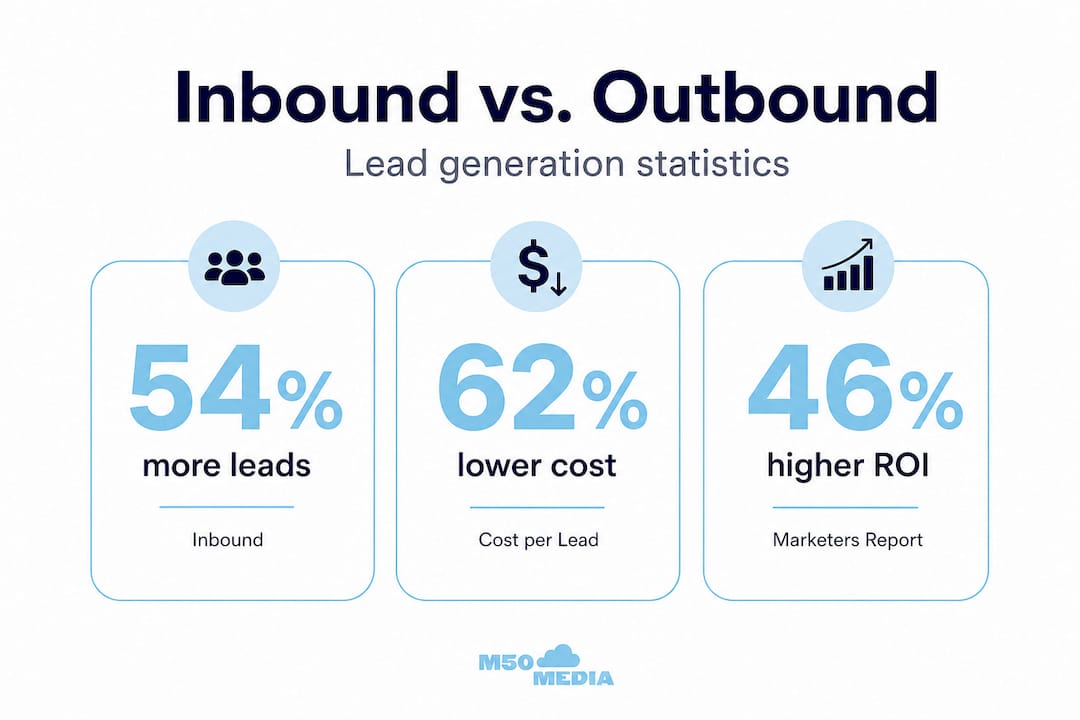
The numbers back this up too. Inbound generates 54% more leads than outbound tactics. More leads, lower cost, higher trust. For a small business owner working with a real-world budget (not a Fortune 500 war chest), that combination is almost too good to ignore.
Key advantages of inbound marketing for small businesses
Now that we understand what inbound marketing is, let’s break down why it’s such a smart move for small businesses in practice.
Let’s be honest. Most small business owners aren’t sitting on a pile of marketing cash. You’re making strategic decisions about every dollar, and you absolutely should be. That’s exactly why inbound marketing is practically made for you.
The marketing advantages for small business owners using inbound are very real and very measurable. Here’s a comparison to put things in perspective:
Metric | Inbound marketing | Outbound marketing |
Cost per lead | Up to 62% lower | Significantly higher |
Lead quality | Higher (self-selected audience) | Variable (broad targeting) |
ROI reported | 46% of marketers say higher | Only 12% say higher |
Scalability | Scales with content output | Scales with budget spend |
Audience ownership | Builds over time | Rented, stops when you pay |
Trust level | High (value-based relationship) | Lower (interruptive) |
That ROI column is worth pausing on. 46% of marketers report higher ROI from inbound compared to just 12% for outbound. That’s nearly four times as many marketers seeing better returns. When those are the odds, you’d be leaving serious money on the table by ignoring inbound.
Beyond the numbers, here’s what really makes inbound sing for small businesses:
You attract higher-quality leads because the people finding you are already looking for what you offer
Your content keeps working long after you publish it (a blog post from two years ago can still bring traffic today)
You build genuine relationships and brand loyalty instead of one-time transactional encounters
Your audience grows organically, reducing dependency on paid advertising over time
You can start small and scale up as your business grows, without needing a massive upfront investment
The content marketing lead generation opportunity alone is staggering. A single well-crafted piece of content can attract leads for months or even years. Compare that to a Facebook ad that disappears the moment you stop paying, and the case for inbound becomes crystal clear.
Pro Tip: Start by identifying the top three questions your customers ask before they buy from you. Build content around those exact questions. That’s your inbound marketing foundation right there, and it costs you nothing but time.
How inbound marketing techniques drive engagement
Seeing the broad benefits is one thing, but how do the mechanics of inbound marketing actually play out for customer interaction?

Great question. Let’s walk through the practical side of things. Inbound isn’t magic (wish it were!). It’s a series of deliberate, connected actions that build momentum over time. Think of it like rolling a snowball down a hill. The first push takes effort, but once it’s rolling, gravity does a lot of the heavy lifting.
Here’s a step-by-step look at how inbound techniques work together to drive real engagement:
Create genuinely useful content. Blog posts, videos, podcasts, guides, and infographics that answer your audience’s real questions. This is your first touchpoint and your trust-builder. Check out some content marketing examples that actually work for small businesses.
Optimise for search engines (SEO). If your content isn’t findable, it’s basically a beautiful tree falling in an empty forest. Basic SEO, things like using the right keywords, writing descriptive meta titles, and building internal links, gets your content in front of people who are actively searching.
Show up consistently on social media. Share your content, engage in conversations, respond to comments, and be genuinely present. Social media isn’t a broadcast channel; it’s a two-way street. Post content that invites dialogue, not just likes.
Use lead magnets to capture interest. Offer something valuable in exchange for an email address. A free checklist, a mini-guide, a template, or a short video course. This moves someone from “casual browser” to “interested prospect” pretty quickly.
Nurture leads with email marketing. Once someone’s on your list, stay in touch with helpful, relevant content. Don’t just email when you want to sell something. Be the person they actually look forward to hearing from.
Measure, tweak, and repeat. Look at what’s working and do more of it. Look at what’s flopping and adjust. Your content strategy for business growth should be a living document, not a set-and-forget plan.
Here’s a quick look at what realistic inbound marketing engagement can look like over time:
Tactic | Short-term impact (1 to 3 months) | Long-term impact (6 to 12 months) |
Blog content + SEO | Gradual organic traffic growth | Compounding traffic and lead flow |
Social media engagement | Increased followers and reach | Community building and referrals |
Email newsletter | List growth, relationship building | Higher conversion rates |
Lead magnets | Immediate email opt-ins | Warm leads ready to buy |
Video content | Engagement spikes | Brand awareness and authority |
The reason inbound generates 54% more leads than outbound is precisely because of this compounding effect. Each piece of content, each social interaction, each email builds on the last. You’re not starting from zero every month the way you do with paid ads.
Pro Tip: Consistency beats intensity every single time. Publishing one helpful blog post every week for six months will outperform a frantic publishing blitz followed by three months of silence. Set a sustainable rhythm and stick to it.
Tips to get started with inbound marketing today
If you’re ready to take action, here are practical steps any business owner can use to tap into inbound marketing’s power.
No fancy agency needed. No enormous budget required. Just a willingness to show up and be genuinely helpful to your audience. Here’s your starter sequence:
Define your ideal customer. Who are they? What problems keep them up at night? What do they Google when they’re looking for help? This is your north star. Everything flows from knowing exactly who you’re talking to.
Audit what you already have. Do you have a website? A social media presence? Past content? Start by seeing what you’re working with before creating anything new. You might already have more than you think.
Build a simple digital marketing plan for small business. Nothing complicated. A one-page plan with your goals, your audience, your content topics, and your publishing schedule is more than enough to get started. Fancy strategy decks are overrated.
Start creating content around your audience’s questions. Pick one format (blog, video, or podcast) and commit to it for 90 days. Trying to do everything at once is a great recipe for burnout and zero results.
Set up a simple email list. Even a basic free account with a reputable email platform works fine when you’re starting out. The point is to start capturing those interested leads instead of letting them drift away.
Invest in your branding for small businesses. Your brand voice, visuals, and messaging should feel consistent across every channel. Inconsistency is the silent trust-killer in inbound marketing.
Track your results weekly. Look at website traffic, email open rates, social engagement, and lead inquiries. Make small adjustments based on what the data tells you.
The effort is absolutely worth it. With 46% of marketers seeing a higher ROI from inbound than outbound, the payoff isn’t just theoretical. It’s what real business owners and marketers are experiencing right now.
Quick wins to aim for in your first 30 days:
Publish your first genuinely helpful blog post targeting a specific customer question
Create one lead magnet (even a simple one-page PDF checklist works)
Set up a basic email welcome sequence for new subscribers
Engage authentically on social media for at least 15 minutes daily
Install analytics on your website so you can start tracking what’s working
Pro Tip: Don’t chase perfection. A helpful blog post published today will always outperform a flawless one that’s still sitting in your drafts three months from now. Done beats perfect, especially in the early stages.
Why the inbound mindset is your best marketing asset
Here’s where we get a little philosophical for a second (stay with us, it’s worth it 😄).
A lot of business owners approach inbound marketing like it’s a cheaper version of outbound. They swap cold calls for blog posts, swap magazine ads for Instagram reels, and then wonder why the results aren’t rolling in. The tactics shifted, but the mindset didn’t.
Real inbound marketing isn’t just cheaper promotion. It’s a fundamentally different way of thinking about your relationship with your customers. It’s the shift from “how do I get people to buy from me?” to “how do I become genuinely valuable to the people I want to serve?” That sounds simple, but it changes everything about how you create content, how you engage on social media, and how you follow up with leads.
The businesses that thrive with inbound are the ones who treat it as a long-term relationship strategy, not a short-term lead hack. They show up consistently, they adapt when their audience’s needs shift, and they genuinely care about being helpful. That kind of authenticity builds brand trust and resilience that no ad budget can buy.
Consider this: a small bakery owner who starts posting weekly videos about bread-making techniques isn’t just generating content. They’re building a community of people who love baking, trust their expertise, and feel a genuine connection to their brand. When those people need a custom cake or want to recommend a bakery to a friend, guess who’s top of mind? It’s not the bakery that ran a one-time flyer campaign.
The mindset shift is also what makes inbound sustainable during tough times. When economic pressures hit and budgets tighten, the business with a loyal inbound audience has a resilient foundation. The business that relied purely on paid ads has to scramble the moment the ad spend dries up.
Inbound marketing isn’t a tactic. It’s a posture. And once you adopt it, it genuinely becomes your single most powerful long-term marketing asset.
Grow your business faster with expert inbound support
Ready to stop guessing and start growing? 🚀 Inbound marketing has serious potential, but navigating all the moving pieces (content, SEO, email, social, analytics) can feel like spinning a lot of plates at once. You don’t have to figure it all out solo.
At M50 Media, we’re all about helping small business owners like you cut through the noise and build marketing that actually works. Whether you’re looking for personalised business coaching for inbound marketing to fast-track your strategy, or you need a quick gut-check with a Free Marketing SOS Call to untangle what’s not working, we’ve got you covered. More of a DIY person? Browse our curated marketing tools and recommendations to build your own inbound toolkit without the guesswork. Whatever your next step looks like, we’re here to help you take it confidently.
Frequently asked questions
How much does inbound marketing cost compared to outbound?
Inbound marketing is significantly more affordable, costing about 62% less per lead than traditional outbound marketing methods, making it an ideal choice for budget-conscious small businesses.
Can inbound marketing really generate more leads?
Absolutely! Businesses that use inbound marketing generate 54% more leads than those relying primarily on outbound tactics, largely because inbound attracts people who are already interested in what you offer.
Is inbound marketing a good investment for small business?
It’s one of the smartest investments you can make. 46% of marketers report higher ROI from inbound strategies, compared to only 12% who say the same about outbound, and the gap just keeps widening.
What’s the first step to implementing inbound marketing?
Start by identifying your ideal customer and creating one piece of genuinely helpful content that answers a real question they have. Measure the results, learn from them, and build from there.
Recommended
Comments