What is market research? A practical small business guide

TL;DR:
Market research is an affordable and practical tool that small businesses can use to understand customer needs and market trends.
By combining secondary data with targeted primary research, entrepreneurs can make informed decisions that reduce risk and uncover new opportunities.
Think market research is something only massive corporations with giant budgets do? Think again. You don’t need a boardroom full of suits or a six-figure research budget to figure out what your customers actually want. In fact, gathering and analysing information about your customers and market is exactly how scrappy small businesses compete with the big players. This guide breaks down what market research is, how it works, and how you can start using it today without losing your mind (or your savings account).
Table of Contents
Key Takeaways
Point | Details |
Market research defined | Market research helps small businesses make smarter, lower-risk decisions by studying customers and the broader market. |
Two research approaches | Use both primary and secondary research methods based on your specific questions and budget. |
Affordable techniques | Surveys, interviews, and online tools make research possible even for small budgets. |
Focus on application | To benefit, turn research findings directly into business and marketing actions. |
Avoid common pitfalls | Balance speed, specificity, and cost; don’t rely solely on generic data or make research an afterthought. |
Defining market research: More than just data
Let’s clear something up right away. Market research is not just a pile of spreadsheets that only a data scientist could love. It’s a practical tool you can use to make smarter decisions, every single day.
“Market research is the process of gathering and analyzing information about customers and the broader market to help validate and improve a business idea and make better marketing and business decisions.”
That definition from the SBA is pretty solid. Essentially, market research combines understanding customer behaviour with tracking larger economic trends, all so you know where your business stands and where it could go.
Here’s why it matters specifically for small businesses:
It helps you validate a new product or service idea before you spend money building it
It reveals what your customers actually need (not just what you think they need)
It reduces the risk of launching something nobody wants (ouch, been there)
It uncovers gaps in the market that competitors have missed
It sharpens your small business marketing strategies so your budget goes further
Two big myths about market research keep small business owners from using it. First, that it’s too expensive. Second, that it’s only for big companies. Both are wrong. You can conduct meaningful research with a handful of customer conversations and a free survey tool. The goal is insight, not perfection, and you don’t need a team of analysts to get there.
Primary vs secondary research: Choosing the right approach
Now that you understand the core purpose of market research, let’s look at the two main types and how each can fit your specific needs and budget.
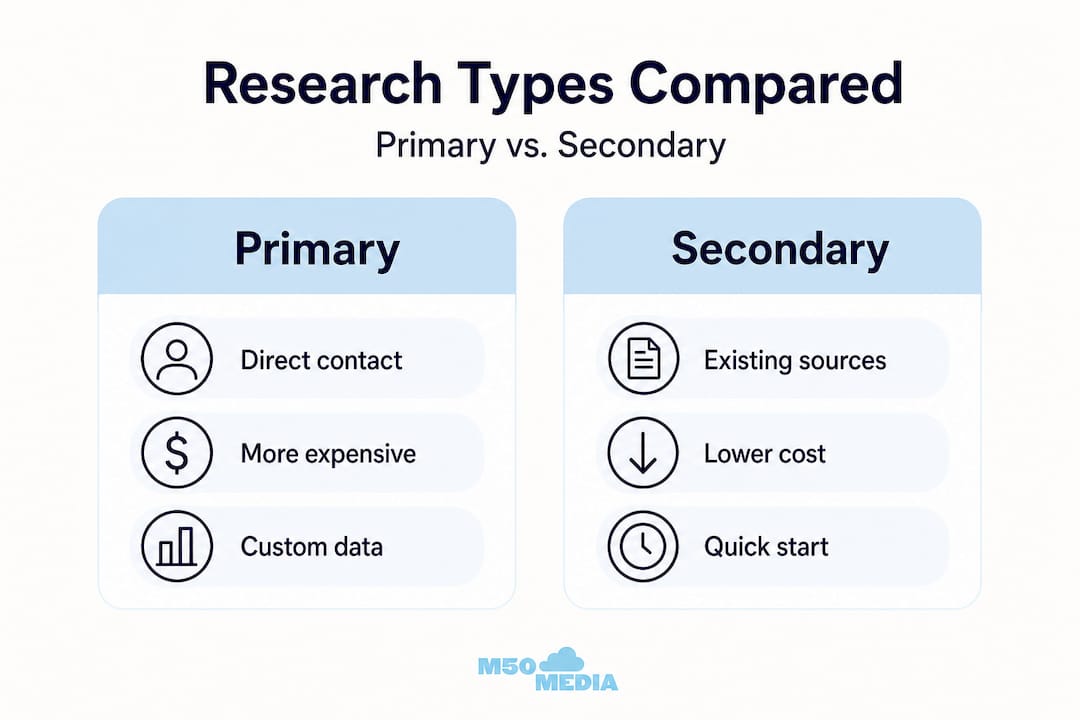
Market research typically combines primary research (directly contacting customers) and secondary research (using existing published or compiled data). Think of it like cooking dinner. Secondary research is reaching into the pantry for what’s already there. Primary research is going to the farmers’ market to get exactly what you need for tonight’s meal.
Here’s a quick comparison to help you decide which to use:
Feature | Primary research | Secondary research |
Cost | Higher (time and money) | Lower (often free) |
Speed | Slower to collect | Faster to access |
Specificity | High (tailored to you) | Lower (general audience) |
Examples | Surveys, interviews, focus groups | Industry reports, articles, census data |
Best for | Specific decisions | Background understanding |
The sweet spot? Start with secondary research to get your bearings quickly and cheaply. Then, layer in primary research when you need to answer a specific question that generic data just can’t address. For example, if you want to know whether Canadians are spending more on sustainable products in 2026 (secondary research has you covered), but if you want to know whether your specific eco-friendly candle line appeals to people in your city, you’ll need to ask them directly.
Understanding the difference between these two approaches also makes you better at reading marketing analytics basics and applying what you find.
Pro Tip: Secondary research is your best friend when you’re just getting started. Government databases, Statistics Canada, and industry associations often publish free reports that can save you weeks of effort. Grab those before you even think about running a survey.
Smart methods for small budgets: Best research techniques
Understanding methods is one thing. Making it actionable for your business, even with limited time or money, is where the real magic happens.
Common practical methods for small businesses include surveys and questionnaires, focus groups, and in-depth interviews, plus a review of existing data. Let’s break these down into something you can actually use this week.
Here are five practical research methods ranked from easiest to most involved:
Online surveys: Use a free tool (think Google Forms or a budget-friendly survey platform) to send a short questionnaire to your existing customers or email list. Keep it under 10 questions. Seriously, nobody wants to fill out a 45-question survey unless there’s a gift card involved.
Customer interviews: Pick up the phone or jump on a video call with five to ten customers. Ask open-ended questions like “What problem were you trying to solve when you found us?” You’ll be shocked at the gold that comes out of casual conversations.
Social media listening: Browse comments, reviews, and posts related to your niche. What questions are people asking? What frustrations keep coming up? This is free, real-time research sitting right in your feed.
Focus groups: Gather a small group of target customers (even six to eight people) for a structured conversation. This works especially well for testing new product ideas or messaging before you go all-in.
Review mining: Read through your own reviews, competitor reviews, and industry forums. People are brutally honest online, and that honesty is your research goldmine.
The stat that should make you feel better? The majority of small businesses rely on simple surveys and direct customer conversations rather than elaborate research programmes. You’re already closer to doing this than you think. And when you pair these methods with the right essential marketing tools, your research becomes even more powerful.
Your research insights also feed directly into stronger branding strategies, because when you understand your audience deeply, your brand voice and messaging naturally click into place.

Avoiding pitfalls: What most small businesses miss about market research
Having covered method selection and execution, let’s safeguard your efforts by looking at the pitfalls that trip up a lot of first-timers. Because honestly, even good intentions can lead to bad research if you’re not careful.
Here are the most common mistakes small business owners make:
Relying only on generic industry data without talking to actual customers
Asking leading questions in surveys (e.g., “Don’t you love our product?”)
Researching everything instead of the specific question you need answered
Treating a one-time research effort as permanent truth (markets change, people!)
Ignoring negative feedback because it’s uncomfortable to hear
Confusing your own opinions with actual customer data
That last one is sneaky. It’s so easy to assume you know what your customers want because you built the product with love and passion. But your customers are not you. They have different priorities, different pain points, and different ways of making decisions.
Existing secondary sources can be fast but may not be specific enough to your exact audience. Direct primary research adds crucial nuance about your particular target customers and their reactions. So while industry reports are helpful starting points, they can’t replace a real conversation with someone who actually paid for your product.
Another big miss? Not matching the depth of research to the size of the decision. If you’re choosing a new font for your website, you don’t need a three-month research project. If you’re launching a new product line that will cost you $20,000 to develop, you absolutely need more than a gut feeling.
Pro Tip: Before you start any research, write down the one question you most need answered. Just one. That single focus keeps your research tight, your results usable, and your sanity intact. Then connect your findings to a solid digital marketing plan to put them into action.
From research to action: Using insights to drive better decisions
After avoiding pitfalls, the next critical step is putting your research to work for real, tangible business improvements. Because research that sits in a folder and never gets used is just expensive procrastination.
For entrepreneurs, market research is used to reduce uncertainty before investing in a launch, by assessing whether there is demand or desire in a target market. The key word there is “uncertainty.” Research doesn’t guarantee success, but it dramatically shortens the distance between guessing and knowing.
Here’s a simple framework to apply your findings:
Summarise your key insights: What did customers actually say? What patterns showed up repeatedly across your surveys or interviews?
Identify the biggest opportunity or risk: What’s the one thing your research revealed that could change a business decision you’re facing right now?
Connect the insight to a specific action: Adjust your product, change your messaging, refocus your targeting, or drop an offering that isn’t resonating.
Set a measurable outcome: How will you know if the action worked? Track a metric, whether that’s sales, click-through rate, or customer satisfaction scores.
Review and repeat: Go back to the research after 60 to 90 days. Did the action move the needle? If not, what else might the research be telling you?
Here’s a practical table to help you connect research insights to marketing decisions:
Research finding | Possible action | Where to measure results |
Customers don’t understand your offer | Rewrite your homepage headline | Bounce rate, time on page |
Customers want faster delivery | Partner with a local courier | Repeat purchase rate |
Customers compare you to a lower-priced option | Add a value comparison on your site | Conversion rate |
Customers love your customer service | Highlight testimonials in ads | Ad click-through rate |
When you pair research with smart execution, you can also unlock the full advantages of online marketing, reaching the right people with the right message at the right time. And applying what you learn to your offers is one of the most effective ways of boosting your online sales without throwing more money at ads.
Our take: Why flexible, focused research wins every time
Here’s something that years of working alongside small businesses has made abundantly clear: the entrepreneurs who get the most out of market research are not the ones who follow a perfect, paint-by-numbers process. They’re the ones who treat research like a flashlight, using it to light up only the dark spots they need to see right now.
Market research does not need to be one rigid sequence. What matters is choosing methods that match the decision you are trying to make and the resources you have. That’s the real secret. Experienced business owners don’t read a textbook and follow every step. They ask “what do I need to know right now?” and then find the fastest, most affordable way to get that answer.
There’s also a massive trap in chasing perfect data. Perfect data doesn’t exist, and waiting for it is just fear wearing a productivity costume. At some point, you have to take the insight you have and make the call.
The other thing that rarely gets talked about? Research needs to evolve with your business. What your customers needed when you launched might be very different from what they need two years in. The businesses that treat market research as a living, ongoing conversation (rather than a one-time box to check) are the ones that stay ahead. Pair that with understanding how reviews boost your sales and you’ve got a real feedback loop working for you around the clock.
Research doesn’t have to be fancy. It just has to be useful.
Need help mastering market research?
Market research can feel overwhelming at first, like trying to solve a puzzle when you’re not even sure what the picture is supposed to look like. But you don’t have to figure it all out on your own. 🙌

At M50 Media, we work with small business owners just like you to build practical research habits that actually lead to better decisions and stronger marketing results. Whether you want personalised business coaching to develop your research strategy or you just need a quick win, our free marketing advice option is a zero-risk way to get expert eyes on your situation. No boardroom required, just real guidance tailored to where you are right now. Let’s figure this out together. 🚀
Frequently asked questions
Is market research expensive for small businesses?
Market research can be very affordable, since many effective methods are low-cost or free, such as online surveys or direct customer interviews. Surveys, focus groups, and interviews are all practical options that don’t require a big budget.
How do I know if my market research is detailed enough?
Your research is detailed enough when it answers your key business questions and reduces uncertainty about your next decision. Market research helps assess demand before you invest, so if you feel confident enough to move forward, you’ve likely done enough.
What’s a quick way to start market research?
Start by reviewing existing industry reports or free data sources, then follow up with short surveys or casual conversations with your target customers. Combining primary and secondary research gives you both speed and specificity without breaking the bank.
When should I use primary versus secondary research?
Use secondary research first for background context or quick validation, then turn to primary research when you need more specific or up-to-date answers. Combining both types gives you the most complete and actionable picture of your market.
Recommended
Comments