Why paid advertising drives small business growth in 2026
You’ve been posting consistently on social media, writing blog content, and doing all the “right” organic things. And yet… crickets. Sound familiar? Here’s the uncomfortable truth: organic reach has been quietly shrinking for years, and in 2026, relying on it alone is like trying to fill a stadium by whispering. Paid advertising isn’t just a nice-to-have anymore. It’s the engine that puts your business in front of the right people, at the right time, without waiting around for the algorithm gods to smile upon you. Let’s break down exactly what paid advertising is, why it matters, and how you can use it to grow without burning through your budget.
Table of Contents
Key Takeaways
Point | Details |
Paid ads enable fast growth | You gain instant access to new audiences and measurable business outcomes with paid advertising. |
Budgets stay in your control | Start small, set daily limits, and invest more only when you see proven results. |
Best results come from blending strategies | Combine organic marketing to test messages, then amplify your top-performing ideas with targeted paid campaigns. |
Analytics drive smarter decisions | Performance data helps you adjust spending and ad creative for maximum impact and efficiency. |
What is paid advertising and why does it matter?
Paid advertising is exactly what it sounds like: you pay a platform to show your message to a specific audience. Simple, right? Unlike organic marketing (think: unpaid social posts, SEO, word of mouth), paid ads give you a shortcut to visibility. You’re not waiting months for Google to notice your blog. You’re showing up now.
The major platforms you’ll want to know about include:
Search ads (Google Ads): appear when someone actively searches for what you offer
Social ads (Facebook, Instagram, TikTok): reach people based on interests, behaviours, and demographics
Display ads: banner-style ads shown across websites in Google’s network
Video ads (YouTube, Instagram Reels): engaging short-form content that builds brand awareness fast
Sponsored content: paid posts that blend into a user’s feed like a chameleon at a paint store
Organic reach on platforms like Facebook has dropped to under 5% for most pages, meaning even your most loyal followers might never see your posts. Paid ads bypass that entirely.
One of the biggest advantages? Real-time analytics let you optimise based on clicks, conversions, and ROI as it happens, not weeks later. That’s a game-changer for small businesses working with tight budgets.
If you’re just getting started, our digital advertising guide walks you through the whole landscape in plain language.
Pro Tip: Set up your analytics dashboard before you launch your first campaign. Knowing your baseline metrics means you’ll spot what’s working (and what’s flopping) almost immediately.
Key benefits of paid advertising for small businesses
Let’s get into the good stuff. Why should you, a busy small business owner with approximately 47 things on your to-do list, care about paid ads? Because the benefits are genuinely hard to ignore.
Here’s what paid advertising brings to the table:
Immediate visibility: your ad can be live and generating clicks within hours of launching
Laser-sharp targeting: reach people by location, age, interests, online behaviour, and even what they’ve searched for recently
Scalable budgets: start with $5 a day if you want. Seriously. Test small, then scale what works
Full spending control: pause, adjust, or stop campaigns any time without penalty
Retargeting: show ads specifically to people who already visited your website (they’re warm leads!)
Access to premium formats: sponsored posts, carousel ads, and video placements that organic simply can’t replicate
The role of digital ads in small business growth has never been more significant, especially as consumer attention shifts increasingly to digital channels. And when it comes to lead generation with social ads, the targeting capabilities alone make it worth exploring.

The real kicker? Performance data lets you optimise in real time, so you’re not just throwing money into the void and hoping for the best. You can see exactly which ad is bringing in leads and double down on it.
Businesses that use paid advertising consistently report faster audience growth and more predictable lead flow compared to organic-only strategies. That predictability? It’s basically the holy grail for small business owners.
Paid advertising vs. organic marketing: Choosing the right approach
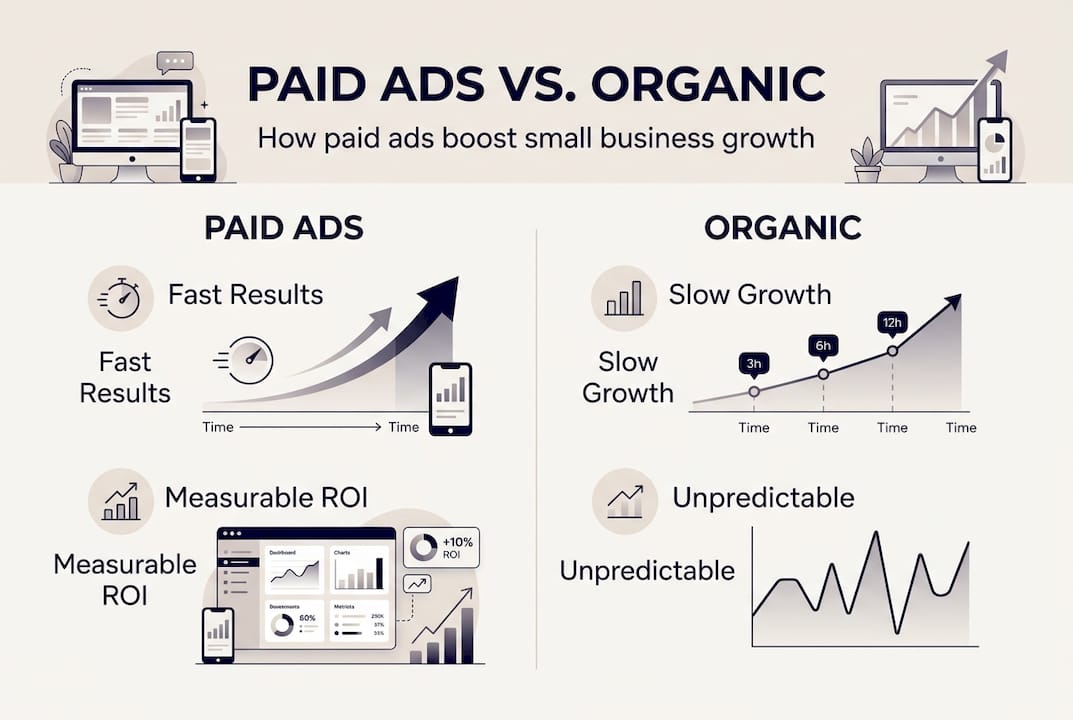
Okay, so paid ads sound amazing. Does that mean you should ditch organic entirely? Absolutely not. Think of it like coffee and sleep. Both matter. One just works faster in the morning.
Here’s a side-by-side look at how they stack up:
Factor | Paid advertising | Organic marketing |
Speed to results | Fast (hours to days) | Slow (weeks to months) |
Cost structure | Requires ongoing budget | Requires time and consistency |
Targeting precision | Very high | Limited |
Longevity | Stops when budget stops | Compounds over time |
Best for | Immediate leads, testing, launches | Brand authority, long-term SEO |
Scalability | Highly scalable quickly | Slower to scale |
As organic vs paid marketing experts at Forbes point out, paid advertising requires ongoing spend while organic builds sustainability over time. The smart move? Use both together.
“Start with organic marketing to validate your messaging, then use paid ads to scale what’s already working. Don’t pay to amplify a message you haven’t tested yet.”
This is genuinely solid advice. If you launch paid ads before you know what resonates with your audience, you’re basically paying for a very expensive guessing game. Build your digital marketing strategy with both channels in mind from the start.
Once you’ve nailed your messaging organically, paid ads become a rocket ship. And understanding better ROI for small business means knowing when to shift budget from organic efforts into paid amplification.
How to maximise ROI with paid advertising
Alright, you’re sold on paid ads. Now let’s make sure you’re not just spending money but actually getting results. Here’s a practical framework to follow:
Set clear goals before you spend a single dollar. Are you after leads? Sales? Website traffic? Brand awareness? Each goal requires a different campaign setup, so get specific.
Start with a small, measurable budget. Even $10 to $20 per day gives you enough data to learn from. Don’t go all-in before you know what works.
Use your analytics dashboard daily (at least in the first two weeks). Watch your click-through rate, cost per click, and conversion rate like a hawk.
Test multiple ad creatives. Run two or three versions of your ad with different images or copy. Let the data tell you which one wins, not your gut.
Retarget warm audiences. People who visited your website or engaged with your social content are far more likely to convert. Retargeting ads typically cost less and convert better.
Review and adjust weekly. Campaigns that worked last month might be stale today. Audiences shift, competition changes, and creative fatigue is real.
Real-time analytics are your best friend here. They help you optimise campaign spend so you’re not wasting money on ads that aren’t pulling their weight.
Need some inspiration? Check out these campaign examples that boost ROI to see what’s actually working for small businesses right now.
Pro Tip: Avoid the “set and forget” trap. Paid advertising is not a slow cooker. It needs regular attention, tweaking, and love. Block 30 minutes each week to review your campaigns and make small adjustments. Those small tweaks add up to big results over time.
Get expert help to grow with paid advertising
Look, understanding paid advertising is one thing. Actually building campaigns that convert, without wasting half your budget on rookie mistakes, is a whole other adventure. That’s where having an expert in your corner makes all the difference.
At M50 Media, we help small business owners like you cut through the noise and build paid advertising strategies that actually work. Whether you’re starting from scratch or trying to fix campaigns that aren’t delivering, our business coaching for ads gives you the clarity and confidence to move forward. Not sure where to start? Book a free marketing SOS call and let’s figure out your next best move together. No jargon, no pressure, just real talk about what will grow your business.
Frequently asked questions
How quickly can I see results with paid advertising?
Most small businesses see measurable results within days of launching, since paid ads deliver immediate visibility and clicks almost as soon as a campaign goes live.
Can I control my advertising costs and start small?
Absolutely. Paid platforms let you set a daily budget, pause at any time, and scale your spend only once you’re seeing results you’re happy with.
Should I use paid ads or focus on organic marketing first?
Start with organic to refine your message, then use paid ads to amplify it. As Forbes recommends, validating your messaging organically before scaling with paid saves you money and improves results.
How do I know my paid campaigns are working?
Use your platform’s analytics tools to track clicks, conversions, and ROI. Real-time data lets you spot what’s working quickly and adjust before you waste budget on underperforming ads.
Recommended
Comments