Role of Marketing Strategy for Retail Success


Running a retail shop means making constant choices, from deciding what products to stock to shaping how customers experience your business. For many small business owners, the challenge is not just keeping up with competition, but delivering real value that stands out. A strong focus on customer centricity helps guide these decisions, ensuring your store adapts to changing needs while building lasting relationships. This article offers practical ways to connect smart marketing strategy with everyday actions that drive sales and loyalty.
Table of Contents
Key Takeaways
Point | Details |
Importance of Marketing Strategy | A well-defined marketing strategy is essential for guiding retail decisions and achieving customer centricity. |
Customer Value and Competitive Advantage | Retailers should focus on clearly identifying customer needs and using that to differentiate from competitors. |
Integrating Digital and Physical Channels | Successful retailers create an omnichannel experience that leverages the strengths of both digital and in-store approaches. |
Building Brand Loyalty | Trust and perceived value are critical to developing lasting customer relationships and should be central to marketing efforts. |
What Marketing Strategy Means for Retailers
Marketing strategy isn’t some abstract concept gathering dust in a binder on your manager’s shelf. For retailers, it’s the operational blueprint that guides every decision you make—from product selection to customer experience to pricing.
At its core, marketing strategy involves deciding how your retail business will compete, who you’ll serve, and how you’ll create value that customers actually want. It’s about managing changing customer needs while building advantage over competitors.
Think of it this way: without strategy, you’re just reacting. With strategy, you’re directing.
Why This Matters for Your Retail Business
Retailers who nail their marketing strategy don’t do it by accident. They succeed because they’ve mapped out how to respond to what customers need better than the competition down the street.
Here’s what a solid marketing strategy accomplishes:
Creates customer centricity across your entire operation—not just in marketing
Builds competitive advantage by focusing on what makes your store different
Guides resource allocation so you’re not throwing money at every shiny new tactic
Helps you adapt as markets shift and new competitors emerge
Aligns your team around shared goals instead of working in silos
Marketing strategy is how you answer the fundamental question: Why should customers choose you over someone else?
The Real Work Behind Strategy
Responding to customer needs better than competitors requires more than good intentions. You’re making deliberate choices about:
Customer value — what problems you solve and how you’ll communicate that
Organisational structure — whether your team is set up to execute the strategy
Marketing priorities — which channels, campaigns, and initiatives get your time and budget
Execution — the day-to-day actions that bring strategy to life
This is where many retailers stumble. They create a solid plan, then fail at the execution phase because the strategy doesn’t translate into actual work.
How This Connects to Your Sales Growth
A clear marketing strategy directly impacts your bottom line. When you understand who your ideal customers are and what they value, you can target them more effectively. When you know your competitive advantage, you can stop competing on price alone.

Retailers who focus on customer value creation and adapt quickly to competitive changes outperform those who don’t. The businesses that grow are the ones treating marketing strategy as central to everything they do—not as an afterthought.
Pro tip: Start by answering three questions: Who is your ideal customer? What problem do you solve that competitors don’t? How will you communicate this difference? Your entire marketing strategy flows from these answers.
Types of Marketing Strategies in Retail
Retail marketing isn’t one-size-fits-all. You’ve got options—lots of them. The key is understanding which strategies align with your business model and the customers you’re trying to reach.
Retailers deploy a range of approaches depending on their goals, budget, and competitive environment. Some focus on price, others on experience, and many combine multiple tactics for maximum impact.
Core Strategy Categories
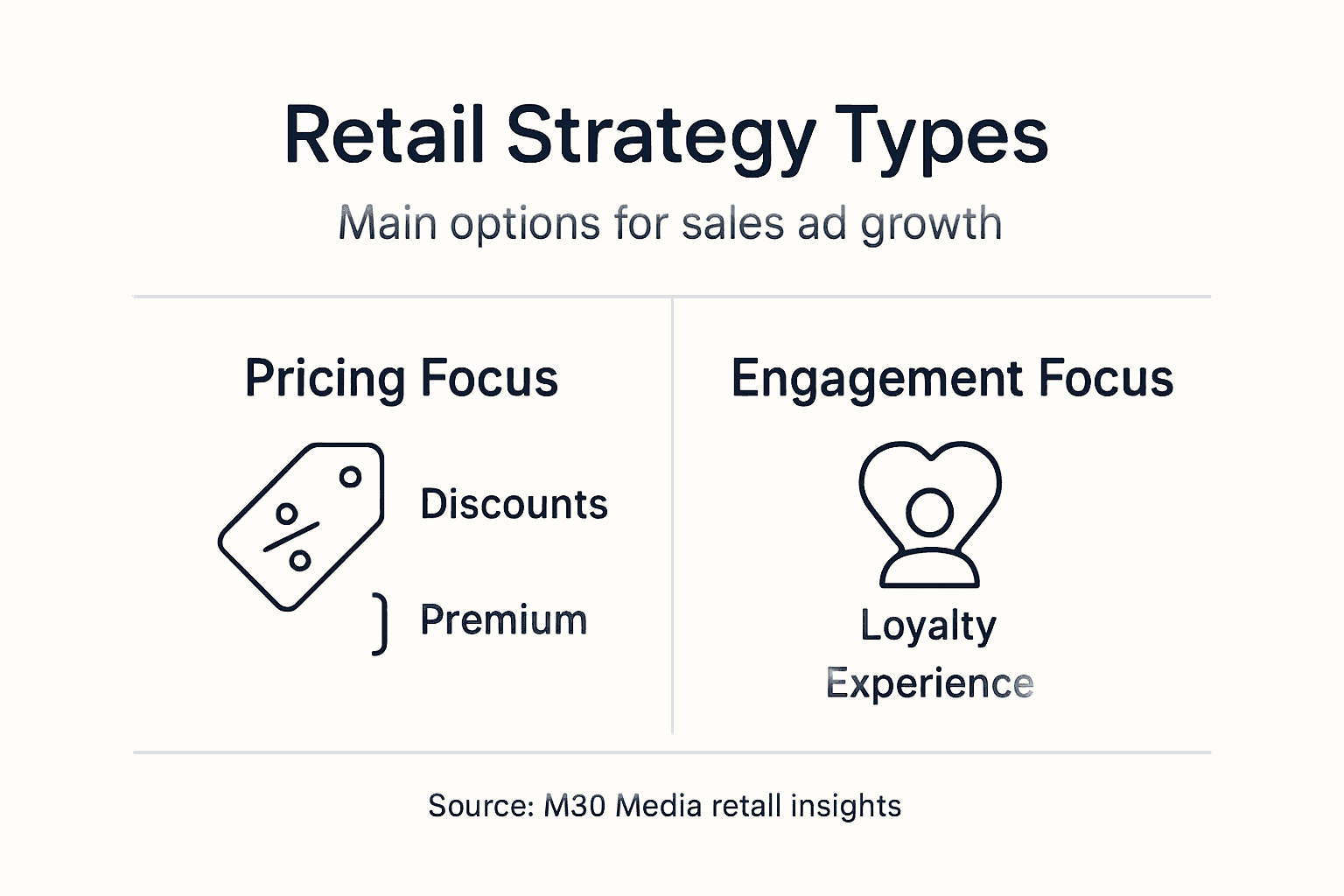
When you break down retail marketing, you’re really looking at several interconnected areas. Pricing strategies, product assortments, and promotional tactics form the foundation of how retailers compete.
Here’s what most retailers are working with:
Pricing strategies — discount pricing, premium positioning, or value-based pricing
Product assortments — which products you stock and how you display them
Promotional campaigns — seasonal sales, flash promotions, bundling offers
Geographical expansion — opening new locations or targeting specific regions
Customer engagement tactics — loyalty programs, in-store events, personalisation
The best retail strategy combines multiple approaches tailored to your specific market and customers.
Modern Retail Marketing Approaches
In-store marketing, influencer collaborations, loyalty programs, and omnichannel strategies represent how retailers are reaching customers today. You’re no longer choosing between one channel or another—you’re orchestrating them together.
Consider what’s happening in successful retail operations:
In-store experience — creating atmosphere, visual merchandising, staff training
Digital campaigns — email marketing, social media, paid advertising
Loyalty programs — rewarding repeat customers, building data insights
Influencer partnerships — partnering with creators who reach your audience
Omnichannel integration — seamless experience across online and offline
Choosing Your Strategy Mix
You don’t need to do everything at once. The retailers winning right now are selecting two or three strategies that align with their strengths and their customers’ preferences.
Start with what matters most to your audience. Are they price-sensitive? Loyalty-focused? Experience-driven? Your answers determine which strategies deserve your attention and budget.
Pro tip: Map out your top three customer pain points, then select one pricing strategy and one engagement strategy that directly address them—this focused approach beats scattered tactics every time.
Digital Versus In-Store Approaches Compared
Here’s the honest truth: the debate between digital and in-store retail isn’t about picking a winner. Both channels influence customer behaviour differently, and the retailers thriving right now understand how to use both.
Your customers aren’t choosing one or the other anymore—they’re moving fluidly between them. Your job is making sure both experiences work together seamlessly.
What Each Channel Does Best
Digital approaches offer convenience and personalisation while in-store methods provide tactile experiences. They’re not competing; they’re serving different needs in the customer journey.
Digital channels excel at:
Reaching customers 24/7 without location constraints
Delivering personalised recommendations based on browsing and purchase history
Making price comparisons easy and transparent
Offering convenience for time-strapped shoppers
Capturing data to understand customer preferences
In-store channels shine with:
Here is a comparison of digital and in-store retail approaches and how they contribute to the customer journey:
Aspect | Digital Approach | In-Store Approach |
Accessibility | Available 24/7, no location limitations | Limited to store hours and specific sites |
Personal Interaction | Automated personalisation, chatbots | Face-to-face service, expert advice |
Experience | Virtual, data-driven recommendations | Hands-on product trials, immersive displays |
Data Insights | Detailed tracking of online behaviour | Observed through staff and POS systems |
Purchase Convenience | Easy price comparison, fast checkout | Instant product acquisition |
Community Building | Online communities, loyalty platforms | Events, social engagement in-store |
Immediate gratification—customers walk out with their purchase today
Tactile product experience—seeing, touching, and trying items
Personal human interaction and expert advice
Building emotional connection to your brand
Creating community and social experience around shopping
The strongest retail strategy blends digital convenience with physical store strengths instead of treating them as opponents.
The Digital Transformation Reality
Digital tools such as online platforms, mobile apps, and data analytics reshape how retailers engage customers and operate. But here’s what matters: digital doesn’t replace stores. It amplifies them.
Successful retailers are:
Using data from digital channels to inform in-store inventory and layout
Enabling online ordering with in-store pickup for maximum convenience
Creating consistent messaging across all touchpoints
Training staff to understand customer digital interactions
Integrating payment systems so customers can shop however they prefer
What This Means for Your Business
You’re not forced to choose between going digital or staying in-store. The winning move is building an omnichannel experience where both channels strengthen each other.
A customer might browse your app, visit your store to see the product, then buy online for delivery. Another might discover you in-store, then research reviews on their phone before purchasing. Both journeys are valid—and profitable when you support them.
Pro tip: Start by mapping how your customers actually shop—online first, in-store first, or mixing both? Then prioritise connecting those specific touchpoints rather than building every channel at once.
Building Brand Loyalty and Long-Term Value
Loyalty isn’t something you buy with discounts alone. Real brand loyalty comes from customers who trust you, feel your value, and keep coming back because they believe in what you offer.
The difference between a one-time buyer and a loyal customer often comes down to whether you’ve earned their trust through consistent, ethical business practices.
The Three Pillars of Customer Loyalty
Trust, perceived value, and satisfaction are critical components that build and maintain lasting customer relationships in retail. These aren’t optional extras—they’re foundational.
Here’s what this looks like in practice:
Trust — delivering on promises, handling complaints fairly, being transparent about pricing and products
Perceived value — customers feel they’re getting what they paid for or better
Satisfaction — consistently positive experiences that exceed expectations
When all three exist together, customers don’t just shop with you again—they recommend you to others.
Customers who trust your brand and feel satisfied with their experience become your best marketers.
Building Meaningful Customer-Brand Relationships
Brand loyalty involves cognitive, affective, and normative dimensions that go beyond transactional relationships. You’re creating emotional connections, not just selling products.
To deepen customer loyalty:
Focus on brand attachment — help customers see themselves reflected in your brand values
Build social identification — create community among your customers
Strengthen trust through consistency — every interaction reinforces your promise
Communicate functional benefits — explain why your products solve their problems
Highlight symbolic meaning — connect your brand to who they want to be
Why Long-Term Value Matters More Than Quick Sales
A loyal customer spending £20 monthly for five years generates more profit than ten one-time buyers spending £100 each. Plus, retention costs far less than constantly acquiring new customers.
Focusing on loyalty means investing in customer experience, quality products, and genuine relationships. These investments compound over time as satisfied customers become advocates who bring new business naturally.
Pro tip: Identify your top 10% of customers by repeat purchases, then reach out with personalised communications or exclusive offers—these high-value customers often generate disproportionate revenue and referrals.
Avoiding Common Mistakes in Retail Marketing
Mistakes in retail marketing often stem from rushing into tactics without proper groundwork. You can avoid costly missteps by understanding where retailers commonly stumble and how to sidestep those pitfalls.
The good news? Most of these mistakes are preventable with clear thinking and the right approach.
Research and Strategy Mistakes
Common market research mistakes include unclear objectives, outdated methodologies, and poor data analysis. When you skip proper research or do it carelessly, everything downstream falls apart.
Here’s what goes wrong frequently:
Unclear objectives — starting research without knowing what you actually need to learn
Outdated methods — relying on old tactics instead of current research approaches
Poor analysis — collecting data but failing to interpret it correctly
Sampling errors — surveying the wrong people or too few customers
Ignoring competitors — missing what rivals are doing and how they’re positioning
Every marketing decision should rest on solid research, not hunches or assumptions.
Digital and Omnichannel Mistakes
Retailers often overwhelm consumers with too many product choices online and neglect to guide them through the shopping process. Failing to integrate digital and physical channels effectively creates friction customers resent.
Common digital missteps include:
To help avoid common pitfalls, here’s a summary of key research and digital mistakes in retail marketing, along with their practical impact:
Mistake Type | Typical Error | Impact on Business |
Market Research | Unclear objectives | Poor decision-making |
Research Methodology | Outdated techniques | Missed market trends |
Data Analysis | Faulty interpretation | Misleading insights |
Digital Channel Management | Weak channel integration | Friction in customer experience |
Product Assortment Online | Overwhelming choices | Increased cart abandonment |
Personalisation | Generic messaging | Lower customer engagement |
Overloading product options — 500 choices paralyse customers instead of exciting them
Ignoring behaviour data — not tracking what customers actually click, buy, and abandon
Poor personalisation — treating every visitor the same instead of tailoring experience
Weak channel integration — online and in-store teams working separately
Unclear navigation — making it hard for customers to find what they need
The Cost of Getting It Wrong
These mistakes compound quickly. A customer overwhelmed by choices abandons their cart. A visitor with no personalisation bounces to a competitor. Missing competitive intelligence means you’re always playing catch-up.
The fix is developing data-driven, customer-centric strategies that guide every decision. This means setting clear goals, using current research methods, analysing your data thoroughly, and understanding your customers’ actual behaviour.
Pro tip: Before launching any marketing initiative, list three specific questions you need answered about your customers or market—then collect data to answer those questions before you spend money on campaigns.
Unlock Retail Success with a Winning Marketing Strategy
Are you struggling to translate your retail marketing strategy into real sales growth or feeling overwhelmed by the challenge of connecting digital and in-store channels effectively? This article highlights the critical need for a clear, customer-centric approach that aligns your team and resources to create long-term loyalty and competitive advantage. It also uncovers common pitfalls that hold retailers back from executing their plans and reaching their business goals.

Take the next step toward transforming your retail business by partnering with M50 Media. As the trusted Marketing Consulting and Education brand led by Digital Marketing Guru Karl Lundgren, M50 Media provides tailored coaching and expert digital marketing recommendations that help you build an actionable strategy focused on your ideal customers and value proposition. Visit M50 Media to access our blog and start mastering the techniques that turn strategy into sales today. Don’t let confusion or hesitation stall your growth—get the clarity and support your retail business needs now.
Frequently Asked Questions
What is the importance of having a marketing strategy for retail businesses?
A marketing strategy is crucial for retail businesses as it helps to define how a company will compete, identify target customers, and create value that meets customer needs. It serves as a blueprint for decision-making in areas such as product selection, pricing, and customer experience.
How can retailers build customer loyalty through their marketing strategy?
Retailers can build customer loyalty by focusing on trust, perceived value, and satisfaction. By delivering consistent experiences and engaging customers emotionally, retailers can turn one-time buyers into loyal customers who return and recommend the brand to others.
What elements should a retail marketing strategy include?
A comprehensive retail marketing strategy should include customer value propositions, organizational structure for execution, marketing priorities, and daily operational plans to ensure the strategy translates into actionable initiatives that meet customer needs effectively.
How do digital and in-store retail approaches complement each other?
Digital and in-store retail approaches complement each other by providing unique advantages. Digital channels offer convenience and personalized experiences, while in-store interactions provide tactile experiences and personal service. Retailers should integrate both strategies to create a seamless omnichannel experience for customers.
Recommended
Comments