What is a marketing funnel: guide for small business success

Many small business owners believe attracting customers happens instantly with a single ad or social post. The reality is far more nuanced. A marketing funnel maps the complete journey from first awareness to final purchase, helping you understand exactly how to guide prospects through each decision stage. This guide explains what a marketing funnel is, breaks down its stages, and shows you how to build one that drives real results for your digital marketing efforts.
Table of Contents
Key takeaways
Point | Details |
Funnels guide customer journeys | Marketing funnels map the path from awareness through interest and decision to purchase action |
Stage-specific strategies boost conversions | Tailoring content and tactics to each funnel stage increases conversion rates and customer loyalty |
Multiple funnel models exist | Different frameworks suit different business types and goals, from simple AIDA to complex multi-touch models |
Optimisation requires ongoing measurement | Tracking metrics and testing improvements at each stage maximises funnel performance and ROI |
What is a marketing funnel and why it matters
A marketing funnel illustrates the customer journey from awareness to conversion. Think of it as a roadmap showing how strangers become customers. The funnel metaphor reflects reality: many people enter at the top, but fewer complete the journey to purchase at the bottom. Understanding this progression transforms how you approach digital marketing.
The funnel typically includes four core stages. Awareness is where potential customers first discover your business exists. Interest develops as they learn more about your offerings and how you solve their problems. Decision occurs when they evaluate your solution against alternatives. Action is the final stage where they complete a purchase and ideally become loyal customers.
Aligning your marketing efforts to each stage dramatically increases conversion and retention. Small businesses benefit enormously by applying this framework systematically. Instead of random marketing activities, you create targeted content and campaigns that move prospects forward intentionally.
Here’s why the funnel matters for your business:
It reveals where prospects drop off so you can fix weak points
It helps you allocate budget to the most effective activities
It ensures you’re nurturing leads properly instead of expecting instant sales
It provides a structure for measuring marketing performance accurately
Consider a prospect who sees your Facebook ad, visits your website, downloads a guide, receives follow up emails, then books a consultation. Each touchpoint represents a funnel stage. Without understanding this progression, you might waste resources on awareness ads when your real problem is converting interested prospects to buyers.
Exploring the main stages of the marketing funnel
Each funnel stage requires distinct marketing tactics and content formats. Matching your approach to where prospects are in their journey is essential for moving them forward efficiently.
Awareness stage: Your goal is attracting attention from people who don’t know you exist yet. Content marketing tailored to funnel stages drives 20% more leads for small businesses. Use blog posts, social media content, videos, and paid ads that address problems your audience faces. Educational content works brilliantly here because you’re building trust before asking for anything.
Interest stage: Prospects now know about you and want to learn more. Engage them with detailed guides, case studies, webinars, and email newsletters that showcase your expertise. This stage is about demonstrating you understand their challenges deeply and have proven solutions. Interactive content like quizzes or assessments works well for maintaining engagement.
Decision stage: Here prospects compare you against competitors and alternatives including doing nothing. Provide comparison charts, testimonials, free trials, consultations, and detailed product information. Address objections directly and make the value proposition crystal clear. Personalised outreach often tips the scales at this stage.
Action stage: Make purchasing frictionless with clear calls to action, simple checkout processes, and immediate confirmation. After purchase, reinforce their decision with welcome sequences, onboarding support, and loyalty programmes. Satisfied customers become repeat buyers and referral sources.
Pro tip: Combine email marketing with social media retargeting to stay visible as prospects progress through stages. Someone who downloads your guide but doesn’t buy immediately should see targeted ads reminding them of your solution while receiving helpful email content that builds confidence.
The beauty of this framework is its flexibility. A service business might have longer decision stages requiring multiple consultations. An e-commerce shop might compress interest and decision into minutes. Adapt the model to your actual customer behaviour rather than forcing prospects into rigid categories.
Comparing marketing funnel models and their business uses
Several funnel variations exist, each organising the customer journey slightly differently. Tailoring funnel design to business goals improves marketing effectiveness. Choosing the right framework depends on your business model, sales cycle length, and customer behaviour patterns.
The classic AIDA model (Awareness, Interest, Desire, Action) is straightforward and works well for simpler sales processes. It emphasises creating desire before asking for action. The TOFU-MOFU-BOFU framework (Top of Funnel, Middle of Funnel, Bottom of Funnel) groups stages into three broader categories, making it easier to plan content strategies for each phase.
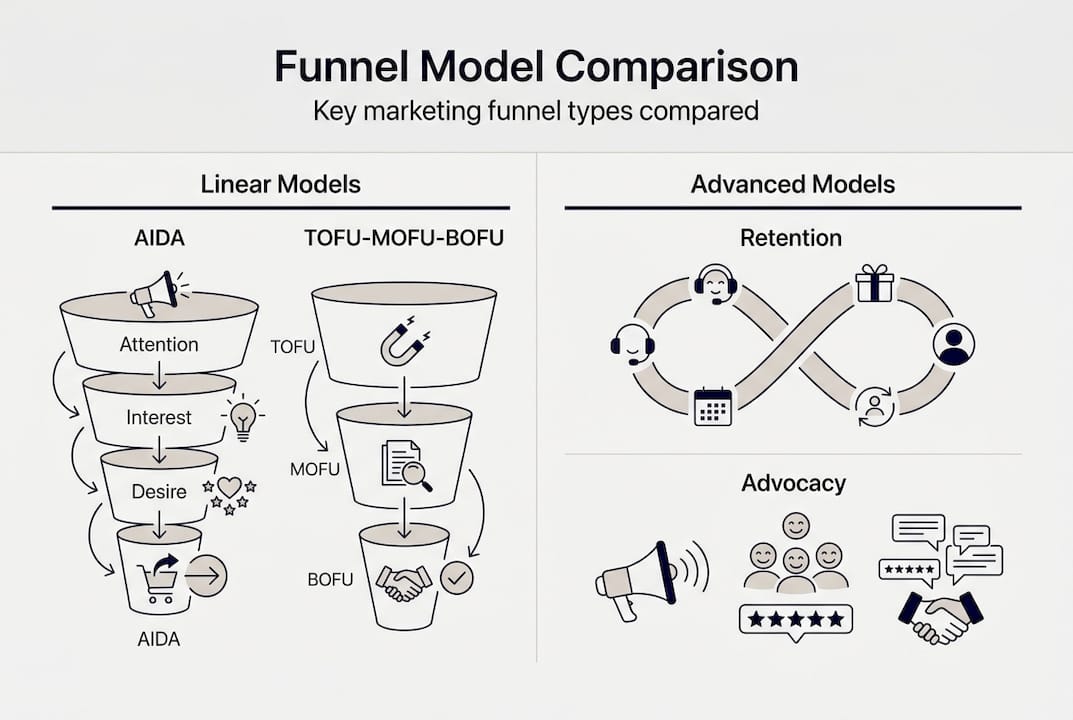
Some businesses use more complex models that include post-purchase stages like retention and advocacy. These recognise that the customer journey doesn’t end at purchase. Loyal customers who refer others become part of your awareness-building efforts, creating a continuous cycle.
| Model | Key Features | Best For | Main Benefit | | — | — | | AIDA | Four linear stages focusing on desire creation | Simple products, short sales cycles | Easy to understand and implement quickly | | TOFU-MOFU-BOFU | Three broad phases grouping related activities | Content marketing planning | Simplifies content strategy development | | Full Lifecycle | Includes retention and advocacy stages | Subscription or repeat purchase businesses | Maximises customer lifetime value | | Multi-Touch Attribution | Maps multiple touchpoints across stages | Complex B2B sales | Reveals which channels drive conversions |
Pro tip: Start with a simple model that matches your current understanding and data capabilities. As you gather more customer journey insights through analytics, evolve your funnel to reflect actual behaviour patterns. Overcomplicating early on leads to analysis paralysis rather than action.
Your choice should reflect how customers actually buy from you. If prospects typically interact with your brand seven times before purchasing, a multi-touch model makes sense. If most sales happen quickly after initial contact, AIDA might suffice. The digital display templates guide shows how visual content adapts to different funnel approaches for maximum impact.
How to build and optimise your marketing funnel for better results
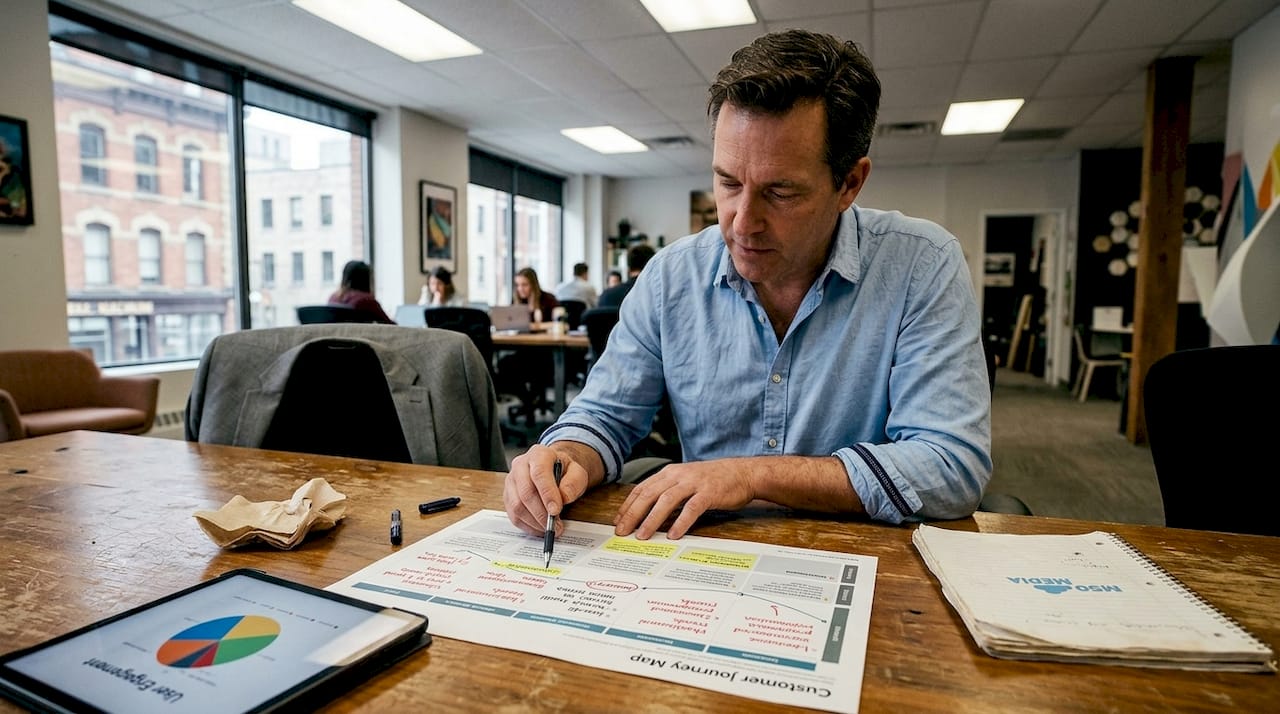
Creating an effective funnel starts with mapping your actual customer journey. Interview recent customers to understand their path from first hearing about you to making a purchase. What content did they consume? Which touchpoints mattered most? How long did the process take? This research reveals your real funnel stages rather than theoretical ones.
Next, create aligned content and offers for each stage you’ve identified. Awareness content should be freely accessible and educational. Interest stage materials can be gated behind email signups. Decision stage resources should directly address purchase concerns. Action stage elements must remove friction and make buying easy.
Using small business marketing tools helps monitor and improve funnel effectiveness. Essential tools include:
Email automation platforms for nurturing leads through stages
Web analytics to track visitor behaviour and conversion paths
CRM systems to manage prospect relationships and interactions
Social media management tools for consistent awareness building
Landing page builders for optimised conversion at each stage
Track key metrics at every funnel stage to identify where prospects drop off. Awareness metrics include reach, impressions, and traffic. Interest metrics cover engagement rates, time on site, and content downloads. Decision metrics track consultation requests, trial signups, and cart additions. Action metrics measure conversion rates, average order value, and customer acquisition cost.
Funnel Stage | Key Metrics | Optimisation Focus |
Awareness | Reach, traffic, impressions | Expand audience, improve targeting |
Interest | Engagement, downloads, email signups | Enhance content quality, relevance |
Decision | Consultation requests, trial signups | Address objections, build trust |
Action | Conversion rate, purchase value | Remove friction, simplify process |
Continuous testing improves every element. A/B test headlines, calls to action, content formats, and offer structures. Small improvements compound over time. A 10% increase in awareness-to-interest conversion plus a 10% boost in decision-to-action conversion yields a 21% overall improvement.
Common funnel mistakes to avoid:
Neglecting top-of-funnel awareness activities because they don’t produce immediate sales
Pushing for sales too early before building sufficient interest and trust
Creating content without considering which funnel stage it serves
Ignoring data that shows where prospects actually drop off
Maintaining inconsistent messaging across different funnel stages
Forgetting to optimise the post-purchase experience for retention
Pro tip: Integrate digital advertising with email automation for powerful funnel nurturing. Use social ads to retarget website visitors who didn’t convert, while simultaneously sending them helpful email sequences that address common objections. This multi-channel approach keeps your solution top of mind as prospects move through decision stages.
Discover expert coaching to master your marketing funnel
Building and optimising a marketing funnel can feel overwhelming when you’re managing everything else in your business. Professional guidance accelerates your progress and helps you avoid costly mistakes. M50 Media offers digital coaching specifically designed for small business owners who want to master their marketing funnels and drive sustainable growth.
Our coaching services help you design customer journeys that convert, create stage-appropriate content, select the right tools, and interpret your funnel data for continuous improvement. If you’re facing an urgent marketing challenge, book a free marketing SOS call to get immediate expert input on your situation. Explore more practical marketing strategies and insights on the M50 Media blog to keep building your digital marketing expertise.
Frequently asked questions
What is a marketing funnel?
A marketing funnel is a framework that maps the stages potential customers move through from first awareness of your business to making a purchase and beyond. It’s called a funnel because many people enter at the awareness stage, but fewer progress to each subsequent stage, with the smallest number completing purchases at the bottom. This model helps you understand customer behaviour and plan appropriate marketing activities for each stage.
How does a marketing funnel differ from a sales funnel?
The terms are often used interchangeably, but marketing funnels typically focus on earlier stages like awareness and interest, while sales funnels emphasise later stages like decision and purchase. Marketing funnels are broader, covering all activities that attract and nurture prospects. Sales funnels concentrate on converting qualified leads into customers. In practise, they’re complementary parts of the same customer journey.
How does digital marketing fit within funnel stages?
Different digital marketing channels serve different funnel stages effectively. Social media and content marketing excel at awareness building. Email marketing and webinars work brilliantly for the interest stage. Retargeting ads, case studies, and consultations support the decision stage. Optimised landing pages and simple checkout processes facilitate the action stage. The key is matching your digital tactics to the stage you’re targeting rather than using every channel for every purpose.
How can small businesses start building their marketing funnel?
Begin by mapping your current customer journey through interviews and data analysis. Identify the typical touchpoints and stages prospects experience before buying from you. Then create or organise your existing content to support each stage you’ve identified. Start simple with basic awareness content, a lead magnet for the interest stage, and clear calls to action for decision and purchase. Refine your funnel over time as you gather performance data and customer feedback.
What tools can help me manage and optimise my marketing funnel?
Essential tools include email automation platforms like Mailchimp or ActiveCampaign for nurturing leads, Google Analytics for tracking website behaviour, CRM systems like HubSpot for managing prospect relationships, and social media management tools for consistent content distribution. Small business marketing tools provide the infrastructure for monitoring funnel performance and making data-driven improvements. Start with free or low-cost options and upgrade as your needs grow.
What common mistakes should I avoid with marketing funnels?
Avoid neglecting any funnel stage, particularly awareness activities that don’t produce immediate sales but fill your pipeline. Don’t ignore the data showing where prospects drop off. Maintain consistent messaging across all stages so prospects have a coherent experience. Test and optimise regularly rather than setting up your funnel once and forgetting it. Finally, ensure your content genuinely helps prospects at each stage instead of pushing for sales prematurely before building sufficient trust and interest.
Recommended
Comments