Understand marketing analytics: grow your small business
- karl7209
- Mar 20
- 10 min read

Many small business owners believe marketing analytics is too expensive or complicated for their needs. That misconception costs real growth opportunities. Marketing analytics is accessible to businesses of any size and essential for making smarter decisions about where to invest your marketing budget. This guide explains what marketing analytics actually is, which metrics matter most, the tools you need, and practical steps to apply analytics effectively. You’ll learn how to measure what works, prove return on investment, and connect your marketing activities directly to revenue growth.
Table of Contents
Key Takeaways
Point | Details |
Accessible analytics for all | Marketing analytics helps small businesses measure where to invest and connect activities to revenue. |
Core metrics that matter | Focus on conversion rate, customer acquisition cost, return on ad spend, bounce rate and lifetime value to guide decisions. |
Practical analytics tools | Use tools like Google Analytics and Google Search Console to collect data and gain insights. |
Avoid vanity metrics | Skip vanity metrics and focus on revenue linked measures and actionable insights. |
Regular review cycles | Establish recurring review and testing cycles to refine campaigns and drive growth. |
What is marketing analytics and why it matters
Marketing analytics is the practice of collecting, measuring, and interpreting data from various marketing channels to inform better decisions, prove ROI, and connect marketing activities to revenue. For small businesses, this means gathering information from your website, social media, email campaigns, paid advertising, customer relationship management systems, and even offline activities like events or phone enquiries. You analyse this data to understand which marketing efforts actually work and which ones drain resources without delivering results.
Many small business owners assume analytics is only for large corporations with dedicated data teams or expensive software. That’s completely false. Marketing analytics is essential for businesses of every size because it replaces guessing with evidence. When you know your digital marketing ROI for small business, you can confidently invest more in what works and stop wasting money on what doesn’t. This direct connection between marketing activities and revenue growth makes analytics your most powerful tool for sustainable business expansion.
Small businesses benefit from marketing analytics in several practical ways. You can identify which traffic sources bring qualified leads, understand customer behaviour patterns on your website, measure campaign performance in real time, and adjust strategies quickly based on actual results rather than hunches. The data helps you prove which marketing investments deliver returns and justify budget decisions with concrete evidence.
“Marketing analytics transforms raw data from digital platforms, CRM systems, and customer interactions into actionable insights that drive revenue growth and improve marketing efficiency for businesses of all sizes.”
The types of marketing data sources relevant to small businesses include:
Digital advertising platforms like Google Ads, Facebook Ads, and LinkedIn showing spend, impressions, clicks, and conversions
Website analytics tracking visitor behaviour, page performance, traffic sources, and goal completions
CRM data revealing customer lifetime value, purchase patterns, and sales cycle length
Email marketing metrics including open rates, click rates, and conversion tracking
Social media engagement data showing reach, interactions, and referral traffic
Offline activities such as phone calls, in-person events, and traditional advertising responses
Pro Tip: Start with one or two data sources you already use and gradually expand your analytics as you build confidence interpreting results and applying insights.
Key marketing analytics metrics small businesses should track
Understanding which metrics matter most saves you from drowning in irrelevant data. Small businesses should focus on key performance indicators that directly link to revenue and profitability rather than vanity metrics like total page views or social media followers. The core KPIs include conversion rate, bounce rate, click-through rate, customer acquisition cost, return on ad spend, and lifetime value.

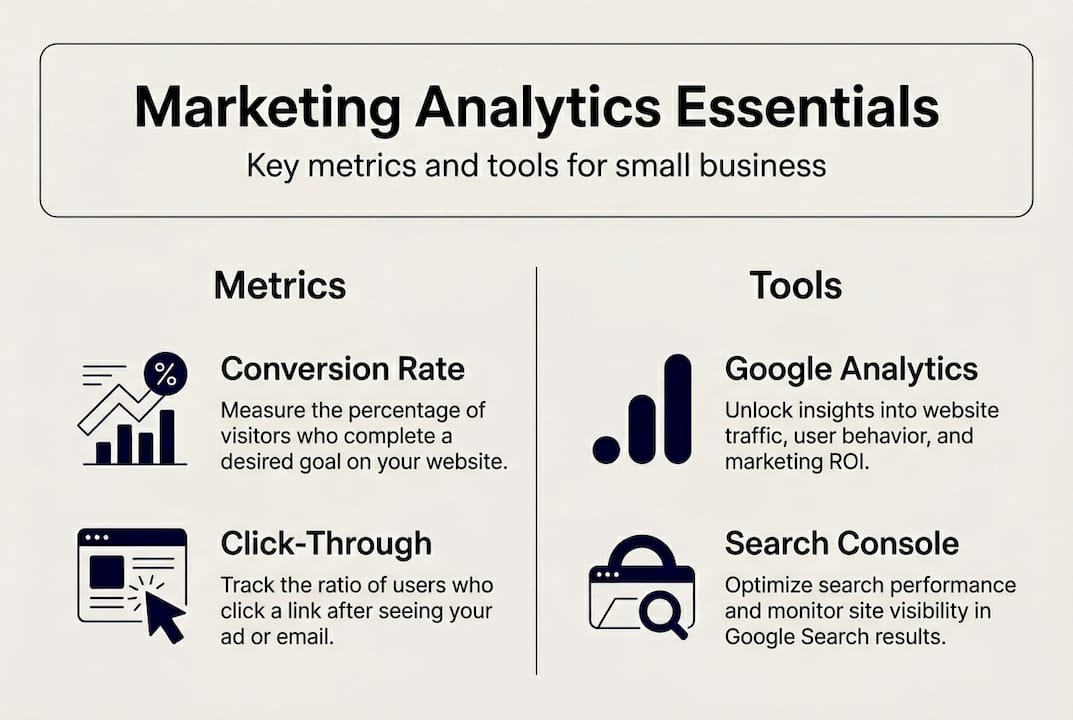
Conversion rate measures the percentage of visitors who complete a desired action such as making a purchase, filling out a contact form, or subscribing to your email list. For small businesses, typical conversion rates range from 2-5% depending on your industry and offer complexity. This metric reveals how effectively your website and marketing messages persuade visitors to take action.
Bounce rate shows the percentage of visitors who leave your website after viewing only one page. Healthy bounce rates for small businesses fall between 30-50%, though this varies significantly by page type and traffic source. High bounce rates often indicate poor page relevance, slow loading times, or mismatched visitor expectations.
Click-through rate measures how often people click your ads or links compared to how many times they’re shown. Customer acquisition cost calculates the total marketing and sales expense required to acquire one new customer. Return on ad spend reveals how much revenue you generate for every dollar spent on advertising, with ROAS targets of 2.5x to 3.8x for Google Ads being common for small businesses. Lifetime value estimates the total revenue a customer generates throughout their relationship with your business.
Metric | Typical SMB benchmark | Why it matters |
Conversion rate | 2-5% | Measures how effectively you turn visitors into customers |
Bounce rate | 30-50% | Indicates page relevance and user experience quality |
Click-through rate | 2-5% for search ads | Shows ad relevance and appeal to your target audience |
Customer acquisition cost | Varies by industry | Determines profitability of marketing channels |
Return on ad spend | 2.5x-3.8x | Proves whether advertising investments generate profit |
Lifetime value | 3x CAC minimum | Justifies acquisition costs and informs retention strategy |
Tips for interpreting and prioritising metrics effectively:
Compare metrics against your own historical performance rather than obsessing over industry averages
Track trends over time instead of reacting to single data points or daily fluctuations
Segment data by traffic source, campaign, or customer type to identify specific opportunities
Calculate ratios like LTV:CAC to understand long-term profitability of acquisition strategies
Focus on metrics you can actually influence through marketing decisions and tests
Pro Tip: Select three to five revenue-linked KPIs and review them weekly to avoid vanity metrics and improve decisions. This focused approach prevents analysis paralysis whilst building your confidence interpreting data and applying insights to your digital advertising guide 2026 strategy.
Practical tools and challenges in marketing analytics for SMBs
Small businesses need accessible, affordable tools that deliver actionable insights without requiring technical expertise or large budgets. Google Analytics 4 and Google Search Console are must-have free tools that provide comprehensive tracking of website performance, traffic sources, user behaviour, and search visibility. GA4 tracks visitor interactions across your website and apps, whilst Search Console reveals how your site performs in Google search results, which queries drive traffic, and technical issues affecting visibility.
Analytify simplifies WordPress analytics by presenting Google Analytics data directly in your dashboard with user-friendly reports and real-time statistics. HubSpot offers CRM integration with marketing analytics, email tracking, and campaign management suitable for small businesses ready to invest in more sophisticated tools. Most advertising platforms including Google Ads, Facebook Ads Manager, and LinkedIn Campaign Manager provide built-in reporting that tracks spend, impressions, clicks, conversions, and return on investment for each campaign.
Despite these accessible tools, small businesses face several data fragmentation, attribution challenges, and privacy regulations that complicate marketing analytics. Data fragmentation occurs when information sits in separate systems like your website analytics, CRM, email platform, and advertising accounts without easy ways to combine insights. This makes it difficult to see the complete customer journey or accurately attribute conversions to specific marketing touchpoints.
Attribution challenges arise because customers typically interact with multiple marketing channels before converting. Did they find you through organic search, see a social media ad, receive an email, then finally convert through a Google search ad? Multi-touch attribution models attempt to assign credit across these touchpoints, but small businesses often lack the data volume or technical resources to implement sophisticated attribution. Privacy regulations like GDPR and evolving browser restrictions on cookies further limit tracking capabilities and data collection.
Practical tips to handle common data challenges:
Use consistent UTM parameters and naming conventions across all campaigns to improve tracking accuracy
Conduct regular data audits to identify gaps, errors, or inconsistencies in your tracking setup
Combine attribution data with incrementality tests or marketing mix modelling to validate channel effectiveness
Focus on first-party data collection through email lists, customer accounts, and direct relationships
Accept that perfect attribution is impossible and use directional insights to inform decisions
Start simple with last-click attribution before investing time in complex multi-touch models
Pro Tip: Use GA4 and Search Console as foundational tools before investing in more advanced paid platforms. Master these free resources to build analytics literacy and identify specific gaps that justify purchasing additional small business marketing tools. Most small businesses underutilise the capabilities already available in free tools before adding complexity and cost.
How to apply marketing analytics to grow your small business
Implementing marketing analytics effectively requires a systematic approach that fits your small business resources and goals. Follow these steps to start measuring what matters and applying insights to drive growth:
Define clear business goals that marketing should support, such as increasing revenue by 25%, acquiring 50 new customers monthly, or reducing acquisition costs by 15%.
Select three to five KPIs that directly measure progress towards those goals, focusing on metrics like conversion rate, customer acquisition cost, and lifetime value rather than vanity metrics.
Set up proper tracking by installing Google Analytics 4, configuring goal tracking and conversions, implementing UTM parameters for campaign links, and connecting your advertising accounts.
Establish a regular review schedule, ideally weekly, to examine your KPIs, identify trends or anomalies, and generate hypotheses about what’s working or failing.
Apply insights by testing changes to underperforming campaigns, reallocating budget towards high-performing channels, and documenting what you learn for future reference.
Best practices for small business marketing analytics:
Prioritise revenue outcomes over activity metrics when evaluating marketing performance
Avoid vanity metrics like total page views, social followers, or email list size that don’t connect to business results
Maintain simple dashboards showing only your most important KPIs to prevent information overload
Document your testing hypotheses, changes made, and results observed to build institutional knowledge
Share analytics insights with your team to align everyone around data-driven decision making
Small businesses can use different analysis methods depending on their questions and data maturity. Descriptive analytics answers “what happened” by summarising past performance through reports and dashboards. Diagnostic analytics explores “why it happened” by identifying patterns, correlations, and root causes of results. Predictive analytics forecasts “what will happen” using historical data to project future trends. Prescriptive analytics recommends “what should we do” by suggesting optimal actions based on data patterns.
Analysis method | What it does | SMB use case |
Descriptive | Summarises past performance | Monthly reports showing traffic, conversions, and revenue by channel |
Diagnostic | Identifies why results occurred | Investigating why conversion rate dropped 30% last month |
Predictive | Forecasts future trends | Projecting holiday season traffic and revenue based on last year |
Prescriptive | Recommends optimal actions | Suggesting budget reallocation based on channel performance data |
Pro Tip: Schedule weekly reviews and hypothesise-testing cycles to compound growth and build measurement confidence. Small businesses that adopt a weekly Collect-Analyse-Act cycle, tie metrics to LTV:CAC ratio, and test hypotheses frequently build confidence faster and drive better growth than those reviewing data quarterly. This regular rhythm helps you catch problems early, capitalise on opportunities quickly, and develop intuition about what works in your specific market.
Resource constraints are real for small businesses, but marketing analytics actually helps optimise limited budgets more effectively. When you know which channels deliver the best return on investment, you can confidently invest your modest budget where it matters most rather than spreading resources thin across unproven tactics. 66% of SMBs spend less than $1,000 yearly on marketing but plan to increase budgets informed by analytics that proves ROI. Start small, measure rigorously, and scale what works using data rather than guesswork to guide your digital marketing plan guide investments.
Get expert help to master marketing analytics
Applying everything you’ve learnt about marketing analytics can feel overwhelming when you’re already managing daily business operations. M50 Media specialises in helping small businesses like yours implement practical, results-focused marketing analytics without the complexity or cost of enterprise solutions. Our business coaching services provide personalised guidance tailored to your specific industry, goals, and resources.

We offer a free marketing SOS call where you can discuss your current marketing challenges, get expert advice on which metrics and tools make sense for your business, and create an action plan to start measuring what matters. This no-risk consultation helps you avoid common analytics mistakes and accelerates your path to data-driven growth. Combine the foundational knowledge from this guide with expert support to maximise results and build confidence in your marketing decisions. Explore our related resources including the digital marketing plan guide to deepen your knowledge and create a comprehensive strategy that drives sustainable business growth.
Frequently asked questions
What is the first step in getting started with marketing analytics?
Start by defining your key business goals and selecting three to five revenue-focused KPIs to track using tools like Google Analytics 4. Set up proper tracking for these metrics, then establish regular weekly reviews to interpret data and make informed marketing decisions. This focused approach prevents overwhelm whilst building your analytics confidence.
Which marketing analytics tool is best for small businesses?
Google Analytics 4 and Google Search Console are must-have free tools for core tracking of website performance and search visibility. Analytify and HubSpot offer more capabilities for WordPress and CRM integration respectively, but master the free foundational tools first. Most small businesses underutilise free resources before needing paid small business marketing tools solutions.
How often should small businesses review their marketing analytics data?
Weekly reviews allow small teams to quickly identify trends and test new hypotheses, compounding growth faster than quarterly reviews. Regular Collect-Analyse-Act cycles help you stay agile and responsive to market changes whilst building measurement confidence. Avoid quarterly-only reviews that delay problem detection and opportunity capitalisation.
What is the difference between vanity metrics and actionable metrics?
Vanity metrics like total page views or social media followers look impressive but don’t connect directly to revenue or business goals. Actionable metrics such as conversion rate, customer acquisition cost, and lifetime value directly measure profitability and inform specific decisions about budget allocation and campaign optimisation. Focus your limited time on metrics that actually influence business outcomes.
Recommended
Comments