What is niche marketing? A guide for entrepreneurs
- karl7209
- May 21
- 9 min read

TL;DR:
Niche marketing targets specific, well-defined audiences, enhancing loyalty and conversion more effectively than broad marketing. It builds emotional connections, allowing brands to charge premium prices and achieve higher engagement within their segments. Success depends on validating demand, tailoring messaging, and gradually expanding into related markets while maintaining brand focus.
If you’ve ever tried to market to “everyone,” you already know how that feels. Exhausting, expensive, and about as effective as shouting into a crowded shopping mall. What is niche marketing, really? It’s the smarter play. Instead of casting the widest net possible, niche marketing focuses your energy on a specific, well-defined group of people who genuinely need what you offer. Far from limiting your growth, it actually multiplies your impact. Stronger loyalty, better ROI, and messaging that actually lands. Let’s get into it.
Table of Contents
Key takeaways
Point | Details |
Niche beats broad | A focused audience approach drives higher loyalty and conversion than mass marketing tactics. |
Emotion sells | Making customers feel “seen” outperforms competitors’ sales growth by up to 85%. |
Validate before you invest | A profitable niche needs unmet demand, willingness to pay, and competitive white space. |
Channel focus wins | Community-driven niche channels convert 2 to 4 times higher than generic paid search. |
Scale with intention | Expand into adjacent markets once your niche stronghold is established and loyal. |
What is niche marketing, really?
Let’s clear up the biggest misconception right off the bat. Niche marketing is not about shrinking your audience. It’s about sharpening your focus so the right people hear you loud and clear.
The niche marketing definition, simply put, is this: it’s a marketing strategy that targets a specific, well-defined segment of a larger market. Instead of trying to appeal to everyone who might buy running shoes, for example, you target ultramarathon runners over 40 who train in cold climates. That’s a niche.
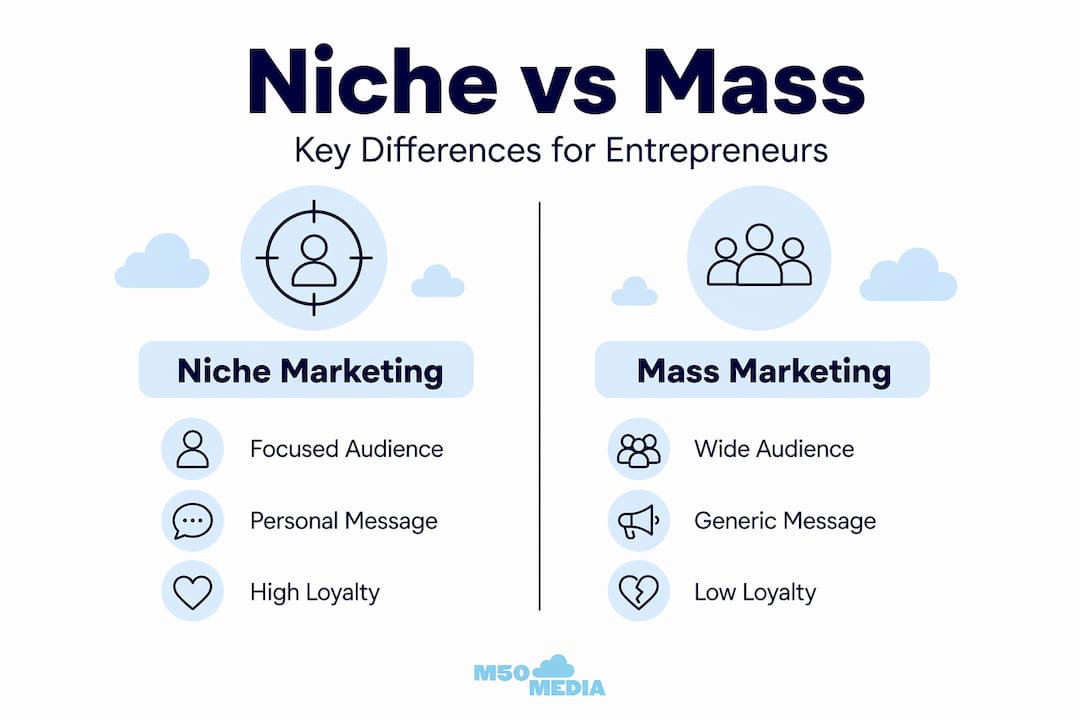
Here’s how it compares to the traditional, throw-everything-at-the-wall approach:
Niche marketing | Mass marketing |
Targets a specific audience segment | Targets the broadest possible audience |
Messaging speaks to shared values and identity | Messaging aims to offend no one (and excite no one) |
Builds deep brand loyalty | Builds broad but shallow awareness |
Lower competition within the segment | High competition across the entire market |
Higher perceived value and pricing power | Competes heavily on price |
Niche marketing focuses on reaching the specific audience that genuinely needs your product, multiplying impact rather than shrinking reach. That’s the key insight most business owners miss.
A niche is defined by more than just demographics. Psychographics matter just as much. Things like values, lifestyle, hobbies, and beliefs. Effective niche marketing involves identifying customer micro-segments by both demographics and psychographics, which enables genuinely specialised product development and messaging.
“Niche marketing isn’t about being small. It’s about being exactly right for the people who matter most to your business.”
Think of it this way. You wouldn’t open a steakhouse and advertise it to vegans. Niche marketing is simply applying that same common sense to your entire growth strategy.
Why niche marketing builds fierce loyalty
Here’s where things get genuinely exciting. When you market to a niche, you’re not just selling a product. You’re telling a specific group of people, “We made this for you.” That feeling is incredibly powerful.

Emotional connection outperforms competitors’ sales growth by 85%. Niche marketing creates that connection by making your customers feel genuinely seen. And customers who feel seen? They stick around.
The numbers back this up. Companies with a niche focus report 71% customer loyalty, compared to just 42% for broad-market competitors. That’s not a small gap. That’s a chasm. And loyalty translates directly into revenue, referrals, and repeat purchases.
Here’s why niche marketing builds such fierce engagement:
Customers identify with your brand on a personal level, not just a transactional one
Word-of-mouth travels fast in tight-knit communities
Niche business brands can charge higher prices because customers perceive greater value from specialised solutions
Lower competition within your segment means your message isn’t drowned out by noise
Marketing spend goes further because you’re talking to people who already care
And there’s something beautifully practical about understanding niche vs broad approaches when building your loyalty strategy. The brands that win long-term are the ones that make their customers feel like members of a club, not just consumers of a product.
Pro Tip: Focus your messaging on customer identity and shared values, not just product features. Ask yourself: “What does my customer believe about themselves?” and build your brand language around that answer.
How to find and validate a profitable niche
Okay, so you’re sold on the concept. Now comes the real work: finding your niche and making sure it’s actually worth your time. Not every niche is a golden opportunity. Some are too small. Some are oversaturated. Some look passionate but the audience never opens their wallet.
A profitable niche must show evidence of unmet demand, willingness to pay, and competitive white space before you invest. Think of it as three checkboxes you need to tick.
Here’s a simple process to get started:
Identify your passion-problem intersection. Where does your expertise meet a real, frustrating problem someone has? The best niches live at this crossroads.
Research existing communities. Look at Reddit threads, Facebook groups, niche forums, and YouTube comment sections. Where are people complaining? What questions come up again and again?
Check for purchasing behaviour. Are there products, memberships, or courses already selling in this space? Existing commerce is a good sign, not a bad one. It validates demand.
Analyse the competition. Are there two or three major players but nobody speaking to a specific sub-segment? That gap is your opportunity.
Test before you commit. Run a small paid campaign or create a free lead magnet targeting your niche. Measure the response. Real data beats gut feeling every time.
Understanding how to identify your audience is where most entrepreneurs either get this right or waste months chasing the wrong people.
The difference between a niche audience and a unique value proposition (UVP) is worth clarifying too. Your niche audience is who you serve. Your UVP is why they should choose you over anyone else. You need both.
Common pitfalls? Going too narrow too soon (a niche of 200 people is a hobby, not a business), ignoring purchasing power (passionate audiences that won’t pay are rough), and skipping validation because the idea “just feels right.” Feelings are great. Data is better.
Pro Tip: Use Google Trends, AnswerThePublic, and niche community forums to validate real search interest before naming your niche. Free research tools are your best friends here.
Niche marketing strategies that actually work
Once you know your niche, the fun part begins: building a marketing approach that speaks directly to them. Generic campaigns won’t cut it here. Your audience has a finely tuned radar for “this wasn’t made for me.”
Niche marketing success depends on matching the messaging rhythms of your audience. That means using their language, referencing their specific frustrations, and reflecting their values back to them. If your niche is sustainable home renovation, you don’t say “great quality.” You say “low-VOC, reclaimed timber, zero-waste installation.” Same idea. Completely different impact.
Here are the channels and techniques that consistently perform well for niche marketing:
Niche online communities (subreddits, Discord servers, Facebook groups) where your audience already hangs out
Micro-influencers with small but highly engaged followings in your specific space
Email newsletters with hyper-personalised content that addresses niche-specific problems
Content marketing that solves specific problems (think “how to train for your first ultramarathon at 45” rather than “running tips”)
Referral programmes that reward word-of-mouth within tight communities
On the paid side, community-driven niche channels achieve conversion rates 2 to 4 times higher and average order values 20 to 60% higher than generic paid search. That’s a serious performance gap, and it shows exactly where to put your budget.
Want to push your niche strategy further with tech? AI-powered personalisation can make a real difference. See how AI boosts niche conversions in practice.
Here’s a quick framework for niche ad performance benchmarks to keep in mind:
Channel type | Average conversion lift | Average order value lift |
Niche community ads | 2 to 4x higher | 20 to 60% higher |
Mass generic paid search | Baseline | Baseline |
Micro-influencer campaigns | 1.5 to 3x higher | 15 to 40% higher |
The strategy that ties all of this together? Personalised, problem-solving content delivered consistently through the channels your niche actually uses. Focused niche marketing efforts produce superior ROI compared to broad, generic campaigns. Full stop.
Challenges in niche marketing and how to scale
No strategy is without its complications. Niche marketing has a few traps worth knowing about before you fall into them.
The biggest risk is going too narrow. If your niche is “left-handed, vegan, competitive axe-throwers in Manitoba,” you’re going to have a rough time scaling. The goal is specific, not microscopic. You want a defined audience with real purchasing power and enough numbers to build a sustainable business.
Here’s how to handle common niche marketing challenges:
If growth plateaus, look at adjacent niches that share similar values and problems with your current audience
If brand messaging feels stale, revisit your customers’ evolving language and update your content accordingly
If acquisition costs keep climbing, check your CAC to LTV ratio regularly. Healthy niche brands aim for a lifetime value at least 3 times their customer acquisition cost
If you want to scale, use a concentric expansion approach, moving outward from your core niche into related segments while protecting your original brand equity
Scaling from a niche requires expanding into adjacent concentric market circles while maintaining the brand coherence and loyal consumer base you worked hard to build. Think of your niche as a beachhead. Once it’s secure, you advance.
And think about the brands that did exactly this. What started as niche tools for hardcore cyclists, specialty skincare for specific skin conditions, or organic baby food for eco-conscious parents grew into major market players, all because they built deep trust first and expanded second.
Pro Tip: Track your CAC to LTV ratio monthly. If LTV drops below 3x CAC, pause expansion and reinvest in retention before acquiring new customers.
Karl’s take on niche marketing
I’ll be honest with you. I spent years watching entrepreneurs try to “appeal to everyone” and then wonder why nobody was buying. Mass marketing isn’t dead, but for small businesses with limited budgets? It’s about as efficient as trying to fill a swimming pool with a garden hose.
What I’ve learned from working with niche-focused entrepreneurs is that the emotional payoff is real. When a customer says, “This brand just gets me,” you’ve won something advertising money can’t easily replicate. That’s loyalty. That’s lifetime value.
The entrepreneurs I’ve seen succeed fastest are the ones willing to say “no” to some customers in order to say a very loud “yes” to the right ones. Saying “this is for you and not for everyone” is not a weakness in your marketing. It’s building brand loyalty with a laser. And lasers, as we all know, cut through things a lot more effectively than a flashlight.
My honest advice? Pick your niche, validate it, and then go all-in on the messaging. Experiment, measure, and adjust. You won’t regret the focus.
— Karl
Ready to find your niche? Let’s talk

Knowing what niche marketing is and actually implementing it are two very different things. The strategy is clear. The execution is where most entrepreneurs get stuck, whether that’s validating the niche, nailing the messaging, or figuring out which channels to actually prioritise.
That’s exactly what Karl’s coaching and digital marketing services at M50media are built for. Whether you need one-on-one strategy support through digital coaching or just want a quick gut-check on your current marketing direction, the free Marketing SOS call is a no-pressure way to get clarity fast. No fluff, no runaround. Just real, tailored advice for your specific situation.
FAQ
What is niche marketing in simple terms?
Niche marketing is a strategy that focuses your marketing efforts on a specific, well-defined segment of the broader market. Instead of marketing to everyone, you speak directly to a targeted group with shared needs, values, or characteristics.
How does niche marketing differ from mass marketing?
Mass marketing broadcasts to the widest possible audience, while niche marketing targets a defined segment with tailored messaging. Niche approaches tend to produce higher customer loyalty (71% vs 42%) and stronger emotional connection with the brand.
What are the biggest benefits of niche marketing?
The main benefits include higher customer loyalty, better conversion rates, lower competition within your segment, stronger word-of-mouth, and the ability to charge premium prices because customers perceive greater value from specialised solutions.
How do I choose a profitable niche?
A profitable niche needs three things: an audience with genuine passion for the topic, a real and pressing problem that needs solving, and clear evidence the audience has purchasing power and willingness to spend. Validate with research before committing.
When should I scale beyond my niche?
Scale when your niche is established, your customer loyalty is strong, and your CAC to LTV ratio is healthy (LTV should be at least 3x your CAC). Expand into adjacent market segments that share your core audience’s values, not random categories.
Recommended
Comments