Local SEO step by step: your 2026 small business guide
- karl7209
- May 18
- 9 min read

TL;DR:
Consistent local SEO efforts, including optimizing your Google Business Profile and building citations, are essential for improving nearby search visibility. Regularly updating your profile, managing NAP consistency, and generating steady reviews help your business rank higher in local search results over time. Small, ongoing actions outperform sporadic efforts and build long-term trust with Google and customers alike.
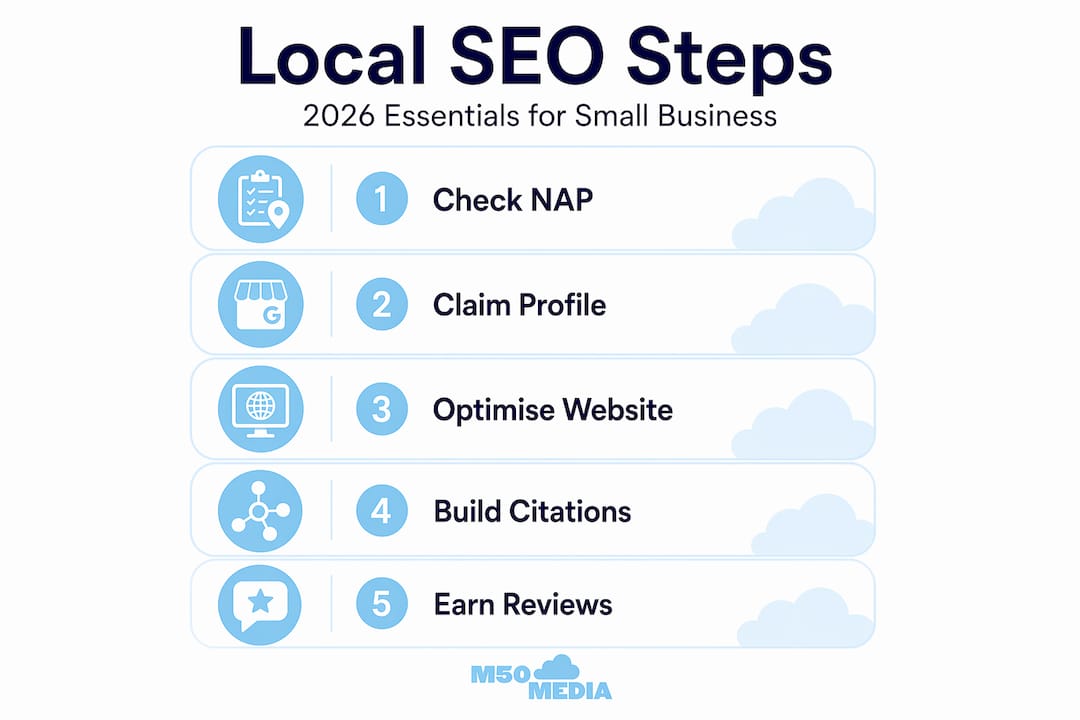
You’ve got a great business, a solid product, and a location people would genuinely love. But when someone nearby Googles “best [your service] near me,” you’re nowhere to be found. Frustrating, right? That’s where local SEO step by step work comes in. This guide walks you through every stage of improving your local search visibility, from the basics of getting your Google Business Profile in order, to building citations, optimising your website, and earning the kind of reviews that make Google (and customers) trust you. No fluff, no mystery. Just practical steps you can actually do.
Table of Contents
Key takeaways
Point | Details |
GBP is your top priority | Your Google Business Profile controls map pack visibility and must be fully completed and regularly updated. |
NAP consistency builds trust | Your business name, address, and phone number must match exactly across every listing online. |
Local citations need auditing | Focus on high-quality directories and audit them every quarter to catch and fix any discrepancies. |
Location pages drive relevance | Dedicated service and location pages with unique content signal geographic relevance to Google. |
Reviews and content compound | Steady review acquisition and locally focused content create long-term ranking gains over time. |
Local SEO step by step: the foundations first
Before you start tweaking anything, you need a solid base. Think of it like building a house. You wouldn’t put up the walls before pouring the foundation (well, you could, but it’s not recommended 😄).
The single most critical foundation concept is NAP consistency. NAP stands for Name, Address, and Phone number, and it needs to be identical across platforms. Not close. Not “basically the same.” Exactly the same. Even something like “Ltd” versus “Limited” can dilute your trust signals with Google.
Here are the foundational tools and resources you’ll want handy before getting started:
Tool or resource | What it does |
Google Business Profile | Manages your map listing, knowledge panel, and local visibility |
Google Search Console | Tracks how your site appears in search results |
Google PageSpeed Insights | Identifies speed and usability issues on your website |
BrightLocal or Whitespark | Audits and manages your local citations |
Semrush or Ubersuggest | Helps with local keyword research |
Once you’ve got your tools lined up, make sure your website is passing the basics. Mobile-friendly and HTTPS sites are non-negotiable because Google indexes the mobile version of your site first. A slow, unsecured website is like showing up to a job interview in sweatpants. Technically present, but not making a great impression.
Your local keyword research doesn’t need to be complicated at this stage. Think about how your customers describe what you do, add a city or neighbourhood, and you’ve got a starting point. “Plumber in Mississauga” or “wedding photographer Ottawa” are the kinds of phrases you’re aiming to rank for.
Pro Tip: Before claiming any new listings, Google your business name to see what already exists out there. Duplicate or inconsistent listings are the number one silent killer of local SEO performance.
Optimising your Google Business Profile
Your Google Business Profile (GBP) is, without question, the most important local SEO asset you have. It controls your map pack placement, your knowledge panel, and even how you show up in voice search. Leaving it incomplete is like owning a storefront but keeping the lights off.
Here’s how to optimise it properly, step by step:
Claim and verify your listing through Google Business Profile if you haven’t already. Verification usually takes a few days via postcard or phone.
Complete every single field: business name, primary and secondary categories, description, phone number, website, and hours of operation. Leave nothing blank.
Write a description that includes your primary local keywords naturally. Mention your city, your services, and what makes you stand out. Keep it under 750 characters.
Add photos regularly. Adding 2 to 3 new photos per month consistently outperforms static profiles in local rankings. Think of it as showing Google you’re alive and active.
Use Google Posts weekly. These are short updates, offers, or events that appear directly on your profile. They signal activity and give customers something to engage with.
Populate the Q&A section proactively. Add common questions yourself and answer them. This saves customers time and gives Google more indexable content.
Respond to every review. Yes, every one. We’ll cover this more in a later section, but your response rate is visible to the public and matters to your ranking.
Set a recurring weekly reminder to check your GBP. Consistent weekly activity like verifying your hours, responding to new reviews, and posting updates compounds into serious ranking gains over time. It’s the tortoise-and-hare situation, and you want to be the tortoise. 🐢
Pro Tip: Use the “Services” and “Products” sections in GBP to add detailed listings. Many business owners skip these, which is essentially leaving ranking real estate on the table.

Building local citations the right way
A local citation is any mention of your business name, address, and phone number on another website. Think directories like Yelp, Bing Places, Apple Maps, and industry-specific platforms. Quality citations on high-authority directories contribute significantly to your local prominence and trust, but a mountain of low-quality, inaccurate listings will do more harm than good.
Here’s how to build and manage citations effectively:
Audit your existing citations first. Use a tool like BrightLocal or Whitespark to see everywhere your business is currently listed. Look for inconsistencies in your NAP and duplicate listings.
Fix any discrepancies you find before building new ones. An inconsistent listing is like a rumour that spreads. The more it circulates, the harder it is to correct.
Prioritise the top-tier directories: Google Business Profile, Bing Places, Apple Maps, Yelp, Facebook, and the Better Business Bureau. Get these right before anything else.
Add industry-specific directories relevant to your field. A restaurant should be on Zomato and OpenTable. A contractor should be on HomeStars. A lawyer should be on Justia.
Look for local directories specific to your city or region. Many Canadian cities have business directories run by the local Chamber of Commerce or regional media outlets. These carry great local authority.
Build citations steadily rather than all at once. A sudden spike of new listings can look unnatural. Think of it as making new friends slowly and meaningfully, not frantically handing out business cards at a speed networking event.
Do a citation audit every quarter. Set it in your calendar now. Local ranking signals include hundreds of factors, and citation accuracy is one of the most controllable ones. Don’t let it slip.
Optimising your website for local relevance
Your Google Business Profile gets the glory, but your website does the heavy lifting behind the scenes. Here’s what you need to have in order on the why investing in SEO front for local searches to pay off.
The biggest missed opportunity for most local businesses is the location page. If you serve multiple neighbourhoods, cities, or service areas, each one deserves its own dedicated page. Location pages with at least 50% unique content for each area perform significantly better than copy-pasted templates. Include local landmarks, specific services offered in that area, testimonials from local customers, and your embedded Google Map.
Here’s a quick website local SEO checklist to run through:
Title tags and meta descriptions include your city name and primary service.
Your NAP appears in the footer of every page and matches your GBP exactly.
You have a dedicated Contact page with your full address and an embedded Google Map.
Each location or service page has unique, substantive content (not just a city name swapped in).
Your site is HTTPS secured, mobile-responsive, and loads in under three seconds.
You’ve implemented LocalBusiness schema markup so Google can read your business details as structured data.
On the technical side, run your site through Google PageSpeed Insights to identify speed issues. A slow website is punished in local rankings, and your customers won’t wait around either. For schema, use Google’s Rich Results Test to confirm your markup is being read correctly.
Internal linking matters more than most people think. Link from your homepage to your location pages, and from blog posts to relevant service pages. It helps Google understand what your site is about and which pages should rank for which searches.
On-page element | Local SEO best practice |
Title tag | Include primary keyword plus city (e.g., “Plumber in Calgary”) |
Meta description | Mention service, location, and a call to action |
H1 heading | Match the page’s main local keyword naturally |
Body content | Include neighbourhood names, local landmarks, and local FAQs |
Schema markup | Use LocalBusiness type with full NAP details |
Reviews and local content that keep you ranking
You might think reviews are a “nice to have.” They are not. Review velocity and consistency matter more than a one-time flood of five-star ratings. Businesses that gain steady reviews over time outperform competitors who get 30 reviews in a week and then nothing for six months.
Here’s how to build a healthy review strategy:
Ask for reviews at the right moment. Right after a successful project, a happy customer visit, or a positive interaction is the sweet spot.
Make it easy. Send a direct Google review link via email or text. The fewer steps, the more reviews you’ll actually get.
Respond to every review, positive or negative. For negative reviews specifically, responding with a calm, localised reply actually enhances trust and adds indexable content to your profile.
Never buy reviews or incentivise them with discounts. Google’s spam filters are smarter than they look, and the penalty is severe.
On the content side, local FAQ pages and blog posts targeting community topics help you earn featured snippets and show up for voice search queries. Write a blog post about “the best time of year to service your HVAC in Edmonton” or “what to ask a family lawyer in Vancouver before signing anything.” That kind of content answers real questions and signals genuine local relevance.
Get involved in local events, partnerships, and community news. Sponsor a local team, partner with a neighbouring business, or write about a community initiative you support. This approach earns local backlinks naturally, which are one of the most powerful signals in local search.
Pro Tip: Create a simple spreadsheet to track your monthly review count across Google, Yelp, and Facebook. Watching that number grow is oddly satisfying, and it keeps you accountable.
My honest take on local SEO for small businesses
I’ve worked with a lot of small business owners who do the initial local SEO setup, feel good about it, and then… never touch it again. Six months later, they’re wondering why their rankings have stalled or dropped. Here’s the thing: local SEO is not a “set it and forget it” situation. It’s more like a garden. You plant it, you water it, and you show up consistently. Skip the watering for a few months and you’ll know about it.
In my experience, the businesses that win local search aren’t the ones who did the biggest one-time overhaul. They’re the ones who spend 30 minutes a week maintaining their GBP, responding to reviews, and posting updates. Small, consistent actions compound in ways that big sporadic efforts never do. I’ve seen a local business jump from page three to the top three map results simply by getting serious about weekly GBP activity and asking every satisfied customer for a review.
The other thing I’d push back on is the idea that local SEO is too technical for a small business owner to handle. Most of it isn’t. Yes, schema markup and site speed require a bit more effort. But claiming your GBP, building citations, and writing a solid location page? That’s absolutely within reach for anyone willing to follow a step by step local SEO approach.
The pitfall I see most often is ignoring NAP inconsistencies. People spend hours on blog posts and ignore the fact that their phone number is wrong on three major directories. Fix the boring stuff first. It pays off more than you’d expect.
— Karl
Ready to get expert help with your local SEO?
Local SEO has a lot of moving parts, and even with this guide, it can feel like a lot to manage solo (especially when you’re also, you know, running an actual business 😅).

That’s exactly why Karl at M50media offers personalised marketing coaching for small business owners who want to build real online visibility without the guesswork. Whether you need a full local SEO strategy or just someone to review what you’ve already built, the coaching is hands-on and built around your specific business. And if you’re not sure where to start, book a free marketing SOS call to talk through your biggest local SEO challenges with Karl directly. No sales pitch, just honest advice.
FAQ
What is the most important step in local SEO?
Claiming and fully optimising your Google Business Profile is the single most impactful step. Completed profiles with updated categories, photos, and regular posts perform significantly better in local search rankings.
How long does local SEO take to show results?
Most local businesses start seeing noticeable improvements within three to six months of consistent effort. Results compound over time, so the earlier you start, the better.
What is NAP consistency and why does it matter?
NAP stands for Name, Address, and Phone number. Even minor differences across listings, like “Street” versus “St.,” can dilute your trust signals and hurt your local rankings.
Do I need a website to do local SEO?
A website significantly strengthens your local SEO, but you can still rank in the map pack with a well-optimised Google Business Profile alone. That said, dedicated location pages on a website provide a major ranking advantage.
How often should I update my Google Business Profile?
Weekly updates are ideal. Check for new reviews, post an update, verify your hours are correct, and add a new photo if you have one. Consistent small efforts compound into significant ranking gains over months.
Recommended
Comments