What is growth hacking: a small business guide

TL;DR:
Growth hacking is a disciplined, fast-paced approach to business growth that emphasizes rapid experimentation and data-driven decisions. It integrates marketing, product development, and analytics to optimize each stage of the customer journey, using frameworks like AARRR to identify and fix leaks. Small businesses can leverage these principles by focusing on one high-impact growth lever, testing continuously, and scaling successful experiments to build sustainable momentum.
You have probably heard “growth hacking” tossed around at every marketing meetup, LinkedIn post, and podcast since roughly 2010, right up there with “synergy” and “disruption” on the buzzword bingo card. But what is growth hacking, really? It is not just running a couple of A/B tests and calling it a day. It is a specific, disciplined approach to growing your business fast, without burning your whole budget on one massive campaign. And for small business owners trying to compete in a crowded digital world, understanding it properly could genuinely change the game.
Table of Contents
The growth hacking process: hypothesis, testing, and scaling
Classic growth hacking examples and lessons for small businesses
Practical steps to apply growth hacking in your small business
Why growth hacking is the future of small business marketing
Grow your business faster with expert coaching and digital strategies
What growth hacking really means and why it matters
The term was coined in 2010 by entrepreneur Sean Ellis, who needed a word for something traditional marketers were not doing: obsessing over growth metrics above everything else. Not brand aesthetics. Not broad awareness campaigns. Just: what moves the number?
Rapid experimentation across marketing and product development replaces big-budget, long-running campaigns with leaner, faster tests. You form an idea, run a quick experiment, check the data, and either scale it or scrap it. That is the whole game.
Here is what makes growth hacking genuinely different from traditional marketing:
Traditional marketing often works in silos: brand team here, product team there, analytics team somewhere in the background eating their lunch.
Growth hacking blends marketing, product thinking, and data analysis into one continuous process.
It is not about gut feelings or “this looks nice.” Every decision is tested and measured.
It applies to every stage of the customer journey, not just getting people through the door.
Speed is the point. You run more experiments in a month than some businesses run in a year.
“Growth hacking is not a trick or a shortcut. It is a mindset that treats every assumption about your business as something worth testing.”
Keeping up with digital marketing trends matters here, too, because growth hacking techniques evolve alongside the tools and platforms available to you. The core philosophy stays the same. The tactics update constantly.
The growth hacking process: hypothesis, testing, and scaling
Alright, so you are on board with the concept. Now how does it actually work in practice? Think of it like cooking a new recipe, except instead of adding more salt and hoping for the best, you actually measure everything.

The growth hacking process runs on a cycle: hypothesise, test, measure, and repeat, scaling an idea only when the relevant metrics actually improve.
Here is how to run that cycle for your small business:
Map your customer journey. Where do people find you? Where do they drop off? Where do they convert? You need a clear picture before you start poking at things.
Pick one metric to improve. Not five. One. Maybe it is your email sign-up rate. Maybe it is cart abandonment. Choose the number that matters most right now.
Form a hypothesis. “If I change my call-to-action button from grey to orange, more people will click it.” Simple, testable, specific.
Run a small controlled experiment. A/B testing is your best friend here. Change one variable, keep everything else the same.
Measure the result honestly. Did the metric improve? Did it stay flat? Did it somehow get worse? (It happens. No judgement.)
Scale or scrap. If it worked, roll it out wider. If it did not, move on fast without any emotional attachment.
Pro Tip: Do not test too many things at once. If you change three elements of a landing page simultaneously and your conversions improve, you will have no idea what actually caused it. One change at a time keeps your data clean and your sanity intact.
The right marketing tools make this cycle much faster. Analytics platforms, email testing tools, and heatmap software all turn guesswork into evidence. Your digital marketing strategy should have room for this kind of continuous experimentation built right in.
Using the AARRR framework to spot growth opportunities
If the growth hacking process is the engine, the AARRR framework is the GPS. It helps you figure out exactly where in the customer journey you should be running experiments right now. (And yes, it is called the “Pirate Metrics” framework, because AARRR. Whoever named it deserves a round of applause.)
The AARRR framework breaks the entire customer lifecycle into five stages, helping you locate the biggest leaks and run targeted experiments to fix them.
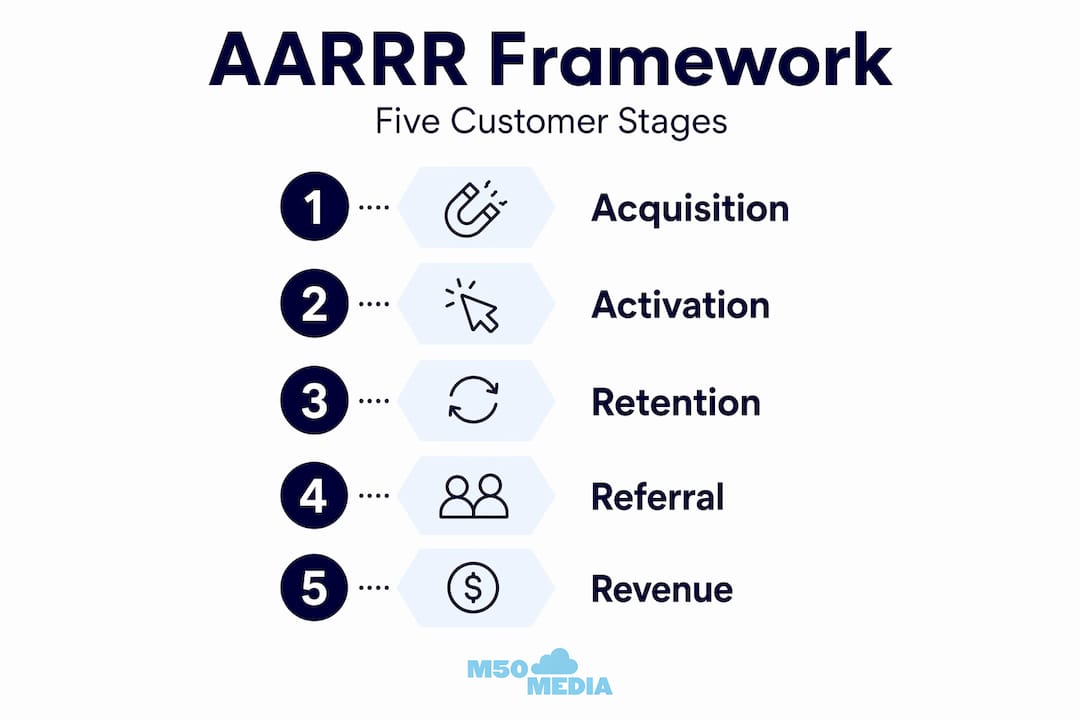
Here is what each stage looks like in practice:
Stage | What it measures | Example metric |
Acquisition | How people find you | Website traffic, ad click rate |
Activation | First “aha” moment | Sign-up completions, first purchase |
Retention | Do they come back? | Repeat visit rate, subscriber open rate |
Referral | Do they tell others? | Referral programme sign-ups, shares |
Revenue | Are they paying? | Average order value, conversion rate |
Most small businesses pour everything into Acquisition and ignore the rest, which is like filling a bucket that has holes in the bottom. You keep getting new people in and watching them quietly disappear.
Here is how to use it well:
Review your metrics for each stage every month.
Find the stage with the biggest drop-off. That is your priority.
Run your experiments there first before touching anything else.
Once you patch that leak, move to the next weakest stage.
Pro Tip: Retention is almost always more valuable than acquisition. Keeping an existing customer costs far less than winning a new one. If your retention numbers are shaky, fix those before you spend another dollar on ads.
Your digital marketing strategy should map to these five stages explicitly. And if you are just getting started with online marketing, understanding the advantages of online marketing can help you see where digital channels fit into each AARRR stage.
Classic growth hacking examples and lessons for small businesses
Nothing makes a concept click like a really good story. These examples are practically legendary in the growth hacking world, and the lessons translate beautifully to small business owners working with real budgets (meaning: not Silicon Valley money).
Here are some of the most instructive cases:
Dropbox: Dropbox’s referral loop grew its user base by 3,900% in 15 months. The mechanic was beautifully simple: refer a friend, both of you get extra free storage. They baked it directly into the onboarding flow so you could not miss it.
Airbnb: Their team wrote custom code to cross-post listings onto Craigslist, tapping into an existing audience of millions at essentially zero cost. Was it slightly cheeky? Sure. Was it growth hacking genius? Absolutely.
Hotmail: They added “P.S. I love you. Get your free email at Hotmail” to every outgoing email. Every single message became a free advertisement sent to someone who already trusted the sender.
Slack: They built a frictionless invite system so that getting your whole team on the platform was almost embarrassingly easy. Viral growth through sheer convenience.
Company | Growth lever used | Outcome |
Dropbox | Double-sided referral reward | 3,900% user growth in 15 months |
Airbnb | Platform piggybacking (Craigslist) | Massive early distribution at low cost |
Hotmail | Email signature viral loop | Millions of users in under a year |
Slack | Frictionless team invites | Fastest growing business app at the time |
What do all of these have in common? They each focused on one high-leverage growth driver and scaled it hard before trying anything else. They did not scatter energy across ten tactics simultaneously.
For your small business, that lesson is everything. Pick one growth lever, run it properly, and squeeze every bit of value from it before moving on. Need some creative social media ideas to use as your lever? Or maybe you need a full refresh of your marketing strategies to identify where the opportunity sits? Either way, start focused. You can also explore broader digital marketing tactics to pair with your growth experiments.
Practical steps to apply growth hacking in your small business
Enough inspiration. Let us get into actual action. Here is how you start doing this without a team of engineers or a venture capital cheque.
Map your customer journey end to end. Write out every touchpoint from first awareness to repeat purchase. Be honest about where it gets fuzzy or where you are guessing.
Identify your one priority metric. Based on your AARRR review, pick the single metric that, if improved, would have the biggest effect on your growth right now.
Generate experiment ideas. Brainstorm five to ten low-cost things you could change or test to move that metric. The wilder the better at the brainstorm stage.
Run your first experiment. Keep it small. A different headline. A new call to action. A follow-up email sequence. Measure carefully with A/B testing to separate real results from random noise.
Review and decide quickly. Give the experiment enough time to collect meaningful data, then make a clear call: scale it or move on.
Document everything. What you tested, what happened, what you learned. This builds an institutional knowledge base that makes future experiments faster and smarter.
Pro Tip: Set a “kill threshold” before you start each experiment. Decide in advance how long you will run it and what result would prompt you to end it early. This removes emotion from the equation and keeps your testing cycle moving.
The right marketing tools make documenting and analysing experiments far easier. And if you want a structured foundation to build your experiments on, a solid digital marketing plan is worth its weight in gold.
Why growth hacking is the future of small business marketing
Here is an opinion you might not hear often: most small businesses are not failing because they lack creativity or budget. They are failing because they are running their marketing like it is 2005, with a big annual plan, a static website, and the vague hope that word-of-mouth will carry them through.
Growth hacking is not a fad. It is the natural evolution of what marketing should have always been: measurable, iterative, and honest about what is actually working.
Scalable strategies discovered quickly through rapid experimentation build a repeatable momentum system that compounds over time. Each experiment teaches you something. Each win stacks on the last one.
The other thing most people miss? Growth hacking is not just for startups. Yes, it was born in the startup world because startups had no choice but to be scrappy. But its principles apply to any business that wants to grow smarter, not just louder.
Small businesses actually have an advantage here. You can make a decision and run a test this afternoon. A large corporation has to run that idea through three committees and a legal review first. Your agility is your superpower. Use it.
The businesses that win over the next decade will not necessarily be the ones with the biggest budgets. They will be the ones who test the most, learn the fastest, and adapt without hesitation. Growth hacking, done well, is the system that makes that possible. Pair it with a strong focus on audience growth strategies and you have a genuinely compounding engine for your business.
Grow your business faster with expert coaching and digital strategies
Reading about growth hacking and actually implementing it are two very different experiences. (A bit like reading about swimming versus jumping in the pool. One is drier.)
If you are ready to go beyond theory and start running real experiments on your actual business, M50 Media’s business coaching is designed exactly for that. Karl works with small business owners to apply growth strategies in a personalised, hands-on way that fits your specific market, goals, and resources. Not generic advice. Real tactics for your real situation. And if something feels urgent right now, book a free marketing SOS call to get fast, focused input on your biggest growth challenge. For ongoing strategic support as your market evolves, digital coaching services keep you sharp, accountable, and moving forward.
Frequently asked questions
What is the main difference between growth hacking and traditional marketing?
Growth hacking differs from traditional marketing by focusing on fast, measurable experimentation across the entire customer journey rather than relying on long brand awareness campaigns with slow feedback loops.
Which metrics are most important in growth hacking?
The most important metrics align with the AARRR stages, and compass metrics like conversion rates, activation milestones, and retention curves give you the clearest signal of where growth is happening and where it is stalling.
Can small businesses without big budgets succeed with growth hacking?
Absolutely. Growth hacking emerged in resource-light startups as a way to grow without big spend, which makes it a natural fit for small businesses that need results without blowing the budget on untested campaigns.
How often should small businesses run growth hacking experiments?
The goal is continuous testing: run rapid, repeatable experiments consistently, measure results, and iterate quickly so you are always learning and improving at least one growth stage at any given time.
What is an example of a growth hacking tactic that small businesses can use?
A referral reward programme is one of the most accessible tactics available. Following Dropbox’s lead, rewarding both referrer and recipient with something valuable creates a self-sustaining loop that brings in new customers through the trust of existing ones.
Recommended
Comments