What is market segmentation: a small business guide

TL;DR:
Market segmentation involves dividing potential customers into meaningful groups based on shared traits to improve targeted marketing efforts. It enhances sales by allowing businesses to craft personalized messages for specific audiences, especially benefiting small enterprises with limited resources. Utilizing demographic, geographic, psychographic, and behavioural data, segmentation informs targeting and positioning strategies within the STP framework for more effective marketing.
If you’ve ever blasted the same email to your entire list and wondered why most people ignored it, you already know the problem that market segmentation solves. What is market segmentation, exactly? Simply put, it’s splitting your broader market into smaller groups that share meaningful traits, so your marketing actually speaks to people instead of shouting into the void. Think of it like the difference between a megaphone at a crowded mall and a well-timed text to your best friend. One gets ignored. The other gets a response. This guide covers the types, benefits, and practical steps to make segmentation work for your business. 🎯
Table of Contents
Key Takeaways
Point | Details |
Market segmentation defined | It splits potential customers into groups with shared traits for better marketing focus. |
Major segmentation types | Demographic, geographic, psychographic, and behavioural bases reveal customer differences. |
Behavioural segmentation power | Focusing on customer actions yields practical, measurable marketing advantages. |
STP framework role | Segmentation guides targeting and positioning to sharpen marketing strategies. |
Practical segmentation tips | Start with observable data, enrich with demographics, and test for effectiveness. |
What is market segmentation and why does it matter
Let’s get the market segmentation definition out of the way first, nice and clean. Market segmentation is the practice of dividing a large, mixed group of potential customers into smaller subgroups based on things they have in common. Those things could be age, location, income, lifestyle, buying habits, or even their favourite type of true crime podcast (no judgement).
The goal is simple. Segmentation improves sales and profits by letting businesses market to the right people in the right way. Instead of one generic message that sort of resonates with everyone and truly connects with no one, you send targeted messages that feel almost unnervingly personal. In a good way.
Why does this matter so much for small businesses specifically? Because you don’t have unlimited budget or time. You can’t afford to waste either on audiences who will never buy from you. Segmentation helps you focus your energy where it actually counts.
Here’s what you can segment your market by:
Age, gender, income, and occupation (demographic)
City, region, climate, or country (geographic)
Values, interests, personality, and lifestyle (psychographic)
Purchase history, brand loyalty, and browsing behaviour (behavioural)
“Knowing your customer isn’t a nice-to-have. It’s the entire foundation of a marketing strategy that doesn’t feel like throwing spaghetti at the wall.”
Understanding the role of marketing strategy in your business becomes a lot clearer once you see how segmentation feeds directly into it. It’s not a separate exercise. It’s the starting line. And if you’re just getting into the habit of thinking strategically, developing a marketing strategy for growth is a great next read.
The main types of market segmentation explained
Alright, so you’re sold on the idea. Now let’s talk about the types of market segmentation, because this is where things get genuinely useful. There are four main types, and each one answers a different question about your customers.
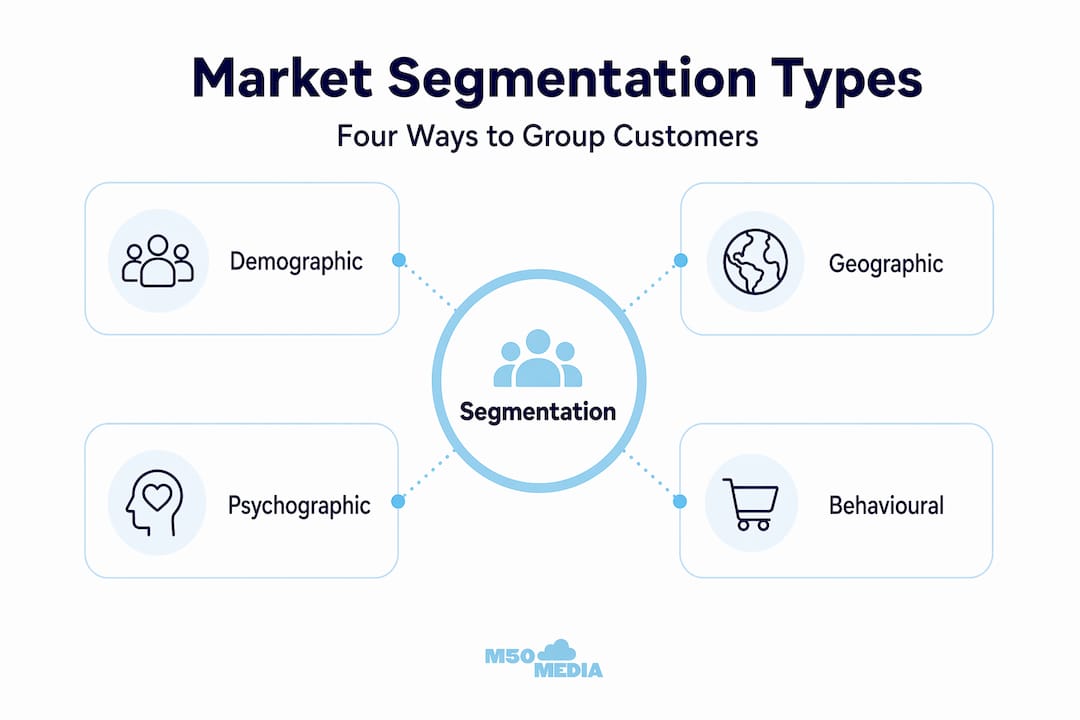
Here’s a quick comparison to make sense of them all at a glance:
Type | What it focuses on | Example question it answers |
Demographic | Age, income, gender, education | Who is buying from me? |
Geographic | Location, region, climate | Where are my customers? |
Psychographic | Values, lifestyle, personality | Why do they care about this? |
Behavioural | Actions, purchase patterns, loyalty | What are they actually doing? |
What is demographic segmentation in plain terms? It’s sorting customers by observable characteristics like age or income. A children’s clothing brand targeting parents aged 25 to 40 with a household income over $70,000? That’s demographic segmentation in action.

Geographic segmentation is exactly what it sounds like. A snow removal service in Winnipeg is not going to spend a cent marketing to someone in Phoenix, Arizona. Location shapes needs more than most businesses realise.
Psychographic segmentation goes deeper. It asks about motivations, values, and lifestyle. Two people can have the same age and income but wildly different reasons for buying the same product. A yoga studio might market to one customer around stress relief and another around community. Same studio, same classes, totally different messaging.
Behavioural segmentation tracks what customers actually do: how often they buy, which channels they respond to, whether they’re loyal or always hunting for a deal. More on this one in the next section because it deserves its own spotlight.
Pro Tip: Don’t try to use all four types at once when you’re starting out. Pick one or two that you have real data for, and build from there. Understanding audience segmentation concepts more deeply will help you figure out which dimension fits your business best.
Want to know how well your segmentation is actually paying off? Tie it directly to your digital marketing ROI to see what’s working and what’s just looking pretty in a spreadsheet.
How behavioural segmentation boosts digital marketing success
Here’s the thing about behavioural segmentation: it’s the most actionable type for digital marketing because it’s built on what people actually do, not just who they are on paper.
Demographics tell you someone is a 35-year-old woman in Toronto. Behavioural data tells you she visits your website three times a week, abandons her cart on Thursdays, and opens every email you send about your clearance sales. That second profile? Way more useful for crafting a campaign that converts.
“Behaviour is the truth. Everything else is a guess.”
Here’s how to put behavioural segmentation to work in your digital marketing:
Start with your own data. Look at your email open rates, website traffic, purchase history, and social media engagement. You probably have more behavioural data than you realise.
Group customers by action. Frequent buyers in one segment. One-time purchasers in another. Cart abandoners get their own group (and a gentle nudge email, obviously).
Match the message to the behaviour. Your loyal customers want to feel appreciated. Your lapsed customers need a reason to come back. Your new visitors need to understand why you’re worth their time.
Choose the right channel for each segment. Some customers only engage via Instagram. Others are strictly email people. Behavioural data tells you where to show up.
Measure everything. Behavioural segmentation makes it much easier to track results because you’re comparing like-for-like groups, which means your ROI reporting gets a whole lot cleaner.
Pro Tip: Use a simple email marketing tool to tag subscribers by their actions (clicked a link, made a purchase, went quiet for 90 days). Those tags are the beginning of a real behavioural segmentation system, and they cost you nothing extra to set up.
If you want to go further with this in your digital advertising, the digital advertising guide for small businesses breaks down exactly how to target segments with paid ads. And if you’re curious about how ads tie into broader growth, the piece on the role of digital ads in growing a small business is worth a look.
Using the STP framework to sharpen your marketing focus
Segmentation doesn’t exist in a vacuum. It works best when it’s part of a bigger plan, and that’s where the STP framework comes in. STP stands for Segmentation, Targeting, and Positioning. It’s a classic marketing model that basically tells you: divide your market, pick who you’re talking to, and then figure out how to stand out for them specifically.
Segmentation is always the first stage. You can’t target anyone until you know who the groups are. And you can’t position your brand meaningfully until you know who you’re positioning it for.
Here’s how each stage works:
Segmentation: Split your market into distinct groups based on shared characteristics (you’ve got this one now).
Targeting: Decide which segment or segments are worth pursuing based on size, accessibility, and fit with your business.
Positioning: Craft a clear message about why your product or service is the right choice for that specific segment.
A simple table makes this easier to use in practice:
STP stage | Key question to ask | Example |
Segmentation | Who are the distinct groups in my market? | Budget shoppers vs. premium buyers |
Targeting | Which group is the best fit for my business? | Premium buyers with disposable income |
Positioning | Why should they choose me over anyone else? | “We save you time, not just money” |
The STP framework keeps your digital marketing strategy from becoming a scattered mess of random tactics. When segmentation feeds targeting and targeting feeds positioning, every decision you make has a clear reason behind it.
Practical tips to create and use market segments effectively
Knowing how to segment a market in theory is one thing. Actually doing it for your own small business is another. Here’s how to make it real without overcomplicating it.
Start with behaviour-based segments from data you already have, then layer in demographics and psychographics to sharpen your messaging. That order matters. Behaviour grounds you in reality. Everything else adds colour.
Here’s a practical checklist to get you moving:
Pull your last three months of sales or website data and look for obvious patterns.
Identify your top 20% of customers and describe what they have in common.
Look for customers who buy once and disappear. That’s a segment worth targeting with a specific re-engagement message.
Survey a handful of your best customers. Ask them why they chose you. Their words become your psychographic insight.
Test a campaign to one segment at a time. One audience, one message, one clear goal.
Review results every 60 to 90 days and adjust your segments as you learn more.
Pro Tip: Don’t let perfect be the enemy of useful. Your first segments won’t be flawless, and that’s completely fine. Marketing that’s based on imperfect segments still outperforms marketing aimed at nobody in particular.
One common mistake is building segments that are too broad to act on. “Women aged 18 to 65 who like fitness” is not a segment. That’s just… most of your neighbourhood. Narrow it down until the message writes itself.
Keep an eye on digital marketing trends to stay ahead of what your segments actually care about as their habits evolve. And if you feel stuck figuring out where to start, a marketing SOS call can help you cut through the confusion fast.
Why many entrepreneurs misunderstand market segmentation and miss its true value
Here’s an opinion shaped by watching a lot of small businesses do this wrong: most entrepreneurs treat segmentation like a demographic filing exercise, and that’s exactly why it doesn’t work for them.
They slice their audience into “women aged 25 to 45” and “men aged 30 to 50” and call it a day. Then they wonder why their tailored campaigns still feel generic. The problem isn’t the effort. It’s the assumption that demographics explain motivation. They don’t.
Meaningful segmentation is about differences that actually change how someone decides to buy, not just labels that describe who they are on a census form. Two customers can look identical on paper but be driven by completely different things. One buys your service to save time. The other buys it to feel accomplished. Same product, completely different value proposition needed.
The second big mistake? Creating segments that never get used. Segmentation only creates value when it leads to a targeting decision and a positioning choice. If you build five beautiful customer personas and then send everyone the same newsletter anyway, you haven’t actually segmented anything. You’ve just done more work for the same bad result.
The fix is to start small and stay observable. Pick one behaviour you can actually see in your data. Build one segment around it. Create one campaign specifically for that group. Measure what happens. Then iterate. Segmentation is not a one-time project. It’s an ongoing conversation with your data, and the businesses that treat it that way are the ones that keep getting better results over time. 🚀
How Karl Lundgren and M50 Media can help you master market segmentation
Getting your head around market segmentation is one thing. Turning it into a marketing system that actually drives results for your business is another story entirely. That’s where having the right guide in your corner makes all the difference.

Karl Lundgren and the team at M50 Media work with small business owners and entrepreneurs to cut through the noise and build real, actionable marketing strategies grounded in solid segmentation thinking. Whether you need a quick gut-check or a full strategic overhaul, the free marketing SOS call is the fastest way to get clarity without commitment. From there, Karl’s coaching goes deeper, helping you map your segments, sharpen your positioning, and build campaigns that connect. If you want ongoing hands-on support, the digital coaching services at M50 Media are built exactly for businesses like yours.
Frequently asked questions
What is the difference between market segmentation and customer segmentation?
Market segmentation divides potential customers into groups, while customer segmentation organises your existing customer base. One is about finding new people to reach; the other is about understanding the people you already have.
Which type of market segmentation is most useful for digital marketing?
Behavioural segmentation is the most useful because it’s based on what people actually do, like purchase frequency and channel response, giving you a direct path to more targeted campaigns.
How do I start creating market segments for my small business?
Begin with your own behavioural data, then enrich with demographics and psychographics to build segments that are specific enough to market to clearly and confidently.
Why is it important to link segmentation with targeting and positioning?
Because segmentation without targeting leads nowhere. Your segments only create value when they inform who you’re talking to and how you’re positioning your offer for them.
Recommended
Comments