What is native advertising? A 2026 guide
- karl7209
- May 19
- 8 min read

TL;DR:
Native advertising seamlessly matches platform content to engage audiences more effectively than traditional ads. It is most impactful mid-funnel, emphasizing storytelling and transparency through clear disclosure labels. When strategically implemented, native ads build trust, enhance brand recall, and generate significantly higher engagement rates.
You scroll past a banner ad without blinking. You skip the pre-roll video before the five-second mark. Sound familiar? Most people do this on autopilot now, and advertisers know it. That’s exactly why native advertising has become one of the most talked-about strategies in digital marketing. But what is native advertising, really? It’s not just a sneaky ad wearing a disguise. It’s a format designed to match the look, feel, and tone of the content around it, so readers actually want to engage. Let’s break down how it works, why it matters, and how you can use it.
Table of Contents
Key takeaways
Point | Details |
Native ads blend in by design | They match the look and feel of the platform, making them far less intrusive than traditional display ads. |
Three core formats exist | Branded content, content recommendation widgets, and in-feed ads are the main types you’ll encounter. |
Disclosure is non-negotiable | Clear labels like “Sponsored” or “Ad” are required by 2026 FTC guidelines and actually build consumer trust. |
Mid-funnel is where they shine | Native ads are most effective at building brand consideration and trust, not just awareness or direct conversion. |
Storytelling drives performance | Authentic, real-world narratives outperform generic product-heavy content in native ad campaigns. |
What is native advertising, exactly?
Native advertising is paid content that matches the form and function of the media platform where it appears. Think of it like a chameleon at a dinner party. It shows up dressed exactly like everyone else, fits right into the conversation, and nobody feels ambushed.
Unlike a banner ad that screams “LOOK AT ME” from the sidebar, a native ad sits inside an article feed, a social media timeline, or a content recommendation widget. It looks and reads like the surrounding content. The key difference is that it’s paid for by a brand and labelled accordingly.
Here’s why that matters for your numbers. Native ads receive 53% more views than traditional display ads and generate up to 8.8 times more click-throughs. That’s not a rounding error. That’s a fundamentally different level of engagement.
The reason for this gap comes down to one thing: relevance. Consumers want control over when and where they engage with brands. Native ads respect that preference by showing up in context, not in the way.
Traditional banner ads and display ads interrupt. Native ads participate. That’s the core distinction, and it changes everything about how audiences respond.
Types of native advertising formats
Not all native ads look the same. The format you choose depends on your goals, your budget, and the platform you’re working with. The three primary native ad formats recognised by industry standards are branded/native content, content recommendation ads, and in-feed/in-content ads.
Here’s a quick comparison to help you choose:
Format | What it looks like | Best use case | Pros | Cons |
Branded/native content | Long-form article or video published on a media site | Brand storytelling, thought leadership | High engagement, deep brand narrative | Higher cost, more production effort |
Content recommendation ads | “You might also like” widgets at the bottom of articles | Driving traffic, retargeting | Scalable, low cost per click | Lower intent, can feel generic |
In-feed/in-content ads | Sponsored posts in social or news feeds | Awareness, consideration | Highly visible, non-intrusive | Requires strong creative to stand out |
Branded content is the most editorial in nature. You’ll see this when a brand partners with a publisher like The New York Times or The Globe and Mail to produce a full article or video that lives on that publication’s site. It’s clearly labelled as sponsored, but it reads like journalism.

Content recommendation ads are those little widgets you see at the bottom of articles. You know the ones: “Sponsored: 10 things you didn’t know about…” They appear as widgets with related articles or products, labelled as sponsored, and are designed to match the host site’s visual style.
In-feed ads are probably the format you interact with most. Every promoted post you see on LinkedIn, Instagram, or a news app is an in-feed native ad. Programmatically delivered native ads can be inserted directly into content streams, making them feel organic without being deceptive.
Pro Tip: When choosing a format, match the format to the funnel stage. Branded content builds trust at mid-funnel. Recommendation widgets drive traffic at the top. In-feed ads can work across all stages depending on your creative.
Benefits of native advertising (and the disclosure thing)
Let’s talk about why marketers love native ads, and why some people get squeamish about them.
The benefits are real and measurable:
Higher engagement rates compared to traditional display ads
Less ad fatigue because the format respects the user’s experience
Better brand recall because the content adds value rather than interrupting
Stronger purchase intent, especially when paired with quality storytelling
More flexibility in format, from short sponsored posts to full editorial features
Now, the disclosure conversation. There’s a myth floating around that native advertising “tricks” people. That’s not the goal, and frankly, it doesn’t even work that way. Transparent, explicit disclosure actually increases trust and engagement rather than reducing it. Consumers appreciate honesty.
Under 2026 FTC guidelines, all native ads must be clearly labelled as “Sponsored,” “Ad,” or “Promoted.” This isn’t a loophole situation. It’s a legal requirement and a smart brand move.
“The best native advertising doesn’t hide what it is. It earns attention by being genuinely useful or entertaining, and the sponsorship label doesn’t change that.” — Native Advertising Institute
The brands that try to blur the line between editorial and advertising end up damaging their credibility. The brands that lean into transparency and produce content worth reading? They win. Check out this guide on social media content regulation if you want a deeper look at how disclosure rules apply across platforms.
Pro Tip: Always place your disclosure label where it’s immediately visible, ideally at the top of the content, not buried at the bottom. Readers notice, and regulators definitely do.
Native advertising strategies that actually work
Knowing what native advertising is gets you halfway there. Knowing how to run a campaign that performs is the other half. Here’s how to approach it:
Match the editorial tone of the platform. If you’re placing branded content on a lifestyle publication, write like a lifestyle publication. Your brand voice matters, but it needs to adapt. Readers will disengage the moment your ad sounds like a press release.
Use data to target with precision. Native ads work best when the content is genuinely relevant to the reader. Use audience segmentation, behavioural data, and platform targeting tools to put the right content in front of the right people.
Think mid-funnel first. Native ads function best as a mid-funnel tactic to build trust and brand consideration rather than pushing for an immediate sale. Use them to warm up your audience before asking for a conversion.
Choose your placement sections wisely. Marketers should focus on brand suitability by choosing niche sections like cooking, games, or lifestyle that align with brand values and consumer habits. The New York Times has been doing exactly this to attract native advertisers who want engaged, habitual readers rather than news-fatigued ones.
Invest in the creative. Authentic, real-world storytelling outperforms generic feature-heavy content in an AI-saturated content world. Spotify’s experiential campaigns are a great example of native storytelling that makes you feel something before you realise it’s an ad.
Build in a collaboration process. Native ad campaigns require ongoing management to align editorial tone with brand goals across multiple stakeholders. Build a clear approval process between your brand team, the publisher, and any agency partners. Miscommunication here kills campaigns.
The power of storytelling in marketing is what separates native ads that get shared from ones that get ignored. Invest time in the narrative, not just the targeting.
Native ads vs traditional ads
So where does native advertising fit in your broader digital strategy? Let’s compare it directly to what you might already be running.
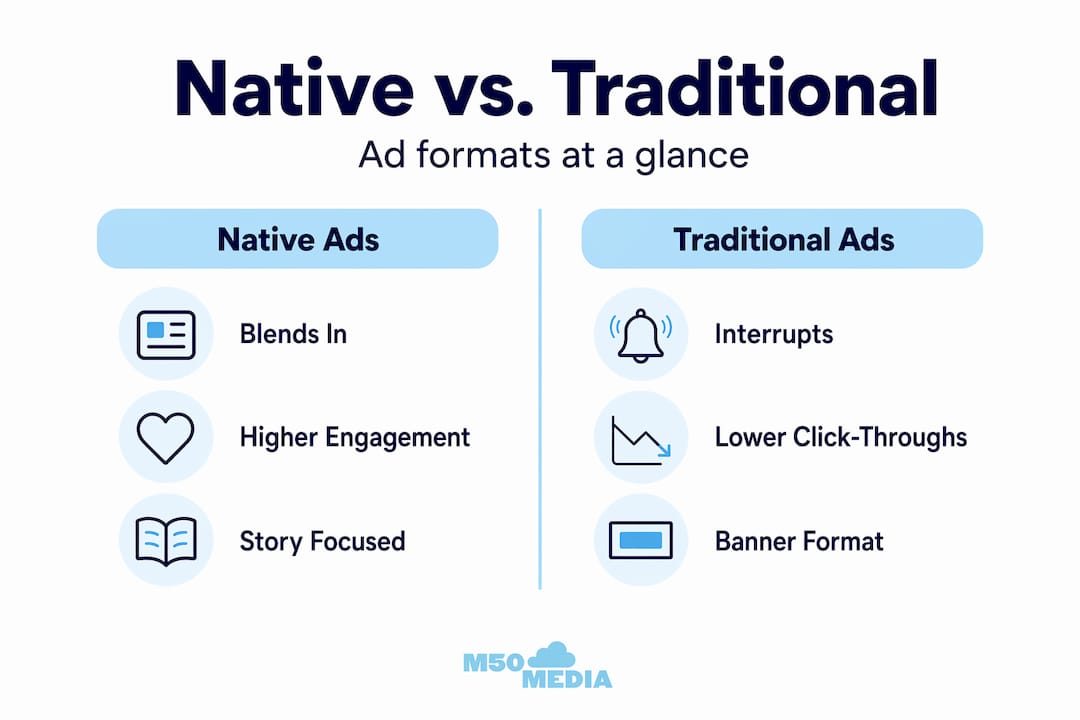
Metric | Native ads | Traditional display/banner ads |
Click-through rate | Up to 8.8x higher | Low, often below 0.1% |
User experience | Non-intrusive, contextual | Interruptive, often ignored |
Purchase intent lift | Significant | Minimal |
Brand recall | High | Low to moderate |
Cost | Higher production cost | Lower cost per impression |
Best use case | Mid-funnel trust building | Broad awareness at scale |
Traditional display ads still have a role. If you need to reach a massive audience at a low cost per impression, a banner campaign can do that. But if you want people to actually read, click, and remember your brand, native wins almost every time.
The key is knowing which tool fits which job. A digital advertising guide for small businesses can help you map out where native fits alongside your paid search, social, and display efforts. Paid search ads, for instance, are technically “native” in that they match the search results format, but they serve a very different role. They’re intent-based and lower-funnel. Native content advertising is about building a relationship before the purchase decision happens.
Don’t pit them against each other. Use them together.
My honest take on native advertising
I’ve worked with enough brands to say this clearly: native advertising is one of the most misunderstood tools in the digital marketing toolkit. Marketers either dismiss it as “fancy sponsored content” or treat it like a magic bullet. Neither is right.
What I’ve found actually works is treating native advertising like a conversation, not a commercial. When I’ve seen campaigns succeed, it’s almost always because the brand was willing to let the publisher’s editorial voice lead. The moment a brand insists on stuffing product features into every paragraph, the content dies. Readers can smell a sales pitch through three layers of editorial polish.
The disclosure piece is something I feel strongly about. I’ve seen brands resist clear labelling out of fear it will reduce engagement. The research says the opposite, and my experience backs that up. Transparency in disclosure actually increases engagement because it builds trust. Readers who know they’re reading sponsored content and choose to keep reading are your most valuable audience.
My take on native’s role in the funnel is this: stop trying to close sales with it. Use it to make people like you before they need you. That’s where the long-term ROI lives.
— Karl
Ready to put native advertising to work?
Native advertising can feel like a lot to figure out on your own, especially when you’re also running a business, managing a team, and trying to keep up with every platform update. (We see you. It’s a lot.)

At M50media, Karl works directly with small business owners and marketers to build digital strategies that actually fit their goals, budget, and audience. Whether you’re just starting to explore native ads or you’re ready to build a full campaign, a free Marketing SOS call is the fastest way to get clarity on where to start. No fluff, no generic advice. Just a real conversation about what will move the needle for your business. You can also explore digital coaching options if you want ongoing support as you build out your strategy.
FAQ
What is native advertising in simple terms?
Native advertising is paid content that matches the style and format of the platform it appears on. It’s labelled as sponsored but designed to feel like a natural part of the user’s content experience.
How does native advertising work?
Brands pay to place content, such as articles, videos, or social posts, within a publisher’s platform in a format that mirrors the surrounding editorial content. The ad is clearly labelled but integrates visually and contextually with the platform.
What are the main types of native ads?
The three primary formats are branded/native content, content recommendation ads (the “you might also like” widgets), and in-feed or in-content ads like sponsored social media posts.
Is native advertising effective?
Yes. Native ads generate up to 8.8 times more click-throughs than traditional banner ads and receive significantly more views, making them one of the higher-performing digital ad formats available.
Do native ads need to be labelled?
Absolutely. Under 2026 FTC guidelines, all native advertising must include a clear and conspicuous label such as “Sponsored,” “Ad,” or “Promoted.” Skipping this isn’t just a legal risk. It damages brand trust.
Recommended
Comments