The role of CRM in ecommerce growth (2026)

TL;DR:
CRM in ecommerce enhances personalization, automates workflows, and significantly boosts customer retention and revenue.
Effective integration and strategic use of CRM tools lead to faster sales cycles, higher customer lifetime value, and scalable growth.
If you think a CRM is just a glorified address book for storing customer emails, you’re leaving serious money on the table. The role of CRM in ecommerce is far bigger than most store owners realise, and the numbers back that up. We’re talking about a tool that can reshape how you sell, how you retain buyers, and how your whole team operates. This article breaks down exactly what customer relationship management in ecommerce looks like in 2026, why it matters more than ever, and how to make it actually work for your business.
Table of Contents
Key takeaways
Point | Details |
CRM boosts revenue significantly | Businesses using CRM report 29% higher sales revenue and better forecasting accuracy. |
Ecommerce CRM is not traditional CRM | Ecommerce-specific CRMs integrate natively with platforms like Shopify to track behaviour and automate workflows. |
Retention improves dramatically | Companies using ecommerce CRM see up to 47% better customer retention and satisfaction. |
AI makes CRM smarter | AI-powered features prioritise leads, automate follow-ups, and cut admin time from hours to minutes. |
Strategy beats software | The best CRM is the one your team actually uses consistently, not the flashiest one on the market. |
What the role of CRM in ecommerce actually means
Let’s clear something up right away. A CRM built for a B2B sales team selling enterprise software is not the same creature as one built for an online store. Many businesses fail when they try to jam a traditional B2B CRM into an ecommerce operation, because the needs are completely different.
Ecommerce is high volume, low touch. Hundreds or thousands of customers move through your store every week, browsing, abandoning carts, buying once, maybe buying again. You cannot manage that manually. You need a system designed for that reality.
So what does an ecommerce CRM actually do?
Builds unified customer profiles that pull in purchase history, browsing behaviour, and support interactions in one place
Tracks browsing behaviour and purchase patterns in real time by connecting directly to your store
Automates marketing workflows like abandoned cart emails, post-purchase follow-ups, and re-engagement campaigns
Segments your audience based on spending habits, location, product preferences, and lifecycle stage
Logs every customer interaction across email, chat, and support tickets so nothing falls through the cracks
The importance of CRM in online retail comes down to one thing: you cannot personalise at scale without it. And personalisation is no longer a nice-to-have. It’s what separates stores that grow from ones that plateau.
Pro Tip: When evaluating any CRM for your ecommerce store, the first question to ask is whether it has a native integration with your store platform. If the answer is “you’ll need a third-party connector,” keep shopping.
The data behind CRM benefits for ecommerce
Okay, let’s talk numbers. Because sometimes you need cold, hard proof before committing to a new tool (fair enough).
CRM delivers $8.71 ROI for every dollar spent, with returns typically landing within 12 months. That’s not a rumour. That’s the kind of return that makes a CFO sit up straight.
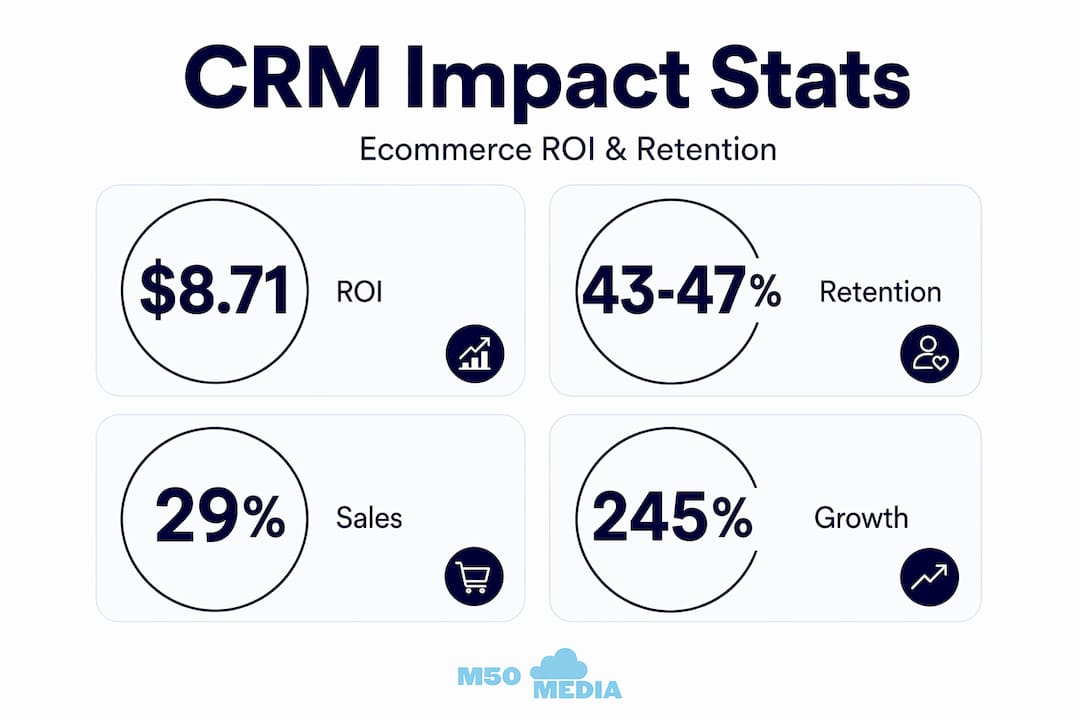
Here’s a quick look at what the research says about CRM performance gains:
Metric | Improvement with CRM |
Sales revenue increase | Up to 29% |
Sales productivity gain | Up to 34% |
Forecast accuracy improvement | Up to 42% |
Customer retention uplift | 43% to 47% |
Revenue potential increase | Up to 245% |
And it gets better. CRM automation shortens sales cycles by 8 to 14 percent, which means fewer dropped leads and faster conversions. For ecommerce businesses running paid ads or email campaigns, that directly impacts your cost per acquisition.
“The real power of CRM in ecommerce is not just knowing your customers. It’s acting on that knowledge automatically, at exactly the right moment.”
Companies using ecommerce CRM report 43 to 47 percent better customer retention and satisfaction, and up to 245 percent higher revenue. Those are not incremental gains. That is a different business entirely.
The crm benefits for ecommerce really crystallise when you look at retention. Acquiring a new customer costs five times more than keeping an existing one. So when your CRM sends a perfectly timed “we miss you” email with a personalised offer, that’s not just cute marketing. That’s a genuine cost-saving move.

CRM integration and automation in action
Here’s where things get genuinely exciting. (Yes, we’re excited about software. We contain multitudes.)
Modern ecommerce CRMs do not just sit there holding data. They connect with your entire operation and start doing things on your behalf. Here’s how that plays out in a real store workflow:
A customer visits your Shopify store, browses winter jackets, and leaves without buying. Your CRM logs the browsing session and triggers an automated email 30 minutes later with the specific products they viewed.
That customer clicks through and buys. The CRM updates their profile, removes them from the abandoned cart sequence, and kicks off a post-purchase onboarding flow.
Three weeks later, the customer opens a support ticket about sizing. Your support rep pulls up the CRM profile and sees the full purchase and browsing history in seconds, delivering a response that actually feels human.
The CRM identifies the customer as a high-value segment based on purchase frequency and automatically enrols them in a loyalty rewards campaign.
That’s multi-channel customer engagement working the way it’s supposed to. Email, SMS, support, and marketing all talking to each other through one shared system.
AI-powered CRM features classify customer queries in real time, enabling faster resolution and lower support costs. And beyond support, AI in premium CRM platforms handles lead prioritisation, automated data capture, and optimised follow-up timing. It shifts the whole system from reactive to proactive.
Pro Tip: Set up your CRM’s abandoned cart automation before anything else. It’s one of the highest-ROI automations in ecommerce and typically takes under an hour to configure if your CRM integrates natively with your store platform.
Choosing the right CRM for your store
Not all CRMs are created equal, and the right choice depends heavily on your store’s size, complexity, and tech stack. Here’s a quick comparison of the major players:
CRM platform | Best for | Standout feature |
HubSpot | Small to mid-size stores | Free tier, strong email automation |
Salesforce Commerce Cloud | Enterprise ecommerce | Deep AI and analytics capabilities |
Zoho CRM | Budget-conscious businesses | Affordable, broad feature set |
Microsoft Dynamics 365 | Larger organisations | Tight integration with Microsoft tools |
Odoo | Businesses wanting an all-in-one system | CRM plus ERP in a single platform |
The crm strategies for ecommerce that actually work always start with the right tool fit. A solo operator running a Shopify store does not need Salesforce Commerce Cloud. That’s like buying a semi-truck to commute to the office. HubSpot or Zoho will do the job beautifully, at a fraction of the cost and complexity.
Scalability matters too. You want a CRM that grows with you without forcing a painful migration three years down the road. Check whether the platform supports increasing contact volumes, additional team members, and expanded automation rules as your business evolves.
Ease of use is genuinely underrated as a selection criterion. The best CRM is the one your team actually logs into every day. A feature-rich platform that nobody uses is just an expensive subscription.
CRM strategies that actually move the needle
Alright, you’ve got the tool. Now what? Here are the CRM strategies for ecommerce businesses that go beyond basic setup and start generating real results.
Segment relentlessly. Do not blast your entire list with the same email. Use your CRM data to create segments based on purchase frequency, average order value, and product category. A first-time buyer needs a very different message than someone on their tenth purchase.
Automate the repetitive stuff first. Abandoned cart recovery, welcome sequences, and post-purchase reviews are your highest-ROI automations. Get those running before building anything fancy.
Use real-time analytics to guide decisions. Your CRM dashboard should tell you which campaigns are converting, which customer segments are churning, and where your sales funnel leaks. Check it weekly, not just quarterly.
Give every team shared visibility. Integrating marketing, sales, and support on one CRM eliminates the communication blind spots that kill customer experience. When your support rep can see the last three marketing emails a customer received, every interaction gets smarter.
Track the metrics that matter. Customer lifetime value, repeat purchase rate, and churn rate are your north stars. Set benchmarks before you launch any CRM campaign, so you can actually measure what improved.
Knowing how crm improves sales is one thing. Applying it consistently is where most businesses either win or quietly give up. The ones who win treat CRM as a living system, not a one-time setup project.
My honest take on CRM and ecommerce
I’ve worked with a lot of ecommerce businesses over the years, and the pattern is almost always the same. They come in thinking CRM is optional, something to worry about once the store “gets bigger.” Then they see their retention numbers and realise they’ve been haemorrhaging repeat customers for months without even knowing it.
Here’s what I’ve learned: the businesses that get the most out of CRM are not the ones with the most sophisticated tools. They’re the ones with the clearest picture of what they want to achieve before they sign up for anything.
I’ve seen stores triple their email revenue simply by setting up basic lifecycle segments in a tool they already had. No new software. No big budget. Just actually using what was there.
My take on AI-enhanced CRM is that it’s not hype anymore. The shift from reporting to proactive decision-making is real, and it’s happening fast. But here’s the thing: AI does not fix a messy customer database. Clean data first, fancy features second.
The number one mistake I see? Buying a CRM based on a demo and then never training the team properly. Software is not strategy. Your CRM is only as good as the process behind it, and the people willing to use it every day.
— Karl
Ready to make your CRM work harder?
Choosing a CRM is just the beginning. Knowing how to configure it for your specific store, integrate it with your marketing, and turn data into actual revenue? That’s where most ecommerce businesses get stuck. And that’s exactly what we help with at M50media.
Whether you need help picking the right platform, building out your automation sequences, or figuring out why your email campaigns aren’t converting, a free Marketing SOS call with Karl is a great place to start. No pressure, no pitch. Just real answers for your real situation. And if you’re ready for a deeper commitment to growth, check out digital coaching built specifically for business owners who want to move fast and smart.
FAQ
What is the role of CRM in ecommerce?
CRM in ecommerce manages customer data, automates marketing workflows, and personalises the shopping experience at scale. It connects your store, marketing tools, and support systems so every customer interaction is informed by real data.
How does CRM improve sales for online stores?
CRM improves sales by shortening the sales cycle, automating follow-ups, and identifying high-value customers for targeted campaigns. Businesses report up to 29% higher sales revenue after implementing CRM systems.
What is the difference between a traditional CRM and an ecommerce CRM?
A traditional CRM is built for low-volume, high-touch B2B sales processes. An ecommerce CRM integrates directly with store platforms like Shopify to handle high-volume transactions, browse tracking, and automated multi-channel marketing.
How does CRM help with customer retention?
CRM tracks purchase behaviour and automatically triggers re-engagement campaigns, loyalty programmes, and personalised offers. Companies using ecommerce CRM report 43 to 47 percent better customer retention as a result.
How long does it take to see ROI from a CRM?
Premium CRMs with AI features typically deliver ROI within 3 to 6 months by automating data entry, improving productivity, and enabling smarter forecasting.
Recommended
Comments