What is organic reach and how to grow it in 2026

TL;DR:
Organic reach measures the number of unique people who see your unpaid social media content.
It plays a crucial role in building trust and community over time, complementing paid advertising efforts.
Organic reach is defined as the number of unique people who see your social media content without any paid promotion behind it. Think of it as your brand’s natural footprint on platforms like Facebook, Instagram, LinkedIn, and TikTok. It is the clearest signal of how well your content resonates on its own merits. If you are a digital marketer or business owner trying to build real, lasting visibility without burning through an ad budget, understanding organic reach is the place to start. Tools like Sprout Social and Zapier both track and analyse this metric as a core indicator of social media health.
What is organic reach vs. paid reach?
Organic reach and paid reach are not the same thing, and confusing them leads to bad budget decisions. Organic reach represents the true, unpaid audience size for your content. Paid reach, by contrast, is the number of people who see your content because you spent money to put it in front of them.
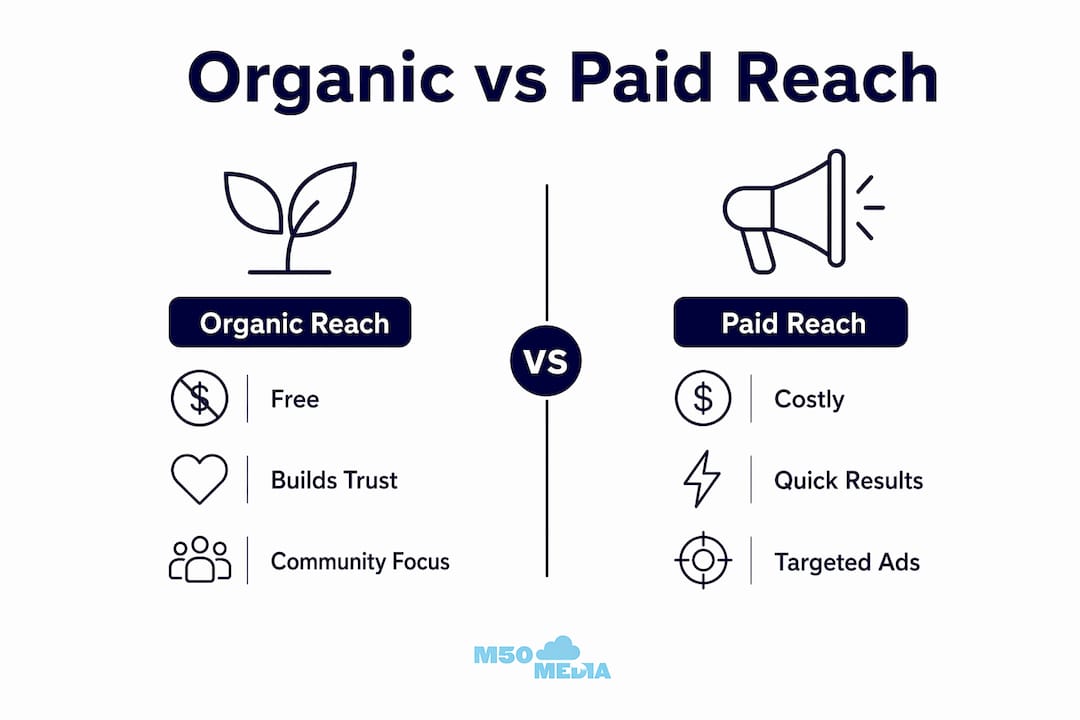
The goals of each are genuinely different. Organic reach builds trust, community, and brand credibility over time. Paid reach buys speed and targeting precision. Neither is better on its own. Effective marketing uses organic to test and build, then uses paid to amplify what already works.
Here is a quick comparison to make this concrete:
Feature | Organic reach | Paid reach |
Cost | Free | Requires ad spend |
Trust factor | High (feels authentic) | Lower (labelled as ad) |
Speed | Slow and compounding | Fast and immediate |
Targeting | Broad, algorithm-driven | Precise, audience-defined |
Best use | Building community and trust | Scaling proven content |
Pro Tip: Run your content organically for 48–72 hours before boosting it. Posts that earn strong organic engagement are far more cost-effective to promote with paid ads.
What affects organic reach on social media?
Algorithms on every major platform decide who sees your content. Understanding what they reward is half the battle.

Engagement is the biggest driver. Likes, comments, shares, and saves all tell the algorithm that your content is worth showing to more people. But not all engagement is equal. Comments and shares carry more weight than passive likes because they signal a deeper reaction.
Timing matters more than most people realise. Early engagement within 60 minutes after posting is weighted more heavily by algorithms than activity that comes hours later. A post that gets ten comments in the first hour outperforms one that gets fifty comments the next morning.
Here are the key factors that shape your organic visibility:
Engagement speed: Fast early reactions signal the algorithm to push your content wider.
Content type: Video, especially short-form on TikTok and Instagram Reels, consistently earns higher distribution than static images or text posts.
Relevance and quality: Platforms like LinkedIn and Facebook reward content that matches what your specific audience has engaged with before.
Link placement: Posts with links in the main text are often penalised by algorithms. Moving links to the first comment improves distribution significantly.
Platform differences: Facebook Pages organically reach roughly 5.9% of followers. Instagram sits around 7.6%. Neither number is huge, but both are worth fighting for.
Pro Tip: Before you publish, message 3–5 of your most engaged followers and let them know a post is going live. That warm-up signal gives the algorithm an early engagement boost and avoids the dreaded cold start.
How to increase organic reach in 2026
Growing your organic reach is not about gaming the algorithm. It is about making content that people actually want to engage with, then removing the friction that holds distribution back.
Here is a step-by-step approach that works across platforms:
Create content for your audience, not for yourself. Ask what your followers genuinely find useful, entertaining, or shareable. A post about a common pain point in your industry will almost always outperform a post about your latest product update.
Respond to every comment within the first hour. 73% of social media users expect brands to respond quickly on social platforms. Fast replies also act as an engagement signal that extends your reach algorithmically. Two wins for the price of one.
Use community features actively. Facebook Groups, LinkedIn newsletters, and Instagram Close Friends lists all get preferential treatment in their respective algorithms. These features reward you for building tighter communities, not just broadcasting to a passive audience.
Move your links to the first comment. This is a 30-second fix that most businesses skip. Keeping the main post body link-free removes an algorithm penalty and improves your content’s natural distribution.
Warm up your posts. Alert 3–5 engaged followers before you publish. Ask them to check it out. Early comments from real people create the momentum the algorithm looks for.
Integrate organic with paid strategically. Top brands use organic to build equity and paid to scale what already performs. Test content organically first, then put budget behind your winners.
Post consistently and use analytics to find your best times. Tools like Sprout Social, Buffer, and Later all show when your specific audience is most active. Posting at peak times increases the chance of early engagement.
Repurpose high-performing content across platforms. A LinkedIn post that lands well can become an Instagram carousel, a short video, or a blog post. One idea, multiple reach opportunities.
For a broader view of how these tactics fit into a full social media growth strategy, the M50media blog has you covered.
Is organic reach dead? Common myths debunked
The “organic reach is dead” narrative gets louder every year. It is also wrong. Organic reach is evolving, not disappearing.
Here are the most common misconceptions worth clearing up:
Myth: Declining reach means your audience stopped caring. Reality: A dip in reach usually signals that your content stopped being relevant or that your posting frequency dropped. It is a feedback signal, not a death sentence.
Myth: You need a huge following to get meaningful reach. Reality: A small, highly engaged audience consistently outperforms a large, passive one. Engagement rate matters more than raw follower count.
Myth: Vanity metrics equal success. Reality: Impressions and follower counts look great in a report but tell you very little about actual business impact. Focus on saves, shares, and click-throughs instead.
Myth: Algorithm changes make organic reach unpredictable. Reality: The core principle has not changed. Compounding trust through regular, human, helpful content drives organic reach effectively even in a competitive environment.
Setting realistic expectations matters here. Facebook Pages organically reach about 5.9% of followers, and Instagram sits around 7.6%. Those numbers are not zero. They are a foundation you can build on with the right approach. For a deeper look at where social media is heading, check out M50media’s take on digital marketing trends in 2026.
Key takeaways
Organic reach is the foundation of sustainable social media growth, and consistent, human content compounds over time to build the trust that paid ads alone cannot buy.
Point | Details |
Organic reach defined | It counts unique, unpaid viewers of your content, not repeat impressions. |
Organic vs. paid | Use organic to build trust and test content, then use paid to scale what works. |
Algorithm priorities | Early engagement within 60 minutes and link placement in comments both lift reach. |
Warm-up tactic | Alert 3–5 engaged followers before publishing to trigger early algorithm signals. |
Organic is not dead | Declining reach signals a content relevance problem, not a platform abandonment. |
Organic reach in a paid-first world: my honest perspective
Here is something I have noticed after years of working with small businesses and marketers: the ones who give up on organic reach too early are usually the ones who were never really committed to it in the first place. They posted sporadically, chased trends that had nothing to do with their audience, and then blamed the algorithm when nothing stuck.
Organic reach rewards patience and consistency in a way that paid advertising simply does not. A single quality post that genuinely helps your audience does not just perform well once. One quality organic post builds trust that compounds to increase reach on future posts. That is a return on investment that no ad spend can replicate.
The brands I have seen thrive organically all share one trait. They treat their social media presence like a conversation, not a billboard. They respond to comments, they ask questions, they share behind-the-scenes content that feels real. That authenticity is not a soft, fluffy concept. It is a measurable driver of reach and engagement.
My advice? Stop treating organic and paid as an either/or decision. Use organic to figure out what your audience actually cares about. Use paid to pour fuel on the posts that already proved themselves. That combination is where the real growth lives. For more on building that kind of lasting organic brand growth, the resources are out there.
— Karl
Ready to grow your organic reach with expert guidance?
Building organic reach takes strategy, consistency, and a clear plan. If you have been posting regularly but not seeing the traction you want, the issue is usually not your content. It is the strategy behind it.
Karl Lundgren works directly with digital marketers and business owners to build social media strategies that actually grow audiences without relying entirely on paid ads. Whether you want a full digital coaching session or just a quick gut-check on your current approach, a free Marketing SOS call is the fastest way to get clear, personalised direction. No fluff, no generic advice. Just real strategy built around your business.
FAQ
What is organic reach in simple terms?
Organic reach is the number of unique people who see your social media content without any paid promotion. It reflects your brand’s natural visibility based on content quality and audience engagement.
How is organic reach different from impressions?
Organic reach counts unique viewers, while impressions count total views including repeat views from the same person. Reach tells you how many people saw your content; impressions tell you how many times it was seen.
What is a realistic organic reach rate on Facebook or Instagram?
Facebook Pages organically reach about 5.9% of their followers, and Instagram sits around 7.6%. These numbers are modest but consistent, and they grow with stronger engagement habits.
How do I increase organic reach quickly?
The fastest wins come from responding to comments within the first hour, moving links from post bodies to first comments, and alerting a small group of engaged followers before you publish. These three changes can lift reach noticeably within days.
Does organic reach still matter when paid ads are so accessible?
Organic reach builds the trust and community that paid ads cannot replicate. The most effective social media strategies use organic content to test and build credibility, then use paid ads to scale what already performs well.
Recommended
Comments